
Send Your Inquiry Today
Cold Foil vs Hot Foil: Which Finish for Your Labels?
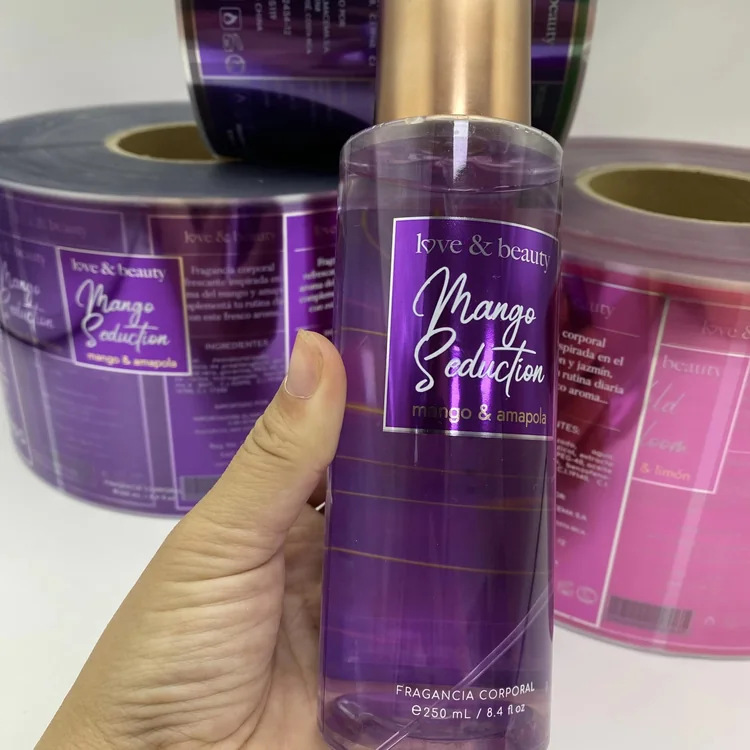
As of October 2026. This article explains two label-finishing processes and a European packaging rule for general information. It is not legal advice — confirm current values with GS1, your compliance advisor, or the competent authority before you act.
Contents
- Cold Foil and Hot Foil at a Glance
- PPWR Recycling-Design: Why the Foil Layer Still Matters
- Who Needs to Decide Between Them
- What It Means for Your Label
- How We Produce Both Finishes
- An Illustrative Finishing Decision
- Spec Table: Cold Foil vs Hot Foil
- Download: Foil-Finish Selection Checklist
- FAQ
- Get a Foil Sample Matched to Your Label
- Related Reading
Cold Foil and Hot Foil at a Glance
Both cold foil (cold transfer) and hot foil (hot stamping) put a metallic or pigmented layer onto a label. They differ in how the foil lands on the substrate, and that difference drives look, cost, minimum detail, and what to watch at the recycling sortation line. We run both processes in-house, so the recommendation is driven by your file and market — not by machine availability.
Both finishes sit within our Hot Stamping Labels range, which also covers cold-foiled constructions.
PPWR Recycling-Design: Why the Foil Layer Still Matters
The EU Packaging and Packaging Waste Regulation, (EU) 2025/40, has applied since 12 August 2026. But its recyclability grades (A 95% / B 85% / C 70%) and the detailed, material-specific design-for-recycling methods land later: the standards are expected in 2028, and the grades apply from 1 January 2030 (or 24 months after a delegated act, whichever is later). There is no enforceable sortability threshold in force today.
So choosing a thin, documented metallic layer now is simply preparing for those requirements early — not reacting to a current ban. The European Commission’s packaging waste guidance explains how the recyclability grades and design methods will roll out. For EU-bound work we flag the foil layer at artwork review and document it in the spec, so the construction is ready when the grades take effect.
Who Needs to Decide Between Them
- Wine & spirits brands — premium shelf pop, often with foil crests and tamper elements.
- Cosmetics & perfume houses — fine line work, seasonal runs, brand colour matching.
- Electronics & luxury packaging — security foils, holographic accents, precise registration.
- Private-label & cross-border e-commerce — cost-sensitive volume with EU recyclability exposure.
If your label carries a metallic element and ships to the EU, the finish choice is also a PPWR labelling decision, not just a design one.
What It Means for Your Label
This is where a converter adds value a material supplier cannot. The finish changes four things you can measure:
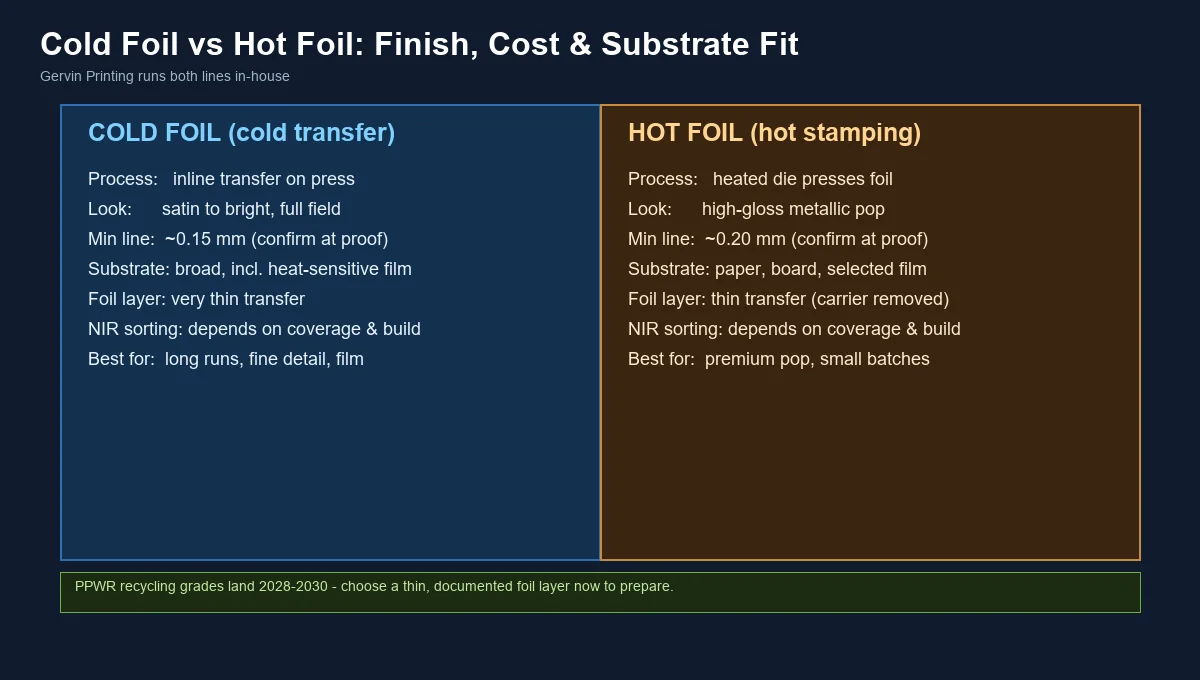
- Minimum line width. Hot stamping typically holds detail down to about 0.20 mm; cold transfer can hold finer, around 0.15 mm, because there is no heated die edge to spread. Both floors depend on substrate and artwork — we confirm at proof. If your artwork has microtext or hairline rules, tell us early.
- Metallic look. Hot foil gives a high-gloss, reflective “pop” with sharp edges. Cold foil reads satin-to-bright and excels at full-bleed metallic fields that would waste foil on a stamped die.
- Substrate fit. Cold foil runs inline across a wide substrate range. Because it adds no heat, it also suits heat-sensitive films that hot stamping can scorch. Hot stamping favours paper and board and selected films; very thin or heat-sensitive webs need a process check.
- Recycling sortability. A thinner cold-foil layer is generally easier to manage, but what mostly drives near-infrared (NIR) sortation is the metallic coverage area and the overall label construction, not the transfer method alone. We assess this per job and document the layer for EU-bound labels.
Abrasion and chemical resistance also differ: hot-foil transfers are generally more resistant to rubbing and alcohol (relevant for custom labels on bottles), while cold foil needs a protective varnish on high-friction applications.
How We Produce Both Finishes
Because we operate both lines, the recommendation follows your file and market rather than what a single machine can do.
Cold foil line
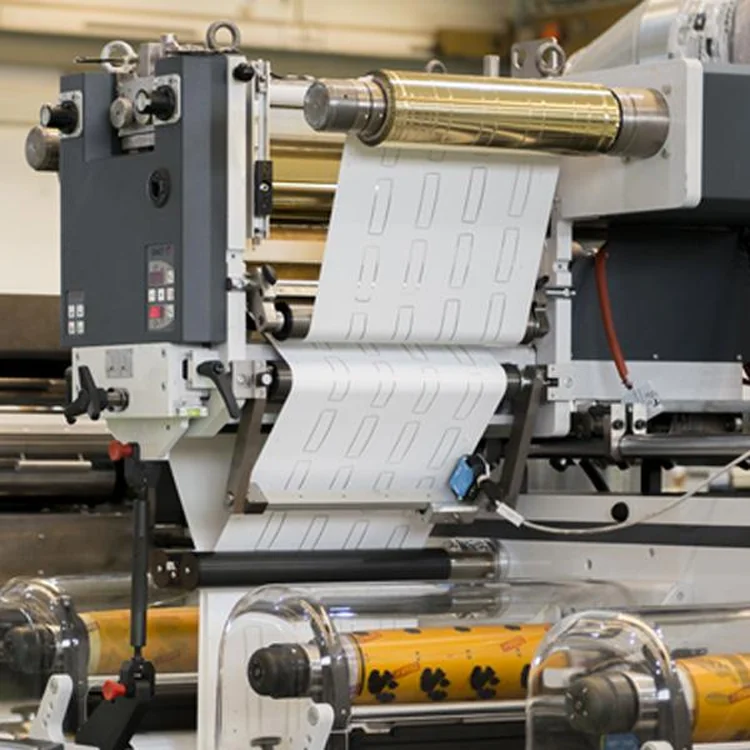
On our cold-foil line the metallic layer transfers inline on a hybrid flexo-digital press, so registration with surrounding graphics is tight and there is no heated die to tool — only a flexo plate to lay the adhesive. It runs with no heat, which is why it suits films. Because it is inline with our digital line, cold foil can also carry variable or serialized data in the same pass. For long runs with full-bleed metallic areas and fine detail, cold foil is usually the faster, lower-unit-cost route.
Hot foil line
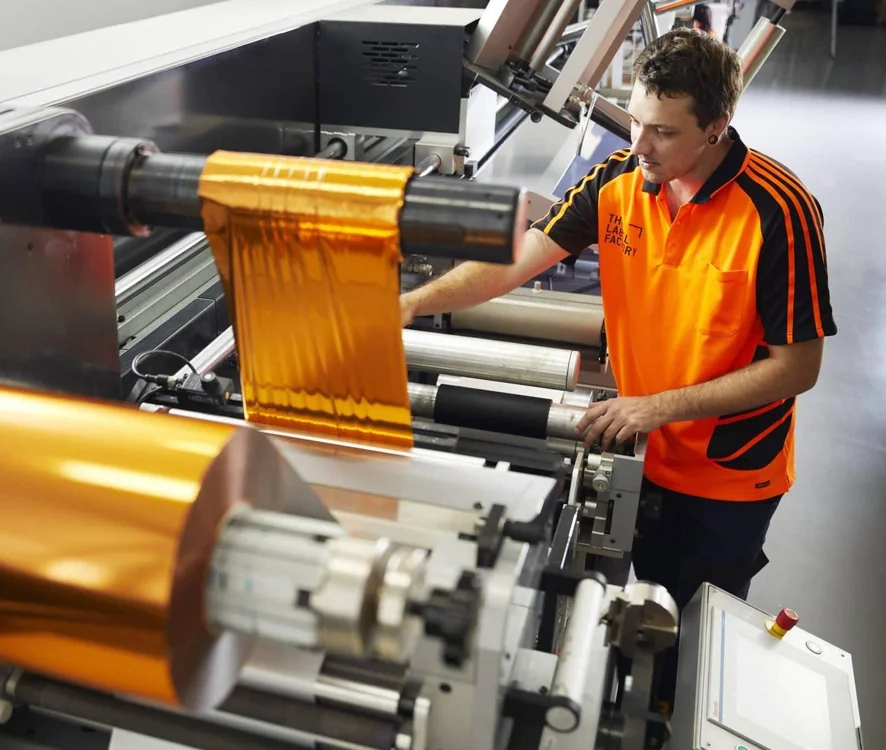
Our hot-stamping line uses heated dies for a deeper, glossier metallic relief — the finish most buyers picture when they say “foil.” On our floor hot foil is a separate step, usually applied offline after print. It is the right call for prestige cues, smaller batches, and applications needing higher rub or alcohol resistance. The trade-off is die tooling and a slower pass versus inline cold transfer.
An Illustrative Finishing Decision
Illustrative example from our shop: a buyer sends a cosmetic label with a foil crest plus 0.15 mm microtext and a full metallic background. Hot stamping would hold the crest with a glossy pop, but it wastes foil on the background and cannot hold the 0.15 mm microtext — its floor is about 0.20 mm. Cold foil covers the background cleanly and holds the fine text, but the microtext edge needs a sharper plate and a protective varnish for the rub test. We printed both as free pre-production samples, ran rub and alcohol checks on each, and let the buyer choose against their fill-and-ship conditions. For EU-bound work we add the layer note to the spec. (This is a composite example drawn from typical jobs; no client name or order figure is implied.)
Spec Table: Cold Foil vs Hot Foil
| Dimension | Cold Foil (cold transfer) | Hot Foil (hot stamping) |
|---|---|---|
| Process | Inline on hybrid flexo-digital press | Heated die presses foil (offline step on our line) |
| Typical lines | Flexo / digital web | Rotary / platen stamping |
| Look | Satin to bright, full-bleed | High-gloss pop, sharp edges |
| Min line width | ~0.15 mm (confirm at proof) | ~0.20 mm (confirm at proof) |
| Substrate range | Broad, incl. heat-sensitive film | Paper, board, selected films |
| Rub / alcohol resistance | Needs protective varnish | Higher as-transferred |
| Foil layer | Very thin transfer | Thin transfer (carrier removed) |
| NIR sortability impact | Depends on coverage & build | Depends on coverage & build |
| Variable / serialized data | Inline with digital | Typically offline |
| Tooling | No heated die (flexo plate only) | Heated die required |
| Lead time | Faster, no heated die | Separate step on our line |
| Best for | Long runs, fine detail, film | Premium pop, small batches |
Download: Foil-Finish Selection Checklist
Use our one-page checklist to brief your supplier and write the RFQ. It maps each decision point to cold vs hot fit and the question to put in your purchase order.
Download the Cold Foil vs Hot Foil label checklist (XLSX)
FAQ
Does foil on a label break PPWR recyclability?
No — foil is not banned. (EU) 2025/40 targets constructions that contaminate streams or fail sortation, and its recyclability grades and detailed methods apply from 2028–2030, not today. A thin, documented foil layer is manageable; we note the layer for EU-bound labels.
Which is cheaper, cold or hot foil?
For long runs with full-bleed metallic areas, cold foil is usually lower unit cost because there is no die and it runs inline. For short runs or a single prestige element, hot foil avoids die tooling and can be cheaper overall. Specific MOQ and lead time we confirm at proof.
Will foil affect my 2D barcode or QR scan?
Metallic areas must stay clear of the barcode quiet zone and contrast must be maintained; a reflective foil behind a code can hurt scan. We keep foil off the code field and verify contrast on press — see our Sunrise 2027 2D-barcode guide.
Can foil be part of an anti-counterfeit label?
Yes. Foil works with holographic and tamper-evident constructions; see our tamper-evident label guide and hologram sticker range.
Get a Foil Sample Matched to Your Label
Send us your artwork and substrate, and we will press both finishes as free pre-production samples, run rub and alcohol checks, and note PPWR sortability for EU-bound work. Tell us your run length and market, and we will recommend the finish that fits the job — not the one our calendar happens to favour. If the foil also needs to carry security features — holographic authentication, serialization or tamper evidence — start from our holographic foil security label buyer’s guide, which explains how to pick the security level and process.
Related Reading
- Holographic Foil Security Labels: The 2026 Buyer’s Guide
- PPWR 2026: What Your Product Labels Must Comply With
- Hot Stamping Labels — product category
- Custom Labels — product category
- Tamper-Evident & Anti-Counterfeit Labels
- Sunrise 2027: 2D Barcodes on Labels & Packaging