
Send Your Inquiry Today
PPWR Labelling Requirements 2026: A Buyer’s Checklist for Packaging and Labels
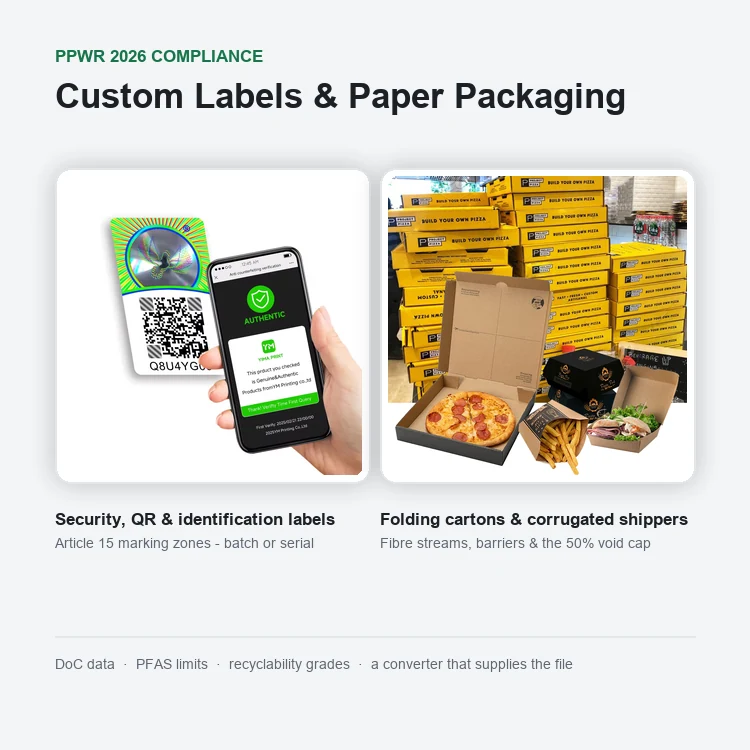
This is not legal advice. What follows is a printer-converter’s practical reading of Regulation (EU) 2025/40 (PPWR) and the European Commission’s published guidance. Several of the dates below move with implementing and delegated acts that the Commission has not yet adopted, and national authorities interpret detail differently. Always check the official text on EUR-Lex and take qualified advice for your own packaging.
Since 12 August 2026, EU packaging law is a regulation rather than a directive: an identifier on the pack, the manufacturer’s contact details, a signed EU Declaration of Conformity, and hard limits on heavy metals and PFAS are all in force, and your label counts as a packaging component. That much is settled.
What is not true is the version circulating in most summaries — that 12 August was a cliff. Packaging produced before that date but not yet placed on the market can still be made available, with the identifier and manufacturer details supplied in an accompanying document: no relabelling, no destruction. And market surveillance starts by requiring the operator to correct the problem, not by pulling goods off the shelf. The honest summary is therefore: the duties are in force, but there is a buffer on existing stock and on enforcement.
Contents
What Must Be on the Pack, and When: The Labelling Timeline at a Glance
If you searched “PPWR labelling requirements”, this is the answer in one screen. Note how many of these dates are written as “or X months after the implementing act, whichever is later” — the Commission missed the August 2026 deadline for the labelling acts, so treat every 2028 date as a floor that can slide.
| Applies from | What must appear on the pack | Legal basis |
|---|---|---|
| 12 Aug 2026 — in force now | An identifier (type, batch or serial number, or another element enabling identification); the manufacturer’s name, registered trade name or trademark and postal address — on the packaging or on a data carrier such as a QR code; importer contact details where applicable; material abbreviations under Commission Decision 97/129/EC, which stays valid until 12 Aug 2028 | Art. 15(5), 15(6); Art. 18; Art. 70(2) |
| 12 Feb 2027 | The physical EPR-scheme symbol (the Green Dot and its national equivalents) moves off the pack to a digital EPR identifier — a QR code or other standardised open data carrier. Check whether your destination market has switched it on | Art. 12(9) |
| 12 Aug 2028 | The harmonised EU sorting label with material pictograms — from 12 Aug 2028 or 24 months after the relevant implementing act enters into force, whichever is later. National schemes may no longer run alongside it. Sales packaging must also have its empty space reduced to the minimum needed for function | Art. 12(1); Art. 24(4) |
| 12 Feb 2029 | Reusable packaging must be labelled as reusable and carry a QR code with reuse-system information, collection points and rotation tracking — from 12 Feb 2029 or 30 months after the labelling implementing acts, whichever is later | Art. 12(2); Art. 11 |
| 1 Jan 2030 | Recyclability performance grades (below 70% loses EU market access); recycled-content minimums for plastic packaging; the 50% empty-space cap on grouped, transport and e-commerce packaging. Grading method and thresholds depend on further Commission acts | Art. 6; Art. 7; Art. 24(1) |
What the PPWR Is – and Why It Replaced the Old Packaging Directive
The Packaging and Packaging Waste Regulation, Regulation (EU) 2025/40 (PPWR), entered into force on 11 February 2025 and became generally applicable on 12 August 2026. It repeals and replaces Directive 94/62/EC, which had governed EU packaging for around thirty years. The difference matters more than the acronym: a directive needed each member state to write its own national law, which is why packaging rules used to vary by country. A regulation applies directly and identically everywhere — one market access threshold for the whole EU.
Scope is wide. It covers all materials and all packaging functions — sales, grouped and transport packaging, empty or filled — for packaging produced in the EU and for packaging arriving with imported goods. Under the Windsor Framework, most PPWR provisions also apply in Northern Ireland, with carve-outs — the EPR obligations notably do not apply domestically in NI, which stays inside the UK’s own packaging EPR regime. So a UK brand supplying both GB and NI is running two packaging systems at once. The European Commission’s packaging waste hub tracks the rolling guidance, and the full legal text is on EUR-Lex.
PPWR Labelling Requirements 2026: What Changed on 12 August
The date that dominates most summaries is not a single deadline. Five obligations became enforceable on the day:
- EU Declaration of Conformity and technical documentation (Articles 38–39) — per packaging type, kept 5 years for single-use and 10 years for reusable packaging.
- Substance restrictions (Article 5) — heavy metals in all packaging, PFAS in food-contact packaging.
- Identification and manufacturer information on the pack (Articles 15(5) and 15(6)) — the most overlooked pair of duties.
- Importer contact details (Article 18) — added by the importer where it acts as importer.
- EPR registration (Articles 44–45) — registration in the national producer register of every member state where packaging is first made available, before it is placed on the market.
What did not start on 12 August: harmonised sorting labels, recyclability performance grades and recycled content minimums. Those run on the 2028–2030 schedule above. The Commission’s FAQ — second edition, published in early August 2026 — adds a chapter on enforcement and describes 12 August as a starting line rather than a single deadline. It also confirms the transitional treatment of pre-August stock. The FAQ interprets the regulation; it does not replace it, so treat it as decision support, not law.
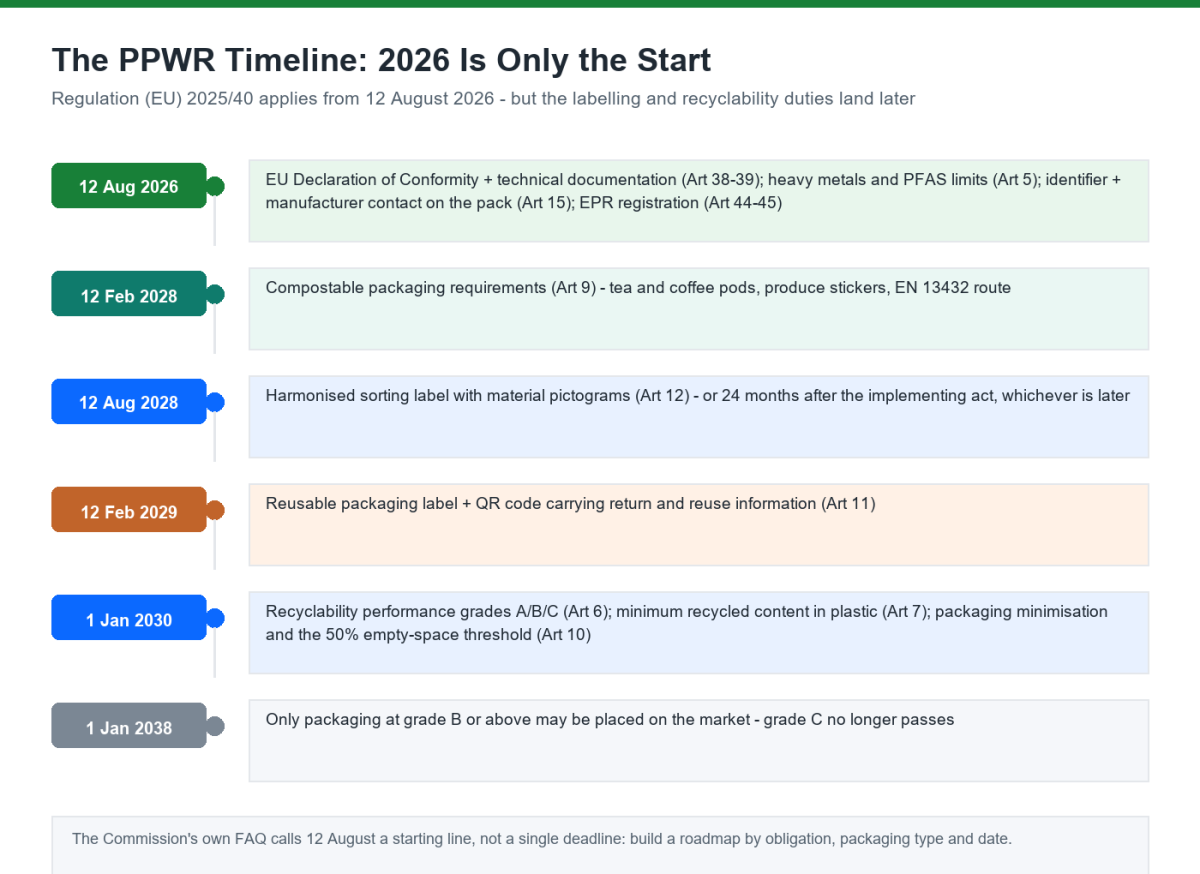
The PPWR timeline — 12 August 2026 is a starting line, not a single deadline. Several later dates move with the implementing acts.
PPWR Identification Number: Do You Need a Serial Number on Every Pack?
No — and this clarification saves real money. Article 15(5) requires packaging to bear a type, batch or serial number, or another element allowing identification, so authorities can link the physical pack to its technical documentation and Declaration of Conformity. The Commission FAQ confirms a production batch identifier is acceptable, and standardised bought-in items — adhesive tape, generic mailers, desiccant bags — are traceable at batch level, not per unit. For a multi-component sales pack (a cup, lid and sleeve, say), marking one component is enough.
Article 15(6) requires the manufacturer’s name, registered trade name or trademark, and postal address — a single contact point — on the packaging, or on a QR code or other data carrier. If the marking genuinely does not fit, the FAQ allows the information to travel in an accompanying document instead.
Two role details with real consequences for importers buying from China:
- If your name or brand is on the packaging, you are the manufacturer for PPWR purposes — even though a factory abroad produced it. For generic unbranded packaging, the physical producer normally keeps the manufacturer role.
- The micro-enterprise exception: where the brand owner is a micro-enterprise and its supplier sits in the same member state, the supplier becomes the responsible manufacturer instead.
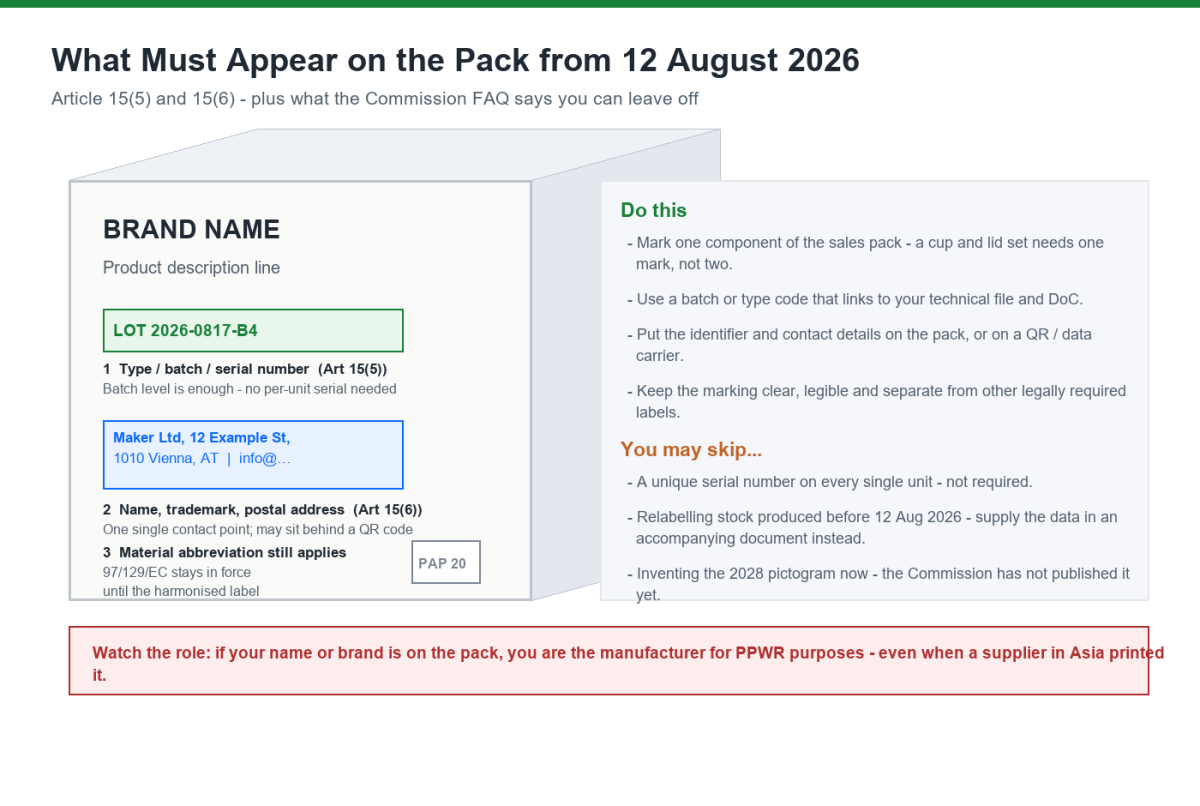
What must appear on the pack from 12 August 2026 — and what the FAQ says you can leave off.
The Declaration of Conformity File: What Goes In It and Who Signs
Every packaging type placed on the EU market needs a completed conformity assessment (Annex VII procedure) and a signed EU Declaration of Conformity (Annex VIII model). The DoC is a document you hold and produce on request — it is not printed on the pack. Right now the assessment covers Article 5(4) heavy metals, Article 5(5) PFAS for food contact, and — where relevant — Article 11(1) reusable packaging; further articles join as their dates arrive (the Article 10(1) weight-and-volume reduction, for example, applies from 2030).
Three FAQ clarifications matter to buyers:
- The duty cannot be outsourced. You may hire labs or certification schemes to do the testing, but compiling the technical documentation — and legal responsibility for the packaging — stays with the manufacturer.
- Language: the DoC must be drawn up in, or translated into, the language(s) required by each member state where the packaging is placed on the market.
- Enforcement starts soft. Under Article 62, a member state that finds formal non-compliance must first require the economic operator to end it; prohibition, withdrawal or recall follow only where an administrative defect persists. Substantive breaches sit on a different track and are punished through the national penalty regimes under Article 68.
For existing stock the news is good: packaging produced before 12 August 2026 but not yet placed on the market does not need to be destroyed or relabelled — the identifier and manufacturer details can be supplied via an accompanying document. Packaging already placed on the market may stay in circulation. One exception to memorise: the Commission has confirmed there is no general stock-exhaustion period for food-contact packaging containing PFAS, and it also warns that empty sales packaging held in a warehouse has not necessarily been “placed on the market” already — that is a factual question about when ownership transferred, so keep the evidence either way.
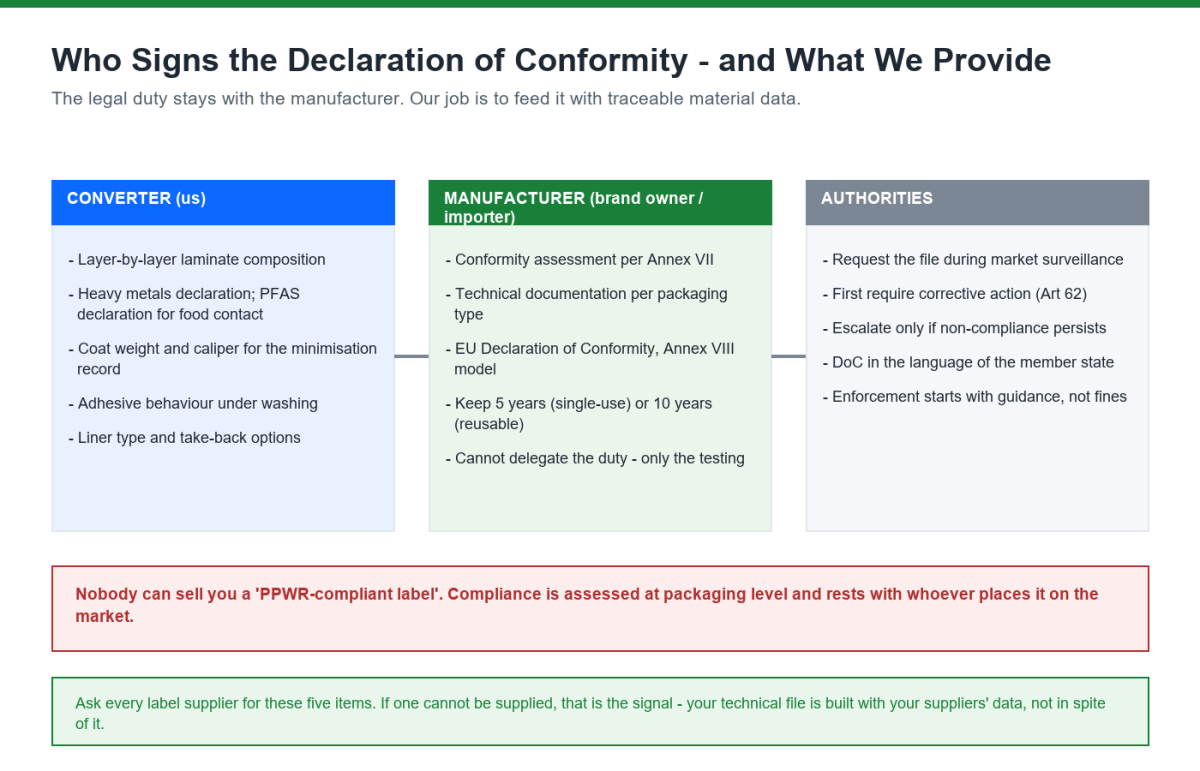
Who signs the declaration of conformity — and what a converter can and cannot provide.
Are Labels Recyclable? What the PPWR Labelling Rules Mean for Your Label
The regulation never discusses labels in isolation — it regulates packaging as a whole, and a label applied to packaging is a component of it. It enters the conformity assessment, the technical documentation and, from 2030, the recyclability assessment. The illustrative list in the regulation even names self-adhesive labels attached to fruit and vegetables. In practice, a label that weighs a couple of grams can decide what happens to the whole pack at end of life, through three mechanisms:
- Optical sorting. Sorting plants identify resins by near-infrared spectroscopy. A label covering a large share of the surface masks the signal of the substrate underneath, and heavily loaded carbon-black inks absorb the beam instead of reflecting it — the pack gets ejected as unidentified.
- Adhesive residue. In the caustic wash the label must release. If the glue holds on, paper and adhesive end up in the flakes and downgrade the recyclate. This is exactly what wash-off adhesives are engineered for — releasing under defined wash conditions.
- Material compatibility. A paper label on a PET bottle puts fibre into a plastic stream; a PP label on an HDPE container travels with its own polymer family. The pack is assessed as a whole, so one component can pull the grade down.
One number worth knowing: the FAQ exempts plastic parts that account for less than 5% of the total packaging unit weight — a small plastic label on a glass jar is exempt on that basis — but the relief is conditional. It does not apply if the element interferes with sorting or recycling, and it does not convert a metallised or multi-material construction into a recyclable one.
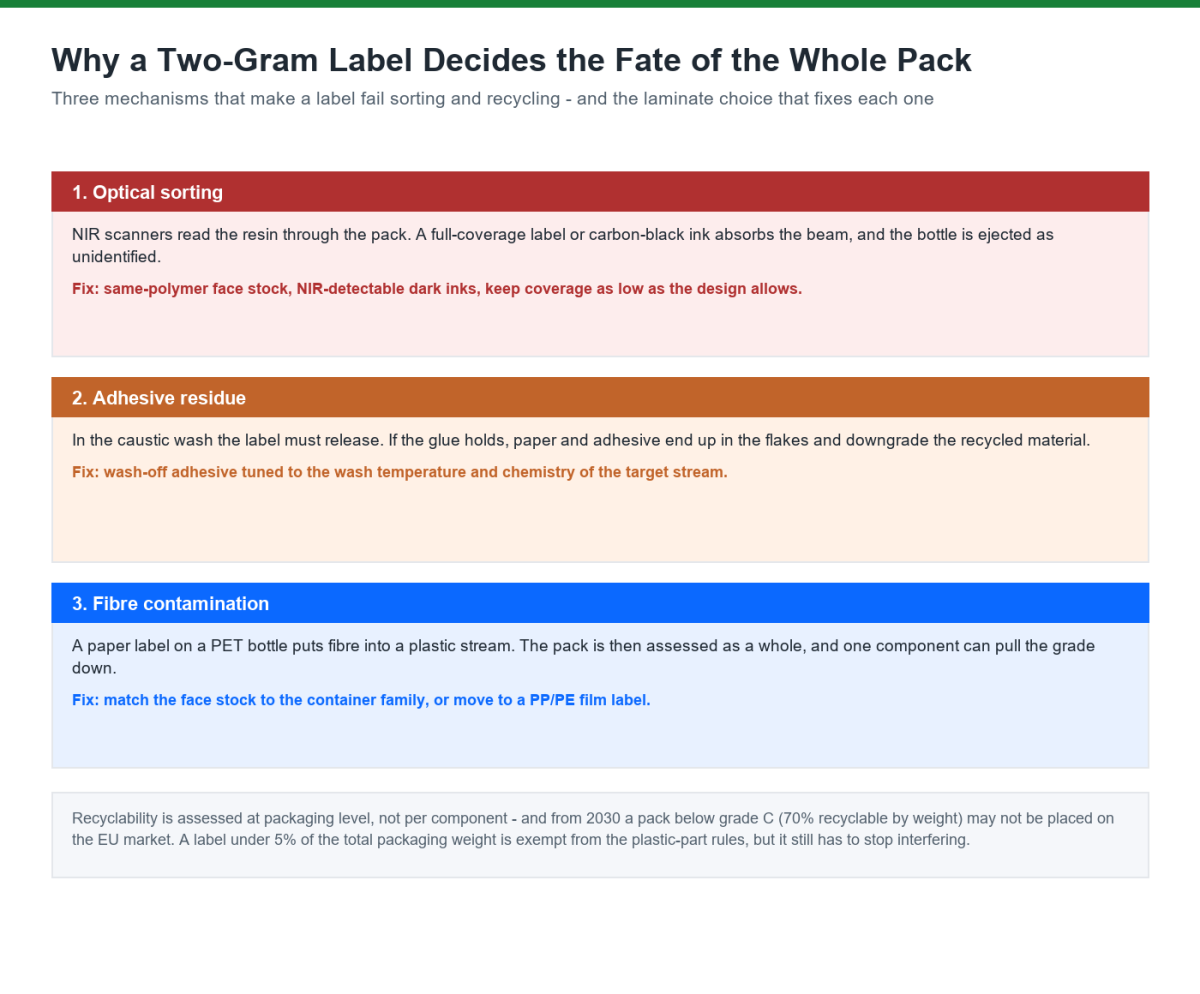
Why a two-gram label decides the fate of the whole pack — and the laminate choice that fixes each failure mode.
Holographic and metallised labels: what actually happens at end of life
This is the question behind most of the RFQs we see on hologram work, and it deserves a straight answer rather than reassurance. A holographic label is normally a metallised polyester film: a PET face stock carrying a vacuum-deposited aluminium layer, embossed with a diffractive microstructure. Nothing about it is prohibited by the PPWR — the regulation does not require holograms anywhere, and it does not ban them either. What it does is make the end-of-life behaviour of that construction part of your pack’s assessment:
- In the plastic stream. A metallised surface reflects instead of transmitting in the near-infrared sorter, so a full-panel holographic label can hide the substrate signal exactly like a shrink sleeve does. The aluminium layer is also not recovered in plastic recycling. Recycling design guidance from the established schemes treats metallised decoration as a sorting risk: keep coverage small, and keep it off the panel the sorter reads.
- In the paper stream. A metallised plastic film does not repulp. Small stickers are normally screened out with the rejects; a large holographic panel laminated across a carton is not, and it shows up as a contaminant in the pulp or in the screen rejects the mill has to dispose of.
- On weight. A small hologram sticker usually sits far below the 5% threshold, so the exemption applies on paper. That is a relief on the plastic-part calculation, not a certificate of recyclability — the condition about not interfering with sorting still stands.
The design answer is almost always placement, not removal. Put the security element where it does the most work and the least damage: a discrete hologram on a closure, a seal or a carton panel, rather than a full-panel metallised laminate across the surface the sorter or the mill cares about.
Tamper-evident and void labels: a deliberate conflict
Tamper-evident and void labels are engineered to do the opposite of what a recycling-optimised label does. Destructible face stocks, high-tack permanent adhesives and void-release patterns exist so the label cannot be removed intact — which means, on a PET bottle destined for bottle-to-bottle recycling, a permanent destructible label is precisely the contaminant recyclers complain about: it does not release in the wash, and the fragments travel with the flakes.
There is no need to choose between security and recyclability, but you have to split the functions:
- On plastic containers: keep the container-body label in a wash-off-compatible, same-family construction, and put the tamper-evident function on the closure or overcap — or move it to the outer carton.
- On paper packaging: a paper-based tamper tape or a destructible paper label keeps the whole set inside the fibre stream, where metallised film would not.
- On cartons that must be fibre-recyclable: a small security sticker is usually acceptable; a metallised tamper band wrapped around the entire carton is the version that gets flagged.
Anti-counterfeit function and end-of-life performance are both design requirements. They conflict only when the security element is specified without saying where the pack will end up — which is why the first question on our quote form is the container and its collection stream, not the decoration.
Can a QR code carry the PPWR identifier and manufacturer details?
Partly yes, and the split matters:
- Manufacturer details: yes. Article 15(6) expressly permits a data carrier, so a QR code is a lawful home for the name, trademark and postal address.
- The identifier: use both. The regulation’s digital-marking rules are still being built out through the labelling implementing acts, and the Commission’s position is that digital content supplements rather than automatically replaces physical marking. The safe 2026 specification is a human-readable lot or type code plus the same data in the QR — the printed code keeps you compliant if the code cannot be scanned, and the QR gives the authority and your customer the richer record.
- Physical marking still comes. The 2028 harmonised sorting label is a physical pictogram requirement, so reserve artwork space for it now rather than assuming the QR will absorb it.
The production detail buyers underestimate: a code that scans on the packing line and fails at the sorting facility is a failed marking. Variable data means digital or thermal-transfer printing rather than a plate change — but the ink and adhesive still sit inside the heavy-metal and PFAS scope, and the code has to survive abrasion, condensation and the cold chain.
What the PPWR Means for Folding Cartons, Rigid Boxes and Corrugated Shippers
Labels attract most of the commentary, but boxes are where the money sits — and where the PPWR quietly changes what a “premium” box may be made of. Paper-based packaging starts from a strong position under this regulation, and then loses it in four predictable ways.
The good news: cardboard boxes are exempt from the reuse quotas
Article 29 sets reuse targets from 1 January 2030 — at least 40% of transport packaging reusable within a reuse system, rising to 70% by 2040, plus a 10% target for grouped packaging in the form of boxes. Cardboard boxes are expressly excluded from both (Article 29(4)), and micro-enterprises placing under 1,000 kg of packaging a year in a member state are exempt from the Article 29 targets altogether (Article 29(13)). A brand shipping in corrugated does not have to build a return, collection and reconditioning system to stay legal, and paper-based packaging also sits outside the mandatory recycled-content quotas, which bind plastic packaging only.
If you are weighing paper against a returnable plastic tote, this is the sentence that settles it — and it is the question e-commerce buyers raise most often.
Where a paper box loses the advantage
- Coatings and laminates. Cartonboard is recyclable because the fibre repulps. PE-extruded board, foil laminates and paper-plastic composites do not repulp cleanly — they are the classic profile of a low-quality recyclable that downcycles. Where a grease or moisture barrier is genuinely required, we quote dispersion-coated or water-based barrier boards ahead of PE extrusion.
- Plastic windows. The FAQ’s 5%-of-weight relief can cover a small PET window, but only if it does not obstruct sorting or recycling — and it leaves a judgement call with whoever assesses your pack. Shrinking the window, or switching to a die-cut aperture with no film, removes the argument entirely.
- Rigid gift boxes glued into one lump. Greyboard wrapped in art paper is fine. The same box with EVA foam, magnets, ribbon and a thermoformed tray is a multi-material assembly nobody can separate at end of life. Pulp or corrugated inserts, paper-based platforms and water-based glues keep the set inside the fibre stream — which is why we quote both routes and let the numbers decide. Note also that features whose only purpose is to make a pack look bigger — double walls, false bottoms, unnecessary layers — are already restricted under Article 10(2) and Annex IV; the wider weight-and-volume reduction duty in Article 10(1) applies from 2030.
- Oversized shippers and void fill. The empty-space ratio for grouped, transport and e-commerce packaging is capped at 50%, applying from 1 January 2030 or three years after the implementing act establishing the calculation method enters into force, whichever is later. Filling material (bubble wrap, air cushions, foam, paper cuttings) counts as empty space, so you cannot cushion your way under the cap. The act was due from the Commission by 12 February 2028 and, until it exists, there is no official measurement method — plan against the principle, not the date. Sales packaging runs on a separate, earlier duty: from 12 February 2028 its empty space must be reduced to the minimum necessary for function. Board grade and flute choice is what makes a smaller box survive the drop test.
| Box type | PPWR pressure point | What we quote instead |
|---|---|---|
| Folding carton (cosmetics, food, retail) | Full-sheet plastic lamination; foil-board composites | Uncoated or dispersion-coated board, water-based inks and glues, foil and emboss kept as decoration only |
| Window carton | PET patch survives sorting? Who judges it? | Reduced aperture, or die-cut window with no film |
| Rigid two-piece / gift box | Foam, magnets and trays make the set inseparable | Pulp or corrugated inserts, paper platforms, easy-separation construction |
| Corrugated shipper / e-commerce mailer | 50% void cap; right-sizing evidence | Grade and flute matched to product, void-fill-free structural fitment, internal void calculation on the quote |
| Food-contact paper box | PFAS in grease-resistant board; no stock relief | PFAS-free barrier board, supplier declaration with the order |
Where the marking goes on a box
Article 15 duties do not stop at the label. Folding cartons carry the identifier and manufacturer details on a base flap or side panel — somewhere that survives opening and is not covered by a sleeve or sticker. Corrugated shippers need the same treatment, and because they are transport packaging they are the unit an inspector sees when a pallet is checked.
We reserve the marking zone in prepress and keep it clear of barcodes, legal copy and the area the 2028 pictogram will occupy. The fibre side of the equation is being written by the industry itself: the 4evergreen alliance and CEPI publish the recyclability evaluation protocols that European mills actually apply to cartonboard.
How We Produce It: Label Laminates and Box Boards That Survive the 2030 Grade
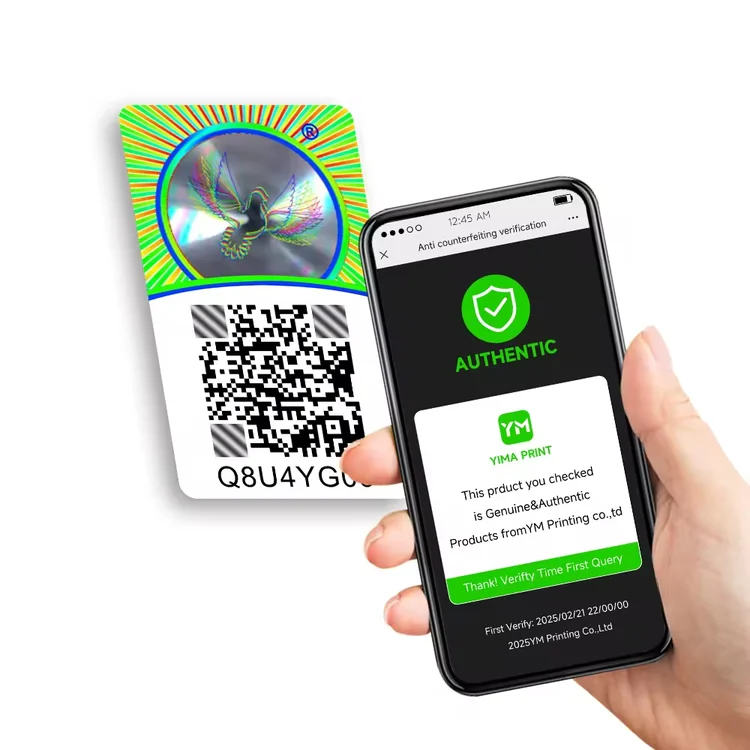
A mixed-colour run of custom security labels with serialised QR codes. A label like this can carry the identifier and manufacturer details — the duty itself attaches to the packaging, not to the security feature.
Transparency first, because it decides what you can promise your customers: we are a printing and converting factory. Nobody — us included — can sell you a “PPWR-compliant label.” Compliance is assessed at packaging level and rests with whoever places the pack on the EU market. What a converter owes you is traceable material data that feeds your technical file. Here is what that looks like on our floor:
- Laminate selection against the end-of-life destination. For labels going onto PET or HDPE containers destined for bottle-to-bottle recycling, we quote wash-off adhesive systems and same-family film face stocks; for paper packaging, paper-based face stocks and plastic-free coatings keep the fibre stream clean. We ask what the container is and where it will be collected before we quote a material.
- Holographic and tamper-evident work, specified with the destination in mind. Discrete hologram or void labels on closures, seals and carton panels; paper-based tamper constructions where the whole pack must enter the fibre stream; metallised film kept off the panel the sorter or the mill reads. Where a security feature and a recyclability target genuinely collide, we say so on the quote instead of after the audit.
- Variable data that survives the pack’s life. Serialised QR and barcode work is printed digitally or by thermal transfer, with the code validated for scan reliability and for resistance to abrasion, condensation and cold chain — the mark has to be readable at the sorting facility, not only at the packing line.
- Substance-aware ink and adhesive choices. For food-contact work we flag the PFAS thresholds at quote stage and steer toward grease-resistant barriers that do not rely on intentionally added PFAS. Ink and adhesive systems are specified with the suppliers’ heavy-metals declarations on file, because the declaration in your technical file has to come from material data, not from a marketing claim.
- Artwork that anticipates 2028. We reserve marking zones for the identifier and contact details, keep them clear of other legally required labels, and can carry them on a QR code — the same data-carrier logic as serialised security labels, and compatible with GS1 Digital Link, the syntax behind the Sunrise 2027 2D-barcode rollout.
- Box boards quoted against the fibre stream. For cartons and rigid boxes we quote uncoated or dispersion-coated board with water-based inks and glues by default, and flag any plastic laminate, window film, foam insert or magnet on the quote itself — together with board grade, caliper and, for transport boxes, the calculated internal void. The trade-off becomes a decision you make, not a surprise at your customer’s audit.
- The document pack per order. Layer-by-layer laminate composition, heavy metals and (where relevant) PFAS declarations from material suppliers, coat weights and caliper for your minimisation record, adhesive wash behaviour, and liner type. Five items; any serious converter should supply all five without blinking.
What we will not do is print a self-invented “PPWR” mark or pictogram. The harmonised symbols do not exist yet — see the next section — and artwork carrying invented compliance marks is a liability, not an asset.
PFAS in Food-Contact Packaging and Heavy Metals: The Limits That Apply Now
Heavy metals (Article 5(4)): the combined concentration of lead, cadmium, mercury and hexavalent chromium must not exceed 100 mg/kg — carried over from the old directive and now applying to all packaging, not just food contact. The FAQ points to CEN report CR 13695-1/2000 as the recommended verification method.
PFAS (Article 5(5)): food-contact packaging must stay under three cumulative thresholds, all at once:
- 25 ppb for any individual non-polymeric PFAS (targeted analysis)
- 250 ppb for the sum of non-polymeric PFAS
- 50 ppm total fluorine, including polymeric PFAS — screen on this first; below it, the rest is very probably fine, and above 50 mg/kg you must show how much fluorine is PFAS versus non-PFAS origin
Three FAQ points that catch buyers out: the limits apply to the whole packaging unit — inks, coatings, varnishes, glues and adhesives included; they count PFAS whether intentionally added or unintentionally present; and there is no CAS-number list, because the PFAS definition itself defines the scope. In practice, grease-resistant pizza boxes, baking paper and popcorn bags are the classic exposure — which is why we ask about food contact at quote stage, not after printing. There is currently no single fully harmonised EU test method covering every food-contact material and matrix, so agree the method with your lab before you commission the test.
PPWR Harmonised Labelling 2028: The Sorting Label and What Comes After
The visible face of the PPWR arrives later. Article 12 establishes a harmonised EU sorting label with material pictograms, mandatory from 12 August 2028 — or 24 months after the relevant implementing act, whichever is later. Once it applies, national labelling schemes may no longer run alongside it. Until the Commission publishes the actual pictograms and technical rules, do not let anyone sell you “the new EU label”: inventing it now means reprinting later. Until that date, the material abbreviations under Commission Decision 97/129/EC remain valid and are the marking you should be printing today.
The product-facing deadlines stack up behind it — each one carrying its own “or X months after the implementing act” tail:
- 12 February 2027 — physical EPR-scheme symbols give way to a digital EPR identifier (Article 12(9)). Audit your artwork for Green Dot-style marks now.
- 12 February 2028 — compostability requirements (Article 9) for items like tea and coffee pods and produce stickers; and the sales-packaging duty to reduce empty space to the minimum necessary (Article 24(4)).
- 12 February 2029 — the reusable-packaging label with a QR code carrying reuse-system, collection-point and rotation information (Article 12(2)), or 30 months after the labelling implementing acts, whichever is later.
- 1 January 2030 — recyclability performance grades (Article 6): grade A is 95%+ recyclable by weight, grade B 80%+, grade C 70%+. Packaging below 70% counts as technically non-recyclable and may no longer be placed on the market. Recycled content minimums for plastic packaging (Article 7) and the Article 10(1) duty to reduce weight and volume to the functional minimum also bite here. The grading thresholds and the assessment methodology are still to be set out in further Commission acts, so treat these percentages as the regulation’s floor rather than the final test protocol.
- 1 January 2038 — only grade B or better passes market access.
Design work starts now for a mundane reason: changing a laminate means validating adhesion on the real substrate, re-running line trials, requalifying with retail customers — on industrial cycles, eighteen months goes quickly. Harmonised standards such as EN 13430 can already be used to substantiate recyclability ahead of the graded regime.
An Illustrative Scenario: What a 2026 Order Actually Needed
The following is a composite example drawn from typical RFQ patterns, not a specific customer order — no figures here should be read as a client result.
A European DTC brand orders folding cartons and roll labels for a subscription box, a few weeks after 12 August. Its importer needs a Declaration of Conformity file, and the batch-level identification route is the one that fits. The sensible sequence:
- Revise the artwork so a lot code and the brand’s registered details sit on one component of the sales pack — no per-unit serialisation, no new plates beyond the marking zone.
- Pull the document pack the importer’s technical file needs: layer-by-layer laminate composition, heavy metals declaration, coat weights. For food-contact items, the PFAS declaration as well.
- Handle pre-12 August carton stock by supplying the identifier and contact details in an accompanying document instead of reprinting.
The cost impact in a case like this is an artwork revision plus a document pack — not a material change. That is the pattern worth internalising: most PPWR obligations in 2026 are documentary, and the suppliers who win are the ones who can produce clean data on demand. A material change is a different and much slower project — see the timing note in the checklist below.
PPWR Compliance Checklist for Labels and Packaging (Copy Into Your RFQ)
| Parameter | What to State | Why It Matters |
|---|---|---|
| Packaging function | Sales / grouped / transport; e-commerce yes-no | Decides which duties and exemptions apply |
| Marking zone | Where the identifier + manufacturer details go (printed code, QR, or both) | Article 15 duties from 12 Aug 2026 |
| Label construction | Face stock family vs container; adhesive type; coverage; any metallised or destructible layer | Sorting, wash release, tamper function and the 2030 grade |
| Food contact | Yes-no; if yes, PFAS declarations required | Article 5(5) thresholds from 12 Aug 2026 |
| Documents | Laminate composition, heavy metals/PFAS declarations, coat weight, liner type | Your technical file and DoC are built from it |
| Finishes | Coating/lamination type — plastic-free where recyclability matters | Future grade A/B/C performance |
| Quantity + stock status | Volume, reorder schedule, any pre-August stock | Transitional rules and reprint planning |
📋 PPWR Label & Packaging RFQ Checklist (copy into your next inquiry)
- Packaging type and function (sales / grouped / transport / e-commerce) with dieline
- Container material the label goes onto (PET, HDPE, glass, paper…) and its collection stream
- Label laminate: face stock family, adhesive (wash-off where recycling matters), coverage estimate, any metallised or destructible layer
- Security elements: hologram / void / tamper-evident — and where on the pack they sit
- Marking plan: identifier (type/batch/serial) + manufacturer details, printed code, QR or accompanying document
- Requested supplier documents: layer composition, heavy metals declaration, PFAS declaration (food contact), coat weight, liner type
- Food-contact flag and target markets (EU-27, Northern Ireland)
- For boxes: board grade and gsm, coating type (dispersion vs PE), window yes-no and film type, insert material, foam/magnets flagged
- For shippers: internal dimensions and the calculated void ratio
- Stock status: any packaging produced before 12 August 2026
- Quantity, target unit cost and destination country
What it costs and how long it takes
Buyers ask this and most guides skip it, so here is the honest shape of it. A 2026 PPWR fix usually lands in one of three buckets, and they have very different price and calendar consequences:
- Paperwork and artwork (days). Reserving a marking zone, adding a lot code, moving manufacturer details onto a data carrier. This is a prepress change. It does not move your MOQ and it barely moves unit price.
- Document pack (days, and it should be free). Laminate composition, substance declarations, coat weights, liner type. If a converter charges for this or cannot produce it, that is the finding.
- Material change (weeks to months). Swapping to a wash-off adhesive, a dispersion-coated board or a different face stock means validating adhesion on the real substrate, then re-running a line trial at your filler, then requalifying with retail customers. The material itself is a modest unit-cost move; the validation is where the calendar goes, and line trials are booked weeks ahead. This is the bucket that has to be scheduled against the 2028 label date, not the week before it.
Ask your converter to quote the material route and the validation steps separately, so you can see which part of the number is ink and board and which part is process. And if a supplier offers you a “PPWR-compliant label” at a premium, ask what exactly is being certified — the honest answer is that nothing is.
What Buyers Ask, by Product Line
These are the questions that appear repeatedly in RFQs for each product line, with the short answer and the line to put in your inquiry.
| What you buy | The question buyers ask | Short answer | What to put in the RFQ |
|---|---|---|---|
| Hologram / security labels | Will a metallised hologram downgrade my pack? | Not by itself. The risk is a metallised layer over the panel the NIR sorter reads, or on a pack that must repulp. Keep it small and off the critical surface. | Hologram size and placement, face stock, whether the pack is plastic or fibre |
| Tamper-evident / void labels | Does tamper evidence conflict with recyclability? | The two are engineered in opposite directions. Split the functions: wash-off label on the container body, tamper evidence on the closure or carton, or use a paper-based tamper tape. | Destructible or void face stock, adhesive type, placement (closure vs body) |
| Labels | Will my label ruin the recycling of the pack? | It can, three ways: masking NIR sorting, adhesive residue in the wash, or the wrong face-stock family for the container. | Container resin, collection stream, coverage %, adhesive type |
| Folding cartons | Is my laminated, foil-stamped carton still recyclable? | Usually yes — the failure mode is the lamination, not the foil. Foil, emboss and spot UV are decoration; a plastic film over the whole sheet is the problem. | Board grade and gsm, coating type, coverage %, finish list |
| Rigid / gift boxes | Do I have to give up foam and magnets? | Not by law today. But multi-material sets drag the 2030 grade down and complicate your customer’s EPR fee modulation — and features that only inflate apparent volume are already restricted. | Insert material, separation method, glue type, decoration list |
| Corrugated shippers | Do I need a reusable crate system? | No — cardboard boxes are excluded from the Article 29 reuse targets. Right-sizing matters; a return system does not. | Board grade, flute, internal dimensions, calculated void % |
| Food-contact paper | Will my pizza box pass? | Only with PFAS data. Grease-resistant food-contact board is the classic exposure, and unlike other stock it has no general stock-exhaustion relief. | Food-contact flag, PFAS declaration, which barrier was used |
FAQ: PPWR Labelling and Packaging from 2026
Does the PPWR apply to labels?
Yes — not as a separate category, but as a component of packaging. Any label applied to packaging (or directly to produce, like fruit stickers) enters the conformity assessment, technical documentation and, from 2030, the recyclability assessment of the pack it belongs to. The regulation does not require holograms, security features or any specific label type.
What are the PPWR labelling requirements from 12 August 2026?
Enforceable from that date: an identifier (type, batch or serial number or equivalent) on the packaging; the manufacturer’s name, trade name or trademark and postal address — on the pack or on a data carrier such as a QR code; importer details where applicable; and the material abbreviations under Commission Decision 97/129/EC, which remain valid until the harmonised labelling system replaces them on 12 August 2028.
Do I need a unique serial number on every package?
No. Article 15(5) accepts a type, batch or serial number “or other element enabling identification”, and the Commission FAQ confirms production-batch identification is sufficient for standard items and multi-component packs. Per-unit serialisation is a commercial choice, not a PPWR one.
Where do holographic and tamper-evident labels fit?
They are not required and not prohibited — they are assessed as components of the pack. A metallised holographic film can interfere with near-infrared sorting on plastic and will not repulp in the paper stream, so keep it small and off the panel the sorter or mill reads. Tamper-evident constructions are permanent by design, which conflicts with wash-off release; put that function on the closure or carton rather than the container body when the pack is destined for bottle-to-bottle recycling.
Can a QR code carry the identifier and manufacturer details?
Manufacturer details, yes — Article 15(6) expressly allows a data carrier. For the identifier, print a human-readable lot or type code as well: digital marking supplements physical marking rather than replacing it, and the 2028 harmonised sorting label is a physical pictogram requirement. Also make sure the code survives the pack’s life — scannable at the packing line but not at the sorting facility is a failed marking.
What happens to packaging stock produced before 12 August 2026?
It does not need to be destroyed, remanufactured or relabelled. For stock not yet placed on the market, the identifier and manufacturer information can be supplied through an accompanying document; packaging already placed on the market may remain in circulation. Two caveats: there is no stock relief for food-contact packaging containing PFAS, and whether empty packaging counts as “already placed on the market” depends on when ownership transferred — keep the evidence.
Is the PPWR mandatory for non-EU sellers?
The regulation binds operators placing packaging on the EU market — so a non-EU factory is not directly regulated, but its EU importer or the brand selling under its own name is. Your data quality decides whether they can file; supplying composition and substance declarations is how a Chinese converter keeps EU shipments moving.
What are the most common mistakes in a PPWR-era RFQ?
Four dominate. Treating 12 August as the recyclability deadline — grades land in 2030; what binds today is documentary. Serialising every unit “to be safe” — batch identification is expressly accepted. Assuming the factory bears the legal duty — if your brand is on the pack, you are the manufacturer; a converter supplies material data, not a compliance verdict. Printing invented pictograms — the harmonised symbols are not published, so early adoption means paying twice.
Do I need a wash-off label adhesive?
If the labelled pack is plastic packaging destined for bottle-to-bottle or flake recycling, in practice yes — a wash-off adhesive releases in the caustic wash instead of contaminating the recyclate, and it is one of the design choices recyclability graders look at. On paper packaging or glass, a standard permanent acrylic often suffices; we match the adhesive to the container and its collection stream at quote stage.
Does the PPWR apply in the UK?
In Northern Ireland, yes — under the Windsor Framework most PPWR provisions apply domestically in NI, though the EPR obligations do not (NI stays inside the UK’s packaging EPR scheme). Great Britain has its own separate packaging regime, so a UK brand supplying both markets is running two systems and should check which one each shipment enters.
What are the recyclability grades A, B and C?
From 1 January 2030, packaging is graded by the share recyclable by weight: A is 95%+, B is 80%+, C is 70%+. Below 70%, packaging is technically non-recyclable and loses EU market access; from 2038 only grade B or better passes. EPR fees are modulated by grade, so the label and laminate choices you make now have a direct cost line later. The assessment methodology is still to be set out in Commission acts.
Get PPWR-Ready Packaging and Labels
Send us your dieline (or just the container details) and the destination market. We will quote the laminate route for your recycling stream, hand over the material declarations and composition data your technical file needs, mark the identifier and contact details correctly in prepress, and send a physical sample before you commit to production.
👉 Request a sample and a PPWR-ready quote
How to use this guide. It is a converter’s practical reading of Regulation (EU) 2025/40 and the Commission’s published guidance, last reviewed in September 2026 — not legal advice, and not a substitute for the official text. Several dates above depend on implementing and delegated acts that the Commission has not yet adopted, and national authorities interpret detail differently. Verify against EUR-Lex and your own advisers before making compliance decisions.
Related Reading
- Custom Hologram Stickers: A Buyer’s Specification Guide
- FSC Packaging Boxes: An EUDR-Ready Buyer’s Guide
- Custom Corrugated Boxes by Industry
- Folding Carton Sample Approval Checklist
- Custom Food Packaging Solutions
- Shipping Packaging for E-Commerce Brands
- Anti-Counterfeit QR Code Labels
- Label & Sticker Printing Guide
- Browse Our Custom Labels
- Browse Our Hologram Stickers
- Browse Our Custom Packaging Boxes