
Send Your Inquiry Today
PPWR Packaging Compliance: What EU 2025/40 Means for Your Custom Boxes, Bags and Labels
- What changed: from directive to regulation
- Who PPWR actually hits
- What PPWR means for your label, box and bag
- How we produce EU-bound packaging
- Illustrative scenario: a scorecard that failed, then passed
- PPWR requirement to purchase order
- Production checklist before you order
- Frequently asked questions
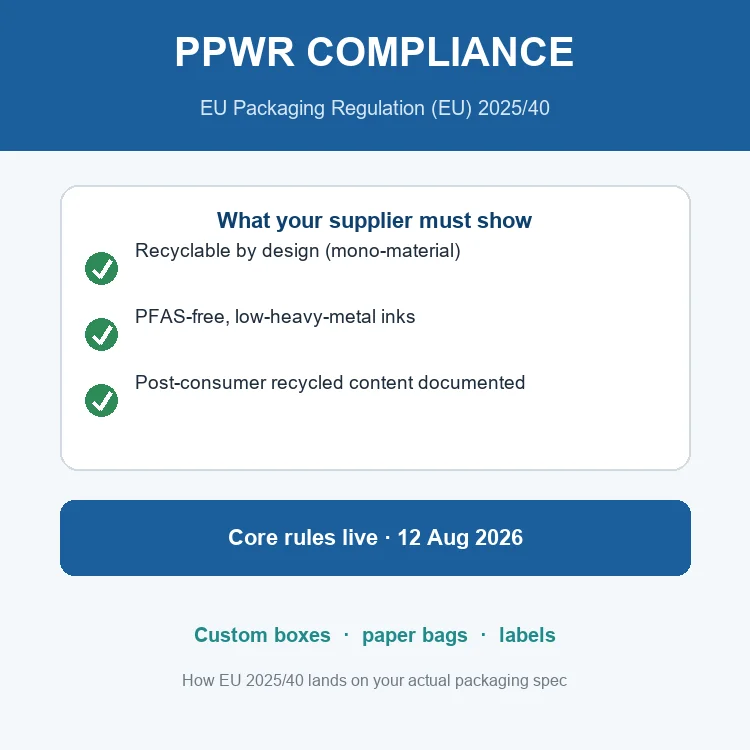
Regulation (EU) 2025/40 — the Packaging and Packaging Waste Regulation, or PPWR — is no longer a future date. Its core obligations have applied across the EU since 12 August 2026, and they reach every packaged product placed on the market, including packaging made in China, printed in Vietnam, or assembled anywhere outside the EU. If your brand sells custom boxes, paper bags or labels into Europe, “make it compliant” is no longer a vague request — it is a spec sheet. This guide translates the regulation into the concrete choices you make on a purchase order.
What changed: from directive to regulation
PPWR replaces the 29-year-old Packaging Directive (94/62/EC) with a Regulation that applies directly in all 27 member states — no national transposition, no grey areas between countries. It was published as Regulation (EU) 2025/40, entered into force on 11 February 2025, and its first and most consequential obligations became applicable on 12 August 2026. Later phases land in 2030 and 2038. The practical shift: packaging is now judged on the full life cycle — recyclability, recycled content, substances of concern, empty space and producer responsibility — not just whether it arrives intact.
General information, not legal advice. Specific thresholds and grades are set by Commission implementing and delegated acts that may be updated; confirm the current text at EUR-Lex and consult a qualified compliance adviser for your product.
Who PPWR actually hits
PPWR binds the whole supply chain: manufacturers, brand owners, importers, distributors, online marketplaces and fulfilment sellers. Two points matter most for non-EU suppliers. First, the rules apply to imported packaging exactly as to EU-made packaging — there is no “made outside Europe” exemption. Second, non-EU producers must appoint an EU-based authorized representative and complete Extended Producer Responsibility (EPR) registration in each member state where they place packaging. A missing Declaration of Conformity (DoC) or EPR number is now a customs and marketplace hold, not a footnote.
What PPWR means for your label, box and bag
Most buyers do not need the legal text; they need to know what changes on the spec. Here is the translation.
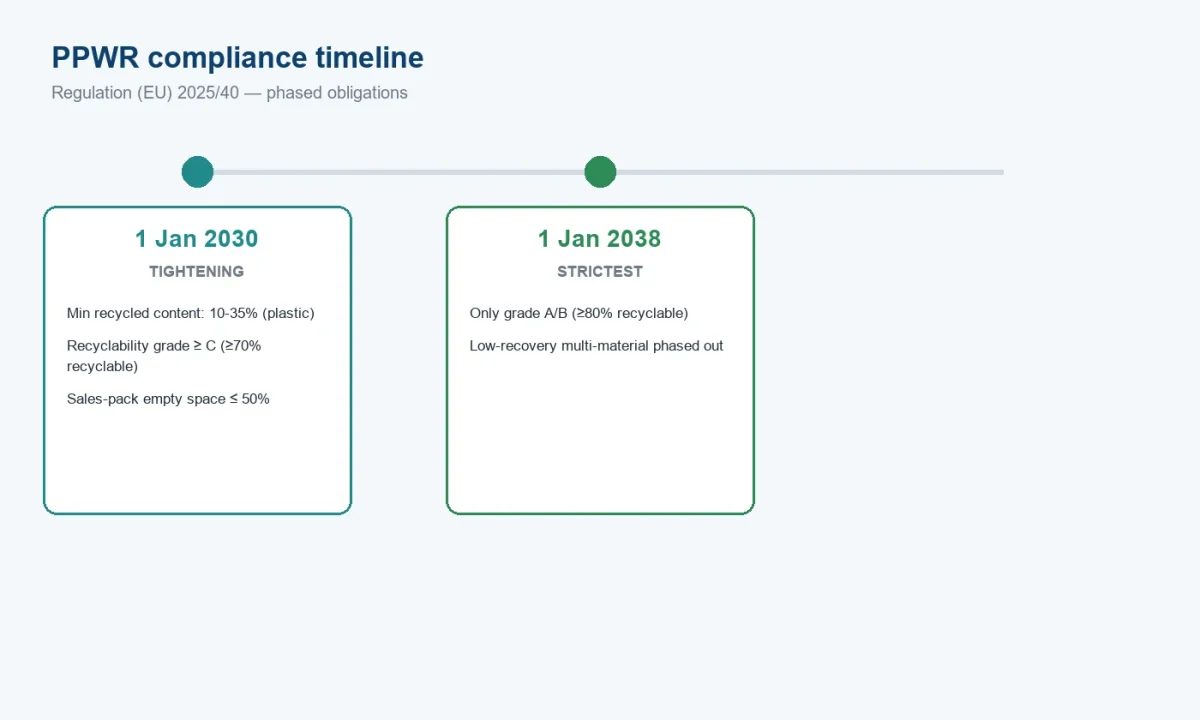
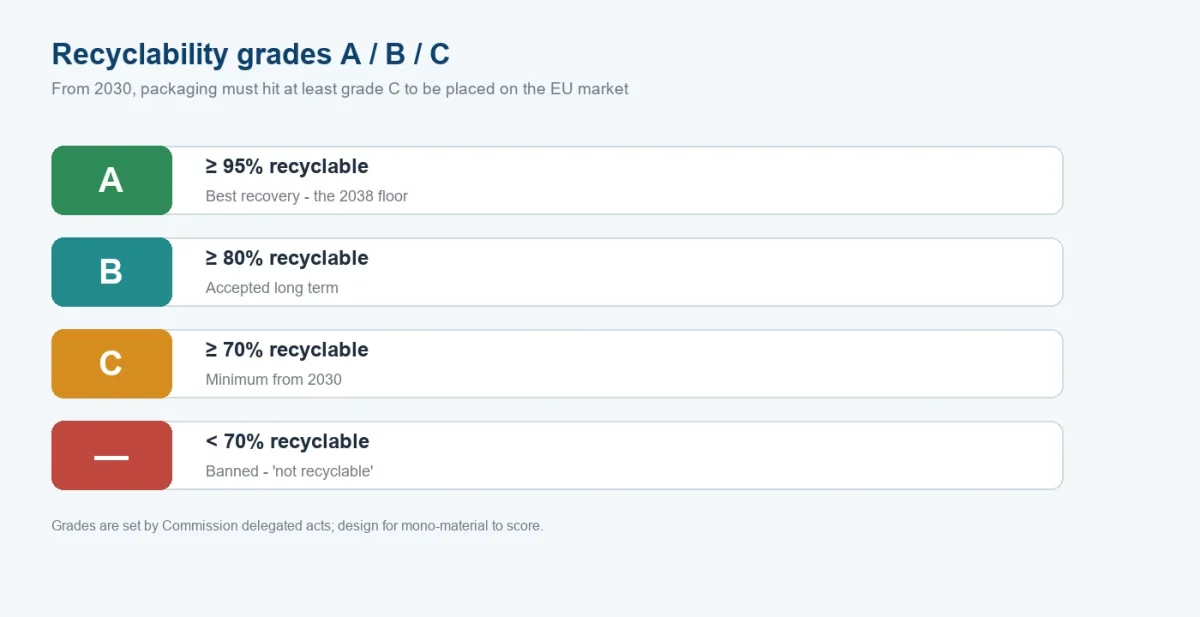
Recyclability by design (Article 6). Every package must be recyclable, and from 2030 it must reach at least grade C (about 70% recyclable) to be placed on the market. For you this means: prefer mono-material cartons and bags, avoid mixed-material laminates no facility can separate, and treat the label as part of the pack — a label that blocks recycling drags the whole item down.
Substances of concern (Article 5). Total lead, cadmium, mercury and hexavalent chromium must stay at or below 100 mg/kg across every component — ink, varnish, adhesive, coating and foil, not just the board. Food-contact packaging faces PFAS limits (single PFAS below 25 ppb; targeted sum below 250 ppb; total PFAS below 50 ppm). Ask for the full-material test report, not only the board certificate.
Recycled content (Article 7, from 2030). Plastic packaging must contain post-consumer recycled (PCR) material — roughly 10% to 35% depending on plastic type, with only PCR counting toward the target. Document the percentage with supplier declarations and, where relevant, chain-of-custody certificates.
Empty space (Article 10, from 2030). Sales-packaging void space is capped at 50%. Oversized mailers and double-walled boxes around small items become both a compliance and a fee problem.
EPR and the EU representative (Article 13). Budget for per-state registration and the authorized representative before you ship, not after a hold.
How we produce EU-bound packaging
Our production playbook for Europe-bound packaging starts from these constraints rather than bolting them on at the end:
- Mono-material cartons and paper bags as the default construction, because fiber-to-fiber and mono-polyolefin streams are what European recyclers actually recover.
- Low-heavy-metal, PFAS-free ink systems and coatings, with third-party test data available on request, so the “substances of concern” line is provable, not promised.
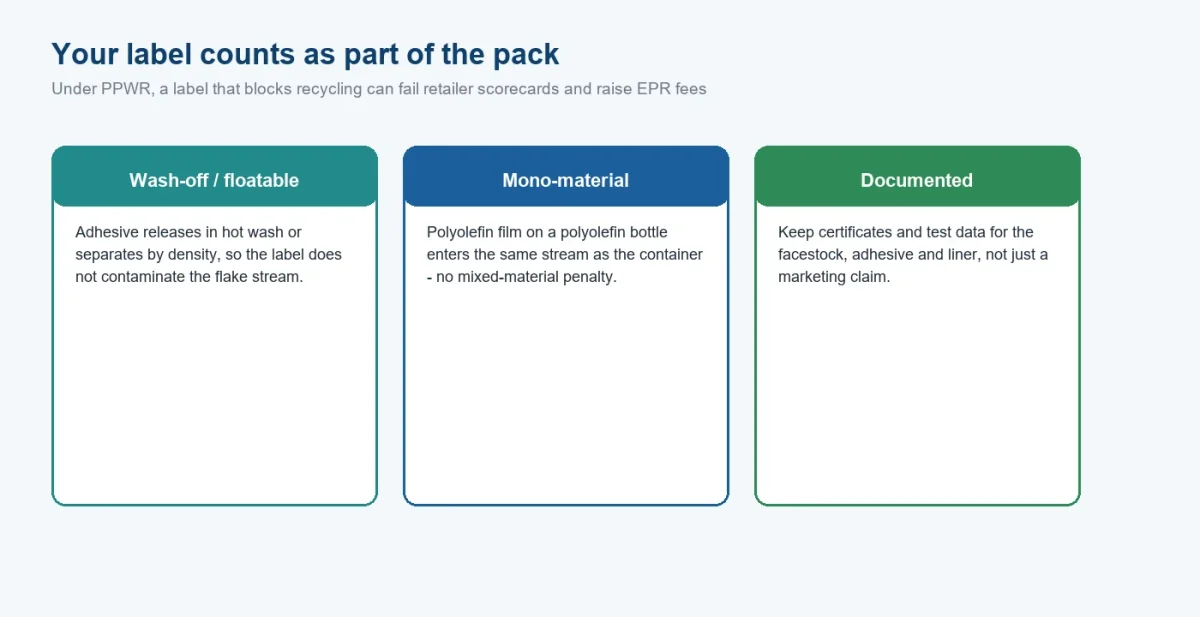
- Wash-off and floatable label adhesives for labels that must separate cleanly at the bottle or tray, plus mono-material label constructions that match the container’s own stream.
- Recyclability and recycled-content documentation packaged with the order — material data sheets, test reports and, where needed, a draft Declaration of Conformity your EU representative can finalize.
Why these choices: a carton or label that looks green on the shelf but fails a recycler’s sort, or a packaging line that cannot show its PCR percentage, is exactly what retailer scorecards and EPR fee modulation now punish. Designing for the stream up front is cheaper than a reprint and a relabel.
Illustrative scenario: a scorecard that failed, then passed
The following is a composite, illustrative example, not a specific customer order. A skincare brand’s gift set used a coated carton with a soft-touch lamination and a standard permanent-adhesive label. On a retailer’s recyclability scorecard the unit scored below grade C because the lamination was a mixed barrier and the label did not separate. On the revised run they moved to a mono-material carton with a repulpable varnish, a wash-off label, PFAS-free inks, and a documented 30% PCR content. Same shelf presence, a different material system — and the unit cleared the scorecard and the EPR grading. Use it as a checklist, not as a claim about any past job.
PPWR requirement to purchase order
| PPWR requirement | What to put on your PO |
|---|---|
| Recyclable by design (Art 6) | Mono-material carton/bag; avoid mixed laminates; label specified to separate |
| Substances of concern (Art 5) | Heavy-metal ≤100 mg/kg full material; PFAS-free for food contact; full test report |
| Recycled content (Art 7, 2030) | PCR % stated; supplier declaration + certificates |
| Empty space (Art 10, 2030) | Void ≤50% for sales packs; right-size the box |
| EPR + EU rep (Art 13) | Register per state; appoint authorized representative |
Article numbers and phase-in dates reflect Regulation (EU) 2025/40 as applicable from 12 Aug 2026; confirm against the official text, as implementing acts may adjust specifics.
Production checklist before you order
Send this to your printer instead of the phrase “make it PPWR-compliant,” and you avoid most surprises:
- Markets and EPR states — where will the pack actually be sold?
- Material system — mono-material or otherwise documented recyclable construction.
- Substances — full-material heavy-metal and PFAS test report, not just the board certificate.
- Recycled content — PCR percentage plus documentation (required from 2030).
- Label — wash-off, floatable, or mono-material matched to the container’s stream.
- Empty space — right-sized, with void at or below 50% for sales packaging.
- Paperwork — DoC template, technical file, and EU representative details.
- Proof — request a physical sample and, where feasible, test it in the intended recovery stream before mass production.
Frequently asked questions
Does PPWR apply to packaging made outside the EU?
Yes. Imported packaging is covered on equal terms, and non-EU producers must appoint an EU authorized representative and complete EPR registration in each member state where they place packaging.
What recycled-content percentage does PPWR require?
From 1 January 2030, plastic packaging must contain 10–35% post-consumer recycled material depending on type (for example, contact-sensitive non-PET around 10%, other plastic packaging around 35%); only post-consumer recycled content counts.
Are FSC-certified boxes required by PPWR?
No. PPWR targets recyclability and recycled content, not forest certification. FSC is a separate voluntary chain-of-custody scheme you may still want for other buyers, but it does not satisfy PPWR’s recycled-content or recyclability rules. For wood-based fiber, ask your mill for the certificate number and a fiber-source declaration.
Do labels have to be recyclable too?
Yes. Under PPWR the label is part of the package; a label that blocks the container’s recycling stream can fail the unit’s grade and raise EPR fees. Specify wash-off, floatable, or mono-material labels accordingly.
What is the empty-space rule?
From 2030, sales-packaging void space is capped at 50%; transport packaging is exempt. Right-sizing also cuts freight and material cost.
Choosing the right label material and adhesive is one half of a durable, compliant pack; matching it to PPWR’s recyclability and recycled-content rules is the other. For variable-data and GS1 Sunrise 2027 QR codes on packaging, or for scratch-off security labels on rolls, see the related guides. Tell us your target markets, material and recycling stream, and we will spec a mono-material, documented, recyclability-friendly carton, bag or label — and send a physical sample to test before you commit. Request a sample and quote.
This article is general information, not legal advice. PPWR obligations phase in through 2030 and 2038, and specific thresholds and grades are set by Commission implementing and delegated acts that may be updated. Always confirm the current text at EUR-Lex (Regulation (EU) 2025/40) and consult a qualified compliance adviser for your product.