
Send Your Inquiry Today
Holographic Foil Security Labels: The 2026 Buyer’s Guide
On this page
- Why holographic foil is a common layer in brand protection
- Who needs holographic foil security labels
- Holographic foil vs a plain printed hologram
- The three security levels — and how to choose yours
- How holographic foil security labels are made
- Hot foil vs cold foil for holographic security
- Combining holographic foil with serialized codes and variable data
- A specifications walkthrough (illustrative)
- Specifications you can send to a supplier
- Sustainability and PPWR: does the foil hurt recyclability?
- Your holographic security label checklist
- Frequently asked questions
Note: This article is general manufacturing guidance, not legal or regulatory advice. Regulation texts, dates and grades change with implementing acts — always confirm the current version via the Sources links and with your own compliance or legal team before finalising artwork or making conformity claims.
Why Holographic Foil Is a Common Layer in Brand Protection
Counterfeiting is no longer a fringe problem for brands that rely on holographic foil security labels. In their 2025 study Mapping Global Trade in Fakes, the OECD and EUIPO estimate that global trade in counterfeit goods was worth about USD 467 billion in 2021 — roughly 2.3% of world trade, and about EUR 99 billion of fakes imported into the EU. The damage shows up as lost revenue, warranty and safety incidents across spirits, cosmetics, pharma, electronics and more.
For a brand owner, the question is usually not “should we add security?” but “which level of security, and how do we keep it hard to copy without killing shelf appeal?”
Holographic foil security labels sit at the intersection of those two goals. Unlike a printed metallic ink, a true holographic foil carries a micro-embossed optical structure that shifts and animates as the viewing angle changes. Reproducing it typically requires the exclusive master, the embossing process and the transfer equipment — that raises the bar for a copycat, even if no single feature is unbreakable. Used well, it is both a premium decorative finish and a first-line authentication cue in one layer.
Three things keep this on the buyer’s agenda:
- Enforcement pressure. Online marketplaces, customs and market-surveillance authorities are stepping up anti-counterfeit checks. A label that is visually obvious and individually traceable is easier to police at the border and on the listing.
- Traceability everywhere. The EU Digital Product Passport and GS1’s Sunrise 2027 push mean more products will carry a 2D code a phone can read. A holographic frame around that code makes “is this the real label?” a glance-able check.
- Recyclability scrutiny. Under the EU Packaging and Packaging Waste Regulation ((EU) 2025/40), decorative layers are part of the recyclability conversation. Foil coverage and substrate choice matter — we cover this in the sustainability section below.
The practical result: buyers who once treated holographic foil security labels as “nice to have” now specify them as part of a layered authentication plan — and they want a converter who can explain the trade-offs, not just print a shiny sticker.
Who Needs Holographic Foil Security Labels
Holographic foil security labels earn their cost wherever a product is (a) high-value, (b) easy to imitate, and (c) sold through channels where grey-market or refill fraud shows up. The clusters we commonly produce for:
- Spirits & wine. Luxury bottles are a classic target. A registered holographic foil on the neck label or capsule pairs visual authentication with the premium look buyers pay for.
- Cosmetics & personal care. Serialised holographic seals on closures stop refill-and-resell and protect brand trust in beauty.
- Supplements & nutraceuticals. Tamper-evident holographic seals protect high-margin products sold through open channels; we produce these as standard security labels.
- Pharmaceuticals (prescription). FMD-style requirements (unique identifier + anti-tampering) apply to the pack, not just the label. We can support the label layer — serialized code plus tamper-evident construction — but actual prescription-pharma production must run through a qualified, regulated supply chain on the buyer’s side. Treat this as “we advise and supply the label component,” not “we are your pharma manufacturer.”
- Electronics & spare parts. Warranty and authenticity seals on high-value components; a destroyed foil proves the part was opened.
- Documents & certificates. Training certificates, warranty cards and authorised-dealer stickers use covert holographic features verified under a simple tool.
If your product sits in one of these lanes and you are fielding counterfeit complaints, copycat listings, or warranty fraud, holographic foil security labels are usually the fastest upgrade from “no security” to “visually obvious + tool-verifiable.”
Holographic Foil vs a Plain Printed Hologram
A quick terminology check, because the words get used loosely. A printed “hologram” is usually a simulated rainbow effect from metallic or diffraction ink — it looks shimmery but any competent print shop can imitate it. A true holographic foil is a transfer film carrying a micro-embossed relief (made from an exclusive master) that creates real diffraction. The difference matters to a counterfeiter:
- Printed imitation: reproducible on a standard press, no origination barrier.
- Holographic foil: needs the master and the transfer process — three things a copycat does not have by default. Add a custom brand motif, microtext and a serial, and the replication cost rises; combined with serialization and a tamper construction, counterfeiting becomes uneconomic for most threat models. No single feature is unbreakable, which is why we recommend layering rather than relying on the foil alone.
This is why our tamper-evident label guide treats holographic foil as one layer in a stack — not the whole answer, but the layer that makes “fake at a glance” harder.
The Three Security Levels — and How to Choose Yours
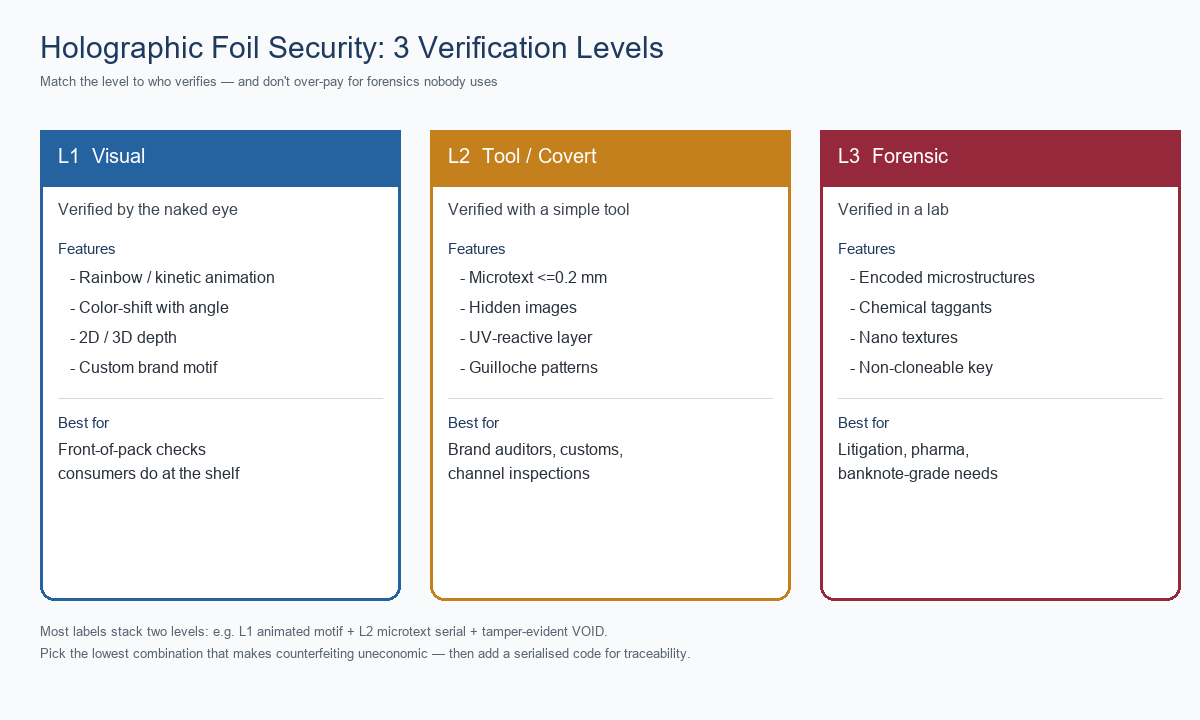
The single most useful framework for a buyer is the tiered model used across security printing: match the verification level to who needs to check, and don’t over-pay for forensics nobody will use.
| Level | How it is verified | Typical features | Best for |
|---|---|---|---|
| L1 — Visual | Naked eye, any consumer | Rainbow / kinetic animation, colour-shift, 2D/3D depth, custom brand motif | Front-of-pack authentication consumers do at the shelf |
| L2 — Tool / Covert | Magnifier, UV light, or a simple decoder | Microtext (≤0.2 mm), hidden images, UV-reactive layer, guilloché | Brand inspectors, customs, channel audits |
| L3 — Forensic | Laboratory equipment | Encoded microstructures, chemical taggants, nano-textures (available via specialist security partners) | Litigation, high-value pharma, banknote-grade needs |
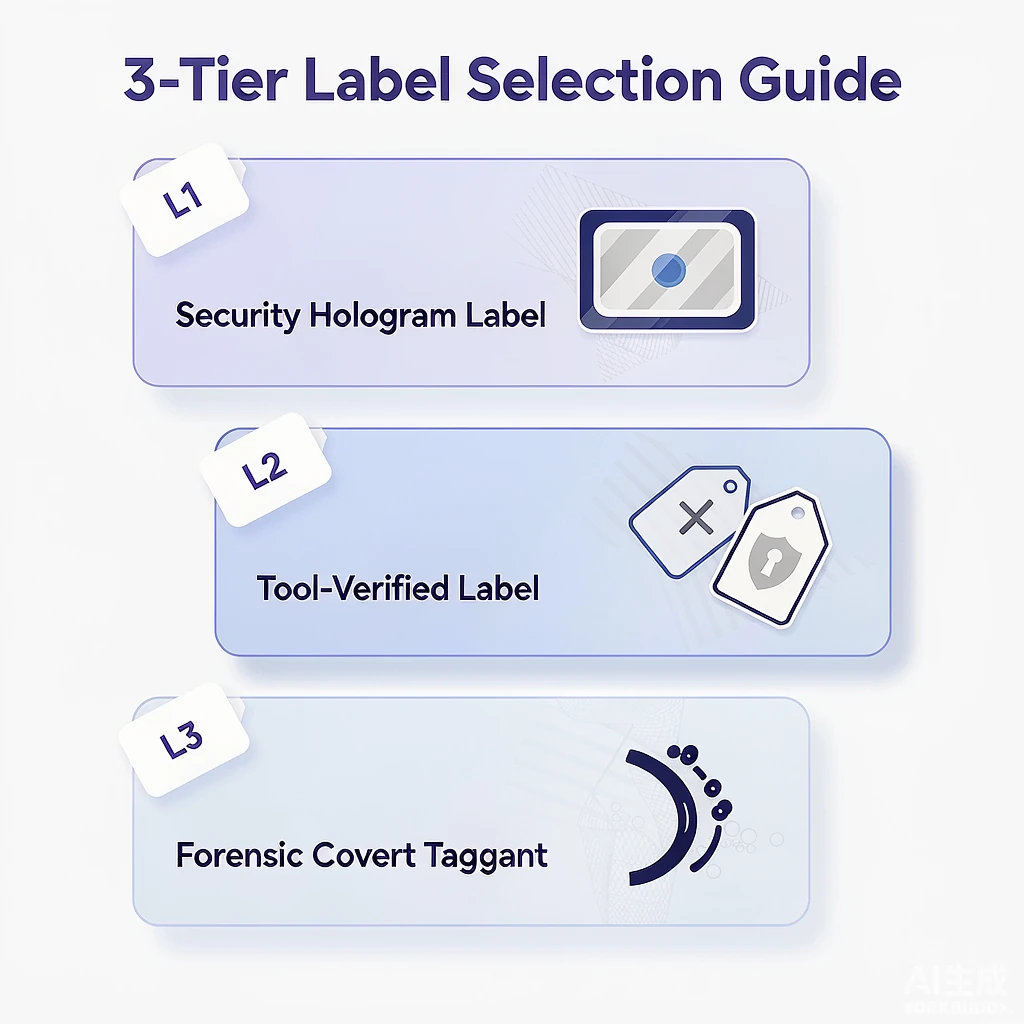
A good label rarely stops at one level. A spirits brand might run L1 (animated holographic motif) + L2 (microtext serial) + a tamper-evident VOID construction. A pharma carton might add L3 taggants only where the regulator or litigation risk demands. The decision rule we give buyers: pick the lowest combination of levels that makes counterfeiting uneconomic for your threat model — then add a serialized code so the item is also traceable, not just authenticatable. And train the people who check: a feature nobody knows how to verify is a feature nobody uses.
How Holographic Foil Security Labels Are Made
This is the part most supplier pages gloss over, and it is where “looks the same” and “is the same” diverge for holographic foil security labels. A holographic foil security label is a stack of deliberate choices:
- Origination / master. The hologram starts as an exclusive optical master (dot-matrix, 2D/3D, or e-beam), embossed onto a metallised PET carrier. An exclusive master is the first barrier — without it, no one reproduces your exact pattern. We develop and transfer masters with our hologram partners so the design stays controlled and is not resold.
- Foil conversion. The holographic image is transferred from the carrier onto the label substrate by hot or cold foil (next section). Registered transfer means the hologram lands exactly where the artwork intends — on the logo, the serial, or a feature box.
- Variable data. A serial, QR or Data Matrix is printed (or laser-etched) onto or beside the foil. This is what turns a “looks real” label into a “provably unique” one.
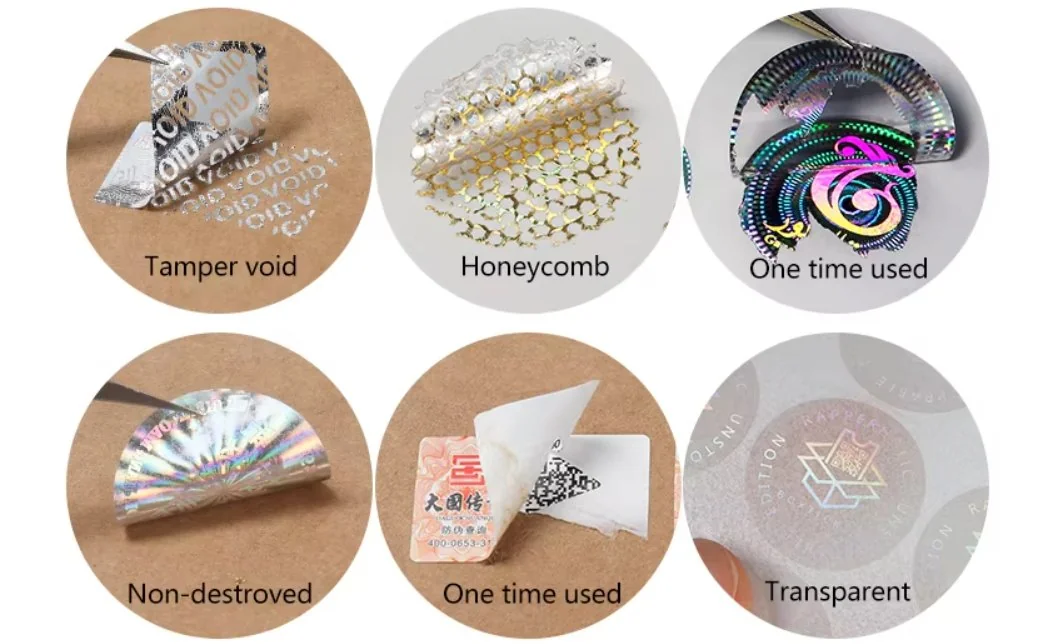
- Security construction. Tamper-evident adhesives and face stocks mean removal destroys the label (VOID, honeycomb, or destructible). For L2, microtext and hidden graphics are locked into the master so they survive production.
- Substrate & finish. PET, BOPP, PP or paper face stock for holographic foil security labels, chosen for the application surface (glass, HDPE, metal, carton) and the durability environment (cold chain, abrasion, alcohol wipes).
The reason we publish this much detail: a buyer who understands the stack can write an RFQ that actually gets quoted correctly, instead of “send me holographic labels” and hoping the factory guesses the threat model.
Hot Foil vs Cold Foil for Holographic Foil Security Labels
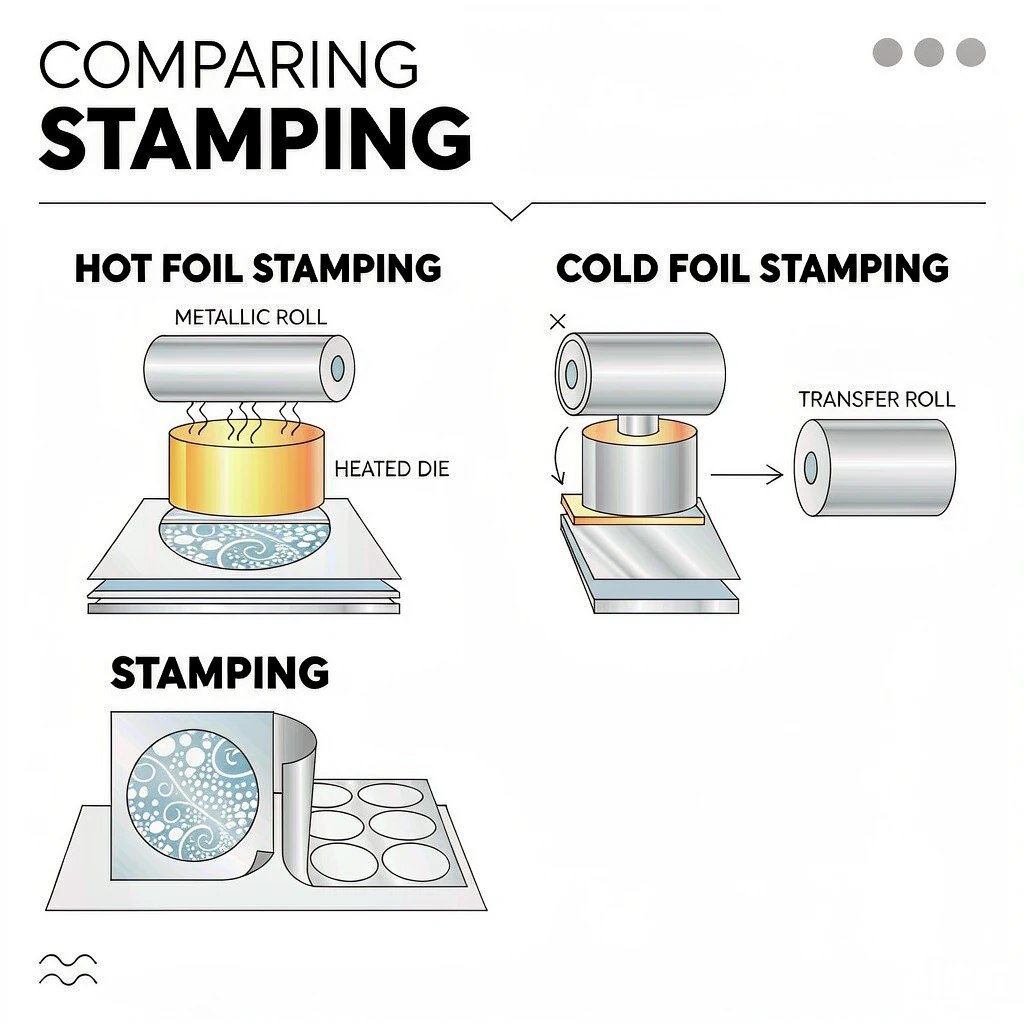
Both transfer a holographic layer; they differ in how. This is the same fork we wrote about in our cold vs hot foil comparison, applied to security.
One technical point worth stating clearly: the holographic diffraction structure is pre-embossed into the foil’s coating at the origination stage. The transfer step does not “press a sharper micro-structure” — so if your microtext or brand motif is part of the master, both hot and cold foil reproduce that same master. What the transfer method actually changes is registration, coverage, speed, substrate behaviour and durability. That is what you should choose on:
| Hot foil stamping | Cold foil | |
|---|---|---|
| How it works | Heated engraved die presses foil onto substrate | Adhesive + pressure transfer inline, no heated die |
| Registration | Very tight on small, precise features | Excellent inline; easiest when combined with print towers |
| Best for | Small, detailed, premium areas; a crisp registered logo or feature box | High-speed, long runs, large-area coverage |
| Substrate fit | Broad; strong on carton and many films | Needs adhesive tuned to the substrate; very good on film webs |
| Durability | Good rub and alcohol-wipe resistance on the stamped area | Good, but the transferred area benefits from a protective varnish in abrasion/ alcohol environments |
| Trade-off | Slower, die cost per design | Slightly less relief “pop”; adhesive must be matched |
For holographic foil security labels we usually recommend hot foil when a small registered feature (logo, feature box) must land with very tight registration on a premium pack.
Cold foil fits when the job is a long-run, large-area holographic background that also carries printed variable data. Many projects use both on one substrate — cold for the field, hot for the critical registered feature.
(For the general foil line-width floor — cold can hold finer foil lines, around 0.15 mm, versus hot around 0.20 mm — see the comparison article; note that microtext inside a holographic master is reproduced by the master, not set by the foil method.)
Combining Holographic Foil Security Labels with Serialized Codes and Variable Data
Holographic foil security labels prove the label is genuine; a serial proves which unit it is. Combining them is where brand protection becomes supply-chain intelligence:
- Serialized QR / Data Matrix. Each label carries a unique code linked to a database (your ERP, a GS1 Digital Link, or another anchor). A phone scan returns “authentic + this exact unit.” For prescription pharma under the EU Falsified Medicines Directive, the unique identifier is specifically a Data Matrix code — not a QR — so specify it explicitly there.
- Scratch-off variants. A holographic label can also carry a scratch-off panel revealing a unique PIN or code — common for vouchers, warranty registration and promotional authentication. It is one more way to make each unit individually checkable.
- Sunrise 2027 readiness. GS1’s 2027 target for 2D barcodes at retail POS means the code on your label should resolve to both checkout and consumer data. A holographic frame around it discourages swap-in of a fake plain label. See our Sunrise 2027 guide for the artwork steps.
- DPP alignment. The EU Digital Product Passport is arriving progressively — batteries have the clearest timeline, with textiles and electronics following as implementing rules land. The same serialised label can carry a passport link where the category applies, so one layer can do several compliance jobs.
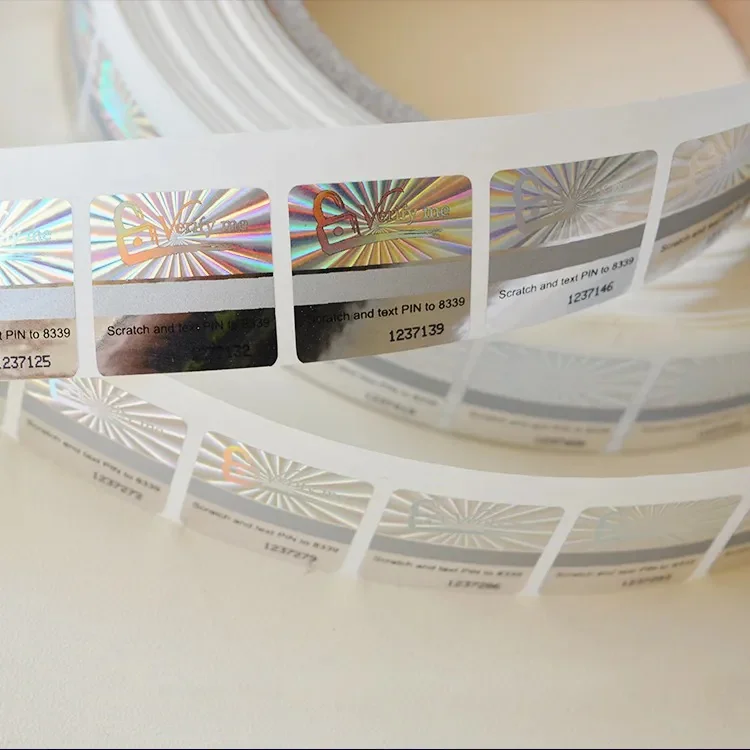
For pharma, the unique identifier is the FMD Data Matrix; for everything else it is your own traceability key. We print variable data inline after foil so the two never mis-register.
A Specifications Walkthrough for Holographic Foil Security Labels (Illustrative)
The following is a composite example, not a specific customer order — it shows how the choices above turn into a real spec.
A mid-size spirits brand is losing shelf presence to copycat bottles and wants authentication a bar staff can confirm at a glance from the shelf, while the brand’s own auditor verifies the registered feature with a simple tool.
We specify: PET face stock, hot-foil transferred exclusive 2D/3D master on the neck label (L1 animated motif + brand logo, verified visually), a ≤0.2 mm microtext serial along the border (L2, checked with a magnifier by the auditor), and a VOID tamper-evident construction on the capsule.
A printed serialized QR sits beside the foil for scan-to-verify. Result: a label that is premium on the shelf, obvious-if-fake to the eye, tool-verifiable by the brand’s auditor, and unique per bottle.
The “illustrative” point is the method — define the threat model, pick the lowest sufficient levels, then add a serial.
Specifications You Can Send to a Supplier
| Parameter | Typical option | Why it matters |
|---|---|---|
| Face stock | PET / BOPP / PP / paper | Surface match + durability (cold chain, alcohol) |
| Hologram type | Exclusive master (dot-matrix / 2D-3D / e-beam) | Exclusive = not resold = harder to copy |
| Transfer | Hot foil / Cold foil / both | Registration, area, speed, substrate, durability |
| Security level | L1 / L2 / L3 (or combined) | Match verification to threat model |
| Variable data | Serial / QR / Data Matrix (Data Matrix for pharma) | Per-unit traceability |
| Microtext | ≤0.2 mm, brand or serial (typical; confirm at proof) | L2 tool-verified feature |
| Construction | VOID / honeycomb / destructible (one-time use) / transparent | Tamper evidence |
| Substrate compatibility | Glass / HDPE / metal / carton | Adhesion and application method |
| Durability | Abrasion / UV / alcohol-wipe tested | Survives the channel |
| MOQ & format | Roll / sheet. As a guide only: master origination commonly around 2–3 weeks, label MOQs often from the low thousands of units — typical ranges, not a quote | Guidance only. Your actual minimum order, format, lead time and price are confirmed against your real order |
This table is the short version of our downloadable checklist (below) — copy it into an RFQ and a competent converter will quote against it instead of guessing.
Sustainability and PPWR: Do Holographic Foil Security Labels Hurt Recyclability?
Honest answer: a metallised foil layer on holographic foil security labels is not invisible to recycling, and the exact rules are still moving. Under (EU) 2025/40 the recyclability grading framework exists, but the detailed, material-specific design-for-recycling methods and the A/B/C grade thresholds are not final yet — the EU timeline puts the detailed standards around 2028 and the grade requirements around 2030, not today. So we design to current trends rather than claiming a certified grade.
Practical moves we use with buyers:
- Keep foil coverage targeted. A registered holographic logo uses far less foil than a full-bleed holographic field — same security, less material in the stream.
- Match the substrate family and check the local stream. Recycling behaviour depends on the full pack and the actual recovery stream; what sorts well in one market may not in another. We advise per application and document the construction so your recycler or converter can assess it.
- Design for separation where a stream or customer requires it. Where a recovery stream or a customer specification calls for clean separation, we can specify adhesives and constructions that help the label release.
We do not claim holographic foil security labels are automatically “recyclable” — that depends on the full pack. What we do is design the foil feature so it adds security without needlessly downgrading the pack’s recyclability, and we document the construction to support your Declaration of Conformity (DoC). Note the DoC for the packaged product is the responsibility of the producer / brand owner under PPWR — we supply construction documentation, we do not issue the pack-level DoC on your behalf.
Your Holographic Foil Security Labels Checklist
Before you brief a factory for holographic foil security labels, work through these. The downloadable version turns them into a one-page RFQ you can send us:
- What are you protecting with holographic foil security labels, and through which sales channels?
- Who verifies authenticity of the holographic foil security labels — consumer, auditor, or lab? (sets L1/L2/L3)
- Do you need per-unit traceability (serial / QR / Data Matrix)?
- Exclusive master, or is a stock pattern acceptable?
- Substrate and durability environment (glass, HDPE, cold chain, alcohol)?
- Tamper-evident required (VOID / honeycomb / destructible)?
- Foil coverage — full field or registered feature?
- Compliance hooks — FMD (Data Matrix), DPP / Sunrise 2027, PPWR grading?
Download: Holographic Foil Security Labels Spec & Level-Selection Checklist (XLSX) — fill it in and send it with your sample request. Guidance only, not a quote; your actual terms are confirmed per order.
Frequently Asked Questions About Holographic Foil Security Labels
What is the difference between holographic foil security labels and a printed hologram?
A printed “hologram” is simulated with ink and reproducible on any press. A true holographic foil carries a micro-embossed optical structure made from an exclusive master, which needs the master and transfer process to reproduce — a higher bar for counterfeiters, though no single feature is unbreakable on its own.
Can you put my logo and a serial number on holographic foil security labels?
Yes. For holographic foil security labels, custom brand motifs are built into the master, and a unique serial, QR or Data Matrix is printed inline after foil transfer so each label is both branded and individually traceable.
Will holographic foil security labels show if someone tries to remove them?
When specified with a tamper-evident adhesive, yes. VOID, honeycomb or destructible constructions destroy the label on removal, leaving a clear mark that the pack was opened. The hologram provides authentication; the tamper construction provides the anti-tampering proof.
Are holographic foil security labels recyclable under PPWR?
The detailed recyclability methods and grades are not final yet (expected around 2028–2030). We design for low foil coverage and document the construction to support your assessment, but we do not claim a certified grade, and the pack-level Declaration of Conformity is the producer’s responsibility.
How do I choose L1, L2 and L3 for holographic foil security labels?
Match the level to who verifies: L1 for consumers at the shelf, L2 for auditors with a simple tool (microtext, UV), L3 for laboratory forensic needs. Pick the lowest combination that makes counterfeiting uneconomic for your threat model, then add a serial — and train the people who check.
Do holographic foil security labels help with pharma FMD or DPP?
It supports both as a component. For pharma, the unique identifier under FMD is a Data Matrix code and the anti-tampering device is the tamper-evident construction (the hologram authenticates, it does not itself prove the pack is unopened); actual pharma production must run through a qualified supply chain. For DPP, the same serialised label can carry a passport link where the category applies — batteries first, then others as rules land.
What is a typical minimum order and lead time for holographic foil security labels?
As a guide only: master origination commonly takes around 2–3 weeks, and security-label MOQs often start in the low thousands of units, with lead time depending on origination and variable-data setup. These are typical industry ranges for planning, not a quote — your actual minimum order, lead time and pricing are confirmed per order, and nothing on this page is a price commitment until we issue a written quotation.
Related reading: our tamper-evident labels hub, the hot-foil holographic roll labels overview, serial-numbered holographic labels, and the hologram sticker specification guide. Browse the full range of holographic foil security labels in our hologram sticker category.
Request a Physical Sample of Holographic Foil Security Labels
Holographic foil security labels are one of those things you need to see move in your hand. Tell us your product, surface and threat model and we will put together a physical sample built to the checklist above. Contact our team to start.
Sources
- OECD & EUIPO, Mapping Global Trade in Fakes 2025 (2021 data): global counterfeit trade ≈ USD 467 billion (2.3% of world trade); EU fakes imports ≈ EUR 99 billion (4.7%). OECD press release and EUIPO news
- EU Falsified Medicines Directive — unique identifier (Data Matrix) & anti-tampering: Commission Delegated Regulation (EU) 2016/161 (EUR-Lex)
- Authentication performance — ISO 12931:2012, Performance criteria for authentication solutions used in anti-counterfeiting (cited by reference; confirm the current edition via ISO)
- Packaging waste & recyclability: Regulation (EU) 2025/40 (EUR-Lex) and the European Commission Packaging Waste page
- 2D barcodes at retail POS: GS1 Sunrise 2027
Regulation texts and dates change with implementing acts — verify the current version via the Sources links before finalising artwork.