
Send Your Inquiry Today
PPWR Recyclability Grades A/B/C: What Your 2026-2030 Packaging Must Meet
PPWR Recyclability Grades A/B/C: What Your 2026–2030 Packaging Must Meet
From 1 January 2030, packaging that cannot prove its recyclability grade may lose access to EU shelves. And the grade is decided long before the label is printed — it is decided by the base material you choose and how many incompatible layers you add on top of it. This guide breaks down the PPWR recyclability grades A, B and C, explains what the PPWR recyclability grades mean, which materials sink your grade, and how a converter can keep your pack both beautiful and compliant.
On this page:
- What changed: (EU) 2025/40 and the grade system
- Who this hits
- ★ What the A/B/C grades actually mean
- ★ How material choices decide your grade
- ★ How we produce recyclable labels & boxes
- Reading the grade on your pack
- Five mistakes that drop a grade
- Free grade pre-assessment
- Real case (illustrative)
- Material vs grade — quick reference
- ★ Download the self-assessment checklist
- FAQ
What Changed: (EU) 2025/40 and the Recyclability Grade System
The EU Packaging and Packaging Waste Regulation — Regulation (EU) 2025/40 — became fully applicable on 12 August 2026. Beyond the labelling and substance rules many buyers already track (see our PPWR labelling requirements guide), it introduces a mandatory recyclability performance grade for packaging placed on the EU market.
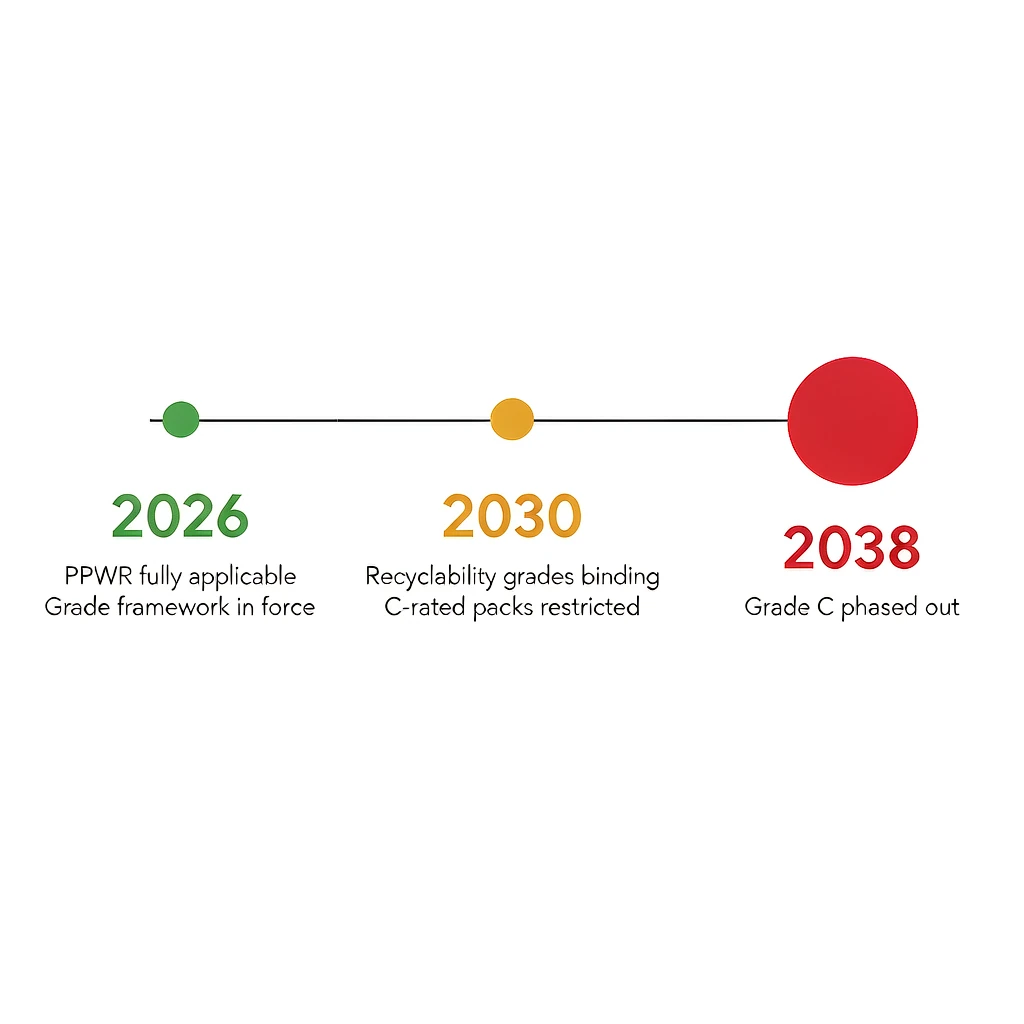
The timeline that matters for buyers:
- 12 Aug 2026 — PPWR fully applicable; the PPWR recyclability grades framework is in force.
- 1 Jan 2030 — PPWR recyclability grades become binding; packaging below the required grade faces market restrictions.
- 2038 — the weakest grades (notably C) are phased out, giving C-rated packs a hard expiry.
The legal text is published on EUR-Lex (Regulation (EU) 2025/40), and the European Commission maintains a PPWR overview page. Detailed performance thresholds are set in implementing acts; figures below are indicative as of October 2026 and should be confirmed against the official acts before you brief your supplier.
Who This Hits
If you place packaged goods on the EU market, this applies to you: brand owners, private-label buyers, and the converters who manufacture their labels, cartons and bags. The sectors feeling it first are:
- Food & beverage — laminated pouches, PE-coated trays, windowed boxes.
- Cosmetics — foil-stamped cartons, rigid boxes, decorative security labels.
- Wine & spirits — multi-material gift boxes and composite caps.
★ What the PPWR Recyclability Grades A/B/C Actually Mean
The PPWR recyclability grades reflect how well your pack is actually recycled in real waste infrastructure — not how recyclable it looks on paper.
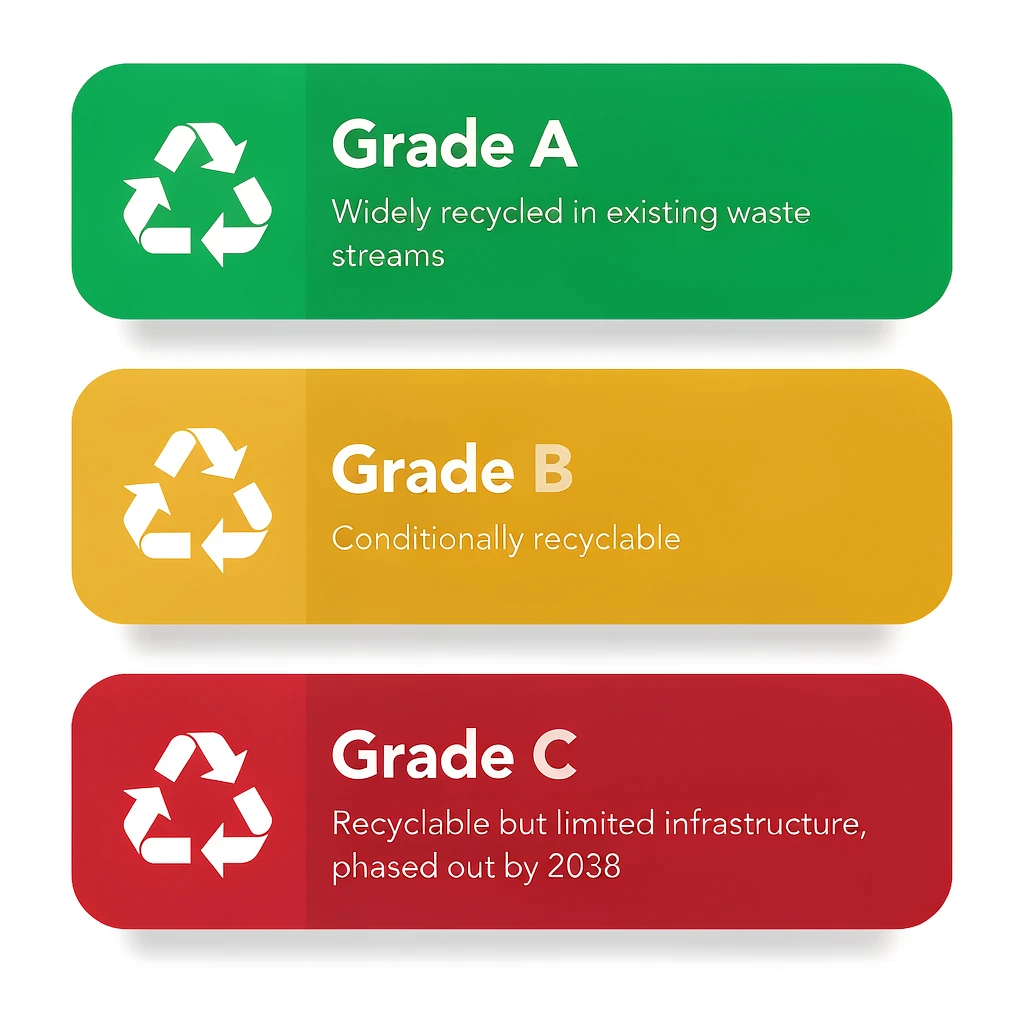
Grade A — under the PPWR recyclability grades, this means recyclable in mainstream, existing waste streams at scale. This is the target: single-fiber paper and board, cleanly printed.
Grade B — the middle band of PPWR recyclability grades: recyclable, but only under specific conditions (e.g. separate collection or a dedicated stream). Acceptable through 2030, but watch the 2038 tightening.
Grade C — the lowest of the PPWR recyclability grades, technically recyclable but with limited infrastructure today. From 2038 this grade is phased out, so any C-rated packaging has a built-in expiry date.
The exact recycling-rate thresholds each grade must hit (for example the minimum measured recycling performance) are defined in the EU implementing acts. As of October 2026, plan for the strictest interpretation: aim for a real, documented recycling rate comfortably above the 70% floor, not a theoretical one.
★ How Material Choices Decide Your PPWR Recyclability Grade
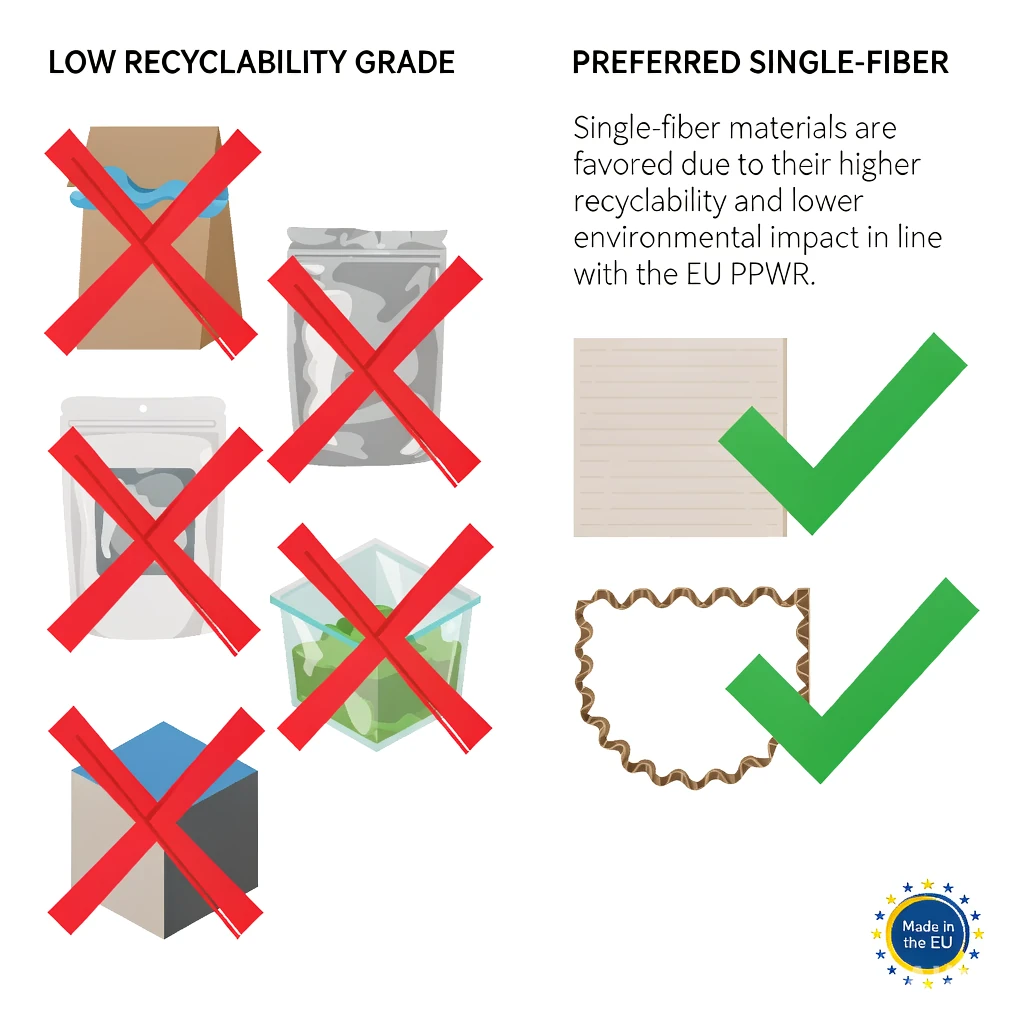
Your place on the PPWR recyclability grades scale is set by the substrate and every incompatible layer you add. These are the typical downgrade drivers:
- PE-coated paper — the plastic barrier sinks the pack toward Grade C.
- Aluminium foil lamination — metallised looks premium but blocks repulping; Grade C.
- Paper–plastic composite — the two materials cannot be separated cleanly; Grade C.
- PET/PP window film — a small window can disqualify an otherwise recyclable carton.
- Multi-material rigid box — foil + board + plastic tray is hard to separate; Grade C.
- High empty-space ratio in transit packs — attracts the Art. 24 void-ratio penalty.
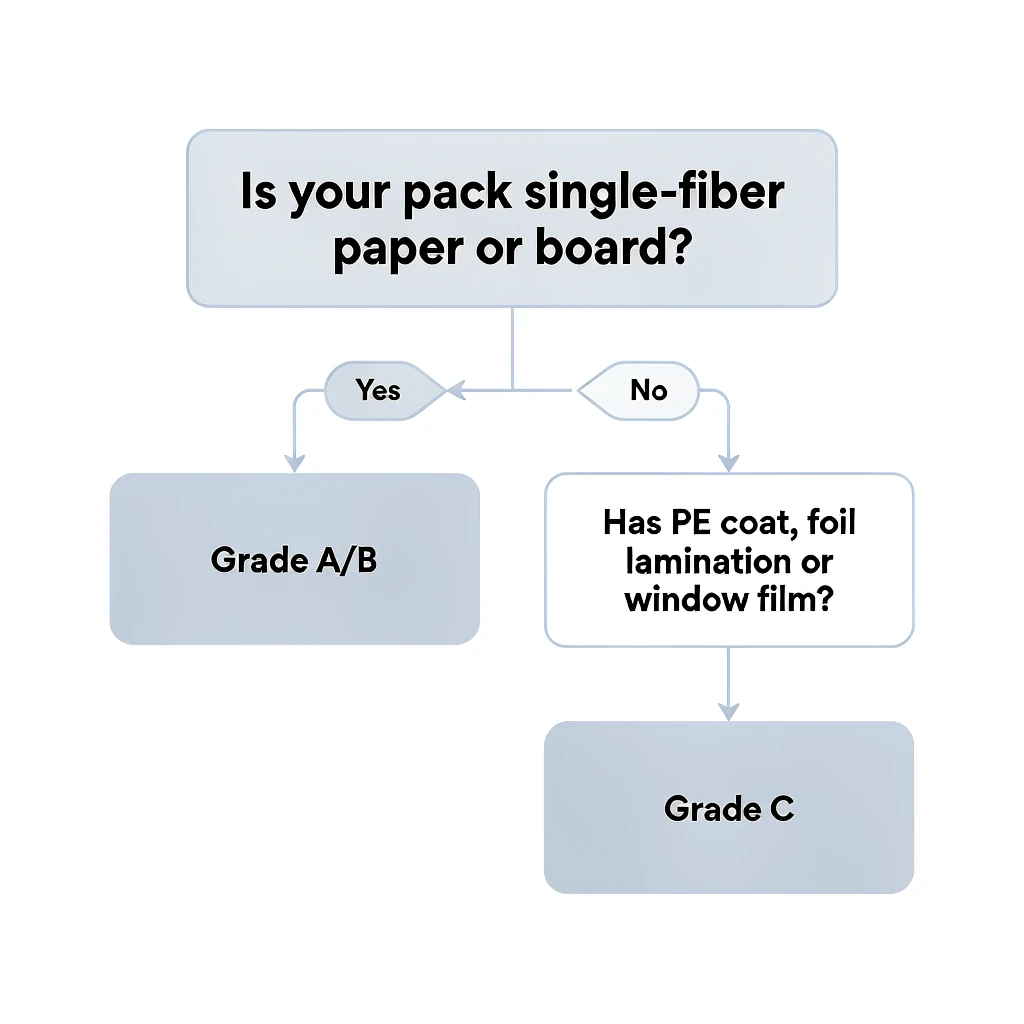
The good news: single-fiber paperboard and corrugated are the materials most likely to land in A/B. Corrugated is also exempt from the Art. 29 reuse quotas, and paper-based formats sit outside the plastic PCR-content quota — so a paper box buyer is not forced to build a plastic recycling loop.
★ How We Produce PPWR-Compliant Recyclable Labels & Boxes
As a converter, we control the exact levers that move the grade. A few things we do on the production floor:
- Single-fiber default. To keep packs on the right side of PPWR recyclability grades, we start from one paper/board grade and avoid foil and PE lamination unless a function truly demands it.
- Repulpable finishes. For food-contact paper boxes we default to water-based, repulpable inks and avoid PE coating — a real production choice, not a marketing claim.
- Inline inspection + batch traceability. Every run is print-checked inline and documented per batch, so we can prove exactly what is in each pack. That documentation feeds directly into a PPWR recyclability grades assessment.
- Look without the downgrade. We can move a decorative foil label to a paper-based, easy-tear construction that keeps the premium feel while lifting the PPWR recyclability grade.
Reading the Grade on Your Pack
The final A, B or C rating is usually communicated through the packaging dossier, the Declaration of Conformity and any supplier documentation. It is not printed as a single letter on the pack, but the design choices that create it are visible: a mono-material carton, a paper label without foil, a corrugated shipper with minimal void fill. Buyers can use the PPWR recyclability grades as a shorthand when briefing designers and converters, and converters can run quick checks against the indicative criteria before artwork is locked.
We encourage clients to request a written assessment that maps each layer of the pack to the A/B/C criteria. That document becomes useful evidence when the brand owner prepares the pack-level Declaration of Conformity, and it flags any component — a window film, a foil lamination, a plastic handle — that could push the grade down before production starts.
Five Mistakes That Drop a Grade A Pack to C
Even well-intentioned packaging projects lose a grade because one component is overlooked. Here are the most common slips we see when buyers brief us against the PPWR recyclability grades.
- Assuming “paper” means recyclable. A paper carton with a PE liner or foil lamination is no longer single-fiber. The substrate is only part of the story; the layers on top decide the PPWR recyclability grade.
- Adding a window film for shelf appeal. A small PET window can shift an otherwise A/B carton toward C. If transparency is essential, ask about fiber-based alternatives or designs that avoid windows.
- Over-specifying foil for decoration. A full-bleed metallised label looks premium but adds a non-paper layer. Registered foil logos use far less material and are easier to justify under the PPWR recyclability grades.
- Mixing adhesives and coatings without documentation. Some adhesives and varnishes interfere with repulping. We keep a repulpable default and document the construction so the PPWR recyclability grade assessment is traceable.
- Ignoring void ratio in transit packaging. High empty-space ratios attract the Art. 24 penalty and can pull the overall pack profile down. Right-size the shipper before you decorate the inner pack.
The theme across all five: the PPWR recyclability grades reward a system view. A beautiful outer carton can be undermined by one incompatible label or liner, so we review the whole pack — not just the hero component.
What to Send for a Free PPWR Recyclability Grade Pre-Assessment
We run a short PPWR recyclability grades pre-assessment for any buyer who sends:
- A cross-section drawing or material list showing every layer — substrate, coatings, lamination, window film and adhesive.
- The intended EU market, because member states may interpret some recovery streams differently.
- Shelf-life and protection requirements, so we do not remove a functional barrier just to chase a letter grade.
Within a few working days we return an indicative A/B/C rating, flag the components most likely to downgrade the pack, and suggest a paper-based sample that keeps the look while improving the PPWR recyclability grade.
Real Case (Illustrative)
One buyer we supported moved a fragrance label from aluminium-foil lamination to a paper-based substrate with an easy-tear structure. The visual finish was preserved; the expected recyclability grade moved from C to B. (Illustrative example based on a typical conversion project — no client name or order figure is stated.)
Material vs Grade — Quick Reference
| Material / structure | Expected grade (indicative) | EU 2030 status |
|---|---|---|
| PE-coated paper | C | At risk |
| Aluminium foil lamination | C | At risk, 2038 phase-out pressure |
| Paper–plastic composite | C | At risk |
| Single-fiber paperboard | A–B | Preferred |
| Corrugated board | A | Exempt from Art. 29 reuse quota |
★ Download: PPWR Recyclability Grade Self-Assessment
Before you brief your converter, run our one-page checklist across your pack: base material, composite layers, coating/lamination, window film, void ratio and the 75%/85% recycling-rate targets. Download the PPWR Recyclability Grade Self-Assessment (PDF) — free, no email required.
FAQ
Are folding cartons recyclable under PPWR?
Yes — when they are single-fiber board without foil lamination, plastic lining or a PET window. Add those and the same carton drops toward Grade C. Keep it mono-material and it usually lands in A/B.
Are paper bags recyclable under PPWR?
Plain kraft and paper bags are among the most recyclable formats and a strong choice for EU-bound brands. Avoid lamination, plastic handles and mixed-material reinforcements that would push them down a grade.
What is the PPWR?
The PPWR is Regulation (EU) 2025/40, the EU’s overhauled packaging law covering design, labelling, recyclability grades, reuse and recycled-content targets. Our PPWR labelling requirements guide covers what must appear on the pack itself.
What does PPWR Grade C mean by 2038?
Grade C packaging — recyclable only where infrastructure is limited — is phased out from 2038. Specifying C-rated materials today means designing in a future compliance gap; aim for A/B instead.
Related compliance guides
- PPWR labelling requirements (2026 guide)
- EUDR-ready paper boxes: a buyer guide
- US state EPR rules for packaging
Get a free recyclability pre-assessment
Send us your pack structure drawing and material list and we will run a free PPWR recyclability grades pre-assessment and supply a paper-based sample. Explore our custom printed labels, recyclable paper bags and custom paper boxes built for the EU market.
Figures in this article are indicative as of October 2026; final recyclability thresholds follow the official EU implementing acts. This page is informational and does not constitute legal or conformity certification.