
Send Your Inquiry Today
Custom Hologram Stickers: Security Labels, 3D Effects and Manufacturer Guide
When a buyer searches for custom hologram stickers, custom security hologram stickers or hologram sticker printing, they are usually trying to solve a practical security problem. They may need to protect a certificate, stop a warranty seal from being transferred, give every product a traceable identity, or make a package visibly harder to counterfeit. A rainbow finish alone is not enough. The security comes from the combination of the master image, optical effects, fine-line artwork, variable data and the way the label behaves when someone tries to remove it.
This guide explains the features buyers see most often in Google searches: security hologram labels, 3d hologram stickers custom designs, serial-number holograms, QR-code holograms, tamper-evident seals and the capabilities to look for in a hologram sticker manufacturer. It is written for procurement teams, brand owners, certificate issuers and packaging engineers who need to compare real options before requesting a quotation.

True 3D hologram sticker with an angle-dependent depth effect and color shift.
What are custom hologram stickers?
Custom hologram stickers are security labels made from a customer-specific optical design rather than a generic stock pattern. The design can include a logo, a product name, a miniature object, a globe, a portrait, a repeating word, a hidden image or a combination of several effects. Depending on the process, the image is transferred to a metallized film, a clear film or another security substrate and then converted into labels in the required shape and size.
The word “custom” matters in two ways. First, the visual design is unique to the brand or document owner. Second, the production file can carry variable information such as a sequential serial number, a barcode or a QR code. A label that looks attractive but is identical on every item offers much less control than a label with a unique identity and a controlled verification process.
For a general overview of the product range, see Gervin Printing’s hologram sticker product category. It is the appropriate starting point when you need a combination of optical effects, adhesive construction and custom finishing rather than a decorative holographic sticker.
How do security hologram labels prevent counterfeiting?
Security hologram labels work by making a convincing copy expensive, technically difficult and easy to challenge during inspection. A counterfeit printer may reproduce a flat color or a simple logo, but it cannot easily reproduce the complete optical behavior of a master image, the microscopic line structure, the correct variable data and the tamper response of the original label.
There is no single feature that proves authenticity. A strong program uses layers:
**An overt feature** that a person can see, such as a 3D image or a color shift.
**A fine feature** such as micro text or guilloche lines that a counterfeiter may miss or blur.
**A data feature** such as a serial number, barcode or QR code linked to a record.
**A physical feature** such as a destructible film, residue or a VOID message that makes reuse obvious.
The visual layer helps with fast checks at a warehouse, retail counter or examination desk. The data layer supports product authentication and traceability. The physical layer addresses the moment when someone attempts to open a package or move a seal to another product. This is why a buyer should ask for a complete security construction instead of asking only for a “holographic finish.”
The WIPO anti-counterfeiting guidance is useful background when a team is defining an anti-counterfeiting program. It reinforces a point that applies to labels: authentication works best as a system of controls, not as a single decorative mark.
True 3D hologram versus a standard holographic finish
The phrase 3d hologram stickers custom is used for more than one type of product. A digitally printed sticker with an iridescent vinyl can have a rainbow effect, but that does not necessarily mean it contains a true 3D hologram. Buyers should ask which optical process creates the depth effect.
True 3D hologram
A true 3D hologram is built from a master image that records depth information. As the label is tilted, the object appears to move, turn or sit at different depths. Creating the master usually requires specialist optical equipment and a longer approval cycle. It is the right choice when the label itself is part of a high-value security program.
Holographic film or rainbow effect
A holographic film can provide a strong color-shifting background, sparkle or diffraction pattern. It is often a cost-effective option for branded packaging, promotional labels and applications where visual impact matters more than covert security. It can also be used as one layer in a broader security design.
How to specify the difference
Ask the supplier to confirm whether the quote includes a true 3D master, a stock holographic film, a 2D diffractive image or a digitally printed imitation. Request a short video or physical sample viewed at several angles. The sample should show the intended logo, text and security elements, not just a generic rainbow film.
Micro text and guilloche: small details with a real purpose
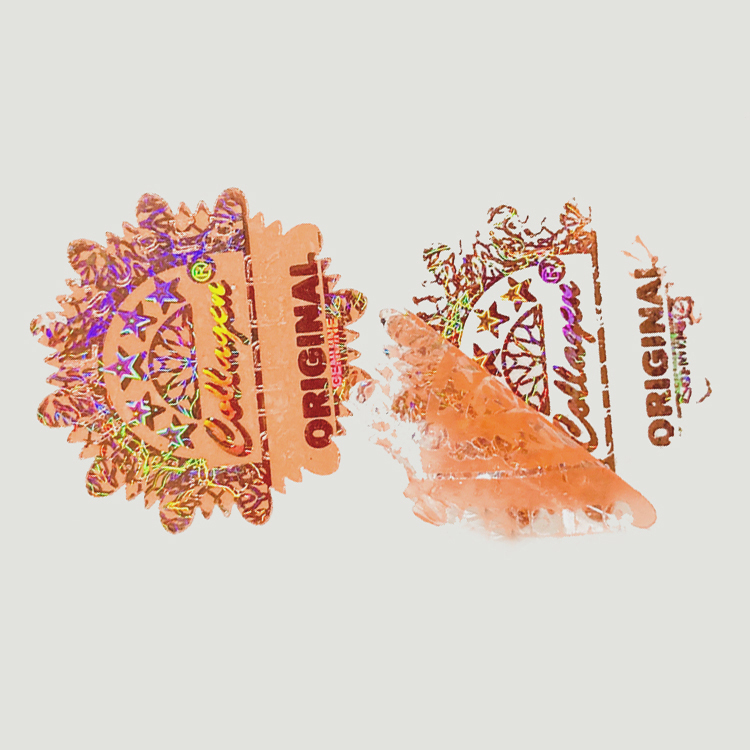
The sample that prompted this research includes repeated micro text under the main mark and fine guilloche linework around the graphic. These are not merely decorative details.
Micro text is text printed or formed at a very small size. Under magnification it should resolve into clear characters; in a low-quality copy it often becomes a broken line. A buyer can use a short brand name, a certificate code or a repeating word such as “ORIGINAL.” The text must be sized for the substrate, viewing conditions and production method. Making it smaller is not automatically more secure if the production line cannot hold the detail consistently.
Guilloche is a set of interlaced, mathematically controlled lines. Banknotes and identity documents use related line structures because a scanned and reprinted copy tends to lose the clean intersections and changing line density. On a custom label, guilloche can frame the logo, create a security background or form a hidden shape that appears only at a particular angle.
These elements should be documented in the approved artwork. The approval proof should identify the micro text, the guilloche area and the viewing condition used to inspect them. This prevents a fine feature from being removed during a later artwork change because it was mistaken for background decoration.

Microtext and guilloche linework should be approved as security features, not treated as ordinary decoration.
What is a dot matrix hologram sticker?
The phrase dot matrix hologram sticker usually refers to an optical pattern made from an array of microscopic dots. The dots can create a bright diffraction effect, a moving image or a structured background. A dot matrix effect is useful when the buyer wants a clearly visible optical response without making the main logo too busy.
Dot matrix artwork can be combined with a 3D image, micro text, a serial number or a QR code. The layers should be checked together because a strong optical background can reduce contrast around small text. The right proofing method is a physical sample under the lighting used by inspectors, not only a flat PDF viewed on a monitor.
How do tamper-evident hologram stickers work?
Holographic tamper evident stickers and holographic tamper evident labels are designed to show that a seal has been disturbed. The response can take several forms:
• A destructible film breaks into pieces when someone tries to remove it.
• A residue pattern remains on the package or document.
• A VOID or OPEN message appears in the label or on the surface.
• The label stretches, delaminates or loses its optical appearance.
• A two-layer construction separates, making the original application difficult to recreate.
This is different from a tamper proof hologram sticker, which is often used in search results as a broad expression. No label can prevent every attempt to tamper with a package. The practical goal is to make interference visible and to make clean reuse difficult.
Before ordering, specify what must happen on removal. “Tamper-evident” is not a complete material specification. Tell the manufacturer whether the label will be applied to coated paper, corrugated board, glass, PET, a varnished box or a certificate stock. Adhesive choice, surface energy, temperature and storage time all affect the result.
For ordinary packaging projects, Gervin’s custom label printing category and custom UV printing label stickers show related label capabilities. A security hologram normally requires a separate construction review because the optical layer and the tamper response must work together.
Can a hologram sticker include a serial number and QR code?
Yes. Hologram sticker with serial number, hologram sticker with QR code and a serial number QR hologram sticker are established buying requirements, not unusual requests. A label can carry a printed or laser-marked serial number, a barcode, a QR code or several variable elements in one design.
The serial number gives each unit a visible identity. It can be sequential, randomized, linked to a batch or matched to a certificate number. The QR code can direct a user to a verification page, product registration workflow, warranty record or traceability database. The label should not promise more than the back-end system can support: a QR code that opens a generic homepage does not provide the same control as a code checked against a live record.
The artwork must reserve enough quiet space for the code. Holographic backgrounds, metallic reflections and fine optical lines can reduce scan reliability. Test the smallest planned size with several phones and under the real lighting conditions. Confirm whether the code will be printed in black, etched, laser demetalized or placed in a clear window.

Serial numbering and QR coding give each label a usable identity for authentication, recalls and channel control.
The phrase QR Code Holograms for Authentication and Traceability describes this combined use of an optical label and a digital record. The GS1 Digital Link standard is a useful reference when a QR code needs to connect a product identifier to online information. The standard is not a substitute for a verification database, but it helps teams think about identifiers and web destinations before printing thousands of labels.
Can custom hologram stickers be used for certificates?
Yes. Custom hologram stickers for certificates and holographic authenticity stickers are used to make unauthorized replacement or alteration easier to detect. A certificate seal can carry the issuing organization’s logo, a serial number, micro text, a year, a QR verification link and a tamper-evident construction.
The seal should be placed where removal would damage the document or leave a visible mark. If a certificate may be laminated, framed or scanned, test the adhesive and optical appearance through the planned handling process. The issuer should maintain a record of the serial range and define what a verifier should do when a code is invalid, duplicated or already marked as used.
A custom hologram seal can also be used on product boxes, warranty cards and certificates of authenticity. The phrase hologram seal of authenticity is common in buyer searches, but the seal should be backed by a clear verification rule. The hologram is evidence; the issuer’s record and inspection process establish what that evidence means.

A certificate seal should make both authenticity checking and attempted removal clear to the next verifier.
How do you check hologram authenticity?
The Google question How to check hologram authenticity? has a practical answer: inspect more than the rainbow shine. A receiving or inspection procedure can include the following steps:
Tilt the label slowly and check whether the 3D depth or color movement matches the approved sample.
Use a loupe or magnifier to inspect the micro text and guilloche lines.
Check the logo, wording, spelling and security pattern against the reference artwork.
Confirm that the serial number is in the expected range and has not already been used.
Scan the QR code and check that the result identifies the correct product, certificate or batch.
Inspect the edges for lifting, residue, a VOID message or other signs of removal.
The search phrase hologram sticker original often comes from a consumer who wants to know whether a product is genuine. The answer should be written in plain language on the verification page. Explain what the customer should see, what a valid code returns and where to report a suspicious label.
How to choose a hologram sticker manufacturer
The right hologram sticker manufacturer should be able to discuss both optical design and production control. A general hologram sticker printer may be suitable for a decorative finish, but a security supplier should also explain master imaging, variable data and tamper performance. Use the following questions during supplier evaluation:
• Can you make a true 3D master, or are you supplying a stock holographic film?
• Which features can be combined: microtext, guilloche, dot matrix, serial numbers, QR codes and laser demetalization?
• What is the smallest reliable microtext size on the proposed material?
• How is variable data generated, checked and reconciled with the shipment?
• What tamper response will the label show on the actual application surface?
• Can you provide a physical proof at the requested size?
• What are the master charge, tooling charge, MOQ and repeat-order terms?
• How will artwork, serial ranges and unused labels be controlled?
• What are the production lead time, inspection method and packaging conditions?
Gervin Printing describes itself as a Guangzhou-based direct supplier with more than 20 years of printing experience and 15 years of labeling R&D. The About Gervin Printing page gives background on the factory and its one-stop packaging work. For a project that combines a security label with a box or a conventional package label, the contact and quotation page is the correct place to send the artwork, size, quantity and intended application.
Cost, MOQ and production lead time
The Google question How much does a hologram sticker cost? cannot be answered with a single unit price. The cost is influenced by the master image, label size, film and adhesive, number of colors, variable data, finishing, tooling, quantity, inspection requirements and freight.
A stock holographic label or a decorative holographic stickers sheet has a lower entry cost, but it may not provide a unique security identity. A fully custom true 3D hologram requires master preparation and proofing, so the first order normally costs more than a repeat order. Adding serial numbering and QR coding adds data preparation and verification work. Tamper-evident materials can also change the adhesive and converting process.
When requesting a quote, include:
• Finished size and shape, including corner radius or perforation.
• Application surface and expected service conditions.
• Whether the label is permanent, removable or tamper-evident.
• The required optical features and any hidden or overt text.
• Serial range, QR destination and barcode requirements.
• Quantity for the first order and estimated repeat volume.
• Packing format, delivery destination and required ship date.
This gives a manufacturer enough information to separate tooling, proofing, production and freight instead of hiding all variables inside a vague per-piece estimate.
Other packaging and label applications
Security hologram labels are used on certificates, electronics, cosmetics, supplements, spare parts, warranty cards, event credentials and branded packaging. They can be paired with conventional labels and boxes so the security element is part of a consistent packaging system.
For a package that needs a matching printed label, see the custom vinyl labels and stickers page and ask about custom hologram sticker printing as a security-focused extension of the printed label process. For packaging projects, the custom packaging box category is useful when the hologram needs to sit on a folding carton or rigid presentation box. A shrink label or bottle application may require a different substrate and adhesive; the transparent BOPP bottle label page shows why the application surface matters.
Frequently asked questions
Do security stickers actually work?
They work best when several features are combined and a verifier knows what to check. A visible holographic effect alone is not a complete anti-counterfeiting system. True 3D depth, microtext, guilloche, controlled serial numbers, QR verification and a tamper-evident construction create more useful layers.
Can hologram stickers be reused?
Some ordinary adhesive stickers can be moved, but a properly specified tamper-evident label is designed to show removal through breakage, residue, a VOID message or delamination. Always test the chosen construction on the real surface.
Can QR codes be scanned on holographic stickers?
Yes, provided the code has adequate contrast, quiet space and size. Metallic glare and dense optical artwork can interfere with scanning, so test physical samples with common phones before approving mass production.
How do you print your own holographic stickers?
Decorative holographic stickers can be produced with a digital printer and holographic media. A security hologram requires controlled optical artwork, a suitable master or film, specialized converting and a verification plan. The distinction matters when the label is intended to protect certificates or branded products.
Which company manufactures holograms?
Look for a supplier that can show relevant samples, explain the optical process, manage variable data and test the tamper response. A supplier that only offers generic rainbow stock may not be equipped for a true custom security program.
Are hologram seals of authenticity reliable?
They are reliable as one part of an authentication process. The issuer still needs controlled serial ranges, a verification record and instructions for handling invalid or duplicated results. A seal that cannot be checked against any record provides limited assurance.
Final checklist before ordering
Before approving a purchase of custom hologram stickers, make sure the quotation and proof answer these questions:
• Is the product a true 3D hologram, a dot matrix hologram sticker, a stock film or a printed imitation?
• Are the micro text, guilloche and color-shifting features visible at the intended viewing distance?
• Does the label include the required serial number, QR code or barcode?
• Does the QR code open the correct authentication or traceability destination?
• What exactly happens if the label is removed?
• Has the adhesive been tested on the actual certificate, carton, bottle or product surface?
• Are serial ranges, artwork files and unused labels controlled?
• Have the master charge, MOQ, repeat pricing, lead time and inspection standard been confirmed?
When these points are clear, a custom hologram sticker becomes more than a shiny label. It becomes a practical link between the product, the package, the certificate and the verification record behind them.
Hologram Types Compared
Choosing the right hologram is a trade-off between visual impact, security level and unit cost. The table below compares the formats we produce.
| Type | Visual effect | Security level | Typical application | Relative cost |
|---|---|---|---|---|
| 2D flat hologram | Single-plane rainbow image | Basic | Promotional stickers, entry-level branding | Low |
| 3D layered hologram | Depth between foreground and background layers | Medium | Certificates, warranty seals, retail packaging | Medium |
| Dot matrix hologram | Fine dot pattern with kinetic movement | Medium to high | Brand protection, tax stamps | Medium |
| True-colour 3D hologram | Full-colour photographic depth | High | Luxury goods, premium certificates | High |
| Demetallized hologram | Holographic pattern with clear or transparent windows | High | Cosmetics, beverage, see-through packs | High |
| Hot-stamping holographic foil | Foil transferred directly onto the substrate | Medium to high | Cartons, covers, high-volume lines | Medium |
| Transparent holographic overlay | Clear film with holographic image over printed artwork | Medium | Documents, ID cards, over-laminate protection | Medium |
Material and Finishing Specifications
| Parameter | Available options |
|---|---|
| Film | PET holographic film, BOPP, vinyl, destructible fragile film |
| Thickness | 25 to 50 micron standard, thicker on request |
| Adhesive | Permanent, removable, high-tack for low-energy surfaces |
| Security add-ons | Serial numbering, QR code, microtext, hidden image, UV ink, scratch-off |
| Supply format | Roll for machine application, sheet for manual application |
| Finishing | Gloss or matte varnish, protective overlaminate, die-cut shape |
Frequently Asked Questions
What is the difference between 2D and 3D holograms?
A 2D hologram shows a flat rainbow image on a single plane. A 3D hologram places artwork on multiple depth layers, so elements appear to float above or sink behind the surface, which is noticeably harder to counterfeit.
Can hologram stickers be serialized?
Yes. We can print a unique serial number, barcode or QR code onto each label so every unit carries its own identity for verification and traceability.
Do hologram labels stick to curved or textured surfaces?
Standard permanent adhesive works on flat cartons, glass and most plastics. For curved bottles, flexible film or low-energy surfaces we specify a high-tack or conformable adhesive.
What is a demetallized hologram?
It is a holographic film where part of the metal layer is chemically removed, leaving transparent windows. The result is a security image that lets the product or printed artwork show through.
What is your MOQ and lead time?
MOQ depends on size, film type and security features. Custom master origination adds tooling cost, so larger runs carry a lower unit price. Share your artwork and quantity for an exact quotation.