
Send Your Inquiry Today
Custom Security Labels Quote Guide: How Suppliers Build a Quote
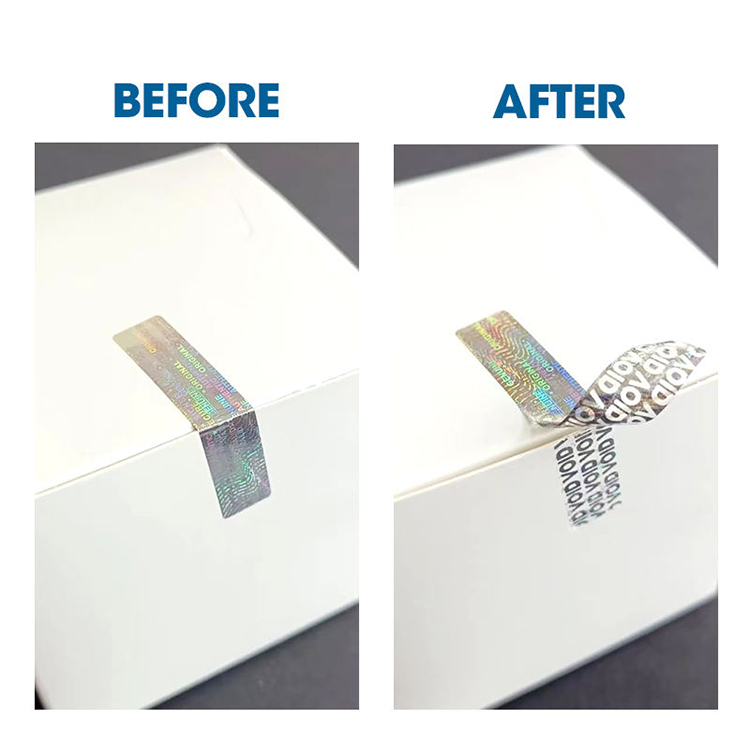
There is no useful universal price for custom security labels.
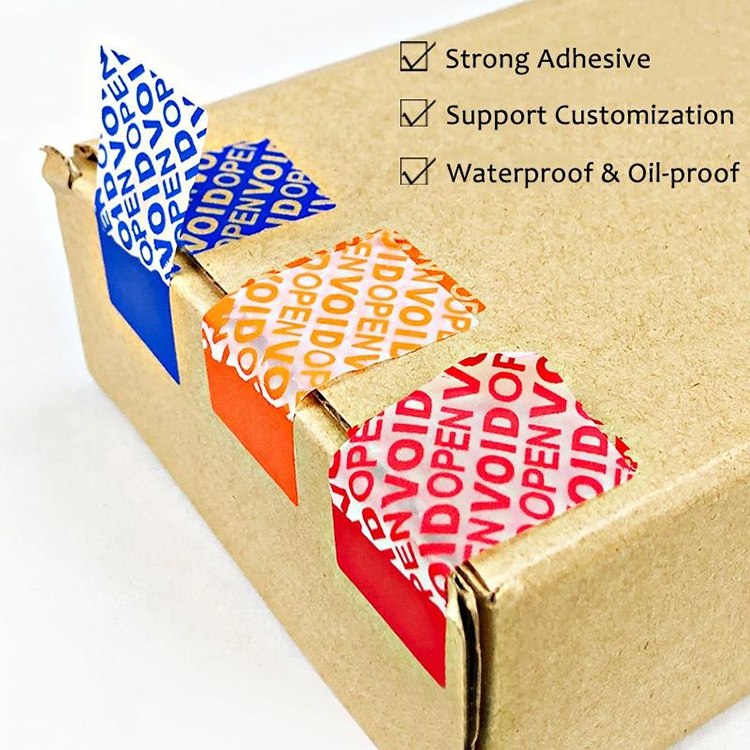
A 30 x 20 mm label can be inexpensive when it uses a standard tamper-evident material and manual application, but substantially different when the same size requires a proprietary hologram, destructible adhesive, serialized QR codes, automatic dispensing and application testing.
The practical answer is to compare the total project cost, not only the unit price:
Total project cost = one-time origination and tooling + label production + variable-data or software services + testing and inspection + packing and freight.
This article explains how suppliers build a security label quote, why two quotations can differ significantly, and which specifications a buyer should send before requesting a final price. It is written for procurement teams that need to compare suppliers without reducing product protection to the cheapest line item.
What Determines Custom Security Labels Cost?
Use this table as the first screen when reviewing a quote. The impact is a planning guide, not a fixed price list; the actual effect depends on quantity, material availability, design and application conditions.
| Cost driver | Typical cost impact | What the buyer should confirm |
|---|---|---|
| Standard paper or film construction | Low to medium | Exact face stock, adhesive and liner |
| Destructible or VOID substrate | Medium | Removal behavior on the real package surface |
| Stock holographic film | Medium | Pattern, finish and available material width |
| Custom hologram origination | High one-time | Master ownership, reuse and change fees |
| Custom die or tight registered cut | One-time plus production impact | Size, corners, waste and registration tolerance |
| Serialized QR or data matrix | Medium to high | Data source, inspection and reconciliation |
| Verification platform or API | Setup plus recurring | Hosting, scan rules, support and data ownership |
| Small quantity or many SKUs | Higher unit cost | Quantity per SKU and artwork versions |
| Application and security testing | Medium | Test method, surface and acceptance criteria |
| Roll conversion and special packing | Low to medium | Core, gap, unwind direction and carton format |
| International freight and duties | Shipment-specific | Destination, Incoterm and quote validity |
The cost driver table is deliberately more useful than a made-up “price per label.” Security label pricing only becomes comparable when the scope behind each line is the same.
How Security Label Construction Changes the Quote
Security labels are a system of face material, security layer, adhesive, liner, ink and protective finish. A lower-cost material is not a saving if it fails on the product surface or on the customer’s labeling equipment.
Standard Tamper-Evident Films
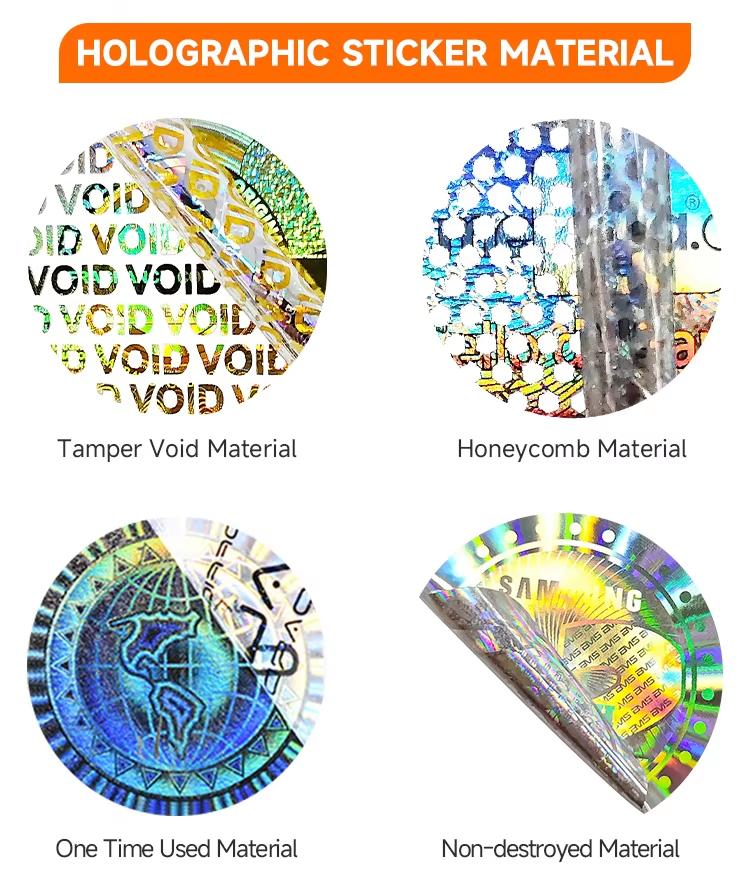
Pre-engineered tamper-evident films can show a standard VOID pattern when removed. They are often suitable when the primary requirement is visible evidence of opening, rather than a proprietary authentication design. Cost still depends on whether the construction leaves full transfer, partial transfer or no residue.
For a separate explanation of this product function, see Tamper-Evident Seals. That page should remain the destination for tamper-evidence technology; this article focuses on how that choice changes an RFQ and quotation.
Destructible Materials
Destructible films or papers fragment when removal is attempted. Brittleness, adhesive strength, label size, die-cut geometry and the substrate all affect performance. Very small labels with tight internal corners may require slower die-cutting and more careful waste control. This is a production consideration that should be checked before finalizing the die layout, not discovered after mass production.
Holographic Materials
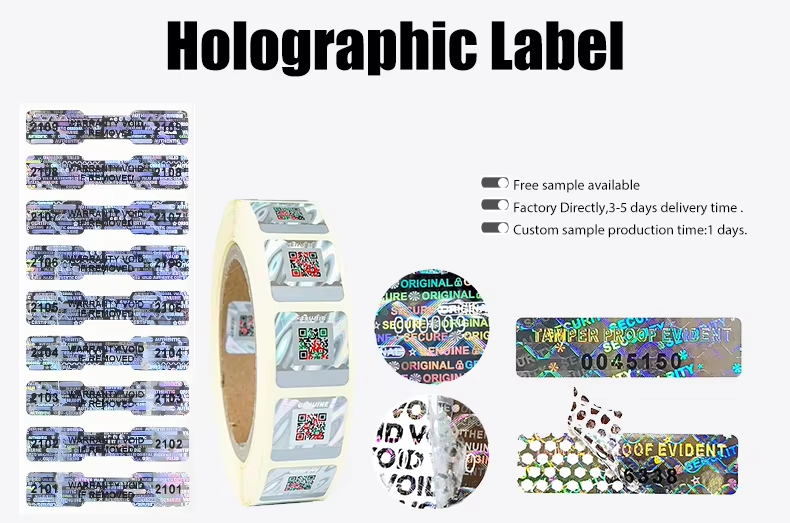
Stock holographic film and a custom holographic master are different cost categories. Stock film can avoid custom origination, while a proprietary logo, kinetic effect, microtext or registered optical feature may require one-time development and tooling.
That is why a quote for a printed label on stock holographic material should not be compared directly with a quote for a brand-controlled security hologram. Both may be described as a “hologram label,” but their development, control and repeat-order costs are different.
Adhesive and Liner
The adhesive must match glass, coated paperboard, metal, PET, PE, PP, textured plastic or another actual substrate. Low-surface-energy plastics, tight curves, cold application, condensation, oils and plasticizers can require a specialized construction. The release liner also affects die-cutting and automatic dispensing.
Before approving a material, provide a product sample or clear application photographs. A generic adhesion test on stainless steel does not prove performance on a curved PP cap, varnished carton or textured powder-coated part.
Why Custom Hologram Labels Cost More
Custom hologram label cost usually increases when the optical image itself is proprietary. A stock holographic pattern with printed branding is different from a custom master containing a controlled logo, microtext, kinetic effect or registered security area.
Ask the supplier to separate:
- optical design and origination;
- master, plate or tooling charges;
- holographic material and converting;
- additional printing, white ink or protective finish;
- inspection of the registered feature;
- repeat-order requirements when the design stays unchanged.
Do not assume that adding more visible effects automatically makes a product safer. The feature must have a defined verification method and fit the product’s threat profile. A security label program should combine the features that the brand, distributor or consumer can actually inspect.
For background on overt, hidden and covert authentication features, see WIPO’s overview of authentication technologies used to combat counterfeiting.
How Serialized QR Codes Affect Security Label Pricing
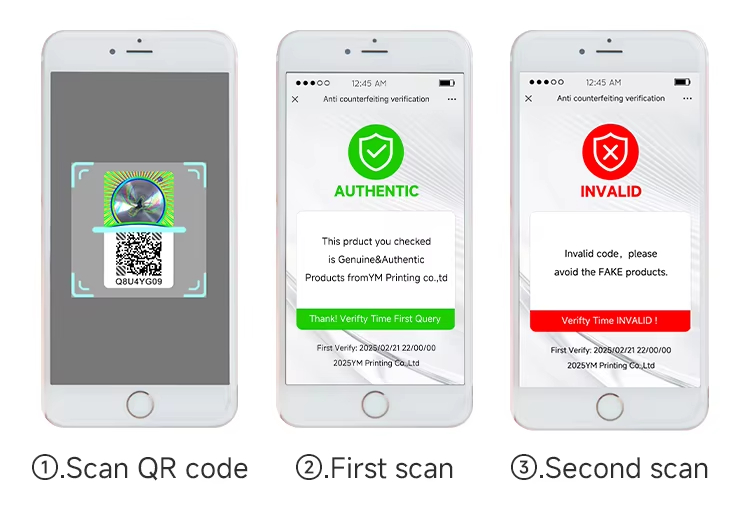
A printed QR code and a serialized authentication program are not the same product.
| QR option | What is printed | Cost and process implication |
|---|---|---|
| Repeated static QR | The same destination on every label | Basic print and scan testing |
| Sequential QR or serial number | Different code for each label | Data preparation, sequence control and inspection |
| Protected verification system | Unique code connected to a platform | Setup, hosting, scan rules, reporting and support |
The GS1 Digital Link standard and the current GS1 Digital Link URI syntax are useful references for connecting product identifiers to online information. A QR code or Digital Link does not, by itself, make a QR code an anti-counterfeit system. The program must also address copied codes, repeated scans, access control, invalid-code handling and customer support.
Before approving a serialized security label quote, confirm:
- who creates and owns the data;
- how duplicate codes are prevented;
- whether every printed code is inspected;
- what production reconciliation report is supplied;
- what happens to rejected labels and unused codes;
- whether hosting or software fees recur;
- whether the system can be transferred or integrated later.
For a product-authentication use case, link the commercial page to Custom Anti-Counterfeit QR Code Labels rather than repeating a full technology overview here.
How MOQ, Quantity and SKU Count Change the Unit Cost
Many setup activities are required whether an order contains 5,000 or 500,000 labels. As volume rises, fixed setup costs can be spread across more units. Material purchasing and press utilization may also become more efficient.
Total quantity is not the only number that matters. A buyer ordering 100,000 identical labels may receive a different quote from a buyer ordering 100,000 labels across 20 SKUs, languages or code sets.
Include these details in the RFQ:
- total project quantity;
- quantity per SKU;
- number of artwork versions;
- number of variable-data ranges;
- labels per roll or sheet;
- expected reorder frequency;
- whether future orders will reuse the same tooling.
Security Label MOQ: What to Ask For
Minimum order quantity depends on the construction and production method. Digitally printed labels using available materials may support a smaller pilot. Custom holographic origination, specialized films or high-volume converting may require a larger commercial quantity.
Instead of requesting only the lowest MOQ, ask for three quantity tiers:
- a pilot quantity for application and verification testing;
- the expected first production quantity;
- the forecast repeat quantity.
This shows where unit-cost reductions are meaningful and where ordering more would only create unnecessary inventory.
Why Two Suppliers Can Quote Very Different Prices
[IMAGE 3 — AFTER THIS H2: Security label quote cost breakdown]
Suggested visual: a branded quote comparison graphic showing tooling, material, printing, data, inspection, packing and freight.
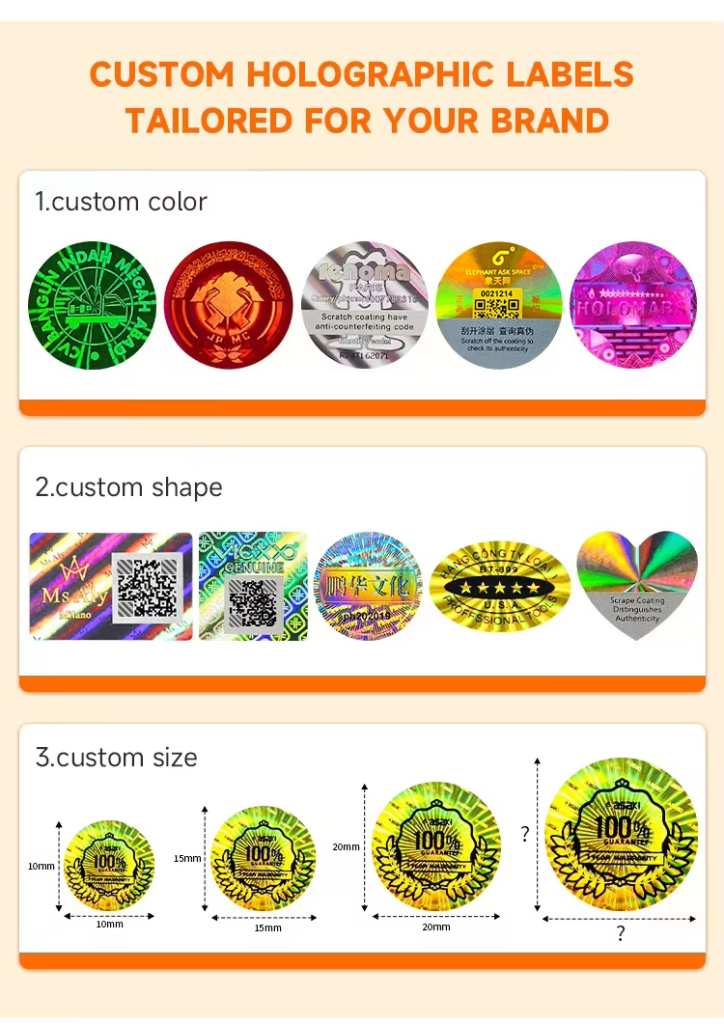
The following is an illustrative RFQ comparison, not a live GV Printing quotation. Replace it with a verified factory quote or anonymized customer case before publishing as a project result.
Option A: Standard Tamper-Evident Label
- 30 x 20 mm finished size;
- available tamper-evident film;
- standard permanent adhesive;
- one printed artwork version;
- no unique data;
- manual application;
- basic appearance and removal check;
- one standard die and repeat production.
Option B: Brand-Controlled Authentication Label
- 30 x 20 mm finished size;
- destructible or controlled VOID construction selected for the actual substrate;
- custom holographic origination;
- serialized QR code for each unit;
- protective finish and registered die-cut;
- automatic roll application;
- code reconciliation and application validation;
- separate tooling, inspection and export packing requirements.
Although the dimensions are identical, the production structure is completely different. Option B includes more development, data control, inspection, tooling and application risk.
The correct comparison is therefore not:
“Why is B more expensive?”
It is:
“Which requirements are included in B and absent from A?”
Use this comparison when a supplier’s quote is much higher than another’s:
| Quote line | Ask both suppliers |
|---|---|
| Material | Is the exact construction named? |
| Adhesive | Was it selected for the real substrate and temperature? |
| Security feature | Stock pattern or proprietary feature? |
| Printing | How many passes, inks and finishes? |
| Variable data | Static, sequential or platform-connected? |
| Tooling | Which dies, plates or masters are included? |
| Inspection | Is code, adhesion or tamper performance checked? |
| MOQ | Is the quantity per SKU clear? |
| Packing and freight | Are roll format, destination and Incoterm the same? |
How GV Printing Should Check a Security Label Before Quoting
The following is the quotation checklist to use with the production team. It is intentionally specific so the RFQ can move from specification → quote → sample → production without repeated assumptions.
- Finished dimensions and shape: confirm size, corners, die-cut and artwork position.
- Application surface: identify glass, paperboard, PET, PP, metal, coating and curvature.
- Adhesive requirement: record application temperature, storage conditions, moisture, oil, alcohol and expected service life.
- Protection mechanism: define tamper evidence, authentication, traceability, warranty control or diversion control.
- Security feature: select stock or custom hologram, VOID, destructible material, UV feature, serial number, QR or another verified mechanism.
- Variable data: confirm data source, code format, sequence, inspection and reconciliation.
- Roll or sheet format: confirm core, gap, unwind direction, label count and applicator requirements.
- Quantity and SKU mix: record total quantity, quantity per SKU, artwork versions and reorder plan.
- Validation: agree the sample, test method, acceptance criteria and report before mass production.
At GV Printing, this checklist should be completed with the actual product photograph, sample or component whenever the surface is curved, low-energy, cold, oily or otherwise difficult. The technical team must verify the available material, equipment, testing and data-service claims before this section is published as a description of current factory practice.
How Security Labels Are Validated Before Mass Production
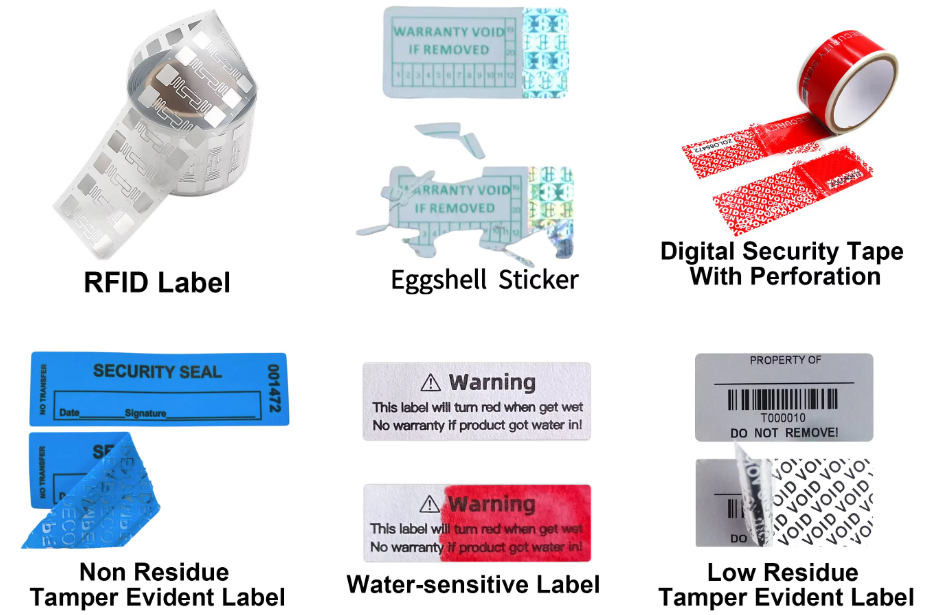
The correct test depends on the application. A useful validation plan may include:
- initial tack and final adhesion;
- visible VOID transfer or material destruction;
- removal attempts at different temperatures;
- exposure to condensation, oil, alcohol or cleaning chemicals;
- abrasion and scuff resistance;
- barcode or QR-code grading;
- code uniqueness and sequence reconciliation;
- roll dimensions and dispensing trials;
- aging after a defined storage period.
For a factory page, use real evidence here: a material sample board, application photographs, a short production video, an inspection record or an anonymized test report. Do not replace these with a generic stock illustration.
Authentication programs can also reference the current ISO 22383:2020 guidance for selecting and evaluating authentication solutions. ISO 12931:2012 has been withdrawn and replaced by ISO 22383:2020. The actual tests and acceptance criteria still need to be agreed for the individual project.
How to Reduce Security Label Cost Without Reducing the Protection Level
Cost reduction should remove unnecessary complexity, not the feature that controls the main risk.
Use a Risk-Based Feature Stack
Choose an overt feature, a tamper-evident mechanism and a digital layer only when the verification workflow can support them. Not every product needs every technology.
Standardize Sizes and Materials Across SKUs
Multiple products may share a label construction, die size or roll format while using different printed artwork or codes. Standardization can reduce tooling, material fragmentation and applicator changes.
Separate Pilot and Scale-Up Requirements
A pilot may use digital printing and a limited feature set to validate adhesion, scanning and workflow. After approval, higher-volume production may use a more efficient process. Confirm that the pilot construction is representative of the final product.
Plan Reorders
Forecasting repeat volume can help reserve material, retain approved tooling and establish a consistent quality standard. It also reduces emergency freight risk.
What Information Do We Need to Quote Your Labels?
Send the following with your inquiry:
- Product and industry;
- Main risk to control;
- Container or packaging surface material;
- Flat, curved or textured application area;
- Label size, shape and artwork;
- Required security features;
- Variable-data and verification requirements;
- Total quantity and quantity per SKU;
- Manual or automatic application details;
- Application, storage and service temperatures;
- Exposure to water, condensation, oil, alcohol, UV or abrasion;
- Roll or sheet specification;
- Sample deadline, production deadline and destination;
- Required tests, reports or certifications.
Photographs of the product, current label and application area are useful. For difficult surfaces, supply an actual container or component instead of relying only on a general material description.
Frequently Asked Questions
Can I get a price before the security-label design is finished?
Yes, but it will be a budgetary estimate. Provide the label size, quantity, surface, required security function and preferred features. The supplier should state which assumptions may change the final quote.
Why do custom hologram labels have an origination charge?
A proprietary holographic image may require development of a controlled optical master. This differs from printing a logo over stock holographic film. Ask whether the quote uses a stock pattern or a unique brand-controlled design.
Does adding a QR code always make the label expensive?
Not necessarily. Printing one repeated QR code differs from printing unique codes connected to a protected database. Data generation, inspection, reconciliation, hosting and support can add cost beyond the physical print.
Is the lowest security label MOQ the best option for a new product?
It can reduce initial inventory, but it may carry a higher unit cost. Compare a pilot quantity with two production tiers and include one-time tooling or platform costs.
Can one label construction work on every product surface?
No. Adhesion and tamper evidence change with surface material, coating, curvature, temperature and contamination. Test the proposed construction on the actual product before mass production.
What should be retained for repeat orders?
Keep the approved artwork, construction specification, color standard, code rules, roll format, signed sample, test method and inspection record. Confirm which tooling and digital assets the supplier will retain.
Request a Security Label Quote
Custom security labels cost can only be compared fairly when each supplier is pricing the same protection level, construction, data workflow and delivery format. Start with the risk the label must control, then document the application surface, quantity, security features, inspection requirements and shipping destination.
Buyer Questions Before Requesting a Security Label Quote
A comparable quote needs the same dimensions, material, finish, quantity, artwork status, packaging format and destination. Missing details often create avoidable revisions.
What information should be included in the quote?
Provide finished size, material, quantity, artwork status, application surface, destination and required delivery date. For security products, also specify the verification method and whether serialized data is needed.
How are MOQ, price and lead time determined?
Quantity, print process, tooling, finishes, testing and freight all affect the total. Approving artwork and material early is the fastest way to protect the requested ship date.
Can you supply samples and help with compliance?
Request a physical pre-production sample on the intended substrate. Confirm applicable food-contact, recycling, barcode or market requirements for the US and EU before mass production.
Related Guides
- Custom Security Labels Overview — the full feature landscape: overt, covert and digital tiers behind every quote line.
- Custom Hologram Stickers Guide — hologram origination, construction and EU compliance — the most-quoted security feature.
- How Custom Security Labels Are Made — the factory process behind your quote: origination, die-cutting, and QC.
- Anti-Counterfeit QR Code Labels — serialization and verification infrastructure — the digital line item in modern quotes.
- Tamper Evident Seals — seal and void-label options often bundled into security label programs.
Ordering, MOQ and Lead Time Questions
What is the MOQ for custom security labels?
Feature-dependent: overt features (custom holograms, color-shifting ink) typically carry an origination or plate cost with MOQ around 5,000–10,000 labels; serialized QR labels need digital printing, which starts lower — around 1,000–3,000 units — plus data-service setup. Quote two scenarios: minimum viable quantity and your annual forecast; the price gap between them usually justifies a larger first order.
How long do security labels take to produce?
First orders run longer than standard labels because origination and covert-feature masters must be produced and approved: plan 2–3 weeks for sampling and 10–15 working days for mass production. Reorders of an unchanged design skip origination and run at standard label lead times. Serialized programs add database setup on first orders only.
Can I get serialized variable data on my labels?
Yes — digital presses print unique QR codes, serial numbers, or both per label at production speed. Specify what each code must contain (URL pattern, serial format, any encrypted payload), how codes map to your verification platform, and whether human-readable serials must match a layout. This is the digital tier of a security program — see the QR label guide above.