
Send Your Inquiry Today
Anti-Counterfeit Labels: Hologram vs Void vs Serial 2D Code — A Buyer’s Selection Guide
Contents
- What changed: why the choice matters now
- Who needs anti-counterfeit labels
- The three anti-counterfeit label technologies
- Who checks what: the verification workflow
- What anti-counterfeit labels mean for your pack
- How we produce anti-counterfeit labels
- Illustrative scenarios
- Spec table you can copy into an RFQ
- Download: selection matrix
- FAQ
- Related solutions
As of October 2026. A counterfeit cosmetics jar can look convincing on the shelf. A refilled spirits bottle can pass a quick glance. In both cases the damage is not one lost sale — it is the brand trust that took years to build. So the honest answer to “do anti-counterfeit labels stop fakes?” is: not on their own, and no responsible supplier should claim otherwise. But the right label makes copying harder, checking faster, and tampering obvious.
The mistake most buyers make is treating a hologram, a void seal, and a serial 2D code as the same thing. They are three different jobs. Prescription medicines have mandatory rules that force the choice; for everything else, the threat profile — not the product category — should drive the spec. This guide walks through the threat first, the technology second, and the verification workflow third, because a feature that nobody checks is only decoration.
What changed: why the choice matters now
For years “add a hologram” was a branding afterthought. That has changed because three rule sets now push the decision onto the pack itself:
- US DSCSA (Drug Supply Chain Security Act) — applies to prescription medicines. It requires an interoperable, package-level product identifier and transaction tracing. The baseline enforcement date was 27 November 2023, with a stabilisation period through 27 November 2024; the FDA later extended certain trading partners (small pharmacies) to 27 November 2026, which is now approaching. The product identifier is a 2D Data Matrix encoded to GS1 standards — not a QR code. FDA DSCSA implementation
- EU FMD — Delegated Regulation (EU) 2016/161 — applies to prescription medicines. It makes a unique identifier (2D Data Matrix) plus an anti-tampering device on the pack mandatory since 9 February 2019. The US DSCSA does not require an anti-tampering device; the EU FMD does. EUR-Lex (EU) 2016/161
- GS1 Sunrise 2027 — by the end of 2027, retail POS should read 2D barcodes (QR or Data Matrix) carrying a GS1 Digital Link, so one code can do both checkout and consumer engagement. Brands preparing artwork in 2026 should print the 2D code now, not in a second re-tooling. GS1 Sunrise 2027
On top of these, ISO 12931 is a voluntary performance standard, not a regulation. It gives a shared vocabulary for authentication features — overt (visible), covert (hidden, inspectable with simple tools), and forensic (laboratory-level) — so buyers and suppliers can brief each other without ambiguity. The practical effect: the “which anti-counterfeit label” question is now a specification question, not a decoration question. This article is general guidance, not legal advice; regulation dates and scopes shift with implementing acts — verify the current text on the official sources linked above before you specify.
Who needs anti-counterfeit labels
The risk profile — not the product category — should drive the spec. Buyers we hear from most:
- Prescription pharmaceuticals — need GS1 Data Matrix serialisation for DSCSA / EU FMD, plus an anti-tampering device for the EU market.
- Spirits, wine & luxury — fight grey-market diversion and refilling; want a visible brand feature plus irreversible proof of opening.
- Electronics & auto parts — warranty fraud and reuse of genuine labels on fakes; want a destructible material that cannot be lifted intact.
- Cosmetics & supplements — want brand recognition and a quick visual check staff can perform. Supplements are not covered by DSCSA or EU FMD; any serialisation here is voluntary brand protection.
- Cross-border e-commerce — want a recognisable security mark plus traceability back to the genuine batch.
Start by naming the real threat: an outright fake, grey-market diversion, refilling, unauthorised opening, or warranty fraud? Who checks — a consumer, a retailer, a QC engineer? What surface — glass, coated carton, low-surface-energy plastic, powder-coated metal? The answers shape the technology, not the other way round.
The three anti-counterfeit label technologies
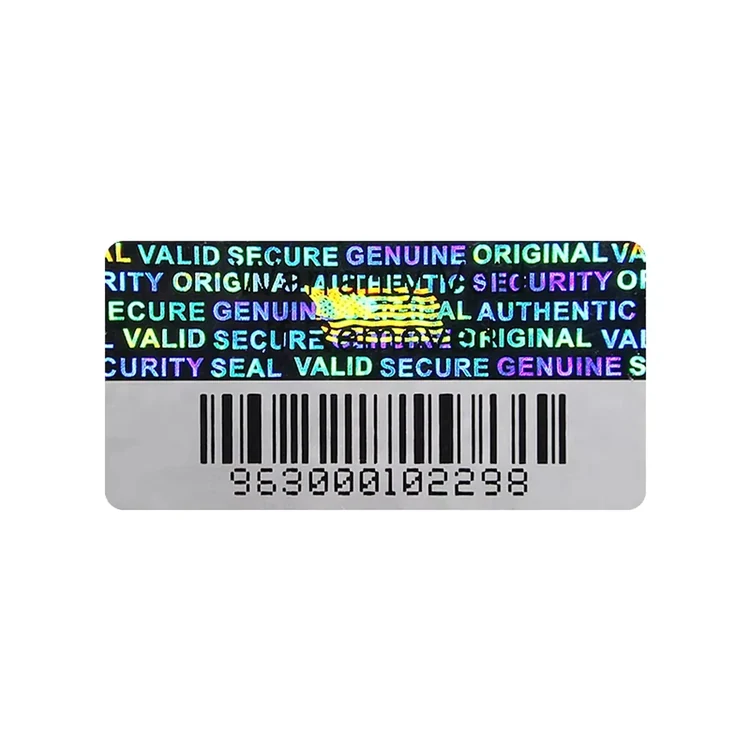
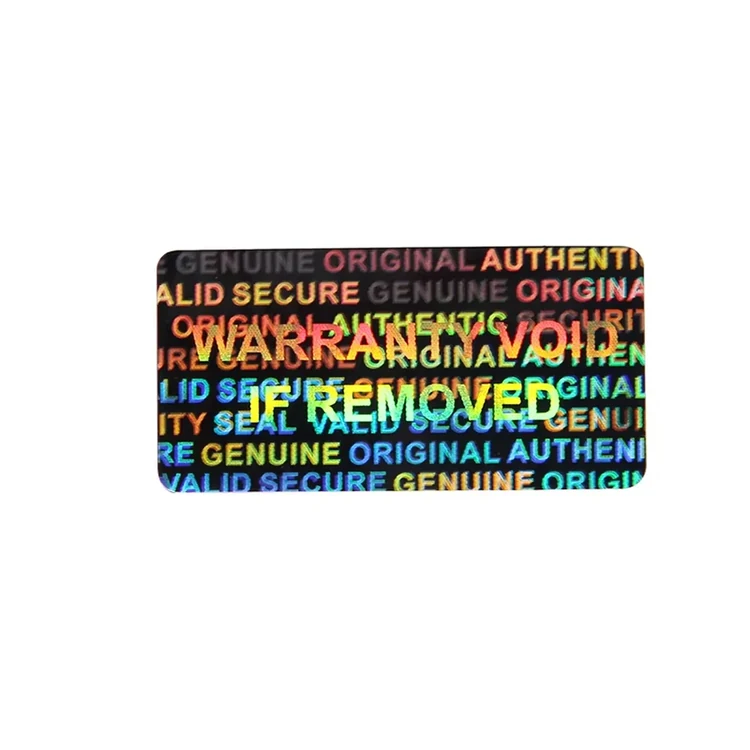
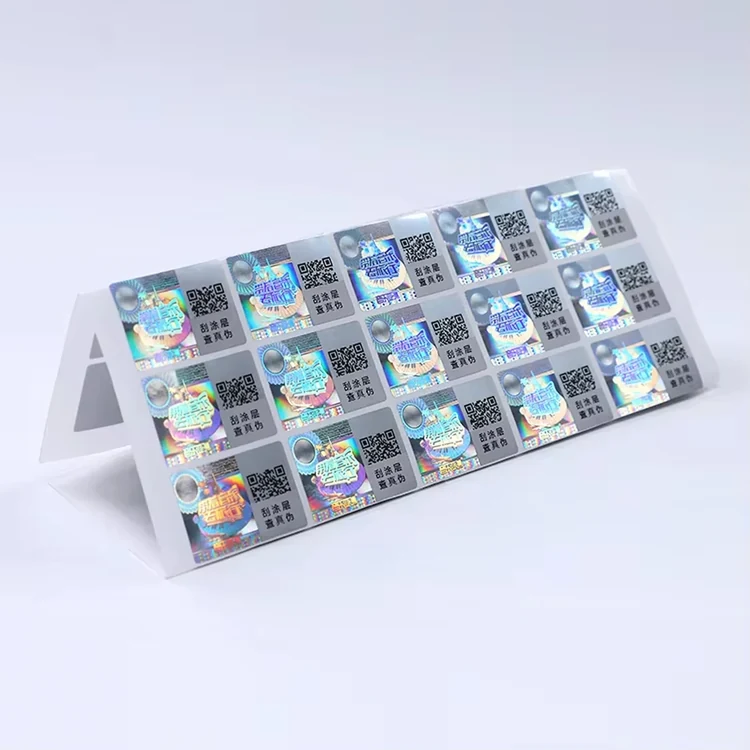
Think of the three options as three different jobs, not three flavours of the same sticker.
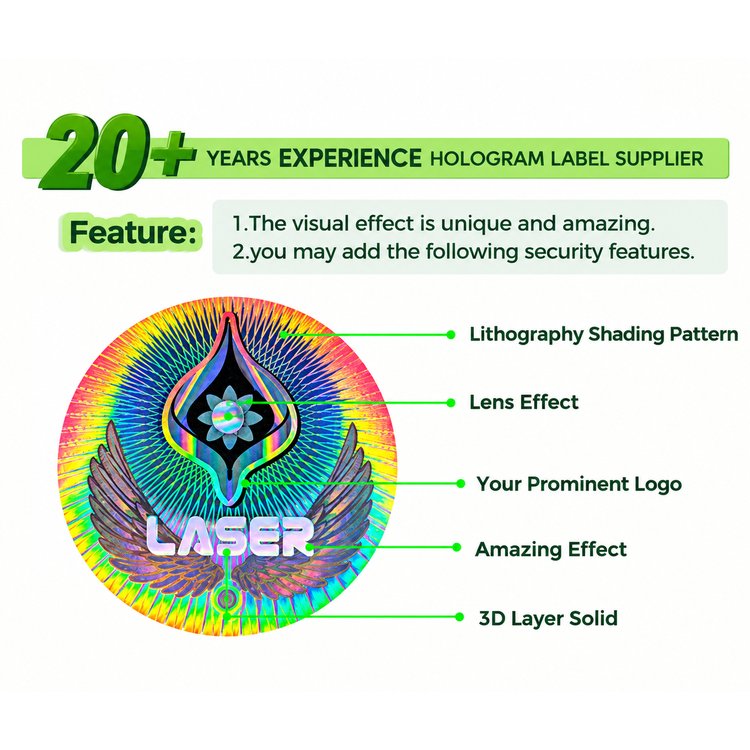
- Hologram (optical security). A custom-embossed image that shifts, shows depth, or animates as you tilt it. Its job is visual deterrence and brand identity — a copied flat sticker is easy to spot. It is weak alone against a determined counterfeiter who can buy stock holograms, so it must be bespoke (your artwork, your master plate). Bespoke tooling raises the difficulty and cost of copying.
- Void / tamper-evident (material security). A destructible or VOID PET material that, when lifted, leaves a “VOID” message on the pack and self-destructs on the label. Its job is irreversible proof of opening — once tampered, everyone can see it.
- Serial 2D code (data security). A unique, scannable code per item, usually printed by variable-data printing and linked to a database. For consumer engagement the code is often a QR; for prescription-medicine traceability the regulators require a GS1 Data Matrix. Its job is traceability to the single unit — it answers “is this the genuine batch?” when a scanner or backend system checks it.
None replaces the others. A spirits brand typically wants hologram + void. A prescription-pharma pack needs Data Matrix + EU FMD anti-tamper. An electronics seal wants destructible + serial. The selection is a combination, and the combination is what the rest of this guide helps you build.
Who checks what: the verification workflow
The most overlooked part of an anti-counterfeit programme is the check itself. A feature that nobody verifies is only a decoration. Match the technology to who will actually look at it:
- Hologram — checked by eye, supported by training. The consumer or retailer tilts the pack and compares it to a reference image. For higher confidence, add a covert feature (UV fluorescence or micro-text) that only trained staff or your own QC verifies. This only works if your team publishes the genuine reference and trains the channel.
- VOID — checked at opening. The end user, pharmacist, or warranty desk sees the broken seal or the “VOID” residue left on the pack. No database is needed, but the check only happens once — when the pack is first opened.
- Serial 2D code — checked by scanner + backend. A pharmacist, customs inspector, or consumer app scans the code and your server returns yes/no/location. The label itself is only the carrier; the protection lives in the database, aggregation, and response workflow. We print the carrier to spec and verify readability; the database and response protocol are your system or your software partner’s.
Before you specify, ask: Who is trained to check? What device or app do they use? What happens when the check fails? If you cannot answer the last two, shrink the spec to what you can actually operate.
What anti-counterfeit labels mean for your pack
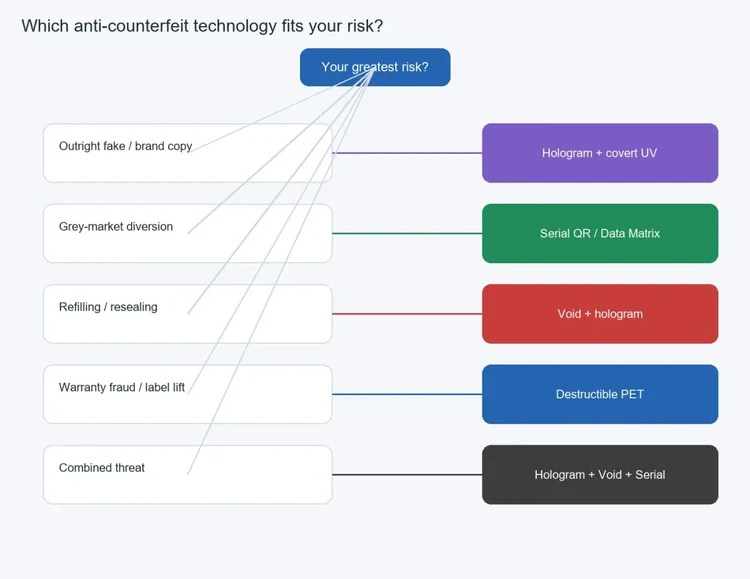
This is the part most supplier blogs skip: mapping the risk to the feature, and the feature to the rule. Use this as your working table.
| Greatest risk | Recommended technology | Why | Standard / regulation touchpoint |
|---|---|---|---|
| Outright fake / brand copy | Hologram (bespoke) + covert UV | Visual + hidden check only your team can verify | ISO 12931 authentication-feature categories |
| Grey-market diversion | Serialised Data Matrix + backend traceability | Unit-level track-and-trace back to authorised batch and market | DSCSA (prescription drugs); brand-owned traceability system |
| Refilling / resealing | Void + hologram across closure | Irreversible proof the pack was opened | EU FMD anti-tampering device (prescription drugs) |
| Warranty fraud / label lift | Destructible (egg-shell) PET | Label shatters on removal, cannot be reused | — (brand protection) |
| Combined threat | Hologram + Void + Serial 2D code | All three jobs at once | DSCSA / EU FMD + ISO 12931 |
Two practical rules we give every buyer: (1) overt before covert — put one feature a warehouse clerk can check in two seconds, and a second feature only authorised staff verify; (2) match the material to the surface — a VOID film that works on coated carton can fail on powder-coated metal, and a destructible paper that is fine indoors can weaken in humidity. The substrate decision is where most “secure” labels actually fail.
How we produce anti-counterfeit labels
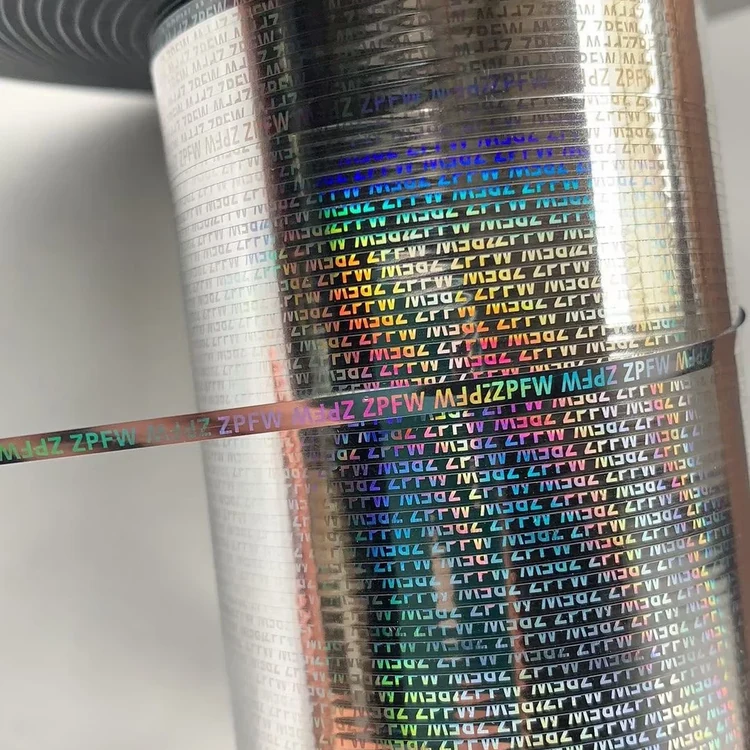
As a converter, our job is to turn the spec above into a label that survives the real world. The production route differs by technology.
Hologram: custom master, not stock
We produce bespoke holograms from your artwork using master-plate tooling registered to your job. Storage or destruction of the master can be agreed in writing so the same design is not re-ordered by a third party. Features we can embed: micro-text down to ~0.2 mm (a covert feature readable with magnification, not a forensic-lab feature), hidden images visible only at a tilt angle, and 3D / kinetic effects that are hard to reproduce without the original master. Hot-stamping or embossing is chosen by substrate and run length.
Void & destructible: the chemistry of evidence
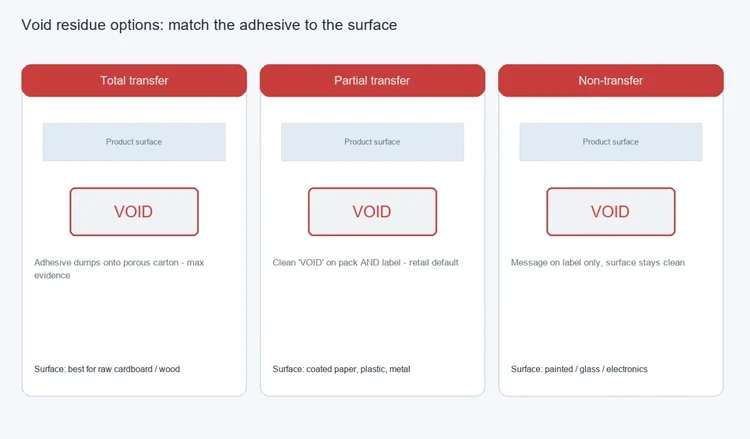
For tamper evidence we select the residue behaviour to the surface: total transfer (adhesive dumps onto porous cardboard — maximum evidence), partial transfer (a clean “VOID” on both pack and label — the retail default), or non-transfer (message stays on the label only, surface left clean — for painted or glass assets). Destructible “egg-shell” paper is a low-cost option for indoor warranty seals but weakens in humidity, so we steer it away from shipping cartons.
Serialised 2D code: print to spec, not to guess
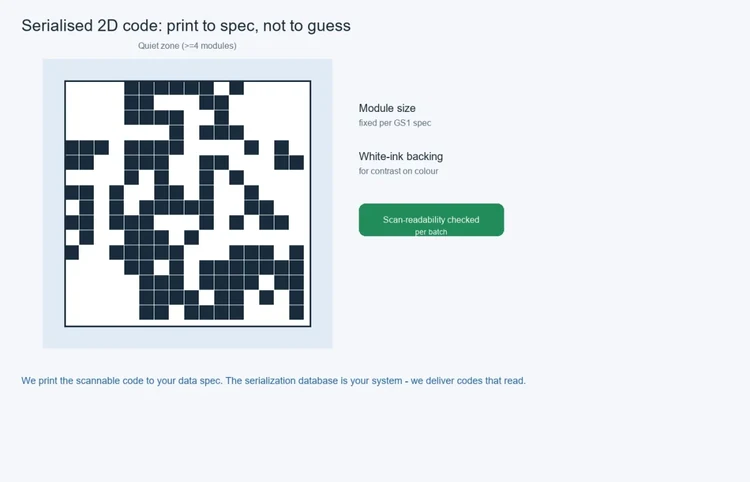
Serialized codes are printed on our variable-data press from your data file. For medicine packs this is a GS1 Data Matrix; for consumer engagement it can be a QR or QR/Data Matrix carrying a GS1 Digital Link. We add the quiet zone and a white-ink backing where the substrate needs it so the contrast passes a scanner. We run a scan-readability check on every serialized batch. One boundary we are clear about: we print the scannable code to your specification and verify it reads; the serialization database, aggregation, and response workflow are your system or your software partner’s. We deliver codes that read — we do not operate the traceability platform.
Across all three, application method decides the convert: roll form for high-speed auto-apply, sheet form for hand-apply. Liner stiffness and die-cut geometry are matched to your line so you avoid downtime. Before any production run we recommend a sample test on the actual pack.
Illustrative scenarios
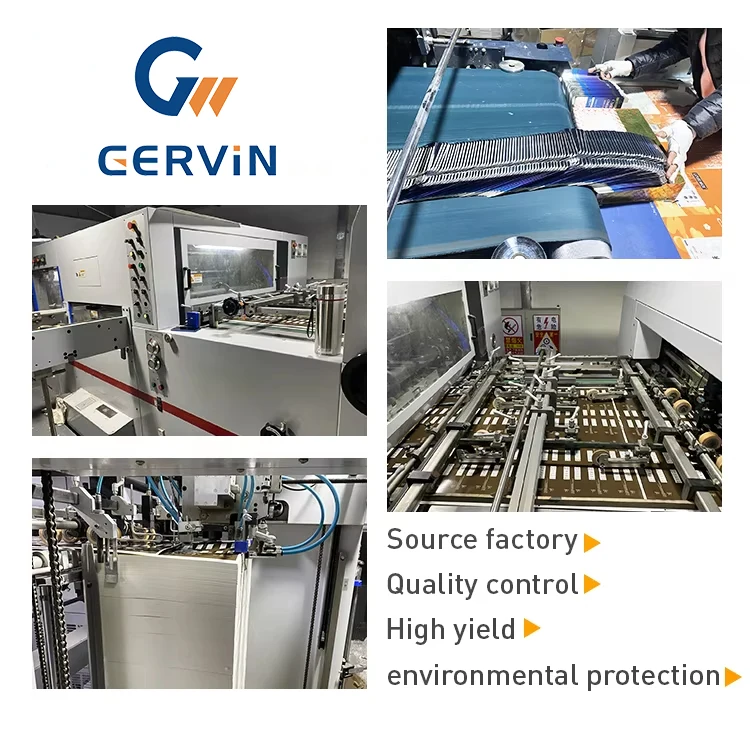
The following are composite examples built from common briefs, not specific customer orders.
Spirits brand fighting refilling. A mid-size spirits exporter saw genuine bottles returned full of counterfeit liquid. We combined a bespoke hologram across the cap with a partial-transfer VOID seal on the closure. Any removal left a permanent “VOID” residue on the bottle neck, while the seal itself shattered and could not be re-applied. The visible hologram also became the in-store check their retailers were trained to perform.
Electronics importer fighting warranty fraud. A brand found its warranty stickers being lifted and re-used on refurbished units. We switched them to an egg-shell destructible label with a serialised Data Matrix printed over a white-ink backing. The label fragmented on removal, and the per-unit code let the warranty desk reject duplicate claims.
Cosmetics brand on a controlled distribution. A skincare line sold through authorised salons wanted consumers to verify authenticity without a database. We used a bespoke hologram with a covert UV logo and printed a short reference guide on the packaging. Salons were trained to tilt the pack under light; any flat sticker was immediately suspect.
Spec table you can copy into an RFQ
| Attribute | Hologram | Void / destructible | Serial 2D code |
|---|---|---|---|
| Primary job | Visual deterrence + brand | Proof of opening | Unit traceability |
| Best for | Spirits, cosmetics, brand marks | Closures, warranties, electronics | Pharma, diversion control |
| Substrate | PET / foil, hot-stamped | VOID PET / egg-shell paper | Coated paper / PET, VDP |
| Covert option | Micro-text, UV, hidden image | — | Signed or encrypted serial payload (decoded by your server) |
| Regulation fit | ISO 12931 | EU FMD anti-tamper (prescription drugs) | DSCSA / EU FMD (prescription drugs); GS1 Sunrise 2027 |
| Typical MOQ | From 5,000 pcs (master setup) | From 1,000 pcs | From 3,000 pcs (VDP setup) |
MOQs depend on size, substrate, and finishing. Use these as planning numbers, not commitments; confirm in the quote.
Download: selection matrix
To make the choice concrete, we built a one-page Anti-Counterfeit Label Selection Matrix (XLSX): pick your industry and greatest risk, and it returns the recommended technology combination plus the compliance touchpoint and the exact spec lines to put in your RFQ. Download the selection matrix or request a scan-readability pre-check of your artwork — send us the pack and the threat you are defending against, and we will spec the combination rather than sell you a stock sticker.
FAQ
Do hologram stickers actually prevent counterfeiting? They deter and slow it, and they make fakes easier to spot — but a stock hologram anyone can buy proves nothing. A bespoke hologram tied to your master plate raises the difficulty and cost of copying. Treat it as one layer, not the whole defense.
What is the difference between holographic labels and security labels? “Holographic” describes the optical effect; “security” describes the job. A holographic label can be a security label when it is bespoke and paired with tamper or serial features — but a generic stock hologram is decoration, not security.
Which industries use tamper evident labels? Pharmaceuticals (anti-tampering device under EU FMD for prescription medicines), spirits and wine (refill defense), electronics (warranty seals), and any brand shipping high-value goods through long supply chains.
Serial number, QR code, or Data Matrix — what is the difference? A serial number is data; a QR code or Data Matrix is the machine-readable carrier. A serial number can be unique, but a human-readable number alone is slow to check at scale. A Data Matrix or QR encodes that serial (and more) so a scanner can read it instantly. For prescription-drug traceability the regulators specify a GS1 Data Matrix. Both a scannable code and a human-readable serial can appear on the same pack.
Can one label combine hologram + void + serial 2D code? Yes, and for combined-threat products it is the standard answer. We print the bespoke hologram, the VOID layer, and the serialized 2D code on one convert, matched to your surface and apply method. The exact code type and data format follow your traceability-system spec.
Related solutions
Dig deeper into the building blocks: our certificate-of-authenticity hologram stickers, the security label factory walkthrough, and tamper-evident seals. For the full background, see the ultimate guide to custom anti-counterfeit printing. Browse the hologram sticker category or talk to our team about your pack and threat profile.
General guidance only, not legal advice. Regulation dates and scopes change with implementing acts — confirm the current text on FDA, EUR-Lex, GS1, and ISO before specifying. This page links to official sources for that reason.
Related guide: Want the compliance detail behind VOID and destructible materials? Our full guide to tamper-evident labels for FDA 21 CFR 211.132 and EU FMD 2016/161 covers how a converter prints them to spec.