
Send Your Inquiry Today
2D Barcodes for Food and Pharmaceutical Packaging: The 2027 Traceability Checklist

As of October 2026. This guide explains retail scanning, US food traceability and pharmaceutical serialization rules for general information. It is not legal advice. Deadlines and enforcement policies shift through implementing acts and agency rulemaking — confirm current values with GS1, the FDA or your compliance lead before you file.
Contents
- What Changed: Three Rules Now Touch Your Pack
- Who Has to Act
- What a 2D Code Means for the Food & Pharma Label
- QR Code vs Data Matrix: Food and Pharma Picks
- How We Produce the Print Side
- A Practical Food-Packaging Change
- Food & Pharma 2D Barcode Spec Table
- Download the Checklist
- The 2027–2028 Traceability Timeline
- FAQ
What Changed: Three Rules Now Touch Your Pack
This guide covers 2D barcodes for food and pharmaceutical packaging from a printer’s perspective. They sit at the intersection of three separate rulebooks. Those rulebooks do not all work the same way, and only one of them is a true government print mandate.
- GS1 Sunrise 2027. The retail commitment that point-of-sale scanners must read 2D barcodes — QR built to the GS1 Digital Link standard and GS1 Data Matrix — alongside the 1D UPC/EAN. The target is the end of 2027. No government fines a missing 2D code on 1 January 2028; the pressure is commercial, from the retailers that control shelf space. GS1 publishes the transition guidance and the roster of supporting retailers on its Sunrise 2027 resource.
- FDA FSMA 204 (US food). The FDA Food Traceability Rule is a recordkeeping rule, not a print mandate. It applies to foods on the FDA Food Traceability List — items such as certain fresh-cut produce, leafy greens, melons, peppers, tomatoes, fresh herbs, sprouts, soft cheeses, shell eggs, nut butters, finfish, crustaceans and ready-to-eat deli salads. Congress directed the FDA not to begin enforcement before 20 July 2028. Most dietary supplements are not on the Food Traceability List and fall under their own 21 CFR Part 111 CGMP lot-traceability rules instead.
- EU FMD and US DSCSA (pharmaceutical). These are genuine legal serialization mandates. Delegated Regulation (EU) 2016/161 has required a unique 2D Data Matrix plus an anti-tampering device on prescription-medicine packs in the EU since 9 February 2019. The US Drug Supply Chain Security Act requires package-level tracing; enhanced electronic, interoperable requirements took effect on 27 November 2023, with a stabilization period that ran until 27 November 2024. The FDA later granted phased exemptions for certain trading partners, including small dispensers with 25 or fewer full-time pharmacy employees, until 27 November 2026.
The practical line for a food or pharma brand: open the artwork once, and design the 2D code so it can serve retail scanning and sector traceability without a second reprint inside eighteen months. For the food side, that is a smart scheduling decision; for prescription pharmaceuticals, the Data Matrix is already a legal fact on EU packs and a tracing requirement in the US supply chain.
Who Has to Act
The obligations are not the same for food and pharmaceuticals, so it helps to split them. The first question is whether 2D barcodes for food and pharmaceutical packaging are a commercial choice, a recordkeeping aid or a legal serialization mandate.
Food and beverage packs
No government agency currently forces a 2D code onto food packaging. The pressure comes from two places:
- Retail readiness. Sunrise 2027 is a retailer commitment. The brand owner — the name on the pack — is the party that needs to plan the artwork change and flow it down to co-packers, importers and contract manufacturers.
- FSMA 204 recordkeeping. If you manufacture, process, pack or hold foods on the FDA Food Traceability List, you must keep electronic traceability records with Key Data Elements at Critical Tracking Events. You do not have to print the traceability lot code on the pack, but carrying lot and date data in a 2D code is one way to make retail and traceability demands coexist in the same artwork.
Any “recyclable,” “eco” or “sustainable” wording on the pack also meets the Empowering Consumers Directive ((EU) 2024/825), applicable from 27 September 2026, which restricts generic green claims. Our PPWR labelling guide covers that copy layer separately.
Pharmaceutical packs
Here the obligation is regulatory. Marketing authorisation holders, manufacturers, repackagers, wholesale distributors and dispensers in the EU and US must handle serialized product. For a printer, the job is usually not to print the live serial number itself — that is normally applied on the customer’s packaging or labelling line with inkjet, laser or thermal transfer to keep the serial database under the manufacturer’s control — but to make sure the carton, leaflet or label we pre-print leaves the right blank area, quiet zone, contrast and substrate so the serialized Data Matrix can be added cleanly and read reliably.
What a 2D Code Means for the Food & Pharma Label
General placement, sizing and quiet-zone rules for Sunrise 2027 are covered in our Sunrise 2027 guide. For food and pharmaceutical packaging, the special issues are the data payload and the physical constraints of the pack.
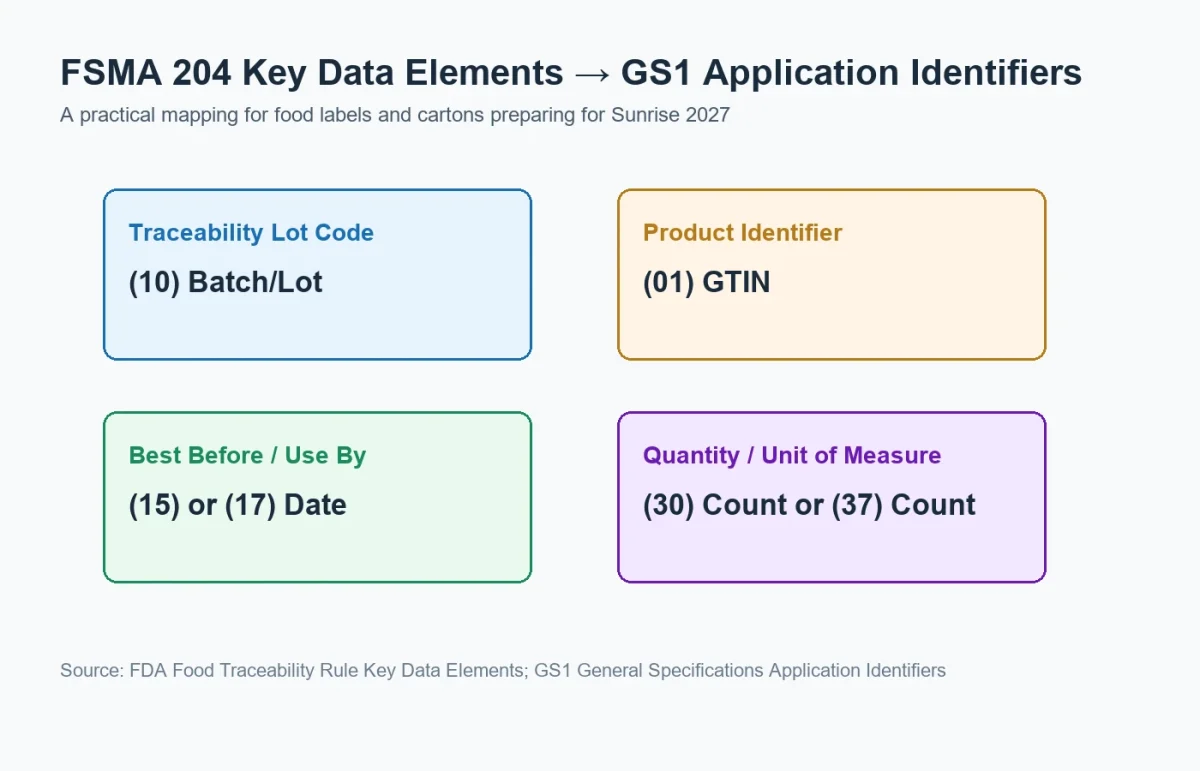
Food: map traceability fields to GS1 Application Identifiers. FSMA 204 requires Key Data Elements at Critical Tracking Events. The traceability lot code is the bridge. In a 2D code, that maps to GS1 Application Identifiers such as (01) GTIN, (10) batch/lot and (15) best-before or (17) expiry. The code can live on the retail panel next to the EAN-13, so one scan can feed both the checkout lane and a traceability lookup. Keeping the lot code in the same symbol as the GTIN is one practical way to align retail scanning and traceability records, but it is not the only way to satisfy FSMA 204.
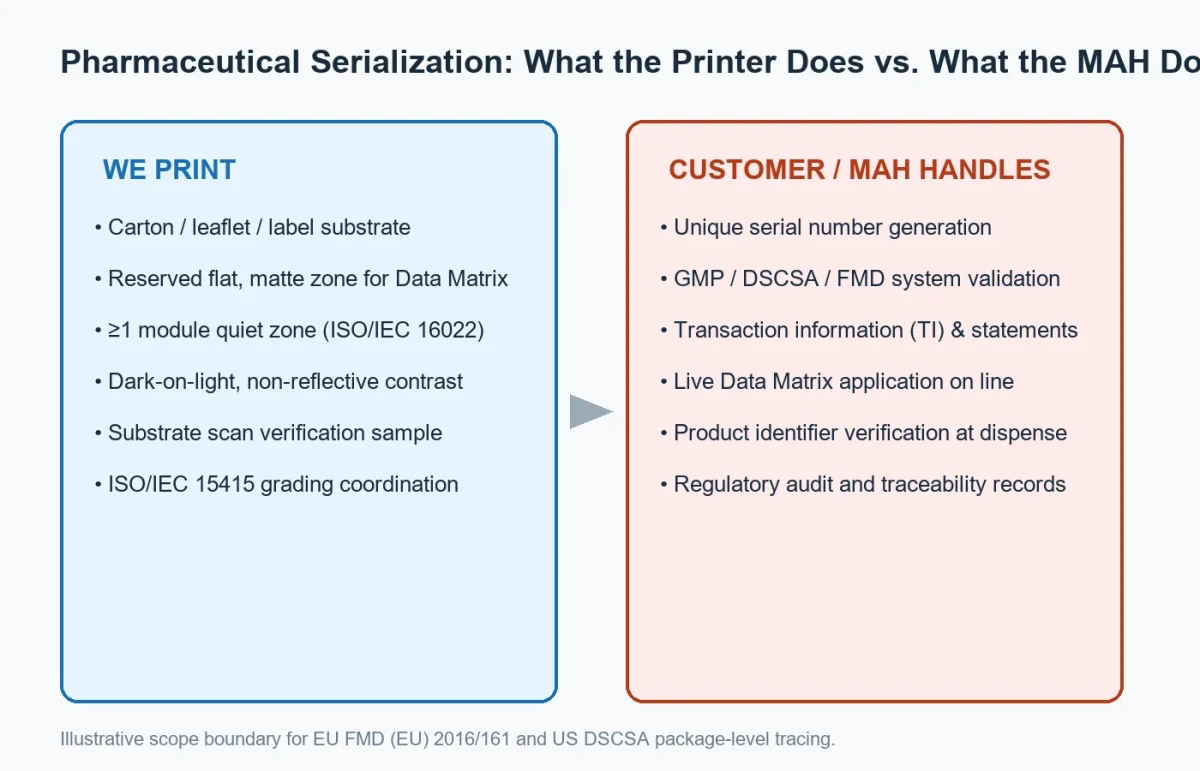
Pharma: reserve a machine-readable area, do not claim the serialization step. A prescription carton or label needs a flat, low-glare area for the Data Matrix, with a quiet zone of at least one X-dimension on all sides per ISO/IEC 16022. The substrate must not reflect the scanner flash, and coatings must not bleed into the modules. We verify the pre-printed carton or label on the actual material so the customer’s serialization line can add the unique identifier and grade it reliably. We do not hold pharma GMP certification and we do not perform live pharmaceutical serialization; we supply the print-ready carrier that the customer’s qualified line completes.
Contrast and substrate. Scanners read reflectance, not brand palettes. Dark modules on a light background — process black on white is safest — win. On foil, metallised film or glossy varnish the symbol must sit in a matte, non-reflective field. Flexo on corrugate or unbleached kraft needs a larger module than a coated label because fibre variation breaks small cells. None of this is exotic, but it is the difference between a code that scans at speed and one that throws manual overrides at the lane.
QR Code vs Data Matrix: Food and Pharma Picks
Two formats are approved for Sunrise 2027, and the choice is driven by how the code will be used. This is the main technical fork for 2D barcodes for food and pharmaceutical packaging.
QR Code with GS1 Digital Link URI is the consumer- and retail-facing default for food and beverage: a shopper’s phone reads it natively, and the same code can carry GTIN, batch, lot and best-before. It works best on flat or gently curved panels.
GS1 Data Matrix is the compact, machine-first option for pharmaceuticals — small enough for unit-dose vials and tiny carton faces, built for serialized track-and-trace rather than shopper engagement. Its payload follows GS1 Application Identifiers: (01) GTIN, (21) serial, (10) batch and the relevant date fields.
The physical split matters. A curved bottle or jar for food usually takes a QR, and GS1 UK guidance sizes retail QR codes at roughly 15 × 15 mm on a flat panel and larger on a curved surface so the quiet zone survives the wrap. A small vial or ampoule for pharmaceuticals takes a Data Matrix because the symbol can be printed very small while remaining readable by machine; the module size follows ISO/IEC 16022 and is graded on the real substrate, not a nominal dimension. Both formats can meet the 2027 retail capability target; the decision is about footprint, scanning environment and whether a smartphone scan is the primary use case.
How We Produce the Print Side
When we prepare 2D barcodes for food and pharmaceutical packaging, the first decision is whether the customer will add the variable data on their line or whether we add it during print. Our workflow depends on whether the project is food or pharmaceutical.
Food labels and cartons
When we produce 2D barcodes for food and pharmaceutical packaging, we validate the GTIN check digit and the GS1 Application Identifiers before generating any symbol, because a wrong check digit points to the wrong product at scale. We then print the code with variable data printing (VDP) — digital or serialized toner/inkjet — so each label or carton can carry a unique lot, batch or expiry rather than one static image. We hold the module (X-dimension) in the 0.4–0.99 mm range for POS scanning and verify the result on the actual substrate — paper label, coated carton, kraft bag or corrugated board — not a laser proof. Ink and coating are selected so they do not bleed or gloss over the symbol, and we run a verification scan on a production sample before the run is released. Where a customer needs a formal ISO/IEC 15415 grade report, we coordinate certified verification alongside the print run.
Pharmaceutical cartons, leaflets and secondary labels
We treat these as a reserved-zone print job. We pre-print the carton or label with a matte, low-glare area sized for the Data Matrix, keep a quiet zone of at least one X-dimension, and avoid folds, embossing, foil stamping and glossy varnish inside that zone. We then verify the blank area on the actual substrate so the customer’s serialization line can add the unique identifier and grade it. The live serial number, transaction information and database integration remain the customer’s responsibility under their GMP and DSCSA/FMD systems.
That verification step — on the real material — is the single most overlooked item in 2D-code preparation, and it is the reason a “looks fine on screen” code fails at the lane or at the pharmacy scan point. Where a claim depends on the substrate, we source from certified mills and can relay the mill’s certificate number and batch documentation where the supplier provides it; we do not hold our own FSC Chain-of-Custody and do not print the FSC trademark — the certificate travels with the paper, not with us.
A Practical Food-Packaging Change
The following is an illustrative scenario, not a specific customer order. A ready-to-eat salad brand with a six-SKU range sold into US retail needed to prepare for both Sunrise 2027 and FSMA 204. The product sits on the FDA Food Traceability List because it is a fresh-cut, ready-to-eat product.
We reworked the primary carton and label so a GS1 Digital Link QR sat within 50 mm of the EAN-13 on the back panel, embedded the GTIN, lot and best-before in the 2D payload, and kept the module at 0.6 mm verified at grade B or better on the coated board. We left a non-reflective, uncoated quiet zone and kept the symbol away from the carton fold. The change was one plate revision per SKU, scheduled into the normal reorder cycle. The brand now has one artwork that serves retail scanning and traceability records without a second reprint.
The lesson holds broadly for food on the FTL: design the 2D code once, place it next to the 1D barcode, and encode the traceability lot data at the same time. The same lesson applies to 2D barcodes for food and pharmaceutical packaging: open the artwork once and plan for every scanner that will read it.
Food & Pharma 2D Barcode Spec Table
Use this table to compare the print and scan requirements for 2D barcodes for food and pharmaceutical packaging side by side.
| Parameter | Food (QR / GS1 Digital Link) | Pharma (GS1 Data Matrix) | Why it matters |
|---|---|---|---|
| Target rule | Sunrise 2027 readiness; FSMA 204 alignment | EU FMD (EU) 2016/161; US DSCSA | Food is commercial pressure plus recordkeeping; pharma is a legal mandate |
| Typical pack | Carton, label, bag, bottle | Carton, leaflet, vial label | Dictates format and placement |
| Minimum size | ~15 × 15 mm flat; larger on curved surfaces | Compact per ISO/IEC 16022; graded on substrate | Reads at speed on the real pack |
| Module (X-dimension) | 0.4–0.99 mm | Per ISO/IEC 16022 | Smaller modules need higher resolution |
| Quiet zone | ≥4 modules clear on all sides | ≥1 module (X-dimension) all sides | Scanners need reflector-free margins |
| Proximity to 1D code | Within 50 mm of UPC/EAN centre | Same panel as any 1D, if present | Both codes in the scanner field |
| Contrast | Dark on light (process black) | Dark on light, matte field | Low-contrast or glossy codes fail at the lane |
| Payload (GS1 AI) | (01) GTIN, (10) batch/lot, (15) best-before | (01) GTIN, (21) serial, (10) batch, dates | One code serves checkout and traceability |
| Who adds the unique ID | Printer can add lot/best-before via VDP | Usually the customer’s serialization line | Pharma serialization stays under the MAH’s control |
| Verification | ISO/IEC 15415 on substrate | ISO/IEC 15415 on substrate | Proof-grade is not production-grade |
Download the Food & Pharma 2D Barcode Traceability Checklist
Specifying 2D barcodes for food and pharmaceutical packaging is easier with a structure. We packaged our internal intake into one checklist you can drop into your next print RFQ and verification log.
Download the Food & Pharma 2D Barcode Traceability Checklist (XLSX) — covering format-and-rule choice (Sunrise 2027, FSMA 204, FMD, DSCSA), a print-and-scan spec sheet, a per-SKU verify log, and an artwork intake questionnaire for your printer.
The 2027–2028 Traceability Timeline
- 9 Feb 2019 — EU FMD Delegated Regulation (EU) 2016/161: 2D Data Matrix + anti-tamper device mandatory on prescription-medicine packs.
- 27 Nov 2023 — US DSCSA enhanced electronic, interoperable tracing requirements take effect for trading partners.
- 27 Nov 2024 — End of the FDA DSCSA stabilization period for enhanced electronic tracing.
- 27 Nov 2026 — FDA phased exemption for certain small dispensers and some trading partners expires.
- End of 2027 — GS1 Sunrise 2027: retailer POS systems able to read 2D barcodes; dual-marking expected to run past 2030.
- 20 Jul 2028 — FDA FSMA 204 enforcement directed not to begin before this date.
Sector rules already run; Sunrise 2027 and FSMA 204 close the loop for the food pack. Brands that get 2D barcodes for food and pharmaceutical packaging right in one artwork cycle avoid paying for the same change twice.
FAQ
Is a 2D barcode mandatory on food packaging in 2027?
No government mandate forces a 2D code on food packs in 2027. GS1 Sunrise 2027 is a retailer commitment — the pressure comes from customers that control shelf space. FDA FSMA 204 is a recordkeeping rule and does not require a printed code. But carrying lot data in a 2D code is one practical way to align retail scanning and traceability records.
Do pharmaceutical packs need a 2D Data Matrix code?
For the EU, yes — Delegated Regulation (EU) 2016/161 has required a unique 2D Data Matrix plus an anti-tampering device on prescription-medicine packs since 9 February 2019. For the US, the DSCSA requires package-level tracing, with enhanced electronic requirements in force from 27 November 2023 and phased exemptions for some trading partners.
Can your plant print live pharmaceutical serial numbers?
We do not hold pharmaceutical GMP certification and we do not perform live drug serialization. We print the carton, leaflet or label with a reserved, verified zone so the customer’s qualified serialization line can add the unique Data Matrix and manage the transaction data.
What size does a pharma Data Matrix need to be?
Data Matrix is compact enough for unit-dose vials and tiny packs; the module size follows ISO/IEC 16022. The real constraint is grading on the actual carton or leaflet, not a nominal dimension — verify on the substrate, not a proof.
Does FSMA 204 require printing a barcode on food?
No. FSMA 204 is a recordkeeping rule; the traceability lot code does not have to be printed on the pack. Carrying it in a 2D code is one option that also supports retailer readiness.
What is the quiet zone for a QR code?
At least four modules of clear space on every side. Keep the symbol off metallised glare, folds, seams and embossing. For retail POS, the QR should sit within 50 mm of the 1D barcode centre so both scan in one field; that 50 mm rule is a placement rule, not the quiet zone. Getting this right matters for 2D barcodes for food and pharmaceutical packaging alike.
Related Solutions
- Sunrise 2027: 2D Barcodes on Labels & Packaging
- PPWR Labelling Requirements: A Printer’s Checklist
- Custom Anti-Counterfeit QR Code Labels
- Tamper-Evident Seals and Serialization
- Custom Printed Labels for Bottles, Food and Cosmetics
- EUDR & Traceable Paper Packaging Buyer Guide
- Custom Labels — Product Category
Get a Scannability Review Before You Reprint
If your next project involves 2D barcodes for food and pharmaceutical packaging, and the print run lands in 2027–2028, send us the artwork and the current spec. We will review barcode placement, size and contrast, run a scannability verification on your substrate, coordinate ISO/IEC 15415 grading if a formal report is required, and return a dieline plus a quote for food and pharmaceutical labels and cartons. It is cheaper to fix the dieline once than to requalify it two or three times.