
Send Your Inquiry Today
Custom Rigid Cosmetic Boxes: Real Cost, Structure Choices, and When Not to Use Them
Custom rigid cosmetic boxes are quoted anywhere from three to twelve dollars per unit for what looks like the same box. That spread is not a supplier being dishonest — it is a specification that has not been written down yet. Two buyers can email the same photo and receive quotes that differ by 300%, because each factory quietly assumed a different greyboard thickness, a different wrap, a different structure and a different freight term.
This guide is written from the production side. It covers what a rigid box actually costs to make, why the structure you choose moves labour more than material, the freight line almost nobody quotes, and — the part competitors rarely write — when you should not buy custom rigid cosmetic boxes at all. For the wider picture across folding cartons and corrugated mailers, start with our custom cosmetic boxes buyer’s guide.
What’s in this guide
What a rigid box actually is
A custom rigid cosmetic box — also called a setup box — is built from greyboard that is wrapped in paper and then assembled. It does not fold flat. That single property drives almost every cost decision downstream, and it is the reason a rigid box behaves nothing like the folding cartons most beauty brands start with.
The board itself is typically 1.5 mm greyboard for standard work, moving to 2.0–3.0 mm when the box needs to feel substantial or protect glass. That step alone lifts material cost by roughly 20–40%, and it also makes the box heavier, which shows up again in freight.
Where the money goes
Take a mid-size beauty box at a $6.00 unit price — soft-touch lamination, two-colour print, foam insert. The split looks roughly like this in our own 2026 quoting:
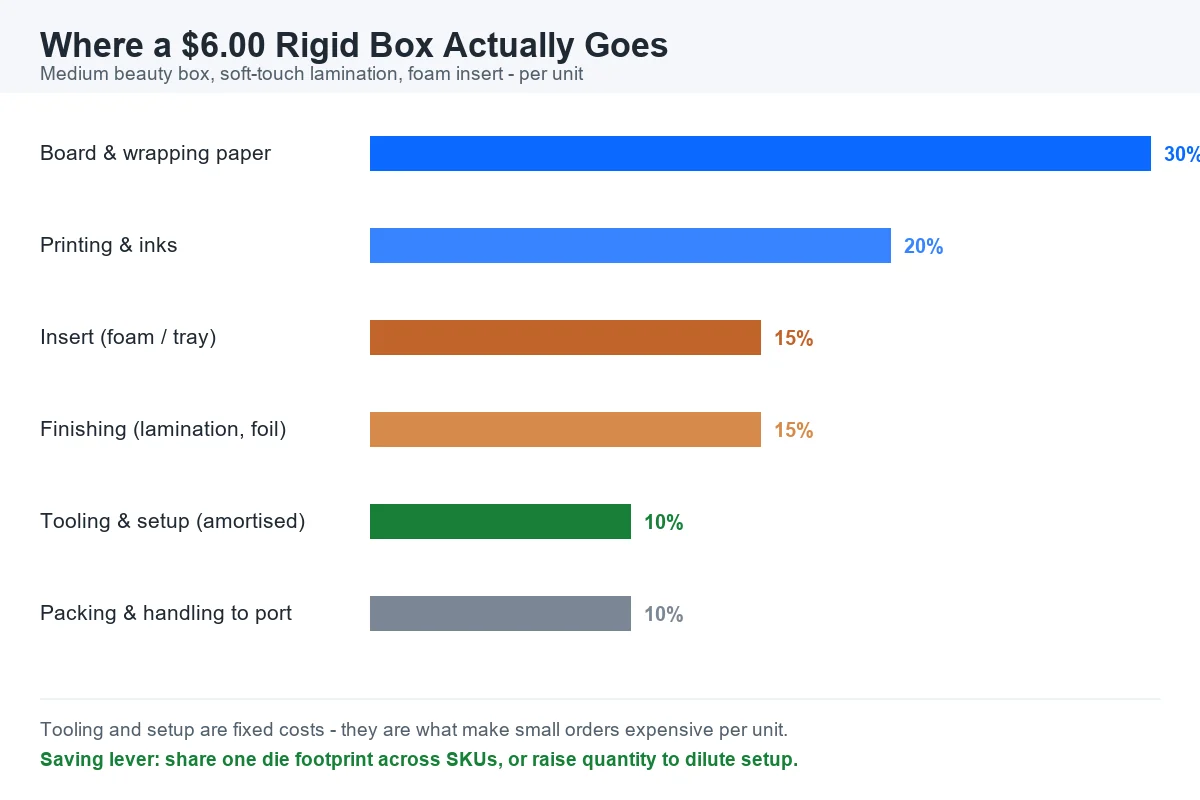
The number that surprises buyers is the tooling line. Cutting dies and printing plates are fixed costs — commonly $150–$750 for a die depending on complexity, and $50–$400 per printing plate. They do not care whether you order 300 units or 30,000. At 300 units, amortised tooling is a meaningful slice of every box; at 5,000 it nearly disappears. This is why MOQ and unit price are the same conversation.
The practical saving levers, in the order they usually pay off: share one die footprint across SKUs, standardise insert tooling, drop from a moulded foam insert to a die-cut paper tray, and reserve specialty finishes for the surfaces a customer actually touches.
Structure drives labour, not material
Two rigid boxes can use identical board, identical wrap and identical print, and still differ by 50% in unit price. The difference is assembly. A two-piece lid-and-base box is largely machine-formable. A shoulder-neck box with a hinged lid is not — it needs staged hand work.
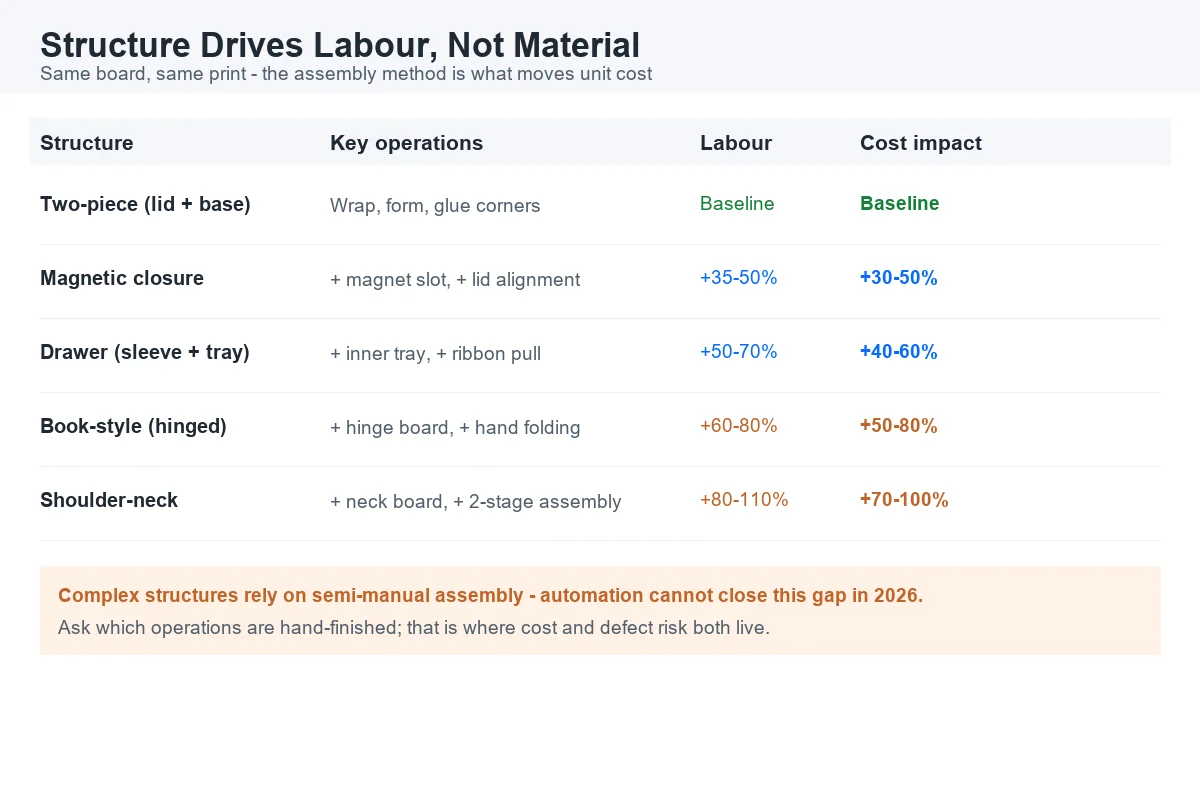
Complex rigid structures remain semi-manual in 2026. Automation has improved die-cutting and wrapping, but magnet placement, lid alignment, ribbon pulls and shoulder-neck assembly still run through trained hands. That has two consequences buyers should plan for: a higher unit cost, and a wider defect band on the first production run.
Ask any supplier which operations on your box are hand-finished. A factory that can name them — and tell you what tolerance it holds — is a factory that has actually costed your box. A quote that says only “rigid box, foil logo” has not been costed at all.
The freight bill nobody quotes
Here is the cost line that most rigid box guides mention in one sentence and then move on. A rigid box ships assembled. It does not fold flat. At 5,000 units that difference is not cosmetic — it is roughly five times the volume, and ocean freight is billed on volume.
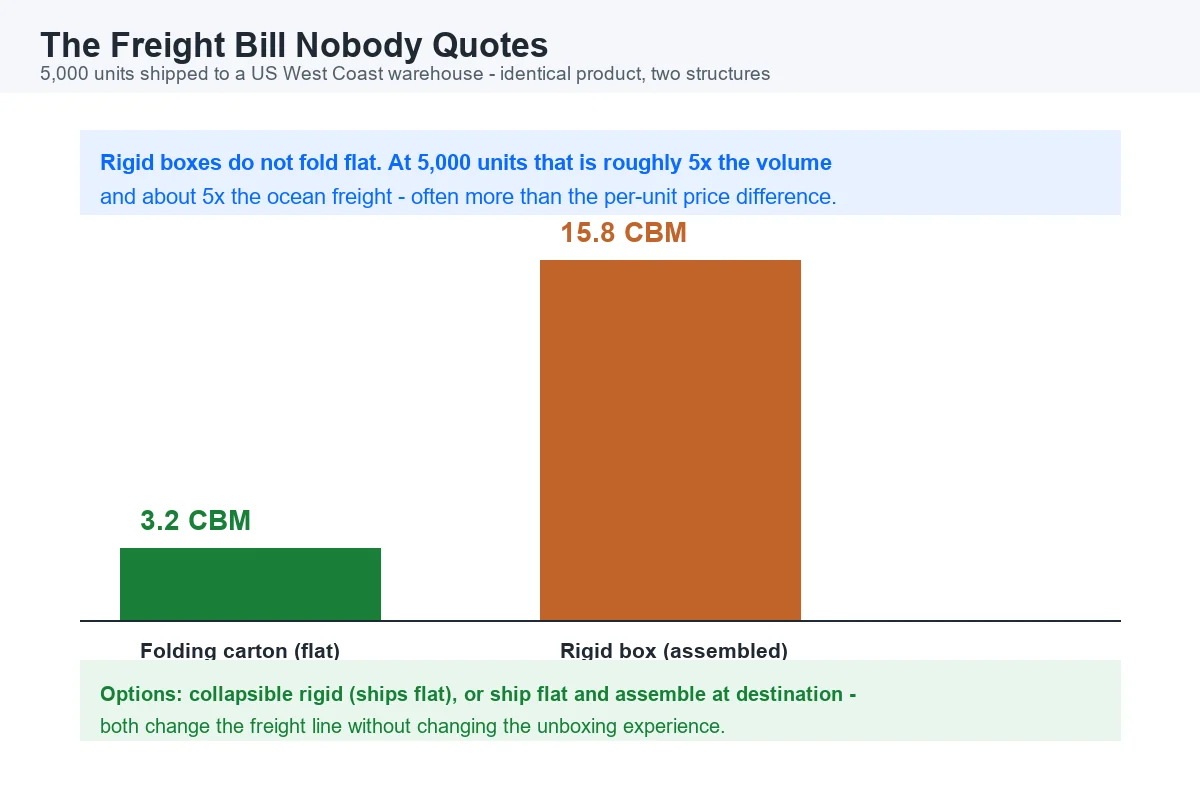
Worked on a real comparison basis — one palletised shipment of 5,000 units to a US West Coast warehouse — flat-packed folding cartons occupy roughly 3.2 CBM, while the same quantity of assembled rigid boxes lands near 15.8 CBM. At typical 2026 ocean rates, that is the difference between a freight bill in the low hundreds and one in the low thousands. On a $3 product, freight can exceed the packaging price.
Three ways buyers handle this without giving up the rigid unboxing:
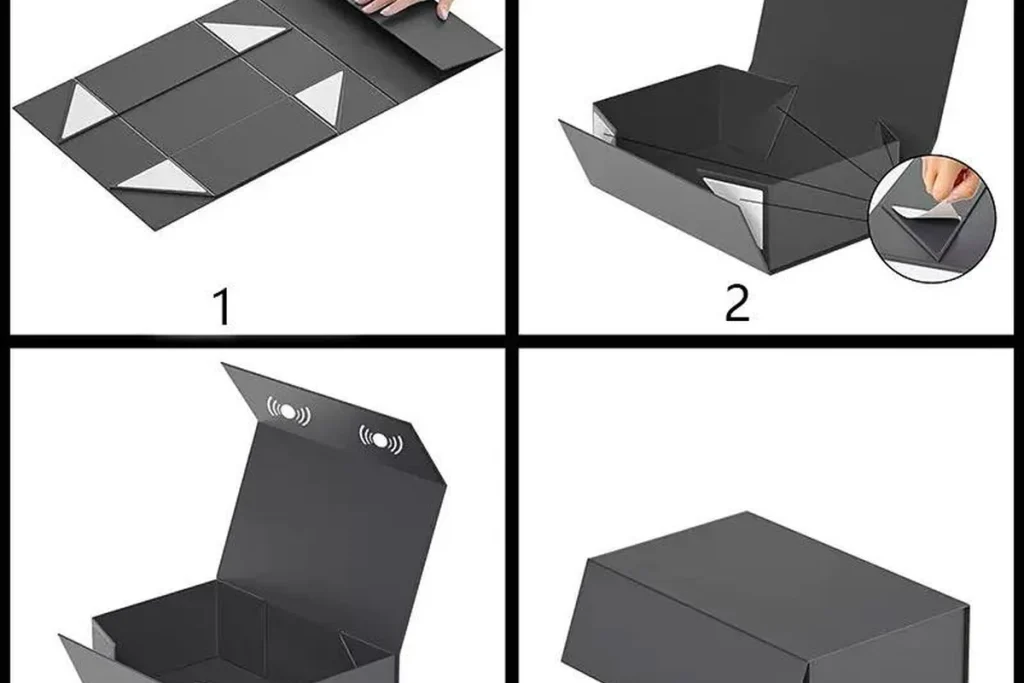
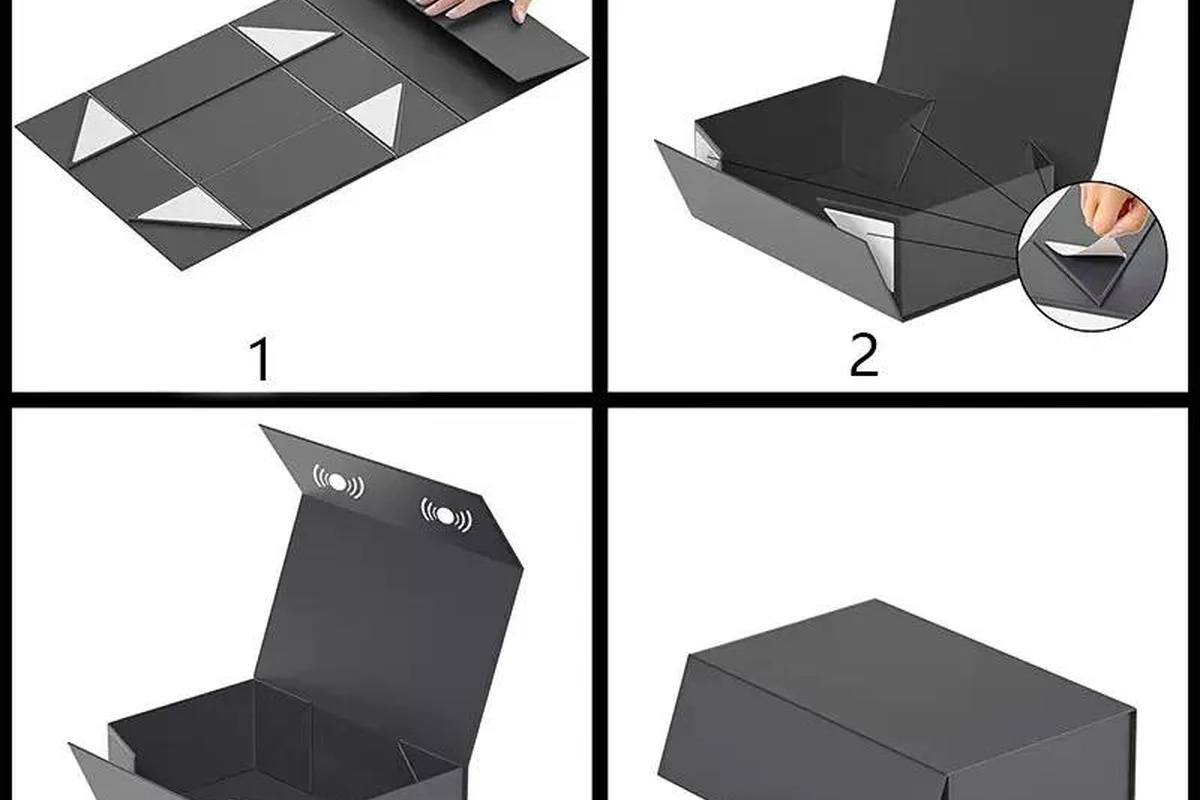
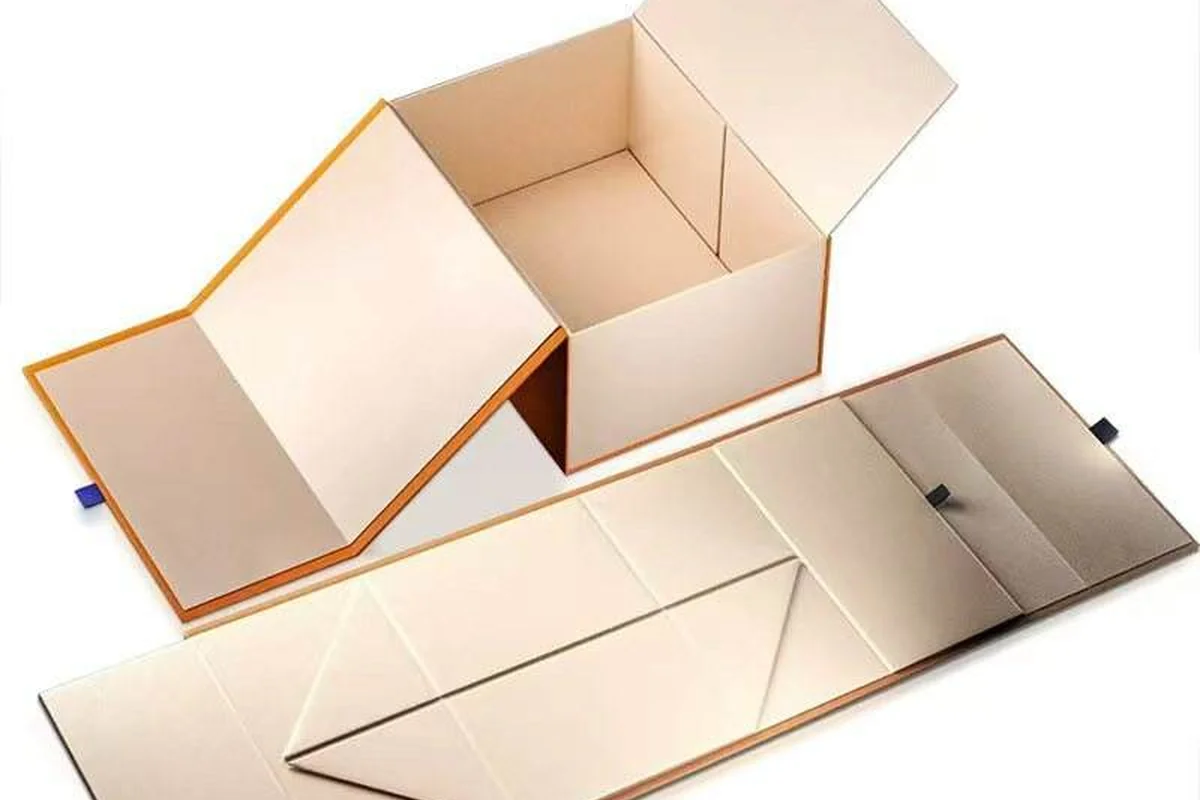
- Collapsible rigid construction. Magnetic or adhesive construction that ships flat and pops into shape. The box looks rigid on shelf; the freight bill looks like a carton.
- Assemble at destination. Ship components flat and assemble at a US or EU fulfilment partner. This only works above a certain volume, but it changes the maths completely.
- Right-size the board. Dropping from 3.0 mm to 2.0 mm greyboard reduces both material cost and packed volume — and most customers cannot tell the difference by hand once the wrap is on.
How we produce rigid boxes
Three steps on a rigid line decide whether a run looks premium or looks cheap, and none of them appear on a quote.
Greyboard moisture content. Greyboard is hygroscopic. If it comes off the stack too dry it drinks the wrapping adhesive unevenly and the wrap lifts at the corners a week later; too wet and it warps after lamination, so lids stop sitting flush. We condition board before wrapping and check moisture before the run starts, not after. This is invisible in a sample and obvious in a container.
Wrap registration. The decorative paper has to land on the board within a consistent tolerance, because any drift shows up as an uneven border along the lid edge — the first thing a customer sees. On patterned or directional wraps the tolerance tightens, which is one reason a textured specialty paper costs more to run than a plain coated stock.
Magnet and closure force. A magnetic closure that is too weak opens in transit; too strong and the customer fights the box. We specify the magnet grade by box size and test pull force on the first article rather than trusting the sample the magnet supplier sent. This is also where counterfeiters fail — closure feel is one of the easiest tells on a fake luxury box, which is why rigid beauty packaging is often paired with a tamper-evident seal.
When not to use a rigid box
Almost every article about custom rigid cosmetic boxes is written by someone selling them. So here is the other side. A rigid box is the wrong choice when:
- Your product ships direct-to-consumer and the box is the shipper. Rigid boxes scuff in transit and cost a fortune to freight. Use a printed mailer, or a carton inside a shipper.
- Unit economics are tight. If your product retails under about $15, a $4–6 box eats the margin. A well-printed folding carton at $0.80–2.00 usually wins.
- You are ordering under 500 units. Tooling amortisation punishes small runs. Start with digital-printed cartons, validate the market, then move to rigid.
- Warehouse space is charged. Rigid boxes occupy shelf and pallet space whether or not they are filled.
- You need variable data or frequent artwork changes. Rigid runs want stability; every new die is another $150–750.
The alternative that usually wins in those cases is a folding carton with a premium finish — soft-touch, spot UV, a foil logo — inside a plain shipper. You keep most of the shelf impact and lose most of the freight. We wrote the full comparison in our packaging box supplier guide.
Rigid vs folding carton vs corrugated mailer
Most beauty brands ordering custom rigid cosmetic boxes end up using more than one of these structures, so it is worth seeing them side by side. The right comparison is not “which is better” but “which job is each one doing”.
| Rigid box | Folding carton | Corrugated mailer | |
|---|---|---|---|
| Typical unit cost (1,000+) | $3.30–6.80 | $0.80–2.00 | $0.60–1.80 |
| Ships flat | No (except collapsible) | Yes | Yes |
| Perceived value | Highest | Medium | Low–medium |
| Works as the shipper | Poorly | No | Yes |
| Tooling cost | $150–750 die + plates | Lower die, plates | Die only often |
| Typical MOQ | 250–1,000 | 500–1,000 offset / lower digital | 500–1,000 |
| Best role | Gift sets, hero SKUs, PR kits | Retail shelf units | E-commerce and subscription |
The pattern we see most often: a folding carton for the retail SKU, a rigid box for the gift set or hero launch, and a printed mailer for anything shipping direct to a consumer. That mix keeps freight sane and saves the rigid spend for the units where it actually moves the customer.
Four QC points specific to rigid boxes
A rigid box fails differently from a carton. When we inspect a first article, these are the four checks that catch most problems before a full run:
- Lid fit. The lid should seat without rocking and lift without sticking. Both failures usually trace back to board moisture rather than to die accuracy.
- Corner wrap. Corners are where the wrap is most stressed. Any lifting, bubbling or visible adhesive here will get worse in transit, not better.
- Closure force. Magnets are tested by pull, not by eye. A closure that feels right on one box and weak on the next means inconsistent magnet grade.
- Insert fit under movement. The product is checked in the insert with the box closed and shaken, not just placed in it. A glass jar that fits when stationary can still travel.
None of these need laboratory equipment. They need someone who knows what failure looks like, which is why we always run them on a physical sample rather than on photographs.
Material and board specification table

| Element | Standard option | Premium option | What it changes |
|---|---|---|---|
| Greyboard | 1.5 mm | 2.0–3.0 mm | Rigidity, weight, material cost +20–40% |
| Wrap | Coated art paper | Textured / soft-touch film | Touch and perceived value; tighter registration needed |
| Structure | Two-piece lid & base | Magnetic / drawer / shoulder-neck | Assembly labour (+35–110%) and unit cost |
| CMYK | Pantone spot + CMYK | Brand colour accuracy | |
| Finishing | Matte lamination | Foil / emboss / spot UV | $0.05–1.00 per unit per process |
| Insert | Die-cut paper tray | Moulded EVA / velvet lining | Insert can be 10–30% of box cost |
| Closure | Lift-off lid | Magnet / ribbon pull | Closure feel; needs pull-force testing |
| Tooling | Die $150–750 | Plates $50–400 each | Fixed cost; drives MOQ economics |
From our production floor
The most common custom rigid cosmetic box problem we see is not a printing defect — it is a specification that was never written down. A buyer sends a photo of a box they like, we quote it as a two-piece with 1.5 mm board, and a competitor quotes the same photo as a magnetic closure on 2.5 mm board. Both quotes are honest. They are not the same box.
The second most common is a launch date set from the production calendar instead of the freight calendar. Rigid box production typically runs 15–45 days after sample approval, but ocean freight to the US or EU adds another 20–35 days. A brand that plans for six weeks and needs ten will end up air-freighting assembled boxes — which is the single most expensive way to ship air, because you are paying by volume for empty space inside a rigid box.
The third is skipping the physical sample. Colour on screen is not colour on coated paper, and a magnetic closure is something you have to feel. We send a physical sample before production because it is where artwork problems, insert fit problems and closure problems all surface at once — when they are still cheap to fix.
RFQ spec sheet: copy this into your enquiry
Send these eight fields and quotes become comparable. Leave any of them out and you are asking each factory to guess — and they will guess differently.
- Product dimensions and weight (the actual item, not the box)
- Box structure: two-piece / magnetic / drawer / book-style / shoulder-neck / collapsible
- Greyboard thickness: 1.5 / 2.0 / 2.5 / 3.0 mm
- Wrap material and finish: coated art paper, textured, soft-touch, kraft-look film
- Print: CMYK only, or CMYK + number of Pantone spot colours
- Finishing processes: foil, emboss, deboss, spot UV — named individually
- Insert type: none / die-cut paper tray / EVA / velvet / pulp
- Quantity breaks and destination port: e.g. 500 / 1,000 / 5,000 to Los Angeles
FAQ
How much do custom rigid cosmetic boxes cost per unit?
In our own 2026 quoting, small trial runs of 50–300 units land around $8–12 per box for a two-piece with lamination, and $13–22 for a magnetic box with a moulded insert. Mid-volume runs of 500–2,000 units typically fall to $3.30–6.80 for a standard build and $7–11 with foil or a custom insert. Above 5,000 units, simple rigid boxes reach roughly $2.80–4.50. These are factory-gate figures — freight is separate and, for rigid boxes, material.
What is the minimum order for custom rigid cosmetic boxes?
Most factories set 250–1,000 units for custom rigid boxes, because die and plate costs have to be amortised. Digital-printed cartons can start lower, which is why we usually suggest testing a market with cartons before committing to rigid tooling.
Can custom rigid cosmetic boxes ship flat?
A conventional rigid box cannot — it is assembled and glued. Collapsible rigid constructions do ship flat and pop into shape, which is the option to ask for when freight matters as much as presentation.
How long does production take?
Plan 15–45 days for production after sample approval, plus 20–35 days for ocean freight to the US or EU. The total from approved artwork to warehouse is commonly 8–12 weeks, and it is the freight leg that most launch plans underestimate.
Are custom rigid cosmetic boxes recyclable?
A rigid box is a composite: greyboard, wrapping paper, adhesive and often a foam or fabric insert. Recyclability depends on whether those layers separate easily in the stream your customer uses. Asking for a mono-material build — paper wrap, paper insert, no foam lamination — is the most reliable way to keep the box recyclable. Buyers placing this on the EU market should also check how Regulation (EU) 2025/40 classifies their packaging before specifying finishes.
Do you supply FSC-certified board?
We source board from mills that hold chain-of-custody certification and we pass through the mill’s certificate number, batch documentation and board technical data sheet with the shipment, so your compliance team can verify the chain. We do not print certification marks on packaging ourselves — the mark belongs to the certificate holder, and a converter applying it without coverage is a real legal risk for the brand.
Order custom rigid cosmetic boxes
Two paths, depending on where you are in the process:
Path A — testing a market (under 500 units). Send product dimensions and target quantity. We will come back with a dieline, a price at three quantity breaks, and a physical sample so you can check colour, closure feel and insert fit before committing to tooling.
Path B — production order (1,000 units and above). Send the eight-field spec sheet above and we will quote the structure, board and finish you actually named — with freight quoted separately so you can see the CBM line before you commit.
Start from our luxury rigid packaging boxes and cosmetic and skincare presentation boxes, or send your RFQ through the contact page.
Sourcing and production information only — not legal or regulatory advice. Price ranges are drawn from our own 2026 production quoting and vary with artwork, board, structure and quantity. Verify EU obligations against the official text at EUR-Lex (Regulation (EU) 2025/40).