
Send Your Inquiry Today
Custom Security Labels Designed for Authentication, Traceability and Brand Protection
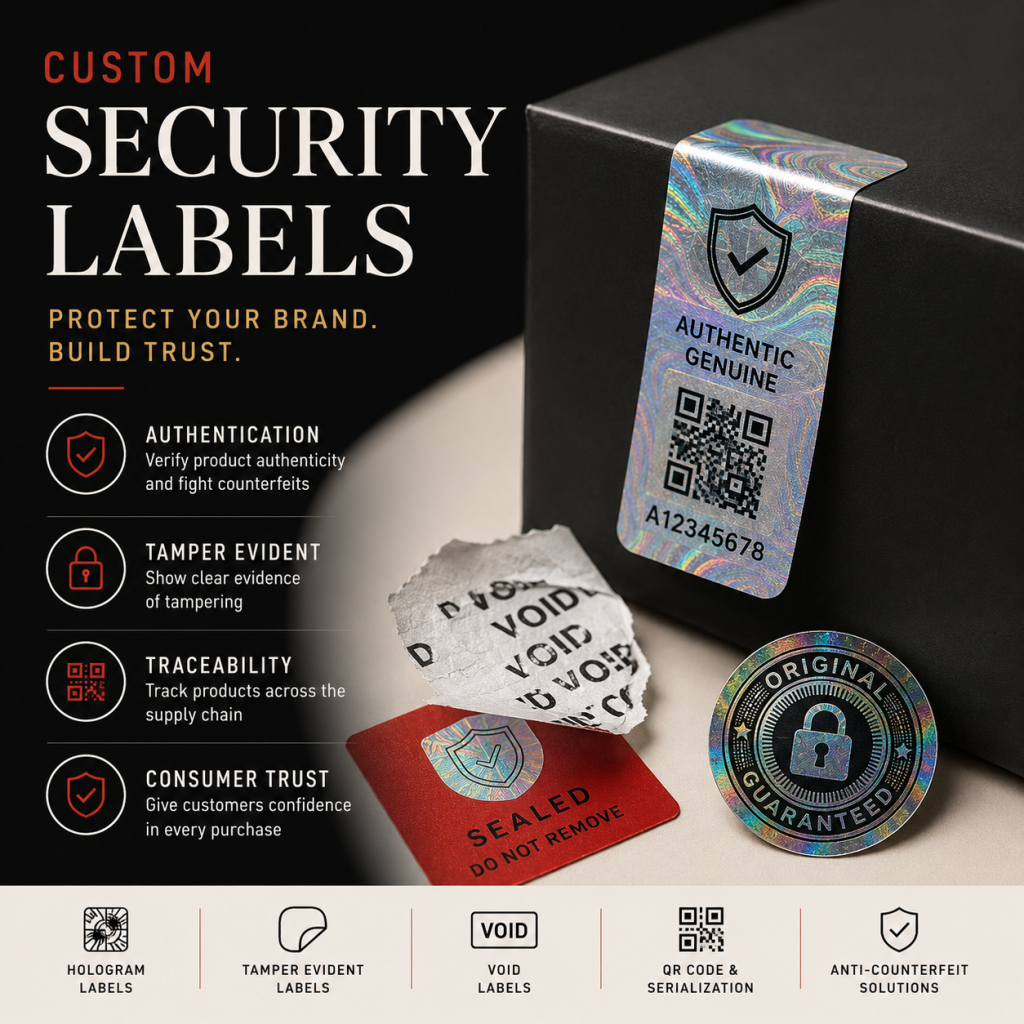
Protecting Products in an Increasingly Complex Market
Counterfeit products, unauthorized distribution, product tampering, and warranty fraud have become major concerns across global industries. According to the International Chamber of Commerce, losses from counterfeiting and piracy are projected to reach $4.5 trillion annually — affecting brands across pharmaceuticals, cosmetics, electronics, luxury goods, and beyond.
Companies today need more than standard labels. They need security solutions that help authenticate products, improve supply chain visibility, and strengthen consumer confidence at every touchpoint — from the production floor to the end buyer.
Custom security labels provide a practical and scalable way to protect products throughout their lifecycle. Whether the goal is deterring counterfeiters, detecting tampering, enabling traceability, or giving consumers a way to verify what they’ve purchased, the right label strategy addresses all of these objectives within a single, integrated program.
Why Product Security Matters More Than Ever
The Growing Cost of Counterfeit Products
Counterfeiting is no longer a fringe problem — it is a mainstream business risk. For branded goods manufacturers, the damage extends well beyond lost revenue. Counterfeit products erode brand equity, create consumer safety risks, and expose companies to legal liability when defective fakes reach the market under their name.
In high-stakes sectors like pharmaceuticals and cosmetics, the consequences are especially serious. A fake medication or a counterfeit skincare product are not just brand problems — they are public health concerns that regulators across the US, EU, UK, and Canada increasingly expect companies to address proactively. Brands that cannot demonstrate product authentication capability face growing scrutiny from distributors, retailers, and compliance auditors alike.
Challenges in Modern Supply Chains
Even without organized counterfeiting, the complexity of modern supply chains creates vulnerability. Parallel imports, unauthorized distribution channels, and product diversion mean that genuine goods sometimes reach consumers through routes that bypass quality controls, warranty terms, or regional compliance requirements.
Serialized labels and track-and-trace features allow brands to identify exactly when and where a product left its authorized channel — giving procurement and compliance teams the data they need to investigate and act. For global brands managing distribution across multiple markets, this visibility is no longer optional.
Consumer Expectations for Product Authentication
Sophisticated consumers — particularly in premium and health-sensitive categories — now actively look for ways to verify what they are buying. QR-based authentication, consumer-facing verification portals, and NFC-enabled labels are rapidly moving from premium feature to baseline expectation in categories ranging from luxury skincare to infant formula.
Brands that invest in consumer-facing authentication consistently report stronger repurchase intent and higher trust scores. Verification has become a consumer touchpoint in its own right — not just a security measure hidden in the supply chain.
How Custom Security Labels Support Product Protection
Modern security labels are not single-function. A well-designed label delivers multiple protective layers simultaneously, each addressing a different threat in the product journey.
Authentication
Authentication features allow distributors, inspectors, and consumers to confirm product genuineness at the point of inspection — without specialized equipment in most cases. Overt features like holograms provide instant visual verification. Covert features such as UV-reactive inks add a second layer detectable only with tools, making systematic counterfeiting significantly more difficult.
Tamper Detection
Tamper evident features provide visible, irreversible proof that a product or package has been opened or interfered with. Once a tamper-evident seal is broken, the evidence is permanent — protecting the brand, the distributor, and the downstream buyer from liability disputes and quality claims.
Traceability
Unique serialized identifiers — barcodes, QR codes, data matrix codes — link each physical unit to a specific production batch, shipment record, and distribution path. This enables real-time supply chain visibility and provides the audit trail required for regulatory compliance in markets like the EU and US.
Consumer Verification
Smartphone-scannable features allow end users to verify product authenticity themselves, directly on the packaging. Beyond security, this generates purchase verification data that closes the feedback loop for brand and marketing teams — turning a security feature into a consumer engagement tool.
Security Features Used in Modern Security Labels
Custom Hologram Labels
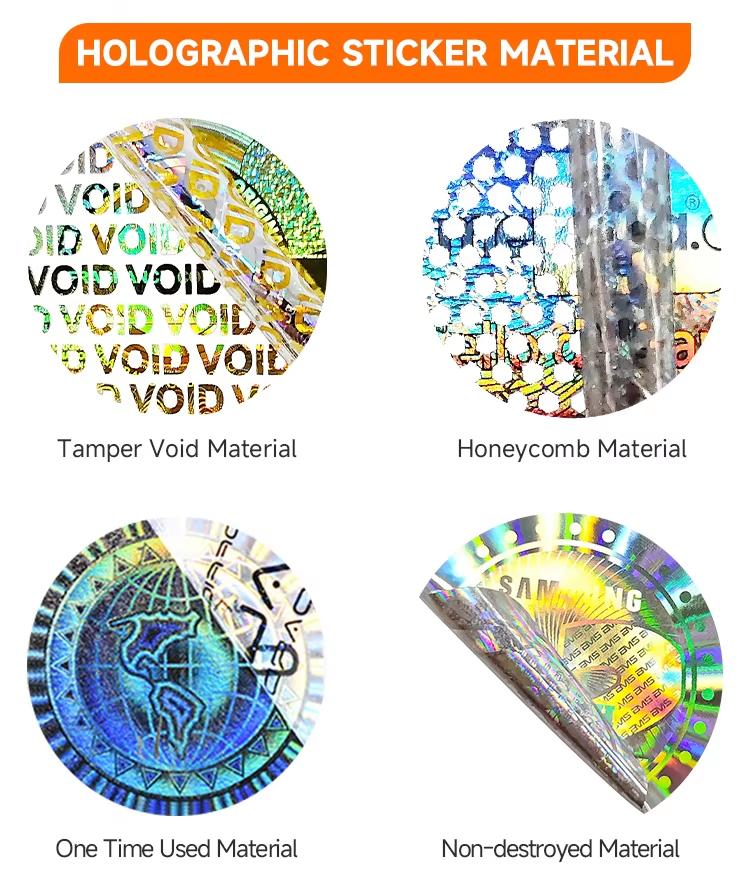
Hologram labels remain the most universally recognized visual authentication device in global commerce. Their optical complexity — diffraction gratings that shift color and pattern with viewing angle — makes mass reproduction prohibitively costly for counterfeiters, while enabling instant verification by any trained distributor or end user.
Modern holographic security goes well beyond standard rainbow effects. Custom hologram labels can incorporate 2D/3D composite designs with embedded brand imagery, dot matrix holograms with pixel-level control, nano text and micro-print features readable only under magnification, and sequential serial numbering integrated directly into the holographic layer. Substrates can be engineered to destroy the label on removal, leaving tamper evidence on the surface.
Custom hologram labels are particularly effective for luxury goods, cosmetics, pharmaceuticals, and any category where immediate visual authentication at the point of sale is essential.
Explore Custom Hologram Security Labels
Custom Tamper Evident Labels
Tamper evident labels provide visible, irreversible proof that a product or package has been opened or accessed without authorization. While hologram labels authenticate the product, tamper evidence authenticates the packaging state — together, they address the full spectrum of product integrity threats.
Options include destructible vinyl labels that fragment on removal, peel-and-reveal labels that expose a hidden “VOID” or custom message, and security seals designed for cartons, pallets, and secondary packaging. Residue-free variants are available for surfaces where adhesive transfer would be problematic.
Tamper evident labels are widely used in pharmaceuticals, food and beverage, cosmetics, and electronics — any category where evidence of unauthorized access has legal, safety, or warranty implications.
View Tamper Evident Label Solutions
Custom Void Labels
Void labels use a specialized pressure-sensitive adhesive layer that transfers a hidden message — typically “VOID OPEN” — onto the substrate when the label is removed. The label itself simultaneously reveals the same message, making tampering immediately apparent from both sides.
Applications include standard VOID OPEN checkerboard pattern transfers, custom hidden message engineering for brand-specific language, asset protection labels for electronics and medical devices, and warranty seal applications where evidence of unauthorized repair carries legal significance. Custom void labels are standard practice in electronics warranty programs, IT asset management, and secure document sealing.
Explore Custom Void Label Options
Anti Counterfeit Packaging Labels
Anti-counterfeit labels combine physical security features with digital infrastructure — serialized codes, QR-based verification portals, and variable data printing — to create a complete product authentication system rather than a single label. Each unit carries a unique identifier that maps to a verified database record, enabling authentication at any point in the supply chain or at the consumer level.
Core capabilities include unique QR codes linked to cloud-based authentication portals, serialized 2D barcodes and data matrix codes for track-and-trace programs, variable data printing for batch-level or unit-level serialization, and covert UV features that are invisible at retail but detectable on inspection. Anti-counterfeit labels are increasingly required for pharmaceutical compliance, and are the standard approach for premium consumer goods sold in markets with high counterfeit exposure.
View Anti Counterfeit Label Solutions
Selecting the Right Security Solution for Your Industry
The optimal security label strategy depends significantly on the specific risk profile of each product category. Below are recommended approaches based on the most common authentication, regulatory, and supply chain requirements by industry.
Pharmaceutical Products
Pharmaceutical products face the highest regulatory expectations for product authentication. Recommended solutions include unit-level serialization to meet EU FMD and US DSCSA compliance requirements, tamper evident labels for primary and secondary packaging, and track-and-trace infrastructure that links each unit to a verified production and distribution record.
Cosmetics and Personal Care
The cosmetics category faces significant parallel import and premium counterfeit risk. Custom hologram labels provide strong visual deterrence and immediate consumer recognition. QR-based authentication allows end users to verify product origin at the point of purchase. Covert UV printing adds an additional inspection layer for distributor and retail audits.
Electronics and Components
Electronics brands face warranty fraud and component substitution as primary risks. Void labels provide clear, irreversible evidence of unauthorized access — critical for warranty claim management. Asset protection labels with serialization support IT asset management programs and corporate compliance requirements.
Luxury Goods
High-value luxury products attract sophisticated counterfeiting operations. Custom hologram labels with brand-specific designs provide strong visual authentication that is both difficult to replicate and immediately recognized by trained retail staff. Anti-counterfeit labels with digital verification add a second layer for distributors and discerning consumers.
Food and Beverage Products
Food and beverage brands use tamper evident seals to protect product integrity at the primary packaging level and serialized labels for lot-level tracking. In markets with high food fraud exposure, QR-based consumer verification is increasingly deployed for premium and infant nutrition products.
Government and Official Documents
High-security hologram labels with multi-layer optical features, nano text, and sequential serialization are used for government documents, certificates, and official seals where forgery prevention is a compliance requirement.
Custom Security Label Printing Technologies
The security level of a label is determined not by design alone — the printing technology defines what features are physically achievable, what run quantities are viable, and what level of variable data can be incorporated.
Digital Printing
Ideal for programs requiring unique serialized data on every label. Supports short to medium runs without plate tooling costs, making it the preferred choice for variable data, QR code generation, and pilot programs before scaling to full production volumes.UV Security Printing
Applies inks that are invisible under normal lighting but fluoresce under UV illumination. An effective covert authentication layer that adds no visible element to product presentation — preserving packaging aesthetics while providing a verifiable inspection feature.
Flexographic Printing
The industry standard for large-volume production. Delivers consistent quality at competitive unit economics. Most appropriate when design is finalized and volumes justify the plate investment. Commonly used for base printing in combination with digital overprinting of variable data.
Variable Data and Serialization
A hybrid approach combining flexographic base printing with high-speed digital overprinting of unique identifiers. Enables unit-level serialization at production-scale speed — the backbone of pharmaceutical compliance programs and global track-and-trace deployments.
What Buyers Should Look for in a Security Label Manufacturer
Sourcing security labels is fundamentally different from sourcing standard packaging components. The manufacturer becomes part of your product authentication infrastructure. Due diligence goes well beyond price and lead time.
Security Feature Expertise
Can the manufacturer produce the specific authentication features your risk profile requires? Hologram production, UV printing, and serialization are distinct capabilities. Verify that all required methods are available in-house — not outsourced to subcontractors who fall outside your quality audit scope.
Manufacturing Capabilities
Ask for specifics: substrate range, print technologies on-site, minimum and maximum run sizes, and in-line finishing options such as die cutting, lamination, and hot stamping. A capable security label manufacturer should answer these questions in technical detail without prompting.
Customization Options
Beyond logo placement: can the manufacturer engineer a custom hologram design, develop brand-specific void messages, and integrate your serialization scheme into their production workflow? True customization means building a solution around your product — not adapting a generic product to fit your brief.
Quality and Compliance Standards
Look for ISO certification, documented quality control procedures, and willingness to participate in your incoming inspection or audit process. Security labels demand zero-defect manufacturing discipline — a single defective label in a production run undermines the entire authentication program.
Global Supply and Logistics Support
Can the manufacturer ship reliably to your distribution network across multiple markets? Duty management, export documentation, lead time guarantees, and the ability to manage inventory for multi-region programs matter as much as label quality when you are protecting a global supply chain.
Common Questions About Security Labels
What is the difference between a hologram label and a security label?
A hologram label is one specific type of security label — one that uses diffractive optical technology to create visual authentication that is extremely difficult to replicate. “Security label” is the broader category, encompassing hologram labels, tamper evident labels, void labels, anti-counterfeit labels, and any label engineered with protective features. Most comprehensive authentication programs combine two or more types to address different threat vectors.
How do anti-counterfeit labels work?
Anti-counterfeit labels use a combination of overt features visible to inspectors and consumers, covert features detectable only with tools like UV lamps or microscopes, and forensic features detectable only with laboratory analysis. Most modern programs also incorporate a digital layer: a serialized QR code linked to a cloud database that returns a verified authentication result when scanned. The combination of physical and digital features makes systematic duplication far more difficult and costly for counterfeiters.
Can security labels include QR codes?
Yes — and in most modern programs, they should. A QR code alone is not a security feature, since any generator can produce one. But a serialized QR code linked to a unique authentication record in a protected database is a powerful verification tool. Combined with physical security features such as holograms or UV printing, QR integration provides both consumer-facing verification and supply chain traceability within a single label.
What industries use tamper evident labels?
Tamper evident labels are used across pharmaceuticals, food and beverage, cosmetics, electronics, and medical devices — any category where evidence of unauthorized product access has legal, safety, or warranty implications. They are also widely used in logistics for carton and pallet sealing, and by government agencies for securing sensitive equipment and documents.
Can security labels be customized for my packaging?
Yes. Custom security labels are engineered to fit specific substrate types, application surfaces, environmental conditions, and brand design requirements. A qualified manufacturer will conduct a substrate compatibility assessment and adhesive selection process before recommending a solution. Shape, size, adhesive type, finish, and security feature combination are all configurable to your packaging specification.
What is the typical MOQ for custom security labels?
Minimum order quantities vary by label type and manufacturing method. Custom hologram labels typically start at 10,000 to 50,000 units due to origination and tooling costs for the holographic master. Digitally printed serialized labels can be produced in smaller quantities without tooling investment. Most manufacturers can produce pre-production samples for evaluation before committing to full program volumes. Contact us to discuss your specific volume and timeline requirements.
Strengthen Product Security with the Right Labeling Strategy
The most effective security label program is one designed around your specific product category, supply chain structure, and risk profile — not the most feature-heavy option available. Selecting the right combination of features, at the right investment level, delivers measurably better authentication outcomes than applying generic solutions to a complex problem.
Gervin Printing works with brand managers, procurement teams, and compliance officers to identify the right label strategy for their program — and to deliver it with the manufacturing quality and supply reliability that global distribution demands.
[CTA 1 — Primary]
Request Security Label Samples See the physical difference our security features make. Sample packs include hologram, tamper evident, void, and anti-counterfeit label examples. → [Request a Sample Pack]
[CTA 2 — Secondary]
Discuss Your Authentication Requirements Tell us about your product, category, and supply chain. We’ll recommend the right solution. → [Talk to Our Team]
[CTA 3 — Tertiary]
Get Recommendations Based on Your Industry Not sure where to start? We’ll map your risk profile to the right label technology. → [Get Industry Recommendations]
For regulatory context, see the ISO security label guidance before approving label materials, inks and adhesives for your market.
Frequently Asked Questions About Security Labels
What is a security label?
A security label is engineered to prove a product is genuine and untampered, using overt features (holograms, color-shifting ink), covert features (microtext, UV ink), and digital features (serialized QR codes). Unlike a standard product label, it is designed so that copying or removing it is either impossible without detection or economically pointless for the counterfeiter.
Do security labels actually stop counterfeiting?
No single feature stops counterfeiting on its own — effective programs layer them. A hologram deters casual copying, a serialized QR code lets you track units and intercept grey-market goods, and tamper-evident construction exposes interference. The goal is to make fakes detectable at every checkpoint: customs, the retailer, and the end consumer.
What is the difference between security labels and tamper-evident labels?
They answer different questions. A security label answers “is this product authentic?” — it verifies origin. A tamper-evident label answers “has this package been opened?” — it protects integrity, typically with VOID adhesives or destructible vinyl that leave visible evidence of removal. Many brand-protection programs combine both functions on a single label.
What information do I need to get a quote for custom security labels?
Five inputs are enough for an accurate quote: label size and shape, application surface and environment, the security features you need (overt, covert, or serialized), annual volume by SKU, and whether variable data or numbering is required. With those, a factory can also advise which features are worth the cost at your risk level — and which are overkill.