
Send Your Inquiry Today
Tamper-Evident Labels for Compliance (2026)
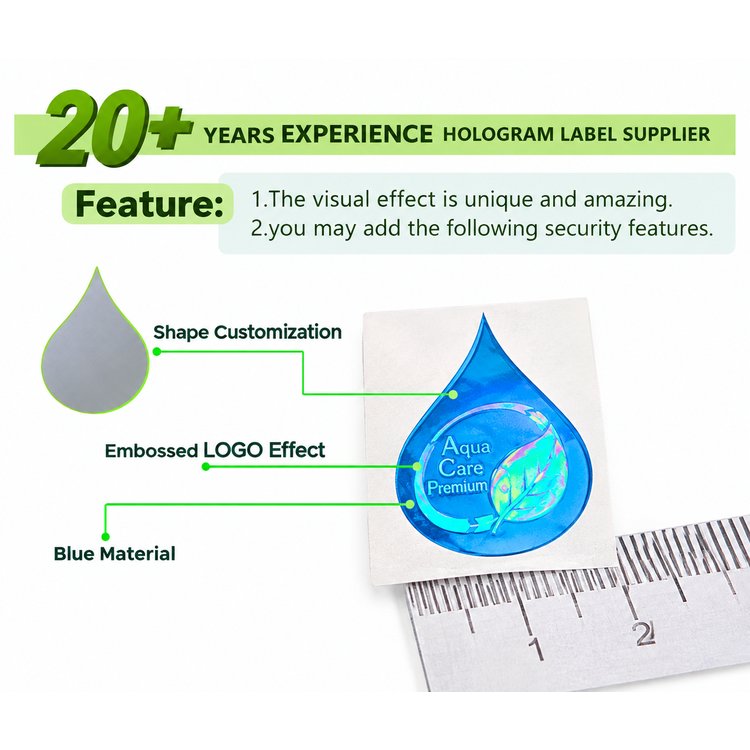
If you are sourcing tamper-evident labels in 2026, the reason is usually a regulation on the desk: an OTC drug line that must meet FDA 21 CFR 211.132, or a prescription medicine entering the EU under Commission Delegated Regulation (EU) 2016/161. Those two rules are the direct drivers. Other programmes — such as US pharma serialization under DSCSA, the EU PPWR packaging rules, or the EUDR deforestation regulation — may apply to the same SKU, but they do not create the tamper-evidence requirement itself. This guide starts from the rules that actually force the requirement, then explains what a converter prints so the label meets spec and survives the supply chain.
On this page:
- Why tamper-evident labels are on the 2026 compliance agenda
- Tamper-evident vs tamper-proof vs tamper-resistant
- The 6 types of tamper-evident labels
- Material science: picking the right substrate
- How a converter prints them to spec
- Compliance mapping: which label for which rule
- 5 questions to answer before you order
- Common mistakes buyers make
- What tamper-evident labels cost
- Downloadable: Tamper-Evident Spec Checklist
- FAQ
Why tamper-evident labels are on the 2026 compliance agenda
Two regulations are the real trigger. A third often gets mentioned but means something different.
- US OTC drugs — FDA 21 CFR 211.132 has required tamper-evident packaging on retail OTC human drug products for decades. The rule demands a package with one or more indicators or barriers that give visible evidence of tampering, plus an on-pack statement telling the consumer what to look for. It resurfaces every time a brand adds an OTC SKU or re-shells an existing line.
- EU prescription medicines — Directive 2011/62/EU (the Falsified Medicines Directive) and Commission Delegated Regulation (EU) 2016/161, in force since 9 February 2019, require two safety features on prescription packs: a unique identifier (GS1 2D DataMatrix serialization) and an anti-tampering device (ATD). EN 16679:2014 describes the technical characteristics an ATD should meet, but conformity assessment against EN 16679 is performed by a notified body or by the marketing-authorisation holder’s own compliance function — not by the label printer.
- US pharma serialization (DSCSA) — the Drug Supply Chain Security Act is about track-and-trace and a unique product identifier. It does not itself mandate a tamper-evident seal, but many pharma packagers add one as part of overall package-integrity controls. If you are quoting a DSCSA SKU, confirm whether the buyer wants serialization only, or serialization plus a tamper-evident closure.
Layer the EU packaging wave on top — PPWR labelling, EUDR deforestation rules, and US state EPR — and the same carton may need a tamper-evident seal and PPWR-compliant substrate and a deforestation due-diligence statement. Each is a separate question; this guide focuses on the first.
Tamper-evident vs tamper-proof vs tamper-resistant
These three terms are used interchangeably and they should not be. The distinction matters because some regulations require evidence of access, not just deterrence:
- Tamper-evident — shows visible proof that someone tried to open or remove it (VOID text, fragmentation). This is what 21 CFR 211.132 and the ATD requirement in EU 2016/161 ask for.
- Tamper-resistant — harder to remove or open, but may leave no clear proof if someone carefully replaces it. It is a physical-property claim, not a regulatory term.
- Tamper-proof — not a defined regulatory term. No label makes a pack perfectly tamper-proof. If a supplier sells “tamper-proof” as a compliance guarantee, push back and ask which regulation it is tied to.
For the deeper mechanism comparison — hologram vs VOID vs serialized 2D code — see our anti-counterfeit labels buyer’s guide.
The 6 types of tamper-evident labels
Each type proves something different. Pick by what you need the label to demonstrate, not by what looks most secure.
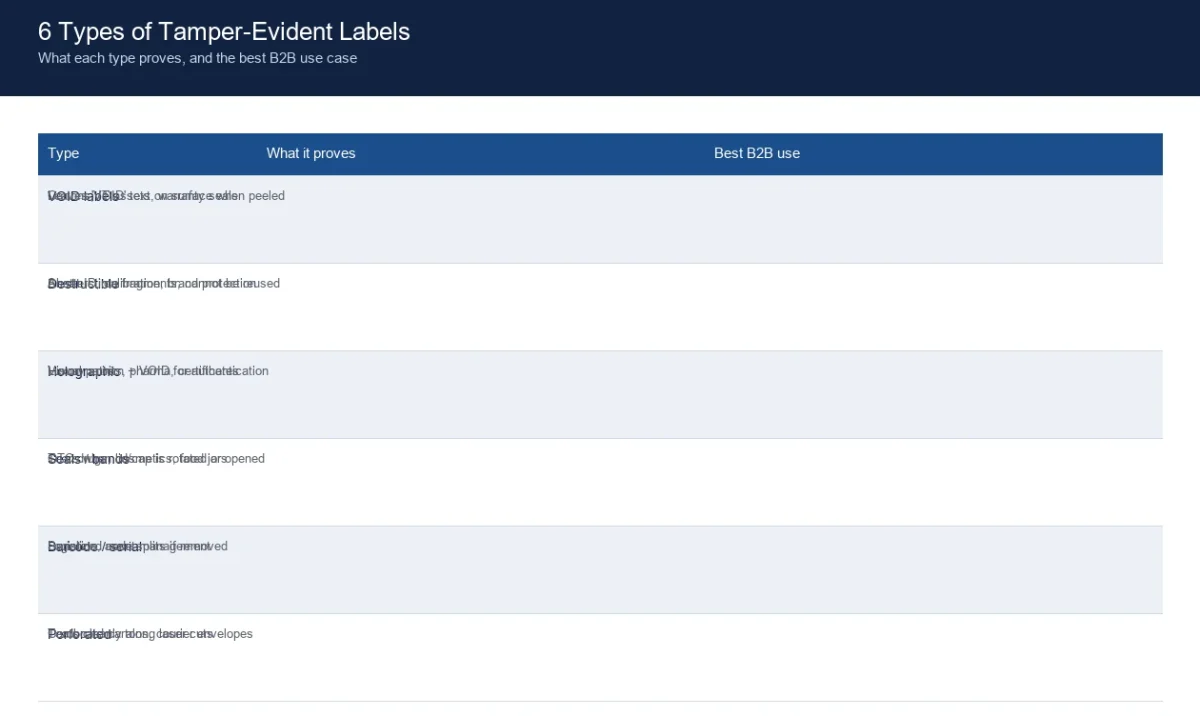
| Type | What it proves | Best B2B use |
|---|---|---|
| VOID labels | Leaves a “VOID” message on the surface when peeled | Cartons, IT assets, warranty seals |
| Destructible / ultra-destructible | Shatters into fragments; cannot be reused | Asset ID, calibration, brand protection |
| Holographic | Visual pattern + optional VOID for authentication | Luxury spirits, pharma, certificates |
| Seals / bands | Tears when a lid or cap is rotated or opened | OTC drugs, cosmetics, food jars |
| Barcode / serial | Serialized code splits if the label is removed | Logistics, asset management |
| Perforated | Tears cleanly along laser cuts | Cardboard cartons, courier envelopes |
Material science: picking the right substrate
The face stock and adhesive decide whether the evidence actually triggers. From the production side, the common choices are:
- VOID PET (polyester) — dimensionally stable, chemical- and heat-resistant; the workhorse for electronics and metal asset tags. Prints high-resolution barcodes with resin ribbon. Available as total-transfer (VOID stays on the substrate) or non-transfer (VOID stays in the label).
- Destructible PVC / paper — very low tear resistance, so it fragments on removal. Conforms to curved or textured surfaces for warranty seals; not suitable where the pack is exposed to water or oil.
- Paper security labels — cost-effective for short-life closures (pizza boxes, courier envelopes) but limited water resistance and lower tear strength.
- PET / PP film — transparent and water-resistant; used where the seal must look clean on premium cosmetics or beverage bottles. PP works on low-surface-energy plastics better than PET if the right adhesive is chosen.
- Holographic film — multi-layer optical film that is almost impossible to copy on a standard digital press; establishes immediate visual trust for high-value goods. Often laminated with a VOID layer so it is both tamper-evident and authentication.
Match the substrate to the surface and the environment before you pick a “type.” A VOID label on a rough, porous carton may leave an uneven mark and fail the evidence test; a destructible label on a wet bottle may dissolve before it proves anything.
How a converter prints them to spec
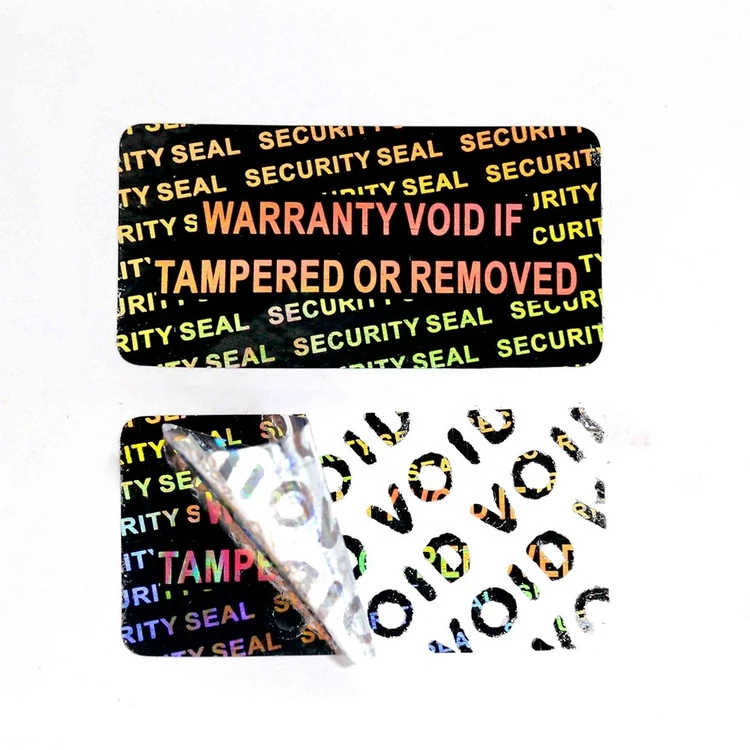
This is where a guide written by a converter differs from one written by a hardware vendor. At our Guangzhou facility, a tamper-evident order moves through controlled steps that are documented for each batch:
- Substrate + adhesive selection — matched to surface energy, application temperature, and expected life. Low-surface-energy PP/PE gets a specialist rubber or acrylic adhesive; metal and glass get higher-tack formulations.
- Security print / lamination — hot-stamp hologram, VOID pattern printing, destructible coating, or holographic lamination with VOID transfer.
- Variable data — sequential numbering, batch codes, GS1 DataMatrix, or serialized QR. Printed by thermal transfer, inkjet, or digital press depending on volume and grade requirements.
- Inline verification — barcode grade checked against ISO/IEC 15415 or 15416; VOID/hologram registration inspected visually and by camera; readable-data checked against the provided key.
- Die-cut and convert — kiss-cut to liner, waste matrix removed, slit to the required roll width or cut to sheet. We also supply automatic-apply rolls with consistent pitch.
- QC release — sample checks for adhesion (peel strength, initial tack, holding power), aging, abrasion, and evidence activation on the actual substrate.
- Batch records — material lot numbers, run parameters, QC results, and shipping data are kept so a buyer can trace a suspect roll back to its production batch.
What we deliver: printed labels to the agreed specification, plus a Certificate of Conformance, material data sheet (MDS), and batch record. What we do not deliver: a regulatory compliance certificate. For EU medicines, final ATD conformity is assessed by the marketing-authorisation holder or its notified body; for US OTC, the brand owner holds the regulatory responsibility under 21 CFR 211.132.
Compliance mapping: which label for which rule
The same physical label can satisfy more than one rule, but only two rules actually create the tamper-evidence requirement.
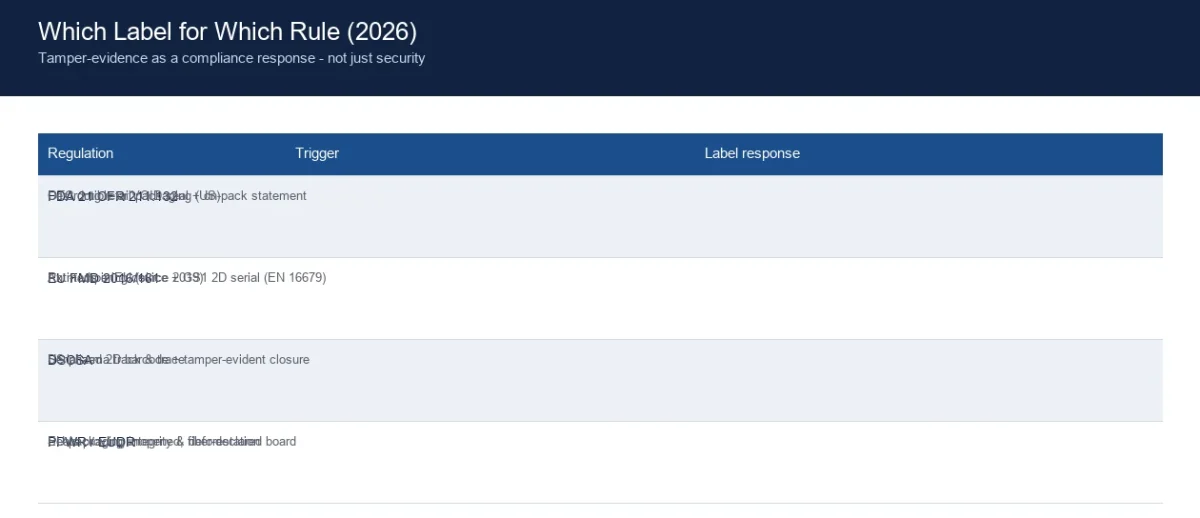
| Regulation | Trigger | Label response | Who certifies |
|---|---|---|---|
| FDA 21 CFR 211.132 | OTC drug retail packaging (US) | Durable VOID or destructible seal + on-pack statement naming the feature | Brand owner / FDA inspection |
| EU FMD 2016/161 | Prescription meds in the EU (since 2019) | Anti-tampering device + GS1 2D serial code | Marketing-authorisation holder or notified body assesses ATD against EN 16679 |
What EN 16679:2014 does: it describes technical characteristics of anti-tampering devices — for example, that the device should be irreversibly damaged or leave visible traces when removed, and that it should not be reusable. It is a technical reference, not a certificate a converter can hand over. If a buyer says “we need EN 16679 certification,” the correct response is: “We can design and print the ATD construction to the requirements described in EN 16679 and supply test data; the formal conformity assessment is performed by your notified body or authorised representative.”
Sources: FDA 21 CFR 211.132 (govinfo); Commission Delegated Regulation (EU) 2016/161 (EUR-Lex). Always confirm current applicability with your regulatory function — this article is production guidance, not legal advice.
5 questions to answer before you order
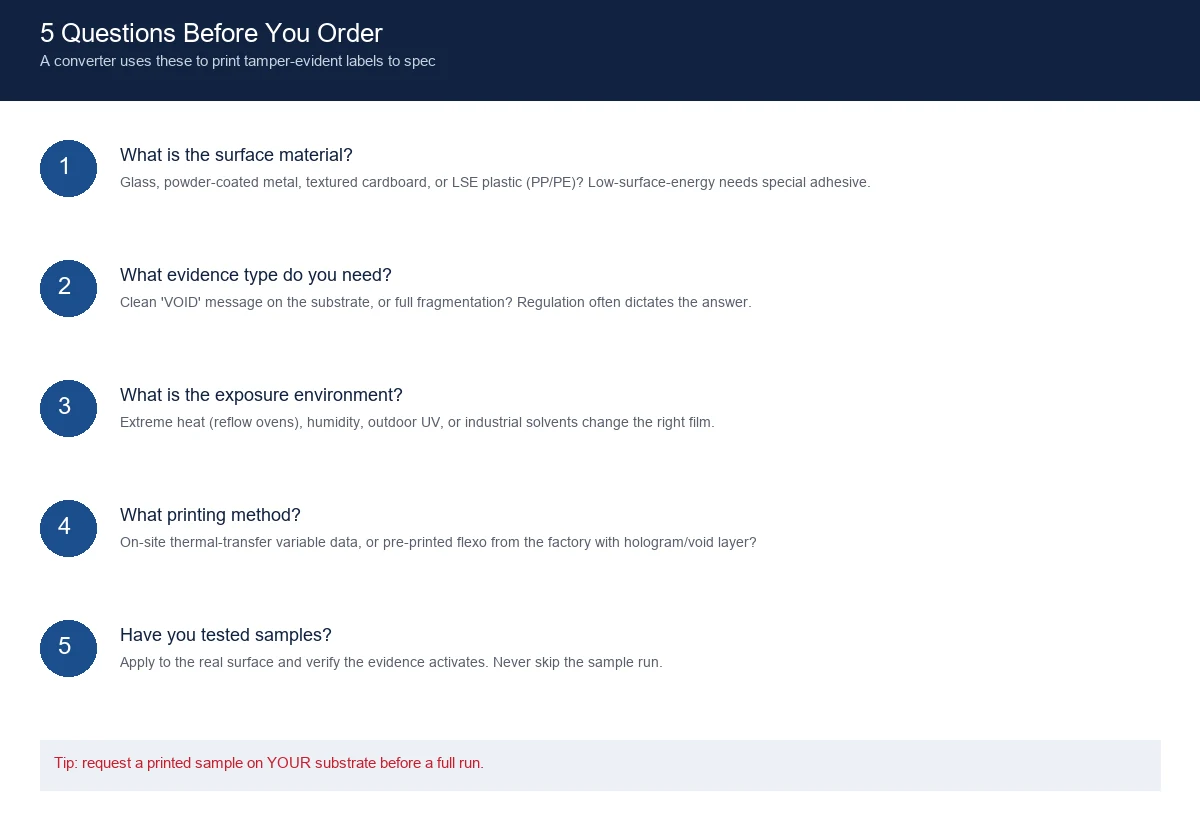
- What is the surface material? Glass, powder-coated metal, textured cardboard, or low-surface-energy plastic (PP/PE)? LSE plastics need a specialist adhesive and often a corona or primer step.
- What evidence type does the regulation require? A clean “VOID” message on the substrate, full fragmentation, or a non-removable seal? The answer usually comes from 21 CFR 211.132 or your EU ATD assessment, not from the label catalogue.
- What is the exposure environment? Reflow-oven heat, humidity, outdoor UV, or industrial solvents change the right film and adhesive.
- What printing method? On-site thermal-transfer variable data, or pre-printed flexo/digital from the factory with hologram/VOID layer?
- Have you tested samples on the real pack? Apply to the actual surface, let it age, then try to remove it. Never skip the sample run.
Common mistakes buyers make
- Treating tamper-evident as anti-counterfeit. Tamper evidence proves opening; anti-counterfeit proves authenticity. A hologram can do both, but a simple VOID seal does not authenticate a genuine product.
- Buying on price without testing. A cheaper VOID film may not activate on your substrate, or may leave a weak pattern that an auditor rejects.
- Not explaining the seal to consumers. “VOID” is not self-explanatory. Where 21 CFR 211.132 applies, add the required on-pack statement.
- Wrong material for the risk. Standard destructible can be patiently peeled in pieces; ultra-destructible is the call when re-application is the concern.
- Expecting the converter to certify compliance. The converter supplies a construction and documentation; the regulatory sign-off sits with the brand owner and, for EU medicines, the notified body.
- Forgetting material data sheets. For PPWR/EUDR-impacted SKUs, the same label must also have substrate traceability. Ask for the MDS and mill certificate chain at quoting stage.
What tamper-evident labels cost
Tamper-evident constructions cost more than a standard label. As a rough, illustrative guide (not a quote): destructible material carries a modest premium over paper; VOID and holographic films sit higher because of the security layer. The useful framing is insurance — the cost is small against a recalled, counterfeited, or shrinkaged product line. Your actual price depends on substrate, size, variable-data complexity, volume, and whether you need additional QC documentation such as peel-strength test reports.
Downloadable: Tamper-Evident Spec Checklist
Download the printable spec checklist
Use this one-page checklist to brief your converter and sign off before production — covers FDA 21 CFR 211.132, EU FMD (EU) 2016/161 and EN 16679 ATD considerations.
⇩ Download Tamper-Evident Label Spec Checklist (PDF) (PDF, ~4 KB)
Before you brief a supplier, lock these down. Use this as your internal one-page spec:
- Target regulation (21 CFR 211.132 / EU 2016/161 / other) and the required evidence type.
- Substrate + adhesive matched to the real application surface.
- Variable data: sequential number, batch code, or serialized 2D code; verification grade required.
- On-pack consumer statement naming the tamper feature (where mandated).
- Environment: temperature, humidity, UV, solvent exposure.
- Sample run on the actual substrate before full production.
- Batch record, material data sheet, and any peel-strength / aging test reports required.
Need the spec built around your SKU? Contact our team with the regulation and surface, and we will propose a print-ready construction.
FAQ
Are tamper-evident labels required for all products?
No. They are legally required for certain categories (OTC drugs under 21 CFR 211.132, EU prescription meds under 2016/161) and appropriate for high-value or safety-critical products. Not every product needs one.
Can tamper-evident labels be removed and reapplied?
Destructible and ultra-destructible cannot be removed intact. VOID labels leave a visible mark if removed; reapplication would look misaligned or partially missing. High-tack adhesives are hard to remove without residue.
Do they work on curved bottles?
Yes, but application is harder — the label must make full contact. Films conform better than papers, and a smaller label face reduces bridging. Confirm the construction works on your package shape before ordering.
Can I print variable data (batch codes, dates) on them?
On most materials, yes. Just ensure the printed data does not interfere with the tamper feature, and verify barcode grade if the code is part of a traceability system.
What is the difference between a tamper-evident label and an anti-tampering device?
For EU medicines, the “anti-tampering device” is the formal term in Regulation 2016/161; a tamper-evident label is one common way to deliver it. EN 16679:2014 describes the technical characteristics, and a notified body or the marketing-authorisation holder assesses conformity.
Does a converter certify my compliance?
No. A converter prints to the specification you define and supplies batch records, material data sheets, and test data. The regulatory certification stays with your compliance function and notified body where applicable.
How do I choose between VOID and destructible?
If you need the surface itself to carry a visible “VOID” signal after removal, choose VOID. If you need the label to physically break apart so it cannot be reused, choose destructible — ideally on a hard, clean, rigid surface.
Related reading: Anti-counterfeit labels: hologram vs VOID vs serial 2D code · How custom security labels are made · PPWR labelling requirements 2026 · EUDR-ready custom boxes · US state EPR requirements · Custom hologram stickers · Custom labels.
As of October 2026. Regulation citations are for production planning; confirm current applicability with your regulatory team.