
Send Your Inquiry Today
Digital Product Passport & Green Claims: Packaging Prep Guide for EU Buyers
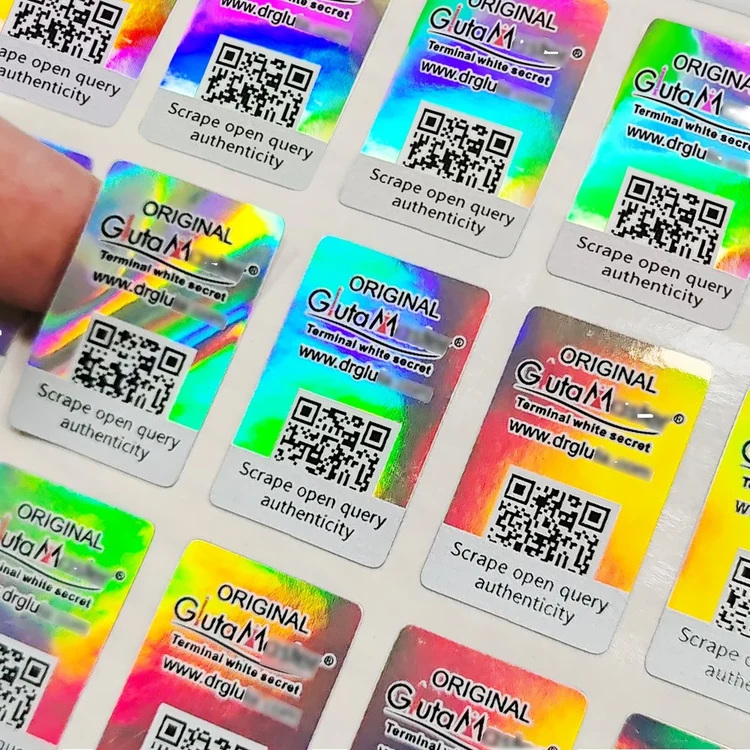
As of October 2026. This guide explains EU green-claims rules and the Digital Product Passport (DPP) for packaging buyers. It is general information, not legal advice. Treat the regulation texts on EUR-Lex as authoritative, and confirm current dates and delegated acts with your compliance lead or the European Commission before you act.
Contents
- What the Digital Product Passport and Green-Claims Rules Mean for Packaging
- What Changed in 2026: EmpCo and the DPP Framework
- Who Has to Prepare Packaging for Green Claims and DPP
- What Green Claims and DPP Mean for Your Label
- How We Print the Data Carrier and Claim-Ready Artwork
- Inventory and Reprint Audit for Existing Pack Stock
- A Practical Specification Scenario
- Green Claims & DPP Packaging Spec Table
- Download the Green Claims & DPP Packaging Checklist
- DPP and Green-Claims Timeline by Category
- FAQ
What the Digital Product Passport and Green-Claims Rules Mean for Packaging
A digital product passport (DPP) links a physical product to a structured digital record through a scannable data carrier — usually a QR code. The carrier can appear on the product itself, on its packaging, or in accompanying documentation, depending on the product group’s rules.
For a packaging buyer, the practical question is not “what is a DPP” but “what do I have to print, and what can I say on the pack.”
The answer has two parts. First, the pack or label may need a machine-readable code that points to the product’s digital record. Second, any environmental wording on the pack must be specific and backed by evidence.
The second part lands squarely on the label and the converter. We print the code and the claim; the brand owns the data and the proof behind it.
What Changed in 2026: EmpCo and the DPP Framework
Two EU instruments matter for packaging copy and data carriers. One is live now; the other is phasing in by product group.
Green claims — the Empowering Consumers Directive is the rule that applies. The standalone Green Claims Directive proposal (COM/2023/166) is not law: the Commission announced in June 2025 that it intended to withdraw the proposal, negotiations were suspended, and it has not been adopted. What actually bites is Directive (EU) 2024/825, the Empowering Consumers for the Green Transition (EmpCo), which amends the Unfair Commercial Practices Directive and applies from 27 September 2026.
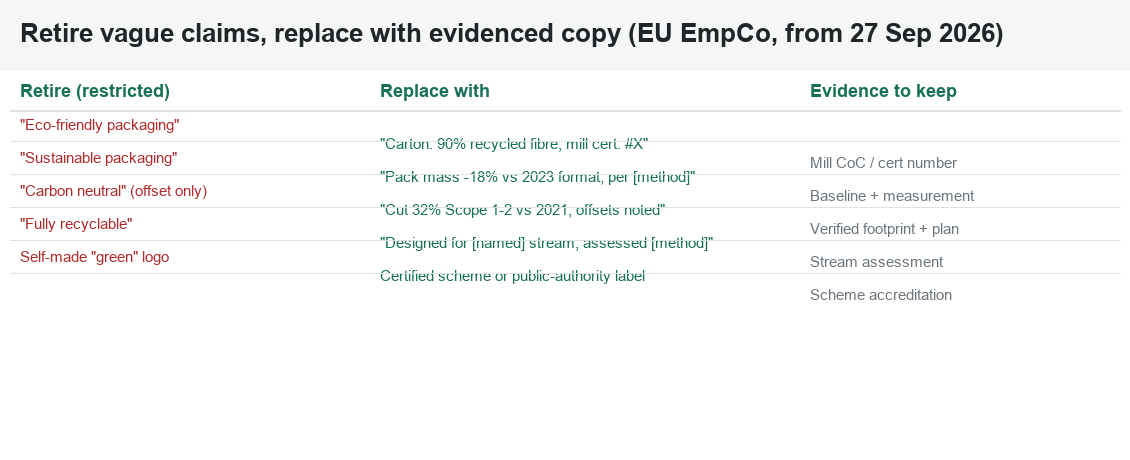
EmpCo treats generic environmental claims — “eco-friendly,” “green,” “climate neutral,” “sustainable” — as unfair unless the trader can demonstrate recognised excellent environmental performance behind the claim. Evidence alone is not enough; the claim must be specific and the performance must be outstanding. Carbon-neutrality claims based only on offsetting are restricted. Self-made sustainability labels not tied to a certification scheme or public authority are restricted too. Specific, factual, evidenced claims — for example a precise recycled percentage with a certificate number — remain permissible.
The DPP — the Ecodesign for Sustainable Products Regulation. The ESPR ((EU) 2024/1781) entered into force on 18 July 2024 and, under Article 9, makes the DPP the compliance mechanism for covered product groups. The EU Central DPP Registry went live on 19 July 2026.
For packaging buyers, the practical takeaway is: the same unique, scannable code a converter already prints for track-and-trace or retail scanning can be designed as a foundation a DPP uses — but the exact carrier format and unique identifier rules for each product group will be fixed in that group’s delegated act.
Who Has to Prepare Packaging for Green Claims and DPP
If you place products on the EU market with environmental wording or a data carrier, these rules reach you — regardless of where you are incorporated. It helps to separate three things:
- (a) Product-body carriers. A battery passport is printed on the battery itself; an electronics DPP may be on the device. That is product engineering, not label printing, and is outside what a converter supplies.
- (b) Pack or accompanying-document carriers. ESPR allows the DPP data carrier to appear on the packaging or in accompanying documentation where the product standard permits. This is what we print: a QR code on a label, carton or insert that links to the passport record.
- (c) PPWR packaging labels. The Packaging and Packaging Waste Regulation sets its own labelling and sorting requirements for packaging as packaging. Our PPWR packaging guide covers that separately.
Who is affected:
- Brands selling into the EU — any “recycled,” “compostable,” or “eco” wording on the pack is a green claim under EmpCo from 27 September 2026.
- Exporters of textiles, furniture, steel, aluminium, tyres and selected electronics — these are in the first ESPR work plan (2025–2030) and will receive DPP obligations as their delegated acts are adopted. Batteries have their own passport under Regulation (EU) 2023/1542.
- Private-label and contract manufacturers — the claim on the pack becomes your customer’s liability the moment a consumer reads it, so supplier claim sheets are now part of qualification.
- US and other non-EU sellers — EmpCo applies to claims directed at EU consumers, so a US brand shipping to the EU must comply just the same.
If your packaging already carries a QR code, a serial, or a sustainability logo, you are already touching these rules — you just need the wording and the carrier to hold up.
What Green Claims and DPP Mean for Your Label
This is the part a materials catalogue will not tell you: the label is where both rules are physically enforced.
1. The claim must be precise, not pretty. Retire vague adjectives. Replace them with a measured statement and the evidence behind it. “Sustainable packaging” becomes “reduced packaging mass by 18% versus our 2023 format, assessed per [method].” “Recyclable” becomes “designed for the [named] stream.”
2. The data carrier must be machine-readable and unique. A DPP is not a static webpage or a PDF. It needs a QR code (or NFC) on the pack linked to a unique product identifier, pointing to a record that regulators, recyclers and consumers each read at their level.
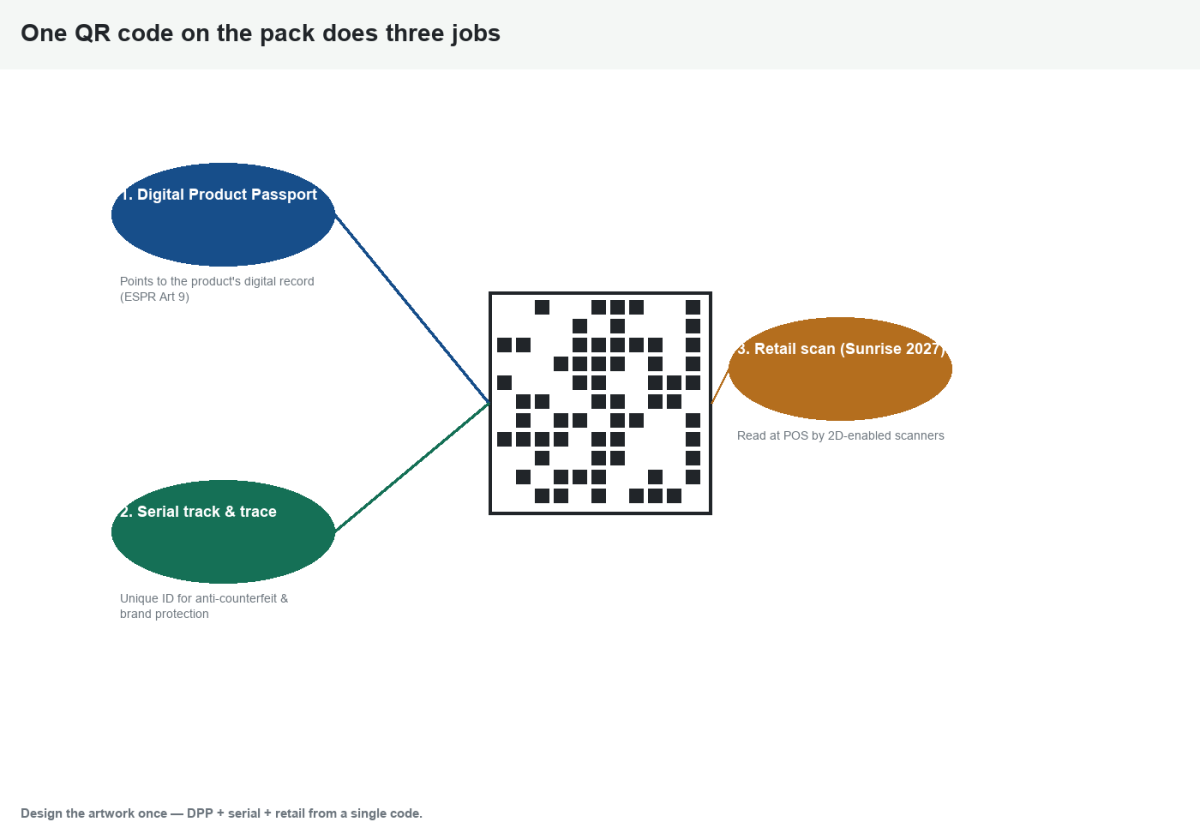
3. Design the carrier so it can serve more than one purpose. The same QR on the pack may one day serve the DPP, carry a unique serial for brand protection, and be read at retail under GS1 Sunrise 2027. We lay out the artwork so those functions can be merged later without re-printing — but the exact rules for each product group will be set in its delegated act, and a DPP portal and an anti-counterfeit verification page are usually best kept separate.
The converter’s job is to print that carrier so it actually scans on the real substrate — and to keep the claim wording inside what the evidence supports.
How We Print the Data Carrier and Claim-Ready Artwork
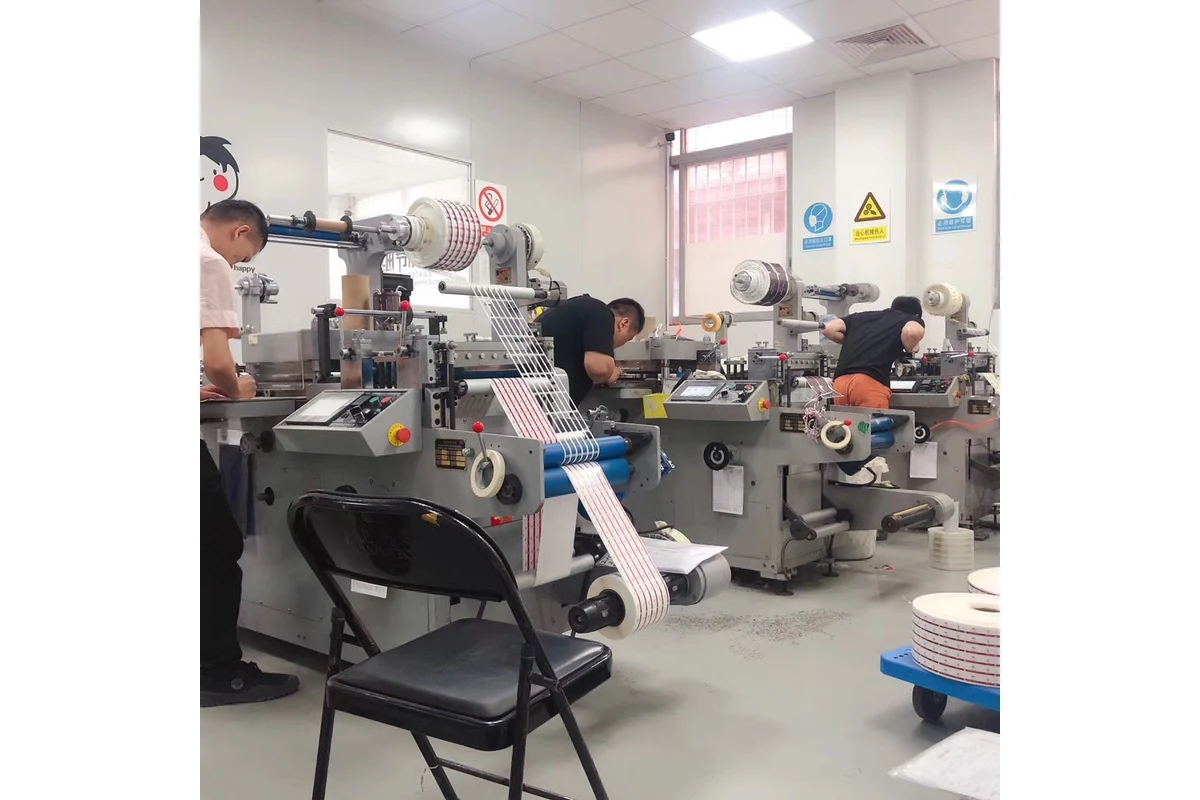
A DPP-ready label is a print job, not a sticker order. At our plant the workflow is built around the code and the copy.
Data carrier first. We generate or receive the unique identifier and encode it as a QR code. Where retail scanning is also required, we use GS1 Digital Link so the same code can serve retail and DPP systems. The code is produced with variable data printing (VDP) so each unit or batch carries its own link.
Scannability on the real material. A QR printed on foil, metallised film or a curved surface can fail the reader. We keep the scan zone on a non-reflective area and verify grading on a production sample — not a laser proof. See our anti-counterfeit QR guide and Sunrise 2027 guide for the full QR-on-foil and ISO/IEC 15415 workflow.
Claim wording support, not claim making. We help you word the pack precisely — “made with 85% recycled paper, mill certificate no. X” — but the substantiation stays with the brand and the material supplier. We do not manufacture the evidence; we print what the evidence supports.
Material statements we can stand behind. Where a claim depends on the substrate, we source from certified mills and can relay the mill’s certificate number and batch documentation where the supplier provides it. We do not hold our own FSC Chain-of-Custody and do not print the FSC trademark; the certificate travels with the paper, not with us. See our EUDR and traceable-paper buyer guide for how that works.
One artwork, future-ready outputs. We lay out the QR, serial and claim block so the file can feed DPP, serialised traceability and Sunrise 2027 without a redesign if the product group’s delegated act allows it. We then verify the code on your actual pack before production.
Inventory and Reprint Audit for Existing Pack Stock
EmpCo applies to products placed on the EU market from 27 September 2026. Several law firms have noted that packaging still within its shelf life after that date should already meet the new wording rules. That makes existing stock a hidden risk.
We run a short audit with buyers before any reprint:
- List every environmental phrase currently on the pack or in accompanying copy.
- Flag generic claims (“eco-friendly,” “green,” “sustainable,” unqualified “recyclable”).
- For each flagged phrase, either retire it or replace it with specific, evidenced wording the brand can substantiate.
- Decide whether the old stock can be used up, needs over-labelling, or must be scrapped.
- Schedule the corrected artwork so the next production run ships compliant.
This is often the fastest conversion point: a reprint with cleaned-up copy and a DPP-ready QR is cheaper than recalling or pulping non-compliant packs.
A Practical Specification Scenario
The following is an illustrative scenario, not a specific customer order. An EU-bound furniture accessories brand — a product group in the first ESPR work plan — wanted to get ahead of DPP obligations while cleaning up green-claims wording on its cartons. At the time of writing no delegated act for furniture is yet in force, so this was voluntary preparation.
We specified a 40 mm square label with a QR in a white-ink quiet zone, a unique per-batch identifier, and the claim “carton contains 90% recycled fibre, certified by mill [name], certificate [no.]” — wording the brand’s compliance lead had evidenced. The code was graded B or better on the carton board (not a flat proof) and pointed to the brand’s planned DPP record.
The change was one artwork revision scheduled into the normal reorder. It prepared the pack for a future DPP obligation, replaced vague claims with defensible copy, and kept the code retail-scannable in a single pass.
Green Claims & DPP Packaging Spec Table
| Parameter | Typical option | Why it matters |
|---|---|---|
| Green-claims rule | EmpCo Directive (EU) 2024/825, from 27 Sep 2026 | Generic claims banned unless substantiated and verifiable |
| DPP legal base | ESPR (EU) 2024/1781, Article 9 | Mandates a data carrier for covered product groups |
| Data carrier | QR code (or NFC) on pack or label | Must be machine-readable and link to the digital record |
| Unique identifier | GS1 key / unique product identifier | Ties the physical unit to its record |
| Code grading | ISO/IEC 15415 on substrate | Proof-grade is not production-grade |
| Claim wording | Specific + evidence (e.g. “% recycled, cert no.”) | Vague terms are restricted under EmpCo |
| Substrate fit | Paper / PET / foil, quiet zone off metallics | Carrier must scan on the actual material |
| Integration | One QR layout compatible with DPP, serial and Sunrise | Avoids redesign; final merge rules depend on each delegated act |
Download the Green Claims & DPP Packaging Checklist
Specifying a DPP-ready, claim-defensible label is easier with a structure. We packaged our internal intake into one checklist you can drop into your next RFQ and supplier qualification file.
Download the Green Claims & DPP Packaging Checklist (XLSX) — covering a green-claims substantiation log (claim → evidence → standard), an inventory audit column for existing pack stock, a DPP data-carrier spec (QR placement, unique ID, substrate grading), and a claim-wording sheet that retires vague terms and replaces them with precise, evidenced copy.
DPP and Green-Claims Timeline by Category
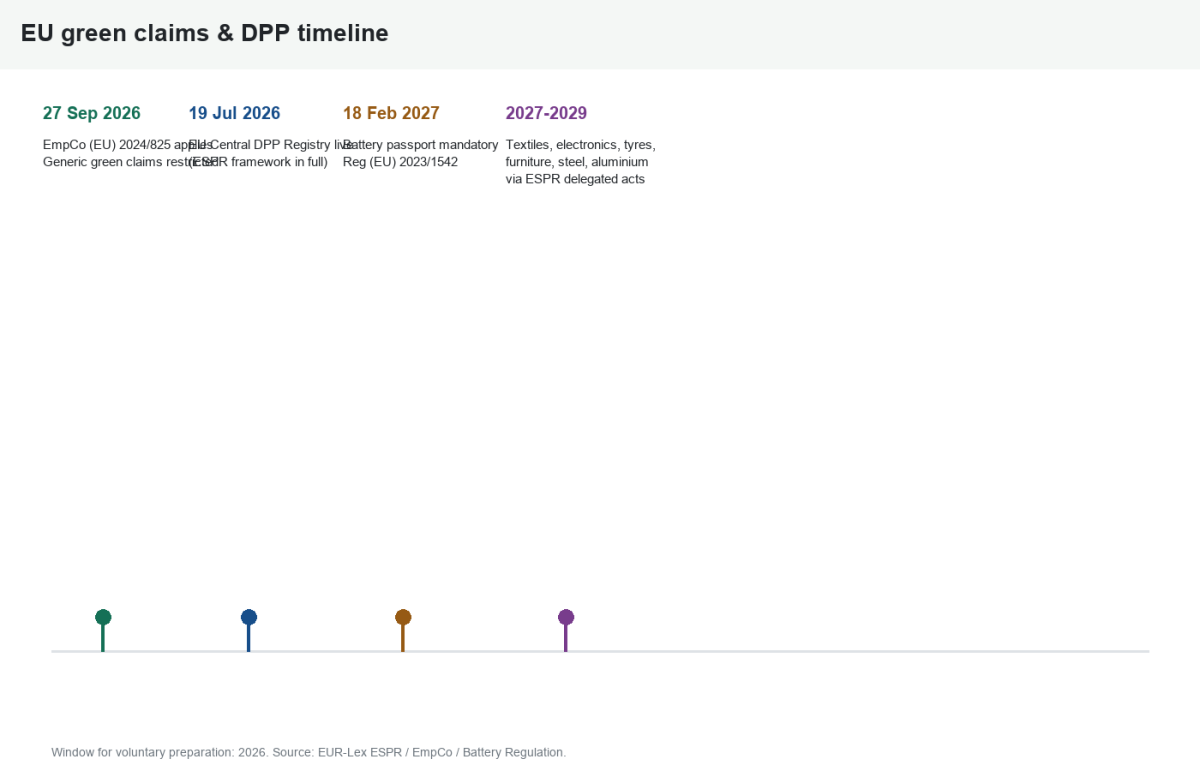
- 19 Jul 2026 — EU Central DPP Registry goes live; ESPR framework provisions are in force.
- 27 Sep 2026 — EmpCo (EU) 2024/825 applies: generic green claims restricted across the EU.
- 18 Feb 2027 — Battery passport mandatory under Regulation (EU) 2023/1542 for EV, LMT and industrial batteries above 2 kWh.
- 2026–2027 — First ESPR delegated acts expected for iron and steel (2026) and textiles/apparel (2027). Obligations usually enter into force 18–24 months after the act is adopted.
- 2028–2030 — Furniture, mattresses, tyres, aluminium, and selected electronics follow. Concrete dates will be fixed only when each delegated act is published.
EmpCo is already in effect; the DPP preparation window is 2026–2027. Retailers and trade partners are already asking suppliers about DPP readiness, so early movers avoid the scramble.
FAQ
Is the EU Green Claims Directive in force?
No. The Green Claims Directive proposal (COM/2023/166) is not in force. The Commission announced in June 2025 that it intended to withdraw the proposal, negotiations were suspended, and the proposal was not adopted. The rule that applies from 27 September 2026 is the Empowering Consumers Directive ((EU) 2024/825), which treats generic environmental claims as unfair unless the trader can demonstrate recognised excellent environmental performance behind them.
What is a digital product passport for packaging?
It is a digital record linked to the product or its packaging by a scannable data carrier — typically a QR code — carrying material, origin, environmental and compliance data. Under ESPR ((EU) 2024/1781), product groups gain a DPP obligation as their delegated acts are adopted; the pack or label carries the code.
Can a QR code on packaging serve both DPP and anti-counterfeit?
It can be designed to support both, but the two use cases are usually best kept separate. A DPP portal is aimed at regulators, recyclers and consumers; an anti-counterfeit verification page is aimed at brand protection and may include scan-count alerts. We lay out the artwork so the same physical QR can be updated or split later without a reprint, but the exact carrier standard and identifier scheme for each product group will be fixed in its ESPR delegated act.
Can we print “FSC-certified” on our packaging?
Only if you hold FSC Chain-of-Custody and are licensed to use the trademark. We do not hold our own FSC CoC. We source from certified mills and can relay the mill’s certificate number and batch documentation, but we do not print the FSC trademark. The certificate travels with the paper, not with us.
Do US brands need to comply with EU green-claims rules?
Yes. EmpCo applies to environmental claims directed at EU consumers, wherever the business is incorporated. A US brand shipping to the EU must substantiate its pack copy just like an EU brand.
What makes a green claim defensible?
A specific, measured statement with named evidence — a standard, a certificate number, a baseline and a percentage — rather than a generic adjective. “18% less packaging mass versus our 2023 format, assessed per [method]” holds up; “sustainable packaging” does not.
Related Solutions
- Sequential Numbered Labels for Anti-Counterfeit Protection
- Sunrise 2027: 2D Barcodes on Labels & Packaging
- PPWR Labelling Requirements: A Printer’s Checklist
- EUDR & Traceable Paper Packaging Buyer Guide
- US Packaging EPR Laws by State
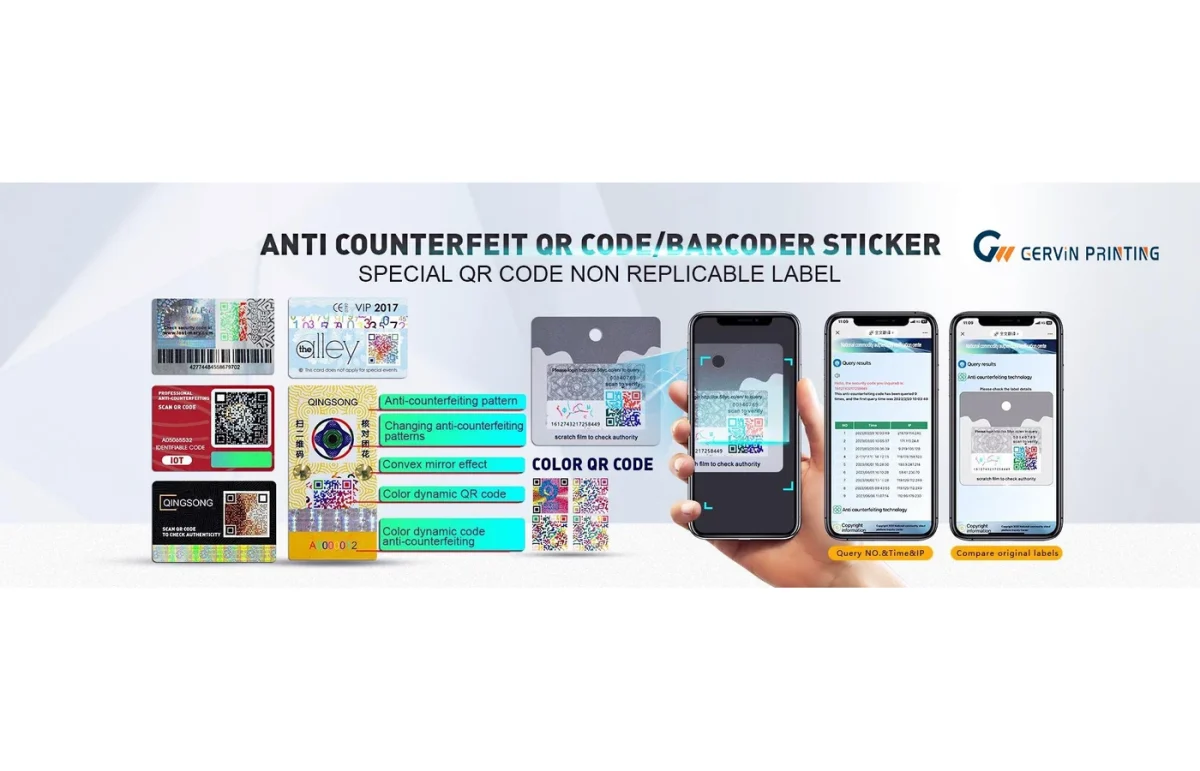
- Custom Anti-Counterfeit QR Code Labels
- Custom Hologram Stickers Specification Guide
- Custom Labels — Product Category
Get a DPP-Ready Artwork and Claim Review
If you are preparing packaging for the EU market — a DPP data carrier, a defensible green claim, or both — send us your substrate, the claim you want to make, and the evidence behind it. We will lay out a QR that can serve DPP, serial track-and-trace and Sunrise 2027 where the rules allow, word the claim precisely, and verify the code on your real pack before production. It is cheaper to specify the label once than to pull a non-compliant pack off the shelf.