
Send Your Inquiry Today
FSC Packaging Boxes: An EUDR-Ready Buyer’s Guide to Custom Boxes from China
If you ship custom packaging boxes into the European Union, two abbreviations now decide whether your shipment clears customs smoothly or stalls at the border: FSC and EUDR. This guide explains what FSC packaging actually means, what the EU Deforestation Regulation requires for paper and cardboard boxes, which board grades and documents to ask for, and how a Chinese converter prepares a box so your EU customer can file their due diligence statement without guesswork.
What Is FSC Packaging?
FSC packaging is a box, carton or sleeve made from board that carries a Forest Stewardship Council® claim — the on-product label that tells your customer the fibre inside was sourced from responsibly managed forests, recycled streams, or a controlled mix of both. The claim is not a vague marketing badge: it is printed under licence, and it must trace back through the chain of custody (CoC) — every company that handled the fibre, from forest to mill to board merchant to converter, holds (or is covered by) an FSC CoC certificate.
For a buyer, that produces one practical rule: an FSC claim on a box is only as good as the certificate number behind it. Any serious supplier can show you the certificate covering your order and you can verify any certificate number yourself in the FSC public certificate database. If a quote says “FSC available” but no number appears on the paperwork, treat it as a red flag.
One distinction that trips up a lot of buyers: the certificate that covers the board (held by the mill or paper merchant) and the certificate that allows a converter to print the FSC trademark on a finished box are different things. To put the FSC logo and claim on your artwork, the printing company must hold its own CoC certificate covering that product scope. A converter without one can still buy certified board and document the fibre — it simply may not print the mark. Ask both questions separately: “Who holds the CoC for the board?” and “Who holds the CoC for the printing?”
Do You Actually Need FSC Certification to Comply with the EUDR?
No — and this is where most buyers over-specify and over-pay. The EUDR requires three things: the product is deforestation-free (land not deforested after 31 December 2020), produced legally in the country of harvest, and covered by a due diligence statement. FSC certification is not mentioned as a requirement. Certification and third-party verification schemes are treated by the Commission as supporting evidence in risk assessment — useful, not mandatory.
So the honest decision tree looks like this:
- Your EU customer only needs to file EUDR due diligence — what matters is fibre origin data, legality and traceability documentation. Certified board helps but is not required.
- Your retailer contract or brand policy requires an FSC-claimed box — then the printing stage must be covered by a CoC certificate, and the claim must be printed under licence.
- You just want the sustainability story — recycled content, plastic-free coatings and paper-based inserts deliver most of the marketing value at a fraction of the administrative cost.
The EUDR for Paper and Cardboard Packaging: Dates That Matter
The EU Deforestation Regulation (EUDR), Regulation (EU) 2023/1115, requires that products placed on the EU market — including paper and paperboard packaging made from wood pulp — come from land that was not deforested after 31 December 2020, and that they were produced legally in the country of harvest. The full legal text is on EUR-Lex, and the Commission’s implementation hub for the Deforestation Regulation tracks guidance and deadlines.
Here is the detail most blogs still get wrong: the application dates were postponed. Under the December 2025 amendment (Regulation (EU) 2025/2650), the current schedule is:
- 30 December 2026 — large and medium operators and traders must file due diligence statements (DDS) before placing boxes on the EU market.
- 30 June 2027 — micro and small enterprises must comply.
- The 31 December 2020 cut-off date has not moved — fibre must always trace to non-deforested land.
The European Commission’s official EUDR guidance document also confirms the point that matters for your product: packing and packaging materials are in scope. Your folding carton, rigid box or corrugated shipper is not exempt just because it is “only packaging”.
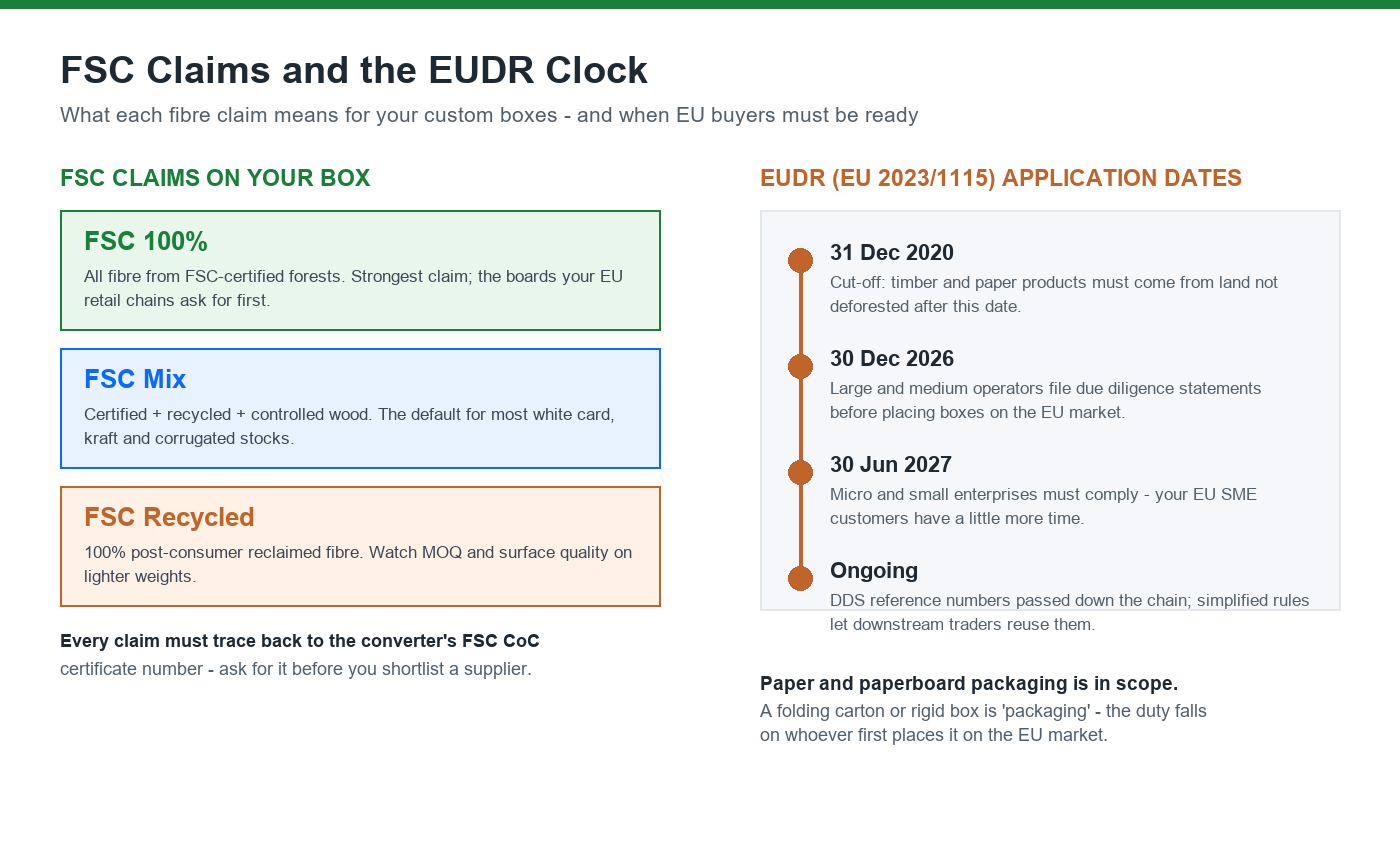
FSC claims on your box vs the EUDR clock — the dates were pushed to 30 Dec 2026 (large operators) and 30 Jun 2027 (micro and small enterprises).
Who This Hits: From EU Importers to Amazon Sellers
The due diligence duty formally falls on the first operator that places the boxes on the EU market — usually your EU importer, distributor, or you-as-seller if you ship DDP. Downstream operators collect and pass on the DDS reference number instead of re-filing. In practice that means:
- DTC and e-commerce brands ordering mailer boxes and folding cartons from China need supplier data that their EU entity or 3PL can file.
- Cosmetics, supplements and electronics brands selling through EU retail chains face FSC questions in vendor onboarding — many chains now ask for the claim and certificate number at line review.
- Wine, spirits and gift brands ordering rigid boxes discover that magnets, plastic windows and EVA foam inserts complicate both recyclability claims and the fibre story.
What the EUDR Means for Your Box: Fibre, Claims and Recyclability
Translated to the box itself, the regulation touches four things:
- Fibre origin. The board in your box must trace to plots of land that were forest on 31 December 2020 and remain forest. This data comes from the mill or paper merchant — not invented by the converter — so your supplier’s board sourcing route matters more than their marketing copy.
- Whether you need a claim at all. FSC 100%, FSC Mix and FSC Recycled each carry different rules (next section) and each requires a certified production route to print the mark. Many EUDR filings need the fibre data, not a printed logo — decide which one you are buying.
- Recyclability of the structure. EUDR covers where fibre comes from; PPWR and EU market expectations cover what happens to the box afterwards. A plastic laminated surface, PVC window or heavy magnet does not break EUDR rules — but it undermines the sustainable story and future PPWR recyclability grades.
- Documentation, not vibes. An EU importer cannot file due diligence on a supplier’s word. The documents in the next section are what turn “we are sustainable” into a filing.
FSC 100% vs Mix vs Recycled: Which Claim Belongs on Your Box?
- FSC 100% — all fibre from FSC-certified forests. The strongest claim; some EU retail chains and luxury brands specify it by default. Certified 100% stocks are a narrower range, so expect fewer gsm options and a modest premium.
- FSC Mix — certified fibre blended with recycled and controlled wood. This is the default reality for most white card (SBS/C1S), kraft and corrugated stocks, and it satisfies most vendor requirements.
- FSC Recycled — 100% reclaimed fibre. Strong sustainability story; watch surface quality and colour consistency on lighter weights, and note that some recycled boards are produced in shorter runs, which affects MOQ.
Two specification rules that save money: first, ask for the claim and the certificate number on every quote; second, keep the claim consistent across all components of your packaging set — a box lid marked FSC 100% glued to a base made of non-certified board is a claim risk, not a compliance strategy.
What Your Supplier Must Hand Over: EUDR Due Diligence Documents
Your EU customer’s filing is only as complete as the data flowing up the chain. As a converter we sit at the end of that chain, so this is the document set we prepare — and the set you should put in every RFQ:
- Fibre origin data — geolocation of harvest plots for the fibre in your board, supplied by the mill or paper merchant.
- Chain-of-custody certificate — the certificate covering the board (mill or merchant), verifiable in the public database; plus the converter’s own CoC if the FSC logo will be printed.
- Deforestation statement — written confirmation that the fibre comes from land not deforested after 31 December 2020.
- Board technical data sheet — grade, gsm, recycled content percentage, coatings and inks; this also feeds PPWR labelling data later.
- Packaging compliance data — material composition per box so your customer can file and report correctly.
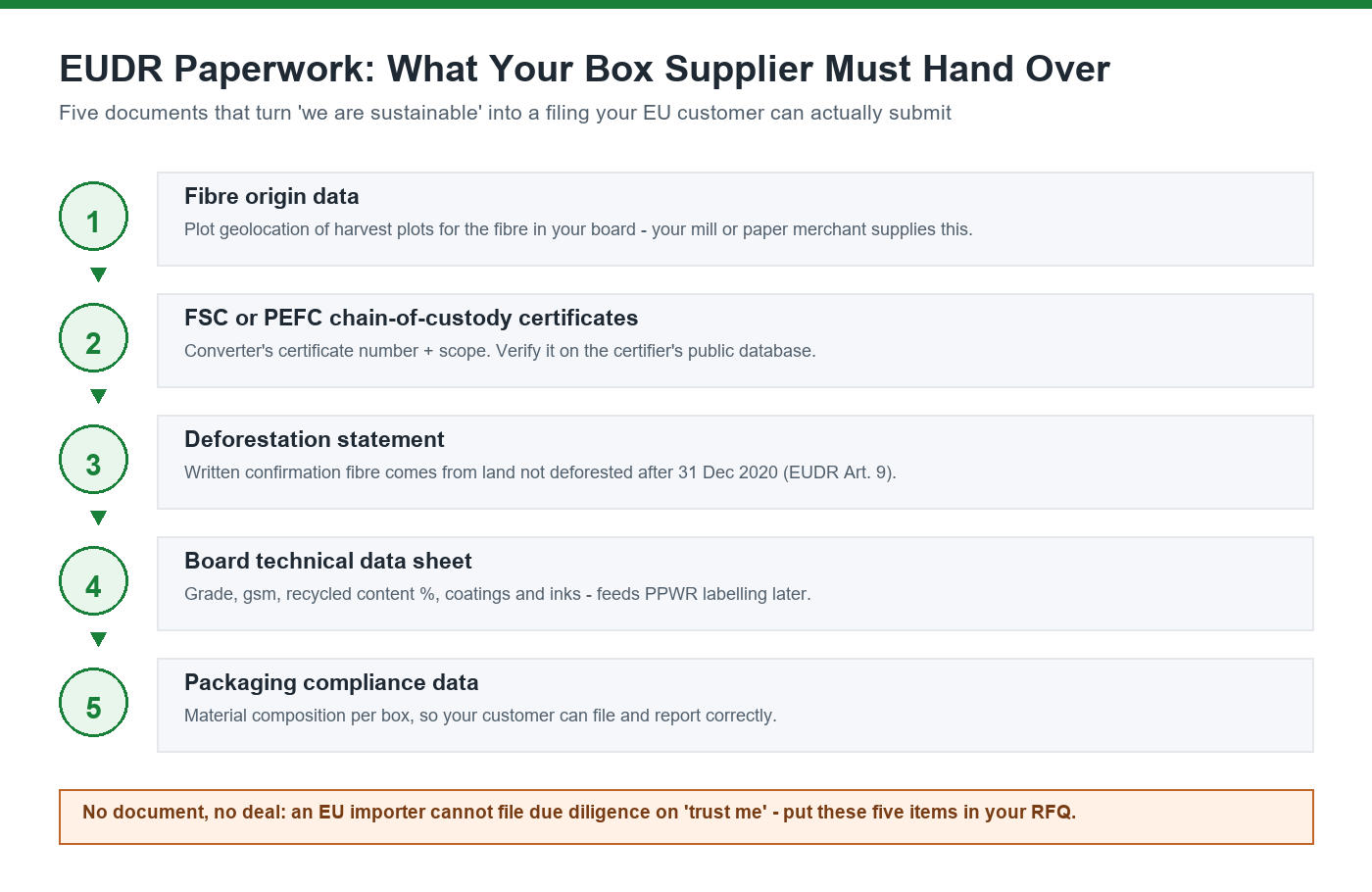
Five documents that turn “we are sustainable” into an EUDR filing your EU customer can actually submit.
📋 EUDR & FSC RFQ Checklist (copy into your next inquiry)
- Box style + dimensions (L×W×D) and structural drawing or dieline
- Board requirement: FSC claim level + gsm (e.g. “FSC Mix, 350 gsm white card”)
- CoC certificate number for the board (mill or merchant) + batch purchase documents; and confirm who holds CoC for printing if you want the logo on the box
- Finishes: foil / emboss / spot UV / matte or gloss lamination (state plastic-free if recyclability matters)
- Insert type: moulded pulp, corrugated, paper card — or EVA/foam (flag recyclability trade-off)
- Print: CMYK + Pantone spots, interior print, food-contact spec if applicable
- Requested documents: board TDS, deforestation statement, compliance data sheet
- Quantity, target unit cost, and destination country (for DGFT/customs planning)
Corrugated Board Grades Explained: F, E, B, C and BC Flutes
Board grades are where most custom box inquiries go vague — and where compliance-minded buyers get precise. Folding cartons use white card or kraft in the 250–400 gsm range; rigid boxes are built on 1,000–1,500 gsm greyboard wrapped in printed paper; corrugated boards are specified by flute — the wave-shaped layer that gives the board its stiffness:
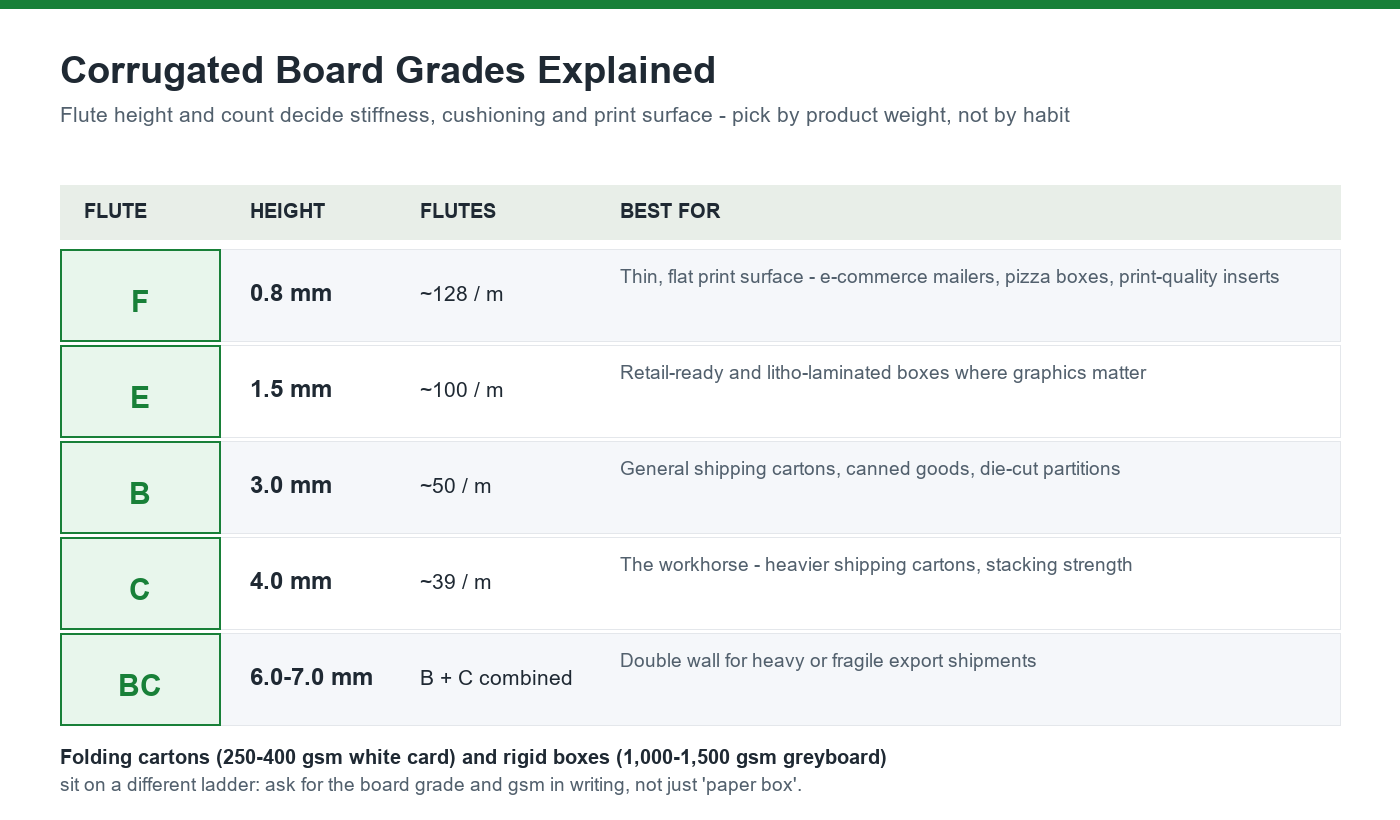
Corrugated board grades explained — flute height and count decide stiffness, cushioning and print surface.
- F-flute (0.8 mm) — thin and flat; e-commerce mailers, pizza boxes, print-quality inserts.
- E-flute (1.5 mm) — retail-ready and litho-laminated boxes where graphics matter.
- B-flute (3.0 mm) — general shipping cartons and die-cut partitions.
- C-flute (4.0 mm) — the workhorse for heavier cartons and stacking strength.
- BC double wall (6–7 mm) — heavy or fragile export shipments.
For an EUDR-facing buyer the flute choice has a hidden compliance angle: corrugated is typically high in recycled content, which supports both your recyclability story and the FSC Recycled claim route — but recycled content percentages must be documented by the mill, so ask for the board TDS rather than a verbal “yes, it’s recycled”.
How We Handle Certified Board and EUDR Data
Transparency first, because it decides what you can promise your EU customer: we are a printing and converting factory, and we do not currently hold our own FSC chain-of-custody certificate. That means we do not print the FSC trademark on finished boxes. What we do instead, every day, is source board from certified mills and pass the fibre documentation up the chain. Here is the workflow:
- Certified board sourcing. We buy white card, kraft, greyboard and corrugated from mills and board merchants that hold FSC (or PEFC) chain-of-custody certificates. On request we order against certified stock and hand you the mill or merchant certificate number plus the purchase documentation for your batch — the evidence your EU filing actually needs.
- Document pack per order. Board technical data sheet (grade, gsm, recycled content), the fibre origin statement your customer’s due diligence needs, and the certificate covering the board. You verify the number yourself in the public database — no trust required.
- Prepress honesty. We will not place a claim or logo on artwork that our production cannot support. If your brand requires the FSC mark printed on the box, we tell you at quote stage and help you route it: either through a certified partner converter for that run, or by planning our own CoC certification before your launch date.
- Printing and finishing. Offset CMYK with Pantone spot colours; foil, emboss and spot UV as usual. For recyclability-focused EU markets we recommend water-based coatings and plastic-free finishes.
- Structure and inserts. Folding cartons, rigid boxes and corrugated shippers with pulp, corrugated or card inserts — we quote foam inserts as an option and flag the recyclability trade-off so you decide with data.
Should we get certified? If a meaningful share of your EU orders starts requiring the printed claim, the answer is yes — CoC certification is an audit against a documented system (purchasing, storage, job records, claim control), accredited bodies quote by site, and most converters complete it within a couple of months. We are happy to run through the process with a customer whose volume justifies it; ask us and we will scope it with you.
A Real Order: The German Skincare Set That Shipped Without the Logo
A German skincare brand asked for a two-piece rigid set for a holiday launch and assumed the box needed the FSC logo printed on the base. Reading their actual requirement, their obligation was EUDR due diligence data for their importer’s filing — not a certified claim on the artwork. We re-quoted the job on certified board from a mill whose certificate and fibre data we could hand over with the order, kept the artwork clean of any claim we could not support, and shipped a document pack the brand filed without a single follow-up question. Cost impact: a small premium for the certified stock, none of the administrative overhead of a licensed claim. The lesson we repeat to every buyer: decide whether you need the logo or the data — they are different purchases, and many brands only need the data.
Custom Box Specification Table (Copy Into Your RFQ)
| Parameter | What to State | Why It Matters |
|---|---|---|
| Box style | Folding carton / rigid / corrugated mailer; dieline if you have one | Decides process, tooling and lead time |
| Board + claim | e.g. “FSC Mix 350 gsm white card” or “E-flute FSC Recycled” | EUDR fibre traceability + FSC claim control |
| Dimensions | L×W×D in mm, tolerance ±0.3–0.5 mm | Fitting, freight cost, pallet utilisation |
| Printing | CMYK + Pantone spots; inside print yes/no | Colour consistency across production runs |
| Finishes | Foil / emboss / spot UV / matte-gloss lamination | Brand impact; plastic-free option for recyclability |
| Insert | Pulp / corrugated / card — or EVA/foam (flag trade-off) | Protection vs recyclability story |
| Documents | Board TDS, fibre origin statement, mill/merchant CoC number | Your EU customer’s EUDR filing depends on it |
| Quantity | Volume + reorder schedule | MOQ and unit price curve (typically 1,000+) |
Common Mistakes That Delay EU Shipments
- Claiming FSC on artwork without a certified production route. The logo can only be printed when the converting stage is covered by a CoC certificate. Decide at RFQ stage whether you need the mark at all — many orders only need the fibre data.
- Buying “FSC board” with no certificate attached. Ask who holds the certificate (mill, merchant or converter) and get the number plus the batch documentation.
- Assuming the old EUDR dates. Deadlines moved to 30 December 2026 / 30 June 2027 — plan sampling and certification accordingly, and cite current sources, not 2024 blog posts.
- Mixing claims across components. Lid FSC 100% + base non-certified is a violation waiting for an audit.
- Ordering “recycled” without documentation. Recycled content is a data point from the mill, not an adjective.
- Ignoring the insert. Foam inserts quietly undermine an otherwise compliant, recyclable packaging set.
- Treating EUDR as an EU-supplier problem only. Non-EU factories are not regulated directly — but your data quality decides whether your EU customer can file at all.
FAQ: FSC Packaging and EUDR for Custom Boxes
Does the EUDR apply to paper and cardboard packaging?
Yes. Paper and paperboard products derived from wood pulp are in the scope of Regulation (EU) 2023/1115, and the Commission’s guidance explicitly confirms that packing and packaging materials are covered when placed on the EU market.
What paperboard is used for folding cartons?
Typically SBS (solid bleached sulphate), C1S/C2S coated boards, and kraft — most quoted in the 250–400 gsm range. For FSC claims, the same grades exist with certified fibre; ask for the claim level and gsm in writing.
Are folding cartons recyclable?
Generally yes — paperboard is among the most widely recycled packaging materials in EU collection streams. Recyclability drops with plastic lamination, heavy foil coverage and non-paper inserts, so specify water-based coatings and paper-based inserts when recyclability matters.
Is FSC certification mandatory for EU packaging?
No. The EUDR does not require FSC or any specific certification scheme — it requires deforestation-free, legally produced fibre covered by a due diligence statement. Certification is supporting evidence in risk assessment. FSC becomes mandatory only when a contract or brand policy requires the certified claim on the box, which also requires the printing stage to be covered by a chain-of-custody certificate.
Can a supplier without its own FSC CoC certificate still deliver EUDR-ready boxes?
Yes — provided the board is sourced from a certified mill or merchant and the documentation travels with the order: the certificate number covering the board, the fibre origin statement and the board technical data sheet. What such a supplier cannot do is print the FSC trademark on the box. If your retail contract requires the printed logo, ask at quote stage; a straightforward supplier will tell you immediately and propose either a certified partner for that run or a plan to get certified.
How much do custom boxes cost?
Folding cartons typically start around a few hundred USD per thousand at 1,000+ units depending on size and finishes; rigid boxes cost more due to manual assembly. FSC-certified board usually adds a low-single-digit percentage — treat it as insurance on your EU market access, not a luxury.
Does the EUDR apply to small businesses?
Yes, but later: micro and small enterprises must comply from 30 June 2027 (30 December 2026 for categories already covered by the EU Timber Regulation). Small status also unlocks simplified declarations.
Get an EUDR-Ready Box Quote
Send us your dieline (or just the product dimensions) and tell us what you actually need — the fibre data for your EU filing, or the printed claim. We will quote the board route, hand over the mill certificate number and document pack your EU customer needs, say plainly what we can and cannot print, and send a free physical sample before you commit to production.
👉 Request a free sample and quote
Related Reading
- Cardboard Packaging Boxes: Types and Specs
- Custom Corrugated Boxes by Industry
- Folding Carton Sample Approval Checklist
- How to Reduce Risks When Customizing Paper Box Packaging
- Guide to Kraft Paper Bags
- Browse Our Custom Packaging Boxes