
Send Your Inquiry Today
Custom Anti-Counterfeit QR Code Labels for Brand Protection & Supply Chain Security
Counterfeiting isn’t a fringe problem anymore — it’s a line item. According to a joint OECD-EUIPO study, global trade in counterfeit and pirated goods was valued at roughly USD 467 billion in 2021, accounting for 2.3% of world imports. Every year, fake goods siphon billions away from legitimate manufacturers, and the damage rarely stops at lost revenue. A single batch of counterfeit electronics, mislabeled pharmaceuticals, or knock-off spare parts can trigger warranty disputes, regulatory penalties, and a level of customer distrust that takes years to repair.
For EU shipments, check our PPWR labelling requirements checklist: what must appear on the pack from 12 August 2026, and what only bites in 2028 and 2030.
The old fix — a printed sticker with a logo and maybe a serial number — doesn’t hold up anymore. Standard labels are cheap to replicate, easy to peel and reapply, and offer no way to verify authenticity beyond “it looks about right.” That’s not a security measure; it’s a formality.
What’s replacing it is a different approach: labels that combine physical tamper-evidence with digital, one-item-one-code traceability. A custom anti-counterfeit QR code label does two things a plain sticker can’t — it shows visible proof if someone has tried to remove or swap it, and it lets anyone with a smartphone confirm, in real time, that the product in their hands matches what’s registered in the manufacturer’s database. For brand owners selling into markets with real counterfeiting pressure, this has become less of an upgrade and more of a baseline expectation.
What Makes a QR Code Label Truly Anti-Counterfeit?
Not every label with a QR code on it qualifies as “anti-counterfeit.” The distinction comes down to two layers working together.
The first is physical. The label itself is built to resist tampering — through the substrate, the adhesive, or both — so that any attempt to remove, transfer, or duplicate it leaves visible evidence.
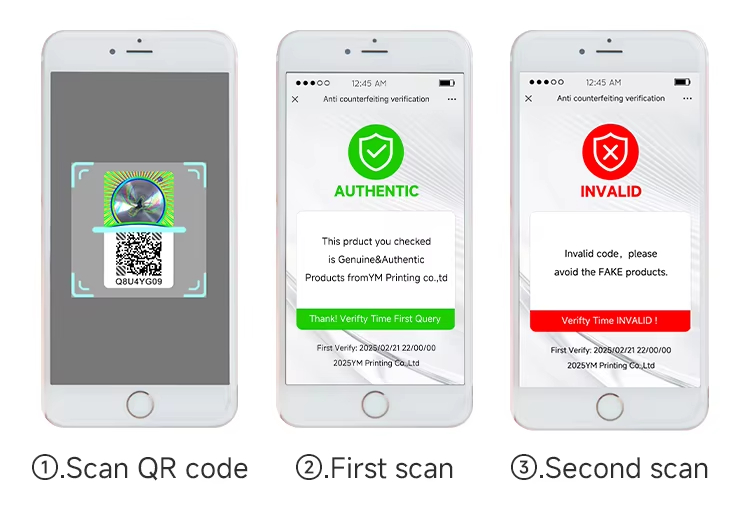
The second is digital. Each label carries a unique, often encrypted code tied to a specific product unit and linked to a cloud database. When a distributor, retailer, or end customer scans the code, they’re not just seeing a static image — they’re pulling live data: production batch, shipping origin, activation status, and whether that code has already been scanned somewhere else. That last point matters more than people expect. A code that’s been scanned in one country and then shows up “unused” in another is often the first sign of diversion or gray-market resale.
Put the two layers together and you get a label that’s hard to copy and easy to check — which is really the whole point.
Key Material & Technical Features of Security Labels
The engineering behind these labels is where the real differentiation happens. A few features come up again and again in B2B specifications.
Tamper-Evident VOID Tags
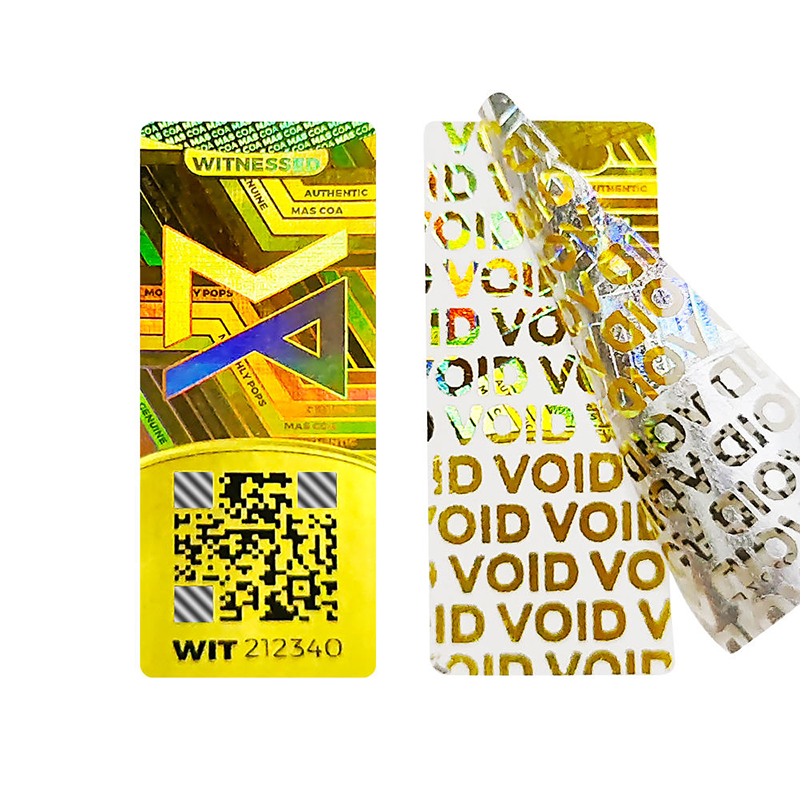
A void tag is designed to fail visibly. If someone tries to peel it off — whether to reapply it to a different product or simply to inspect the adhesive — the label fractures and leaves a permanent “VOID” pattern behind on both the surface and the substrate. There’s no clean removal, no way to reset it, and no way to disguise that it’s been tampered with. For products that pass through multiple hands before reaching the end customer, this single feature does a lot of the security work on its own.
Waterproof & Heavy-Duty Vinyl Substrates
Labels that look great on a factory bench don’t always survive a six-week ocean freight route, a chemical warehouse, or an outdoor storage yard. That’s why industrial vinyl substrates matter — they’re built to resist moisture, abrasion, and UV exposure so the QR code stays scannable after the kind of handling that would fade or peel a standard sticker. For exporters shipping into humid climates or industries like agrochemicals and marine equipment, this isn’t a nice-to-have; it’s the difference between a functioning traceability system and a label nobody can scan by the time it reaches the buyer.
Serialized QR + Barcode Integration
Many manufacturers still run warehouse management systems built around traditional 1D barcodes, while customer-facing verification runs through QR codes on a phone. Rather than forcing a choice, a well-designed label carries both — a linear barcode for internal logistics scanning and a serialized QR code for authentication. Many manufacturers structure this dual-code layout around GS1 barcode and traceability standards, which most warehouse and retail scanning systems already recognize. One label, two functions, no need to redesign existing warehouse workflows.
Strategic Business Benefits for Global Brands
For a B2B buyer evaluating whether this is worth the added cost per unit, the value tends to land in a few concrete places.
- Revenue protection. Blocking counterfeit and diverted “gray market” goods keeps genuine products from competing against cheaper fakes carrying your own branding.
- Supply chain traceability. Every scan generates a data point, which means a manufacturer can trace a product from the production line to the point of sale — and pinpoint exactly where in the chain something went wrong if a problem shows up.
- Consumer trust. Giving buyers a simple way to self-verify authenticity turns a passive purchase into an active confirmation, which builds confidence, particularly in categories where counterfeiting is common knowledge among consumers.
- Regulatory compliance. In regulated industries, serialized labeling isn’t optional. Pharmaceutical and medical device manufacturers selling into the U.S. market, for example, need packaging and labeling that aligns with FDA requirements — including the FDA’s Drug Supply Chain Security Act (DSCSA) provisions around product identification and traceability. A properly engineered QR label, with unique serialization and tamper-evidence built in, can be structured to support these documentation and track-and-trace obligations rather than working against them.
Industry Use Cases
The specific application shifts depending on the industry, but the underlying logic — physical tamper-evidence plus digital verification — stays consistent.
Electronics & Hardware. Component manufacturers use serialized labels to cut down on warranty fraud, where used or defective parts get returned as if they were new, or counterfeit components enter the supply chain disguised as originals.
Pharmaceuticals & Healthcare. This is arguably the highest-stakes category. Packaging needs to prevent tampering and substitution while meeting FDA labeling and serialization standards. A tamper-evident QR label supports both goals at once — patient safety and regulatory documentation — which is a big part of why pharma has been an early and consistent adopter of this technology.
Luxury & Retail Goods. High-end spirits, cosmetics, and fashion goods rely on anti-counterfeit labels to protect brand reputation as much as revenue, since a customer who unknowingly buys a fake tends to blame the brand, not the counterfeiter.
Automotive Parts. Spare parts and components need traceability for both quality control and compliance, particularly where a failed part could trigger a safety issue or a warranty claim years down the line.
Deployment Options: Factory Pre-Printed vs. On-Demand Printing
There isn’t one correct way to implement this — it depends on production volume, how much customization is needed, and where the labeling happens in the manufacturing process.
Pre-printed custom labels work well for brands that want higher-tier security features baked in from the start — UV-reactive inks, holographic overlays, micro-text — features that require specialized printing equipment most factories don’t have in-house. These are produced in bulk by a label manufacturer and shipped ready to apply.
On-demand printing systems suit manufacturers who need to generate variable data — unique serial numbers, batch codes, expiration dates — directly on the production line. This usually means investing in industrial-grade label printers integrated with the production workflow, but it gives far more flexibility for smaller batch runs or frequent product variations.
Most mid-size to large manufacturers end up using a mix: pre-printed labels with advanced security features for flagship products, and on-demand printing for higher-volume or fast-changing SKUs.
Conclusion
Counterfeiting isn’t going away, and the manufacturers absorbing the biggest losses are usually the ones still relying on labels that offer no real way to verify authenticity. A custom anti-counterfeit QR code label — tamper-evident, weather-resistant, and tied to a live traceability system — turns packaging from a passive brand element into an active line of defense across the entire supply chain, from the factory floor to the FDA-regulated shelf.
Ready to secure your product supply chain? Contact our engineering team today to request custom sample kits and tailored quote options.
Frequently Asked Questions
How does serialized QR verification actually stop fakes?
Every code is unique (one code per label) and links to a verification system. When a buyer scans it, the system checks the code against the issued database and can show first-scan location and time. A copied label prints the same code many times, and the system flags repeat or impossible scans as suspect. We handle the serialized printing and can provide a reference verification architecture.
Can QR and VOID tamper evidence be combined on one label?
Yes, and it is one of our common builds. The VOID layer leaves a permanent “OPENED” message when lifted, while the serialized QR stays readable (or is destroyed with the substrate) so a removed label cannot be reapplied elsewhere. We laminate or register the two features so they survive handling together.
Factory pre-printed vs on-demand printing — which fits my operation?
For stable, high-volume SKUs, factory pre-printed labels are cheaper and more consistent. For variable or lower-volume runs, on-demand printing works better — we can supply pre-secured blank security stock plus the serialization software so you print what you need. We will recommend the split based on your volumes and changeover frequency.
What if someone photocopies or reuses my QR label?
One-code-per-item plus the verification system’s scan history is the main defense: a reused or cloned code triggers an alert on the second scan. Adding a scratch-off layer or a VOID base makes physical reuse harder. For high-risk products we can add a covert or forensic layer that a copier cannot reproduce.
Will the labels survive cold chain, outdoor use or rough handling?
We build them for the environment. Waterproof synthetic substrates with a durable adhesive and lamination handle moisture and abrasion; a frost-resistant adhesive is used for cold chain; UV-stable varnish protects outdoor exposure. We can run an adhesion and weather test on your samples before the full order.