
Send Your Inquiry Today
How Custom Security Labels Are Made: Inside a Security Label Factory
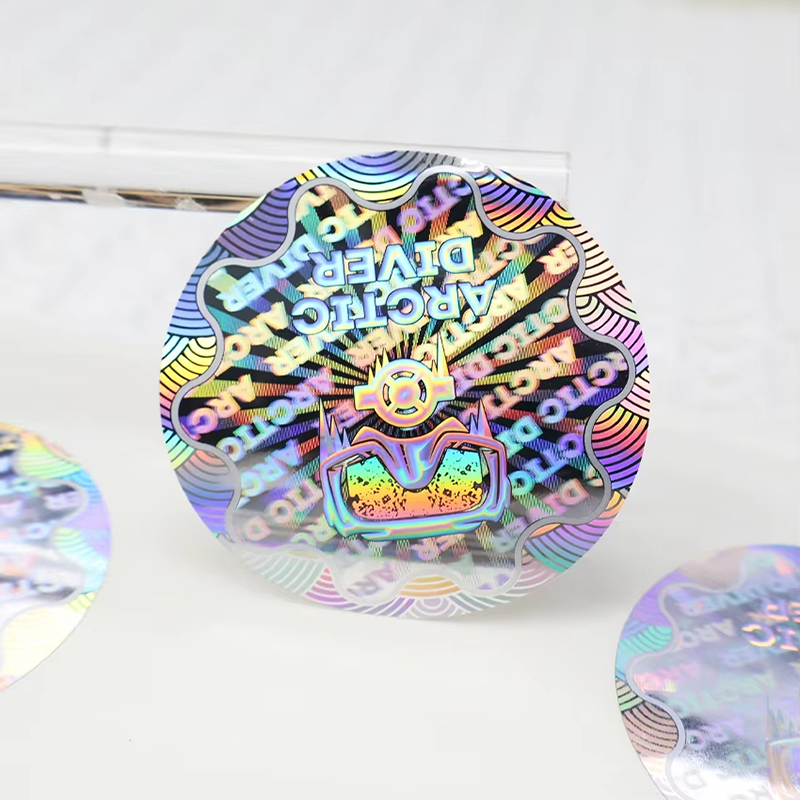
Counterfeit products, supply chain fraud, and warranty abuse cost global businesses over $4.5 trillion annually. The right security label strategy is no longer optional – it is a fundamental layer of product integrity.
Companies today operate in supply chains that span dozens of countries, multiple distribution tiers, and millions of individual consumer touchpoints. In that environment, a label is no longer just a brand identifier. It is a verification mechanism, a tamper record, and a chain-of-custody document all in one. Custom security labels provide the infrastructure for product authentication at every stage of the product lifecycle.
Why Product Security Matters More Than Ever
The Growing Cost of Counterfeit Products
The International Chamber of Commerce estimates that global losses from counterfeiting and piracy will reach $4.5 trillion by 2025. For branded goods manufacturers, the damage is not limited to lost revenue. Counterfeit products undermine consumer safety, erode hard-earned brand equity, and create significant legal exposure when defective fakes injure end users.
In sectors like pharmaceuticals, cosmetics, and electronics, the consequences are especially acute. A counterfeit medication or a fake battery pack is not just a brand problem. It is a public health and safety risk that regulators increasingly expect companies to address proactively.
The question for brand managers is no longer whether to invest in product authentication. It is which layer of protection provides the highest deterrence for their specific risk profile.
Challenges in Modern Supply Chains
Even without organized counterfeiting operations, supply chain complexity creates vulnerability. Parallel imports, unauthorized distribution channels, and product diversion mean that genuine goods sometimes reach consumers through routes that bypass quality controls, warranty terms, or regional compliance requirements.
Serialized labels and track-and-trace features allow brands to identify exactly when and where a product left its authorized channel, giving procurement and compliance teams the data they need to act.
Consumer Expectations for Product Authentication
Sophisticated consumers, particularly in premium and health-sensitive categories, now actively seek verification. QR-based authentication, consumer-facing verification portals, and NFC-enabled labels are no longer premium features. They are rapidly becoming baseline expectations in categories from luxury skincare to infant formula.
Key Insight
Brands that deploy consumer-facing authentication tools report measurably higher repurchase intent and stronger trust scores. Verification is becoming a consumer touchpoint in its own right, not just a security measure.
How Custom Security Labels Support Product Protection
Modern security labels are not single-function. A well-designed label can deliver multiple protective layers simultaneously, each addressing a different threat vector in the product journey.
Authentication
Visual and digital features allow distributors, inspectors, and consumers to confirm product genuineness at the point of inspection, without specialized equipment.
Tamper Detection
Tamper evident labels provide irreversible physical evidence of unauthorized access. Once a tamper-evident seal is broken, the record is permanent, protecting both the brand and the downstream buyer.
Traceability
Unique serialized identifiers, including barcodes, QR codes, and data matrix codes, link each physical unit to a specific production batch, shipment record, and distribution path.
Consumer Verification
Smartphone-scannable features allow end users to verify authenticity themselves, generating purchase trust data and closing the feedback loop for brand teams.
Security Features Used in Modern Security Labels
Each security label technology addresses a different combination of threat levels, budgets, and product categories. Understanding the distinct role of each feature type is essential to selecting the right solution.
Custom Hologram Labels
For the full specification checklist — origination, artwork layers, material options and MOQ — see our custom hologram sticker specification guide.
Hologram labels remain the most universally recognized visual authentication device in global commerce. Their optical complexity, including diffraction gratings that shift with viewing angle, makes mass reproduction prohibitively costly for counterfeiters while enabling instant verification by any trained distributor or end user. Manufacturers active in this space are often affiliated with industry bodies such as the International Optical Technologies Association (formerly IHMA), which maintains quality and authenticity standards for the hologram industry.
Modern holographic security goes well beyond standard rainbow effects. Custom hologram labels can incorporate:
- 2D/3D composite holograms with embedded brand imagery
- Dot matrix holograms with precise pixel-level control
- Nano text and micro-print features readable only under magnification
- Sequential serial numbering integrated into the holographic layer
- Customized substrates for tamper-evident destruction on removal
Custom Tamper Evident Labels
Tamper evident labels provide visible, irreversible proof that a product or package has been opened or interfered with. Unlike hologram labels, which authenticate the product, tamper evidence authenticates the packaging state. Used together, they address the full spectrum of product integrity threats.
Common tamper evident label options include:
- Destructible vinyl labels that fragment on removal
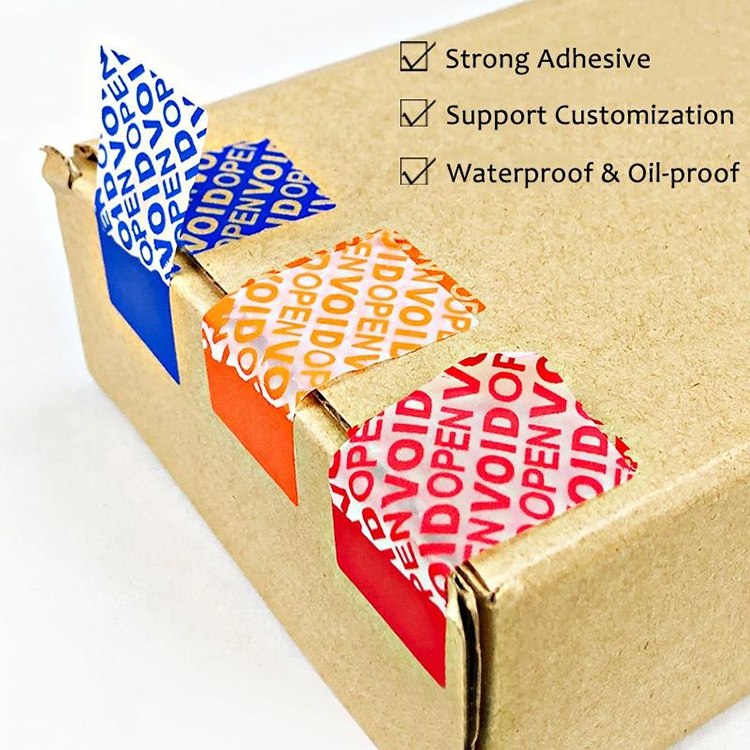
- Peel-and-reveal labels showing hidden “VOID” or custom messages
- Security seals for cartons, pallets, and secondary packaging
- Residue-free tamper evidence for sensitive surfaces
Custom Void Labels
Void labels use a pressure-sensitive adhesive layer that transfers a hidden “VOID OPEN” message, or a custom message, onto the substrate when the label is removed. The label itself also shows the message, making tampering immediately apparent from both sides.
Void label applications include:
- Standard “VOID OPEN” checkerboard pattern transfer
- Custom hidden message engineering for brand-specific language
- Asset protection labels for electronics, medical devices, and IT hardware
- Warranty seal applications where evidence of repair is legally significant
Anti Counterfeit Packaging Labels
Anti-counterfeit labels combine physical security features with digital infrastructure, including serialized codes, QR-based verification portals, and variable data printing, to create a product authentication system rather than just a label. Each unit carries a unique identifier that maps to a verified database record.
Anti-counterfeit label features can include:
- Unique QR codes linked to cloud-based authentication portals
- Serialized 2D barcodes and data matrix codes for track-and-trace programs
- Variable data printing (VDP) for batch-level or unit-level serialization
- Covert UV features readable only under UV light and invisible at retail
Selecting the Right Security Solution for Your Industry
The optimal security label strategy depends significantly on the specific risk profile of each product category. The table below maps industry applications to recommended feature combinations, based on the most common authentication, regulatory, and supply chain requirements.
Pharmaceuticals Primary risk: Patient safety and regulatory compliance Recommended solutions: Serialization, tamper evident labels, track and trace. In the United States, these programs are shaped directly by the FDA’s Drug Supply Chain Security Act, which mandates electronic, package-level traceability for prescription drugs.
Cosmetics & Personal Care Primary risk: Brand dilution and parallel imports Recommended solutions: Hologram labels, QR authentication, covert UV features
Electronics & Components Primary risk: Warranty fraud and component substitution Recommended solutions: Void labels, warranty seals, asset labels
Luxury Goods Primary risk: High-value counterfeiting Recommended solutions: Custom holograms, anti-counterfeit labels, NFC integration
Food & Beverage Primary risk: Tampering, diversion, and food fraud Recommended solutions: Tamper evident seals, serialized labels, lot tracking
Government & Official Documents Primary risk: Document fraud and forgery Recommended solutions: High-security holograms, serialized tracking, micro-print
Custom Security Label Printing Technologies
The security level of a label is not determined by design alone. The printing technology used defines what features are physically achievable, what run quantities are viable, and what level of variable data can be incorporated. Understanding the key methods allows procurement teams to match production capabilities to program requirements.
Digital Printing
Digital printing is ideal for programs requiring unique serialized data on every label. It supports short to medium runs without the cost of plate tooling, making it the preferred choice for variable data, QR code generation, and pilot programs.
Best for: Short runs and variable data
UV Security Printing
UV security printing applies inks that are invisible under normal light but fluoresce under UV illumination. It is an effective covert authentication layer that adds no visible element to the product presentation, preserving packaging aesthetics.
Best for: Covert features and authentication
Flexographic Printing
Flexographic printing is the industry standard for large-volume production. It delivers consistent quality across high-volume runs at competitive unit economics. It is most appropriate when the design is finalized and volumes justify plate investment.
Best for: High volume and cost efficiency
Variable Data & Serialization
Variable data and serialization can use a hybrid approach that combines flexographic base printing with digital overprinting of unique identifiers. This enables unit-level serialization at high speed and forms the backbone of pharmaceutical compliance and track-and-trace programs.
Best for: Track and trace and compliance
What Buyers Should Look for in a Security Label Manufacturer
Sourcing security labels is fundamentally different from sourcing standard packaging components. The supplier becomes part of your product authentication infrastructure, which means due diligence goes well beyond price and lead time.
Security Feature Expertise
Can the manufacturer produce the specific authentication features your risk profile requires? Hologram production, UV printing, and serialization are distinct capabilities. Verify that all required methods are in-house, not outsourced.
Manufacturing Capabilities & Equipment
Ask for specifics: substrate range, print technologies, minimum and maximum run sizes, and in-line finishing options. A capable manufacturer should answer these questions in technical detail without prompting.
Customization Depth
Beyond logo placement, can the manufacturer engineer a custom hologram design, develop brand-specific void messages, and integrate your serialization scheme into their production workflow?
Quality & Compliance Standards
Look for ISO certification, documented QC procedures, and willingness to participate in your incoming inspection or audit process. Security labels demand zero-defect manufacturing discipline. Buyers evaluating authentication performance specifically can also reference ISO 12931, the international standard that defines performance criteria for authentication solutions used to combat counterfeiting.
Global Supply & Logistics Support
Can the manufacturer ship reliably to your distribution network across multiple markets? Duty management, export documentation, and lead time guarantees matter as much as label quality when you are protecting a global supply chain.
Common Questions About Security Labels
What is the difference between a hologram label and a security label?
A hologram label is one specific type of security label, using diffractive optical technology to create visual authentication that is extremely difficult to replicate. “Security label” is the broader category that includes hologram labels, tamper evident labels, void labels, anti-counterfeit labels, and any other label engineered with protective features. Most comprehensive authentication programs combine two or more types.
How do anti-counterfeit labels work?
Anti-counterfeit labels use a combination of overt features, covert features, and forensic features. Overt features are visible to inspectors and consumers. Covert features are detectable only with tools like UV lamps or microscopes. Forensic features are detectable only with lab analysis. Most modern programs also incorporate a digital layer: a unique serialized QR code linked to a cloud database that returns a verified authentication result when scanned.
Can security labels include QR codes?
Yes. A QR code alone is not a security feature because any QR generator can produce a code. However, a serialized QR code linked to a unique authentication record in a protected database is a powerful verification tool. When combined with physical security features like holograms or UV printing, QR integration provides both consumer-facing verification and supply chain traceability in a single label.
What industries use tamper evident labels?
Tamper evident labels are used across pharmaceuticals, food and beverage, cosmetics, electronics, and medical devices. They are appropriate for any category where evidence of unauthorized product access has legal, safety, or warranty implications. They are also widely used in logistics for carton and pallet sealing, and by government agencies for securing sensitive documents and equipment.
Can security labels be customized for my specific packaging?
Yes. Custom security labels are engineered to fit specific substrate types, application surfaces, environmental conditions such as temperature, humidity, and chemical exposure, and brand design requirements. A qualified manufacturer will conduct a substrate compatibility assessment before recommending a solution. Shape, size, adhesive type, and security feature combination are all configurable.
What is the typical MOQ for custom security labels?
Minimum order quantities vary significantly by label type and manufacturing method. Hologram labels typically start at 10,000 to 50,000 units due to tooling and origination costs. Digitally printed serialized labels can be produced in smaller volumes. Most manufacturers can produce samples or pre-production runs for evaluation purposes before committing to full program volumes.
Conclusion: Strengthen Product Security with the Right Labeling Strategy
The best security label program is one designed around your specific product category, risk profile, and supply chain structure. A strong manufacturer should work with brand managers and procurement teams to identify the right combination of features, not simply the most expensive one.
Suggested WordPress CTA Text
Request security label samples to compare hologram, tamper evident, void, and anti-counterfeit label options for your product packaging.
Discuss your authentication needs with a security label specialist and get industry-specific recommendations for your product category.
Inside the Factory: The 7 Stages of Security Label Production
Most guides describe what security labels are. Very few show how they are actually made — and the manufacturing route determines which features are even possible, what quantities make sense, and where counterfeiters will try to attack. Here is what happens on the floor, stage by stage.
Stage 1: Substrate intake and preparation
Production starts with the face stock: polyester (PET) for durability, polypropylene for conformability, paper for cost, or a fragile destructible film for tamper evidence. Each roll is checked for coating weight and surface energy, then corona-treated or primed so inks and adhesives bond properly. Adhesive choice — permanent, removable, freezer-grade, or tamper-transfer — is locked at this stage, because it dictates how the label behaves when someone tries to remove it.
Stage 2: Hologram origination and embossing
A custom hologram begins as an optical origination: a master produced by lithography or e-beam, then electroformed into a nickel embossing shim. That shim presses the diffraction pattern into metallised film under heat and pressure. This is the most capital-intensive step and the reason hologram MOQs sit higher than printed labels — the shim is one-time tooling, but embossing itself runs fast once the shim exists.
Stage 3: Security printing
Security inks are applied here: UV-fluorescent inks invisible under normal light, microtext below 0.2 mm, optically variable inks that shift colour with viewing angle, and guilloche patterns. These run on UV flexo or offset units with tight registration. Combining an overt feature (a visible hologram) with a covert one (UV ink) at this stage is what separates a genuine security label from decorative foil.
Stage 4: Variable data and serialization
Each unit receives a unique identity — a serialized number, QR code, or DataMatrix — applied by digital inkjet or laser. Codes are generated from a controlled database and bound to batch, line, and shipment records. Critically, they are verified in-line: a camera reads every code and rejects unreadable or duplicated ones before the roll advances.
Stage 5: Die-cutting and finishing
Rotary or flatbed dies cut labels to shape. For tamper-evident designs the die is engineered to cut fragile nicks or partial-depth patterns into the face stock, so the label tears — or leaves a VOID residue — the moment removal is attempted. Lamination, varnish, or liner changes are applied last, depending on how the label will be dispensed.
Stage 6: Quality control
QC is what makes a security label trustworthy. Typical checks: 100% camera verification of every serialized code, peel adhesion testing on the specified substrate, rub and solvent resistance, environmental cycling (heat, cold, humidity), and destructive tamper testing on sampled units to confirm the intended failure mode. A supplier who cannot show you these records is selling decoration, not security.
Stage 7: Secure packing and waste control
The final stage is unique to security printing. Because a finished security label is itself a target for diversion, reputable factories run numbered-roll control, reconcile produced versus delivered quantity, and shred or chemically destroy setup waste and rejected units. Ask about this specifically: a factory that cannot account for its own scrap is a supply-chain risk, however convincing the hologram looks.
Frequently Asked Questions
How is the hologram master made, and why does it matter for security?
Security starts at origination. We create a custom holographic master carrying 3D depth, microtext and hidden marks, then emboss it onto foil. The master is controlled and never released to the open market, so reproducing the label requires the same master and embossing tooling — that is the first and hardest barrier. This is Stage 2 of our seven-stage process.
How do you guarantee serialized codes don’t duplicate or misprint?
In the variable-data stage we drive printing from a controlled database with check digits, then verify every code after printing — misprints and duplicates are rejected at inspection. Our QC stage includes read-rate and duplicate-code scans, so a bad code is caught before the roll ships.
What does your quality control actually check?
At Stage 6 we check registration accuracy, hologram completeness, code readability, adhesion, die-cut dimensions and surface defects. Critical stations are fully inspected and the rest is sampled; we also keep retained samples from each lot for traceability.
How are leftovers and rejects handled so codes don’t leak?
Secure packing and waste control is Stage 7. Spoilage and rejected pieces with variable data are shredded or destroyed under control, and serial-number ranges are logged. We treat any material carrying codes as sensitive and follow an information-security procedure for disposal.
What is the sampling and MOQ process for a new security label?
We start with a real-material proof that includes the actual substrate, hologram and code so you can confirm the effect and readability before committing to volume. MOQ is set per roll or per plate. With 20+ years making security labels, our sampling cycle is short and the production schedule is stable.
Related guide: For a compliance-focused look at the same production line, see how we print tamper-evident labels for FDA and EU FMD requirements.