
Send Your Inquiry Today
Mastering Packaging Printing: How to Choose the Right Process & Prepress for Your Boxes
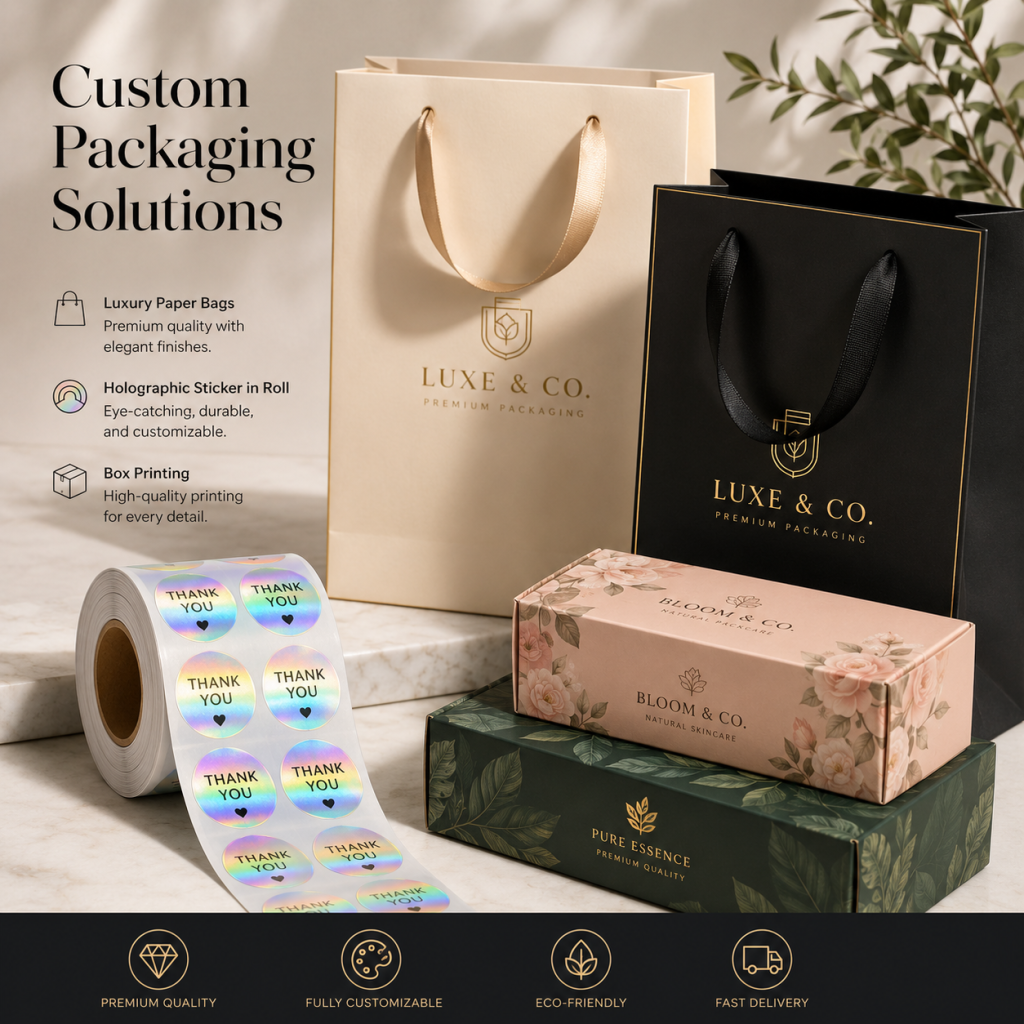
Every packaging printing quote is really an answer to three questions: how many units, what substrate, and which press. Choose the printing method correctly and unit economics fall into place; choose it wrong and you either pay setup costs you will never amortize or accept quality your brand cannot carry. This guide compares the five core packaging printing processes and shows where each one wins.
The Five Core Processes
Offset lithography — the quality benchmark
Offset prints from a plate to a rubber blanket to the sheet. Setup (plates, make-ready) is expensive, but per-unit cost at volume is excellent and image quality — fine line screens, smooth gradients, precise Pantone matching — is the industry benchmark. Break-even against digital typically lands somewhere between 300 and 1,000 units depending on format. For premium folding cartons and litho-laminated corrugated, offset is the default. Box printing specifics are covered here.
Digital — the short-run enabler
No plates, no make-ready: the file prints directly. Unit cost stays flat as quantity rises, which makes digital unbeatable below roughly 500 units and for variable-data work (serialized codes, personalized packaging). The tradeoffs: slightly softer fine detail than offset on some substrates, and a narrower specialty-finish menu. Digital is also what makes low-MOQ programs — like MOQ 500 packaging for growing brands — economically possible.
Flexography — the corrugated workhorse
Flexo uses flexible relief plates and fast-drying inks directly on corrugated board — including recycled and kraft surfaces other processes struggle with. It is the cheapest process at true volume for shipping cartons and e-commerce boxes. Modern high-definition flexo handles surprisingly fine graphics, but for photographic retail packaging, litho-lamination still wins.
Screen printing — the specialty tool
Screen pushes thick ink through a mesh, laying down more ink than any other process. That makes it ideal for saturated spot colors on rigid boxes, metallic effects, and printing on uneven or curved surfaces. It is slow and color-count limited — a specialty instrument, not a volume process.
Gravure — the ultra-long-run machine
Gravure engraves the image into a cylinder: enormous cylinder cost, but the lowest per-unit cost in existence over millions of units with flawless consistency. If you are printing ten million identical flexible-pouch or label repeats, gravure is the answer. Below that scale, it is never the answer.
Decision Table: Process by Quantity and Job
| Your job | Quantity | Best process |
|---|---|---|
| Market-test cartons, startups | 50–500 | Digital |
| Retail folding carton | 1,000–50,000 | Offset |
| Shipping / e-commerce boxes | 1,000–100,000 | Flexo |
| Premium retail box, photographic art | 3,000+ | Offset lamination |
| Rigid gift boxes, spot color luxury | 500–10,000 | Screen + offset wrap |
| Serialized QR / variable data | Any | Digital |
| Tens of millions, static design | 1M+ | Gravure |
Prepress: Where Costs Quietly Hide
Three prepress disciplines keep a job economical. Bleed and safety margins: 3mm bleed outside the dieline, live content 5mm inside fold lines — artwork that ignores this gets rebuilt on the clock. Ink coverage: heavy flood coverage raises cost and drying time on every process; restrained design prints cheaper and often looks more premium. Color specification: name every brand color by Pantone number in the file. “Bright blue” is a conversation; “PMS 286 C on coated stock” is an instruction. Working through these details is standard prepress at any serious packaging printing supplier.
Frequently Asked Questions
Digital or offset for 500 boxes?
Almost always digital at 500 units: no plate amortization, faster turnaround, and quality that most retail contexts cannot distinguish. Get a dual quote — if your supplier prices offset at 500 only slightly above digital, you have found the top of the digital price curve and future re-orders get cheaper.
Can digital printing match Pantone colors?
Approximate well, match exactly only sometimes. Digital builds every color from CMYK toner or ink, so out-of-gamut Pantones (bright oranges, some blues) drift. If an exact brand color is non-negotiable at digital quantities, printers can combine a screen-printed spot color pass with digital process work — ask for it explicitly.
Why is my per-unit price higher at 2,000 than my competitor’s at 20,000?
Setup costs are fixed: plates, make-ready, die tooling, press time. At 2,000 units that fixed cost divides by 2,000; at 20,000 it nearly vanishes per unit. This is why price-break tables matter more than unit price at your first quantity — see the quote logic in how suppliers build quotes, which applies to boxes as much as labels.
First-Order Printability Checklist
Before you request a quote, confirm these five points — they determine whether your design prints as intended or gets rebuilt on the clock:
- Dieline locked: final size, fold, and window positions fixed, with 3 mm bleed and 5 mm live safety margins.
- Colors specified: every brand color called out by Pantone number, not by name or screen swatch.
- Process matched to quantity: digital under ~500 units, offset 1k–50k, flexo for volume corrugated, screen for spot-color luxury.
- Finishes chosen: foil, emboss, soft-touch, or varnish decided up front — they change both tooling and cost.
- Substrate confirmed: coated, kraft, or recycled stock picked for both look and recyclability.