
Send Your Inquiry Today
Why Manufacturers Are Choosing Custom Tamper Proof Stickers to Protect Their Products
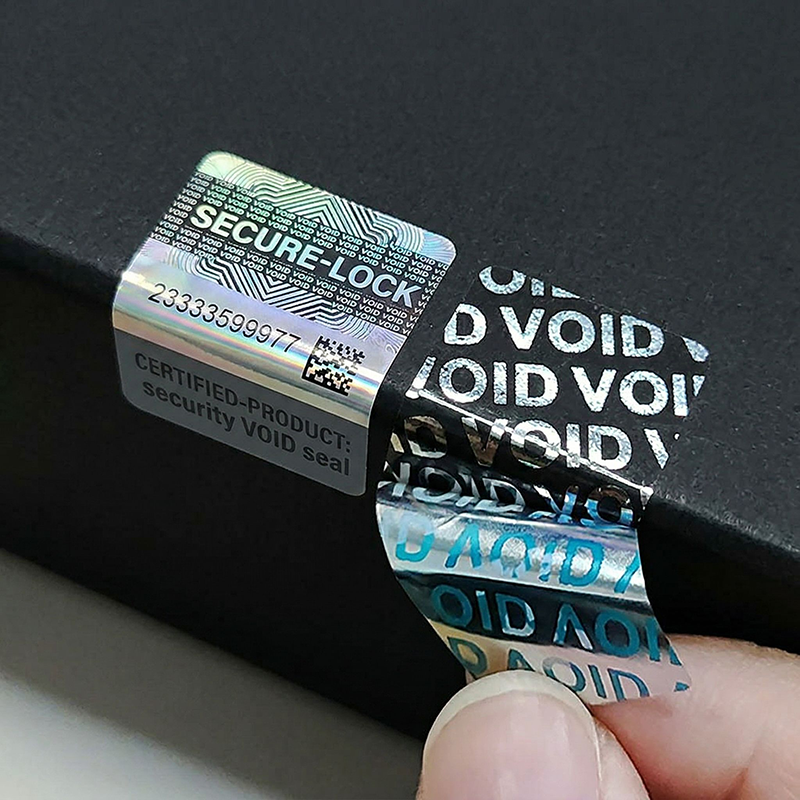
A packaging engineer at a mid-size cosmetics brand once told us that the moment she started taking security labels seriously wasn’t after a counterfeit scare — it was after a single angry email from a distributor who received a shipment with three broken seals and no explanation. That’s usually how it goes. Companies don’t add tamper proof stickers because a textbook told them to. They add them because something already went wrong once, and they’d rather not find out what happens the second time.
That’s the real story behind the growing demand for custom tamper proof stickers across pharmaceutical, electronics, cosmetics, food, and logistics packaging. It isn’t a trend chasing attention. It’s a response to a supply chain that has gotten longer, more automated, and — in a lot of cases — harder to keep an eye on personally.
Why Tamper Proof Stickers Have Become a Standard for Modern Packaging
Ten years ago, a lot of security decisions were made at the retail end: better locks, better cameras, better staff training. Today the risk sits earlier in the chain — at the factory, in the warehouse, on the truck, at the customs checkpoint. Products change hands more times before they reach a customer than they used to, and each handoff is a chance for something to be opened, swapped, resealed, or diverted.
Tamper proof stickers close that gap cheaply. A roll of security labels costs a fraction of what a single product recall or brand-damaging incident costs, and unlike cameras or RFID systems, they don’t need power, software, or staff monitoring to work. The label itself does the job: once it’s disturbed, it shows it, permanently and visibly.
This is also why the global counterfeit trade keeps showing up in the reasoning brands give for adopting security labels. The most recent joint study from the OECD and the EUIPO puts the value of counterfeit goods in global trade at roughly USD 467 billion in 2021, and notes that the same patterns have continued to shape the market since. OECD/EUIPO report That is not a niche problem limited to luxury handbags — the same report points to counterfeiters expanding into automotive parts, medicines, cosmetics, toys, and food, categories where a fake product carries real safety risk, not just financial loss.
For a manufacturer, that statistic translates into a simple question: if a customer can’t tell your product from a fake by looking at it, what’s stopping someone from trying?
How Custom Security Labels Prevent Product Tampering
The mechanics are straightforward, even if the materials behind them aren’t. A well-made security label is engineered to fail visibly the moment someone tries to remove, lift, or reseal it. There are a few common approaches manufacturers rely on:
- Destructible vinyl or paper facestock that tears, shreds, or fragments into small pieces the instant someone attempts to peel it off, making it impossible to reapply cleanly.
- Void patterns, where the word “VOID” or a custom message is left behind on the surface underneath once the label has been removed.
- High-tack adhesives formulated to bond more strongly to the surface than to the label film itself, so the label essentially self-destructs before it lets go.
- Sequential or serialized numbering, which lets a company track exactly which unit was sealed, when, and by which production line — useful for tracing a tampering incident back to its source.
None of this depends on the end customer knowing anything technical. They just need to glance at the label and see that it’s intact — or that it isn’t.
Industries That Depend on Tamper Evident Labels
Some industries treat tamper evident labels as a formality. Others treat them as close to non-negotiable.
Pharmaceuticals sit at the strict end. Falsified or tampered medicine isn’t just a brand problem, it’s a patient safety issue, which is why regulators have pushed hard on this front. The FDA maintains ongoing guidance on counterfeit medicine risks and enforcement, and continues to warn the public about specific incidents as they surface. [external link: FDA – Counterfeit Medicine] Internationally, tamper verification on medicinal packaging is formalized under ISO 21976, which sets out requirements for how tamper-evident seals on pharmaceutical products should be designed, applied, and checked. [external link: ISO 21976:2018]
Electronics manufacturers use tamper evident stickers less for counterfeiting and more for warranty control and supply chain accountability — a broken seal on a device casing usually tells a service technician the unit has already been opened.
Cosmetics and personal care brands lean on security stickers largely for consumer trust. Buyers in this category are unusually sensitive to product safety, and an intact seal reassures them that nothing has been added, removed, or substituted.
Food and beverage producers use tamper evident seals for similar reasons, particularly on products with health claims or premium positioning where contamination concerns run high.
Luxury goods brands often combine tamper evident labels with authentication features like holograms, since counterfeiting and tampering tend to overlap in this space.
Logistics and third-party fulfillment operations apply tamper seal stickers at the carton or pallet level, mostly to establish a clear chain of custody between warehouse, carrier, and final delivery point.
Tamper Proof Stickers vs VOID Security Labels
These two terms get used almost interchangeably, which causes more confusion than it should.
“Tamper proof stickers” is the broader category — any label engineered to show visible evidence of removal or interference. That includes destructible vinyl, foil stickers that fracture, and security seals in general.
“VOID security labels” are a specific type within that category. Their defining feature is what happens after removal: the label leaves behind a residue pattern, usually spelling out “VOID,” “OPENED,” or a custom warning, directly on the surface it was applied to. Even if someone manages to lift a VOID label carefully, the substrate underneath tells the story.
The practical difference matters when you’re choosing between them. Destructible vinyl is generally better suited to situations where you want the label itself to be unusable after tampering — it can’t be reapplied, period. VOID labels are better when you want a permanent visual mark left on the product or packaging itself, which is useful for retail and inspection scenarios where someone downstream needs to see, at a glance, that a seal was broken.
Many manufacturers end up using both, depending on the packaging surface and the level of scrutiny a given product line requires.
Choosing the Right Security Label Manufacturer
This is usually where the research gets harder, because the differences between suppliers aren’t always obvious from a product page.
A few things worth checking before committing to a security label manufacturer:
- Material sourcing and testing. Does the manufacturer test adhesive performance across temperature ranges, humidity, and different substrate materials, or just assume one formulation works everywhere?
- In-house printing capability. A tamper evident label manufacturer that handles printing, die-cutting, and quality control under one roof tends to have tighter control over consistency than one that outsources stages of production.
- Customization depth. Can they actually produce serialized numbering, QR codes, and custom void patterns to spec, or only offer a fixed catalog of stock designs?
- Minimum order flexibility. Manufacturers set up for large industrial runs aren’t always a good fit for a smaller brand testing a new packaging line, and vice versa.
- Compliance awareness. For pharmaceutical or food-adjacent products, a supplier that understands relevant packaging standards will save you time compared to one that needs to be walked through the requirements.
Price matters, obviously, but a security label that fails prematurely or doesn’t tamper-evident as promised ends up costing more than the cheaper unit price ever saved.
Custom Printing Options for Security Stickers
Beyond the base tamper-evident mechanism, most manufacturers offer a layer of custom printing that adds authentication and traceability:
- Hologram foil — adds a visual authentication layer that’s difficult to replicate without specialized equipment, commonly used alongside tamper evident features rather than instead of them.
- QR codes — link each label to a digital verification page, batch record, or authentication tool, giving both consumers and distributors a way to check legitimacy on the spot.
- Barcodes — support inventory and logistics tracking in addition to security.
- Serialization and sequential numbering — assign a unique identifier to each label, useful for recalls, audits, and pinpointing where in the supply chain an issue occurred.
- Destructible vinyl — as covered earlier, ensures the label itself can’t survive a removal attempt intact.
The right combination depends on what problem you’re actually solving — brand protection, warranty tracking, regulatory compliance, or all three at once.
How Anti Counterfeit Labels Protect Brand Reputation
Counterfeiting doesn’t just cost a company in lost sales. It costs in the harder-to-measure category: the customer who bought a fake, had a bad experience, and blamed the real brand for it without ever knowing the difference.
Anti counterfeit labels and product authentication labels give both distributors and end customers a way to check legitimacy without relying on guesswork. A verifiable QR code, a hologram that can’t be casually reproduced, or a numbered seal that matches a manufacturer’s database all shift the burden of proof away from “does this look right” toward something a customer can actually confirm.
For manufacturers exporting into markets with weaker enforcement, this matters even more. A brand protection label doesn’t stop counterfeiting on its own, but it makes fakes easier to identify and easier to act on legally once they’re found.
Frequently Asked Questions
What are tamper proof stickers? They’re security labels designed to show visible, permanent evidence when someone tries to remove, lift, or interfere with them — used to seal packaging, containers, or products so any tampering attempt is immediately noticeable.
Are tamper proof labels reusable? No, and that’s intentional. A genuine tamper proof label either tears apart, leaves residue, or otherwise self-destructs when removed, which is what makes it effective as a security feature.
How do VOID security labels work? When a VOID label is peeled off, it leaves behind a pattern — typically the word “VOID” or a custom message — printed onto the surface it was applied to, so the tampering evidence stays on the product even after the label itself is gone.
What materials are available for security labels? Common options include destructible vinyl, tamper-evident paper, polyester film, and foil, each suited to different surfaces and levels of tamper resistance.
Can security labels include serial numbers? Yes. Sequential or unique serialization is a standard option and is widely used for traceability, recall management, and matching individual units back to production batches.
What’s the difference between tamper evident labels and security stickers? In practice, the terms overlap heavily. “Tamper evident label” tends to describe the function (showing evidence of interference), while “security sticker” is often used more broadly to include authentication features like holograms or QR codes alongside tamper evidence.
How long do security labels last outdoors? It depends on the adhesive and facestock, but most industrial-grade security labels are formulated to hold up against UV exposure, humidity, and temperature swings for extended outdoor or warehouse use — worth confirming with a manufacturer for your specific climate conditions.
Can I order custom security labels with my logo? Yes, most manufacturers support custom branding, including logos, colors, and messaging, alongside the tamper-evident and authentication features.
For regulatory context, see the ISO security label guidance before approving label materials, inks and adhesives for your market.