
Send Your Inquiry Today
China Green Printing: Certificates & Documents to Request (FSC, ISO 14001, Ten-Ring)
As of October 2026. This guide helps EU and US packaging buyers request defensible green-printing evidence from a China supplier. It is general information, not legal advice. Treat the regulation texts on EUR-Lex and the FTC as authoritative, and confirm current dates with your compliance lead before you act.
Contents
- What “China Green Printing” Means for a Buyer
- What Changed: Green Claims Now Need Proof
- Who This Hits
- What It Means for Your Label and Packaging
- How We Print — and What We Can Evidence
- A Documentation Handoff, Step by Step
- Documents to Request: Spec Table
- Download the Supplier Verification Checklist
- FAQ
What “China Green Printing” Means for a Buyer
China green printing is the set of lower-impact production practices Chinese label and packaging converters use — low-VOC inks, paper sourced from certified mills, mono-material structures built for recyclability, and documented environmental management. For a buyer, the value is not a slogan; it is the paper trail behind any environmental wording you put on a pack.
A converter is where most of that evidence is created: the board grade, the ink formulation, the mill certificate, the batch record. If those are not captured at order entry, no later “eco” claim will survive scrutiny under the EU’s Empowering Consumers rules or the US FTC Green Guides.
What Changed: Green Claims Now Need Proof
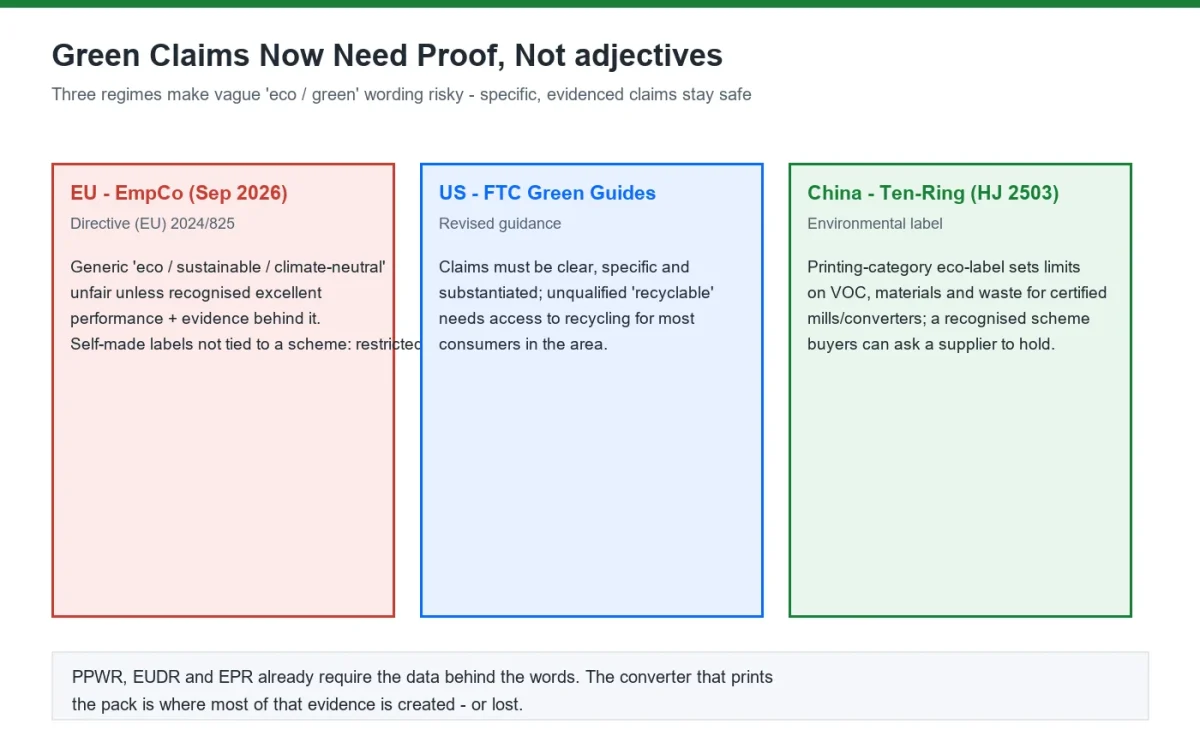
Three regimes now make vague environmental wording risky, while specific, evidenced claims stay permissible.
EU — EmpCo (Directive (EU) 2024/825), live from 27 September 2026. Generic terms like “eco-friendly,” “green,” “sustainable” or “climate-neutral” are unfair unless the trader can show recognised excellent environmental performance with evidence. Carbon-neutrality claims based only on offsetting are restricted. Self-made sustainability labels not tied to a certification scheme or public authority are restricted too. A precise, certificate-backed claim — a stated recycled percentage with a certificate number — remains fine. The text is on EUR-Lex.
US — FTC Green Guides. The FTC Green Guides require claims to be clear, specific and substantiated; an unqualified “recyclable” needs recycling access for most consumers in the market. The same “show the proof” logic applies.
China — Ten-Ring (HJ 2503). The printing-category environmental label sets limits on VOC, materials and waste for certified converters — a recognised scheme a buyer can ask a supplier to hold. These three together are why the documents below matter more than the adjectives.
Who This Hits
If you place labelled or packaged products on the EU or US market with any environmental wording, this reaches you — wherever you are incorporated:
- Brands selling into the EU — any “recycled,” “compostable” or “eco” wording is a green claim under EmpCo from 27 September 2026.
- US exporters — the FTC Green Guides apply to how you market, including on-pack claims.
- Buyers sourcing from China — you need the converter’s paper, ink and certificate records, not just a price. Our PPWR labelling guide and US state EPR guide cover the packing-side obligations those claims sit on top of.
What It Means for Your Label and Packaging
The practical effect is simple: the pack or label may carry environmental wording only if the converter can supply the documents behind it. That changes two things at artwork stage.
- Wording must be specific. “Recyclable” becomes “recyclable where facilities exist, mono-material SBS, remove insert” — with the composition data to back it.
- The data carrier carries the proof. A QR or Digital Link on the pack can point to the certificate pack and batch record, exactly as the DPP and green-claims framework describes. We print the carrier; the brand owns the data behind it.
For paper specifically, the EU Deforestation Regulation adds a due-diligence statement for relevant paper products — our EUDR buyer guide explains how mill certificates and fibre declarations feed that statement.
How We Print — and What We Can Evidence
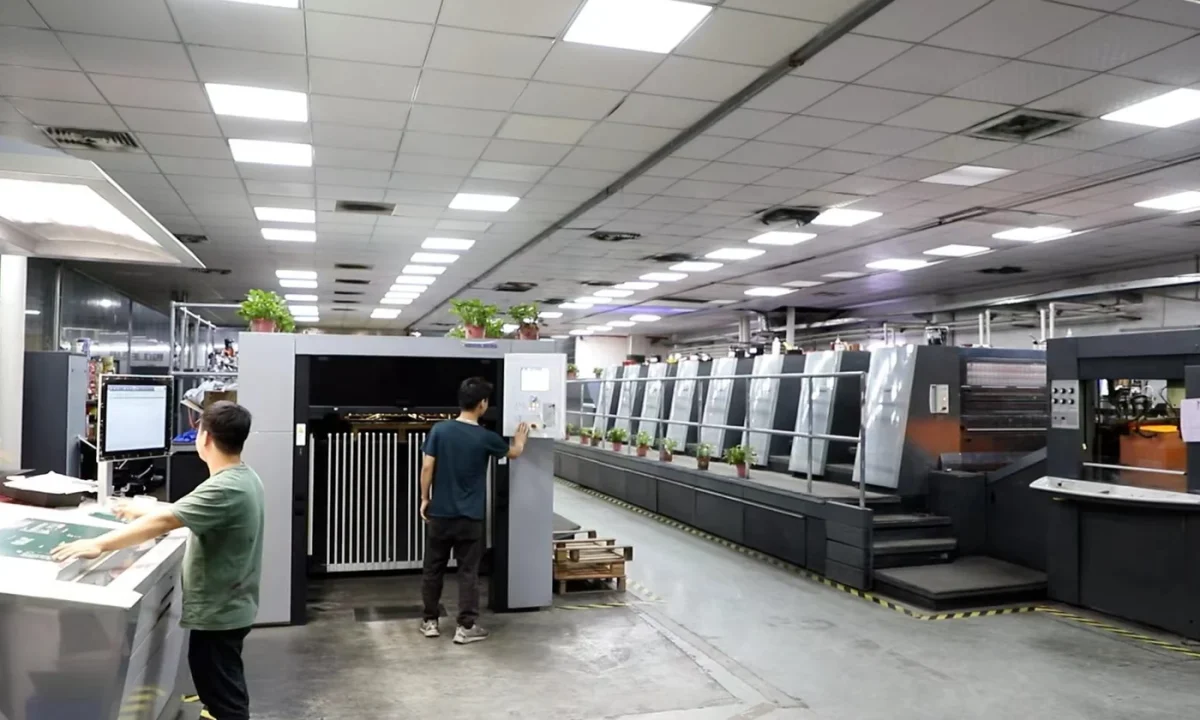
We are a Guangzhou printing converter with 20+ years producing self-adhesive labels, folding cartons, paper bags and rigid boxes for EU and US brands. We do not self-declare environmental certifications we cannot evidence. Here is exactly what we provide so your claim is defensible:
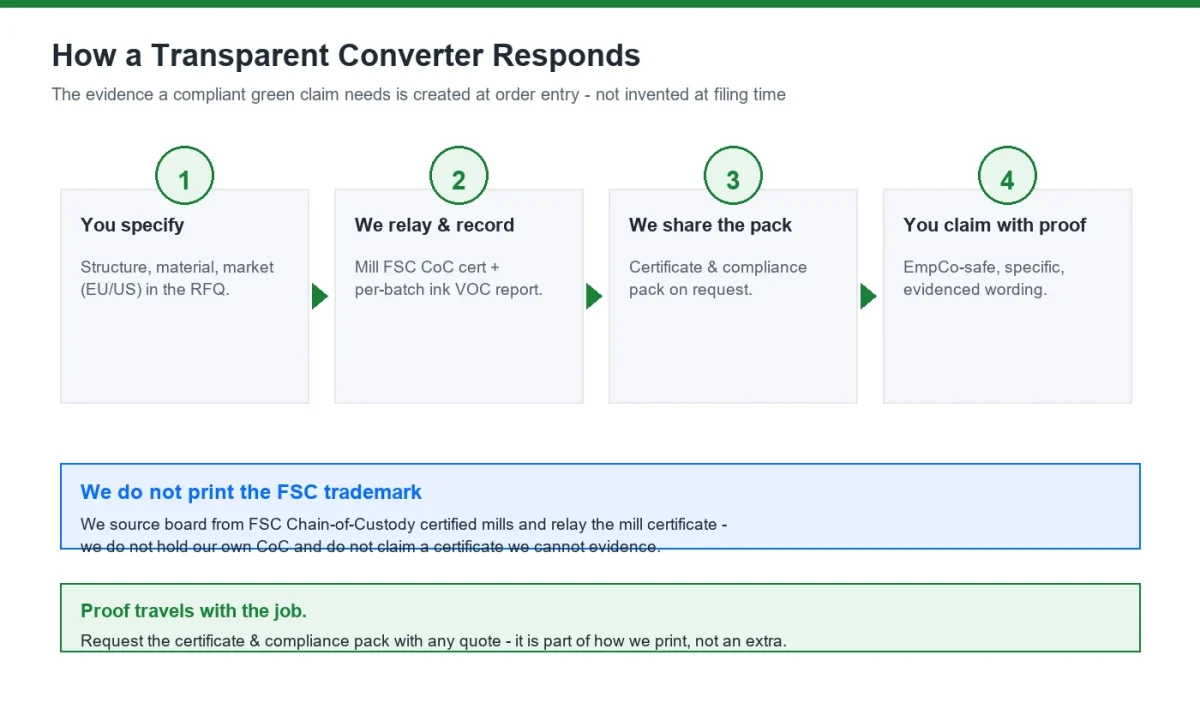
- Paper & board provenance. We source from mills that hold FSC Chain-of-Custody and relay the mill’s CoC certificate, batch certificate and fibre declaration to you. We do not hold our own FSC CoC and do not print the FSC trademark — we pass through the certified mill’s documentation.
- Ink evidence. Low-VOC, low-migration UV and soy/vegetable-oil-based inks for food-contact and cosmetic applications; we provide the ink VOC / migration test report per batch on request.
- Design for recyclability. We default to mono-material SBS or kraft, and advise against PE lamination and PET windows unless a barrier is required — supporting the recyclability grades PPWR will grade against.
- Certificate & compliance pack. Available on request with any quote: whatever facility-level certificates we hold (for example ISO 14001 or China Ten-Ring HJ 2503 where applicable) together with the mill and ink documents above.
Ask us for the pack when you request a quote. It is part of how we print, not an extra step — proof travels with the job.
A Documentation Handoff, Step by Step
A typical handoff for a cosmetics brand launching in the EU looks like this (illustrative, not a named client):
- RFQ specifies market and structure. EU launch, mono-material folding carton, no lamination.
- We record per job. Board grade, basis weight, coating, and the mill’s FSC CoC certificate reference.
- We provide the batch ink report. Low-migration ink VOC / migration test for the cosmetic-contact print.
- You receive the certificate pack. Mill cert + batch cert + fibre declaration + ink report + any facility certificate we hold.
- You file the claim with evidence. “Recyclable, mono-material SBS” with the composition data attached — EmpCo-safe and PPWR-aligned.
The same records feed your EPR filing and your EUDR due-diligence statement where paper is in scope. One set of documents, several obligations.
Documents to Request: Spec Table
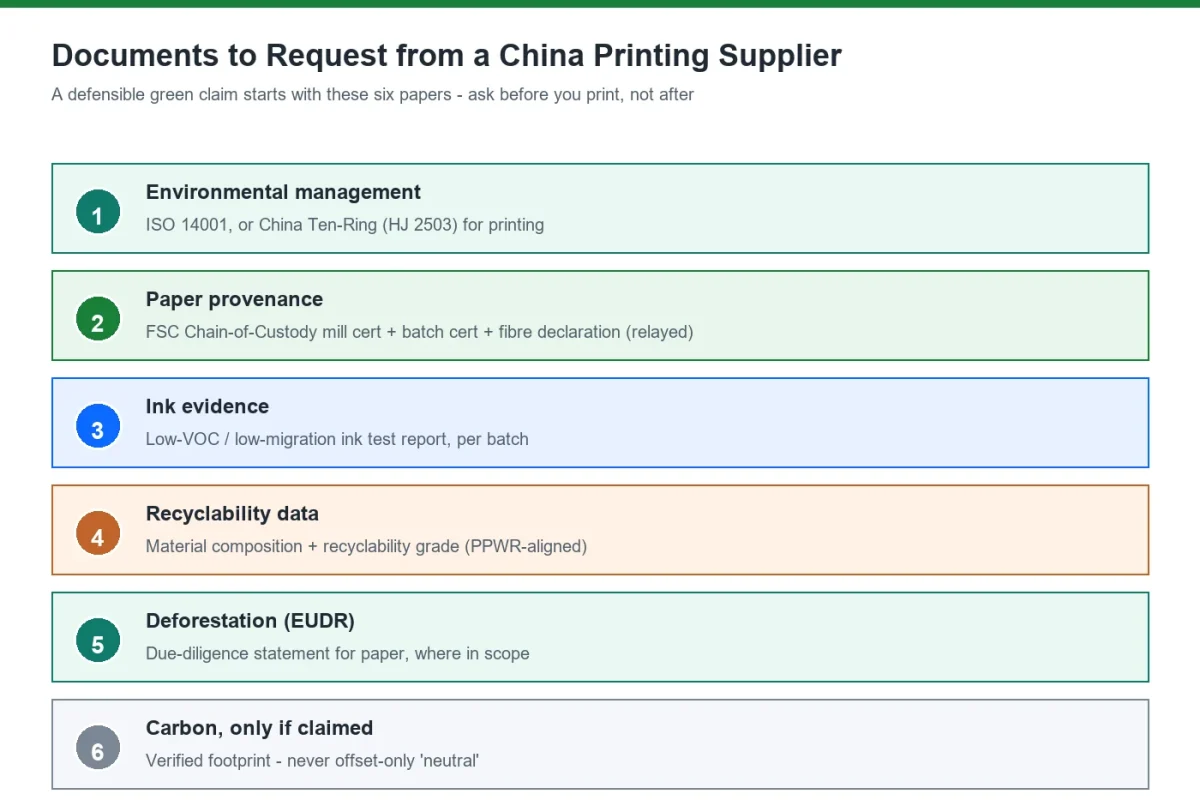
| Document | What it proves | Who supplies it |
|---|---|---|
| Environmental management (ISO 14001 / China Ten-Ring HJ 2503) | Certified environmental system at the converter | Converter, on request |
| FSC Chain-of-Custody mill certificate + batch cert + fibre declaration | Paper came from a certified, traceable source | Mill, relayed by converter |
| Ink VOC / migration test report (per batch) | Low-VOC, low-migration print for food / cosmetic contact | Ink maker, relayed by converter |
| Material composition + recyclability data | Mono-material, sortable, reprocessable structure | Converter |
| EUDR due-diligence statement (paper, where in scope) | Deforestation-free, legal paper | Mill / converter record |
| Verified carbon footprint (only if claimed) | Substantiated footprint — never offset-only “neutral” | Verifier, if used |
Download the Supplier Verification Checklist
Use this checklist when you brief any China printing supplier. Send it with the RFQ and ask for the certificates back before you print — not after.
- Ask for ISO 14001 and/or China Ten-Ring (HJ 2503) certificates — in writing.
- Request the paper mill’s FSC Chain-of-Custody certificate, batch certificate and fibre declaration.
- Require a per-batch low-VOC / low-migration ink test report for food or cosmetic contact.
- Confirm the structure is mono-material unless a barrier is documented as required.
- Ask for material composition and recyclability data you can file under PPWR / EPR.
- Request the EUDR due-diligence statement for paper where your product is in scope.
- Hold off any “eco / green / recyclable” wording until the documents above are in hand.
Want the fillable version? Request our certificate & compliance pack with your next quote — we return the mill and ink documents plus whatever facility certificates we hold, ready to attach to your green claim.
FAQ
Do you hold FSC certification?
We do not hold our own FSC Chain-of-Custody and do not print the FSC trademark. We source board from FSC-CoC-certified mills and relay the mill’s certificate, batch certificate and fibre declaration to you.
Can you print “recyclable” on my box?
Yes, where the structure is genuinely mono-material and sortable — and we give you the composition data to back the wording. We will not print a blanket “recyclable” on a multi-layer structure that fails a recyclability test.
Do you use low-VOC inks?
We use low-VOC, low-migration UV and soy/vegetable-oil-based inks for food-contact and cosmetic applications, and we provide the per-batch ink test report on request.
What is China Ten-Ring (HJ 2503)?
It is the Chinese environmental label for the printing category, setting limits on VOC, materials and waste. It is a recognised scheme a buyer can ask a supplier to hold; we share it where our facility holds it.
How does this connect to PPWR, EPR and EUDR?
Those rules create the data obligation; the converter’s paper, ink and certificate records are the evidence. See our PPWR guide, US EPR guide and EUDR guide.
Related reading: Custom Cosmetic Boxes Buyer’s Guide · Custom Rigid Cosmetic Boxes.