
Send Your Inquiry Today
Folding Carton Printing: A 2026 Buyer’s Guide
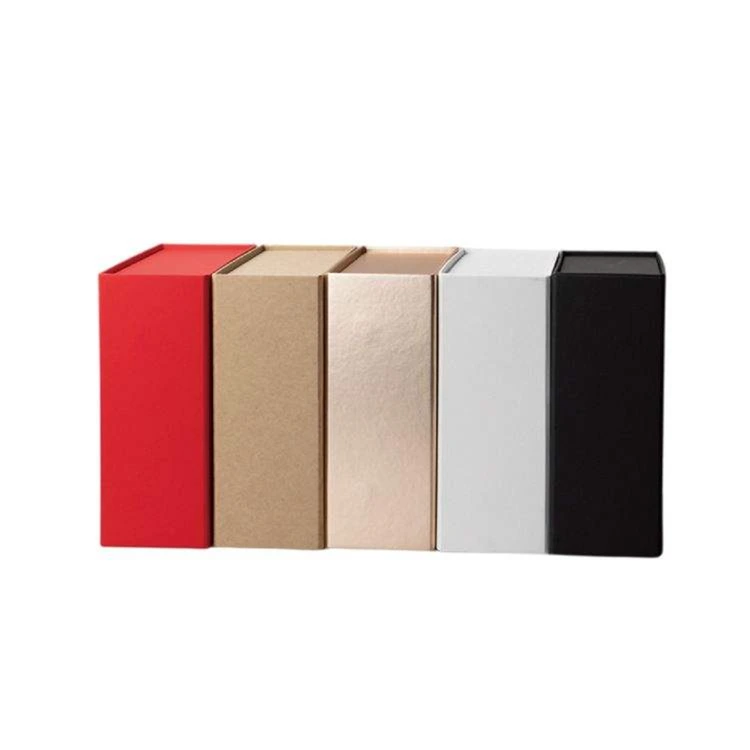
A folding carton is the retail face of your product – the printed paperboard box a customer actually handles. But “make me a folding carton” is not a spec. The board grade, the print process, the coating, the structure and (for food) the compliance status are five separate decisions, and each one changes cost, look, recyclability and whether the pack is legal to put food in. This guide walks the spec line so you can write an RFQ a converter can engineer to, not a guess a photocopier can misquote.
On this page
- Why the folding carton spec decides everything
- What changed: PPWR 2030, EU 1935/2004 and FDA 21 CFR
- Who this hits
- Decode the spec: board grade, print, coating, structure
- How we print and produce it
- Illustrative scenario
- Folding carton RFQ spec table
- Downloadable RFQ checklist
- Frequently asked questions
Why the folding carton spec decides everything
Buyers compare cartons by price per thousand. But two quotes at the same price can be built on completely different board – one on bright SBS that prints crisp and holds its shape, the other on low-grade clay-coated board that scuffs in transit and looks cheap on the shelf. The grade is the structural and visual specification; it is the difference between a pack that sells and a pack that generates returns.
What changed: PPWR 2030, EU 1935/2004 and FDA 21 CFR
Three shifts in 2025-2027 turn the carton spec from a cost line into a compliance variable:
- EU – PPWR. Regulation (EU) 2025/40, applicable from 12 August 2025, phases in recyclability and recycled-content rules through to 2030 and sets performance criteria a plastic-laminated or mixed-material carton can fail. See the PPWR text on EUR-Lex.
- EU – food contact. Regulation (EC) 1935/2004 requires materials in contact with food to be safe and traceable, with specific rules on recycled fibre and migration. The carton is in scope the moment it touches the product.
- US – FDA. Food-contact cartons must meet FDA 21 CFR rules on food-contact substances, including low-migration inks and compliant coatings.
- US – green claims. The FTC Green Guides require any “recyclable” or “compostable” claim to be substantiated for the actual material and market.
The practical result: the same board and coating choices that protect your brand now also decide your compliance cost. Read our PPWR recyclability grades explainer and the PPWR PFAS food-contact guide for the regulatory detail.
This article is general guidance, not legal advice. Regulation (EU) 2025/40, Regulation (EC) 1935/2004 and FDA rules change with implementing acts; confirm current text with EUR-Lex, the FDA and the relevant authority before specifying.
Who this hits
- Cosmetics and fragrance brands where the carton is the primary shelf presentation.
- Supplement and nutraceutical brands where cartons double as the information panel.
- Confectionery, bakery and food brands where food-contact rules apply.
- Pharma and medical-device brands needing tamper-evident, compliant cartons.
- DTC and subscription brands shipping the carton itself to the door.
Decode the spec: board grade, print, coating, structure
A real folding-carton quote should name four things plus the structure. If it names fewer, you are comparing guesses.
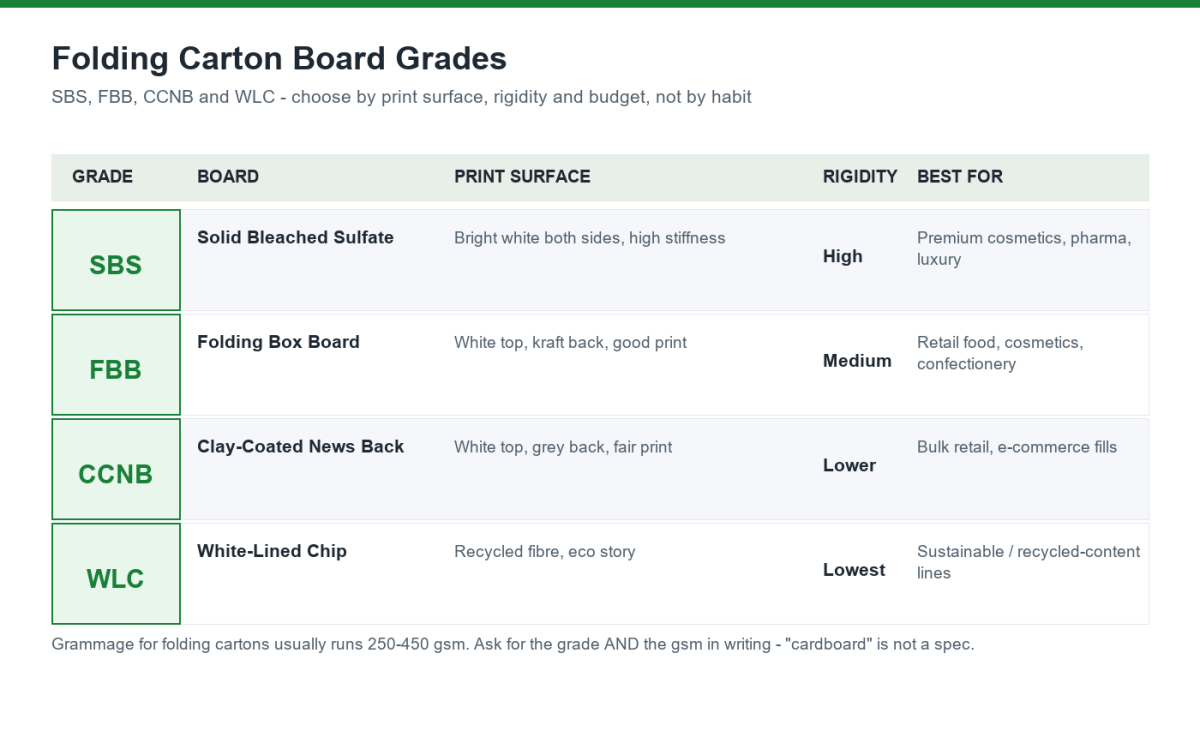
Board grade. SBS (solid bleached sulfate) is bright white both sides and the premium choice for cosmetics and pharma. FBB (folding box board) is white on top with a kraft back – the retail workhorse. CCNB (clay-coated news back) is white over a grey recycled back for budget bulk. WLC (white-lined chip) is recycled content for sustainable lines. Grammage usually runs 250-450 gsm; always ask for the grade and the gsm together. See the chart below.
Print process. Offset gives the sharpest graphics for long runs; flexo is the value choice for simpler art and kraft; digital handles short runs, versions and personalisation without plates. The process is chosen from the artwork and the volume, not from habit.
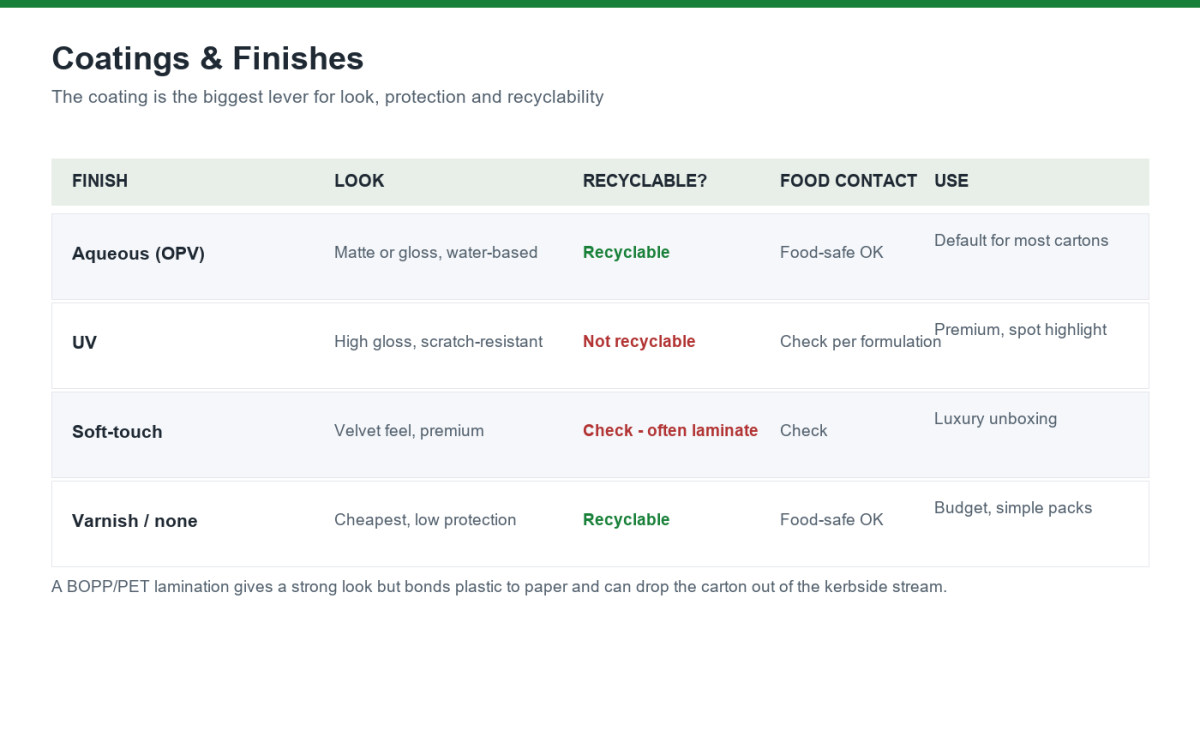
Coating. An aqueous (OPV) coating is water-based, recyclable and usually food-safe – our default. UV gives high gloss but is not recyclable. Soft-touch feels premium but is often a laminate, so check recyclability. A BOPP or PET lamination bonds plastic to paper and can drop the carton out of the kerbside stream.
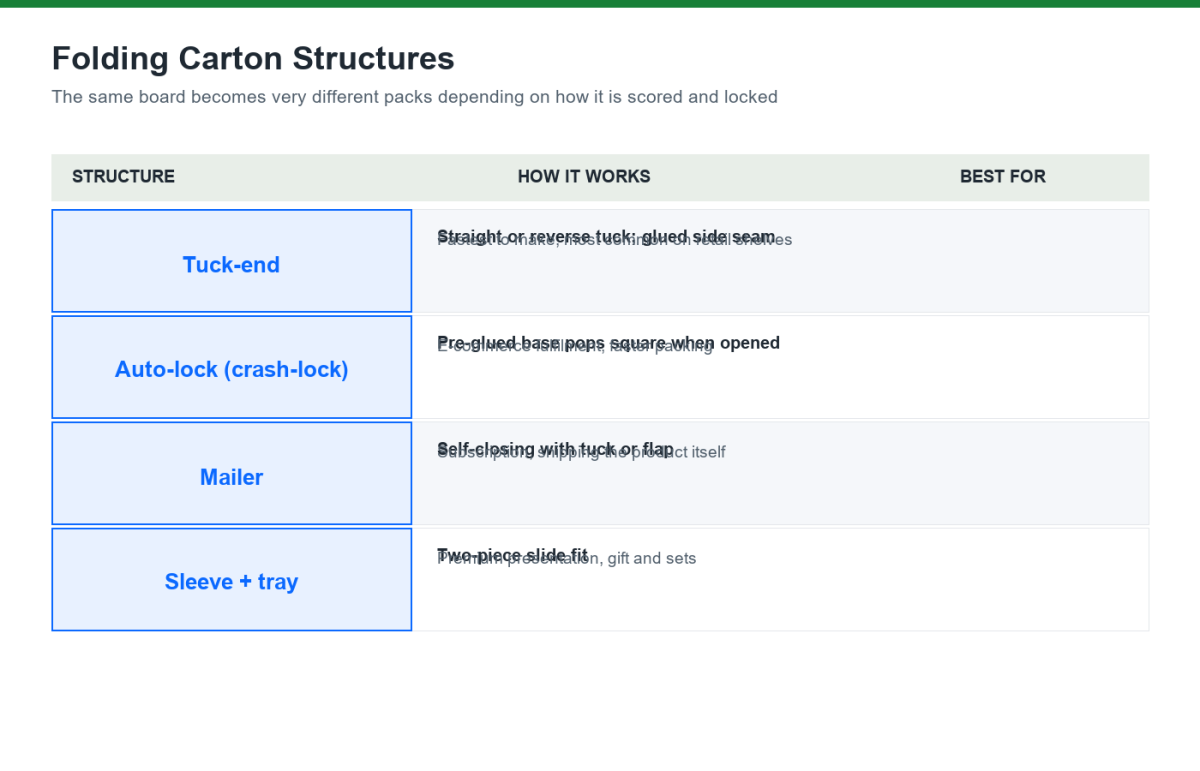
Structure. Tuck-end (straight or reverse) is the fast, common retail carton. Auto-lock (crash-lock) bases pop square for faster e-commerce packing. Mailers ship the product itself. Sleeve-and-tray is the premium gift presentation. See the structure chart.
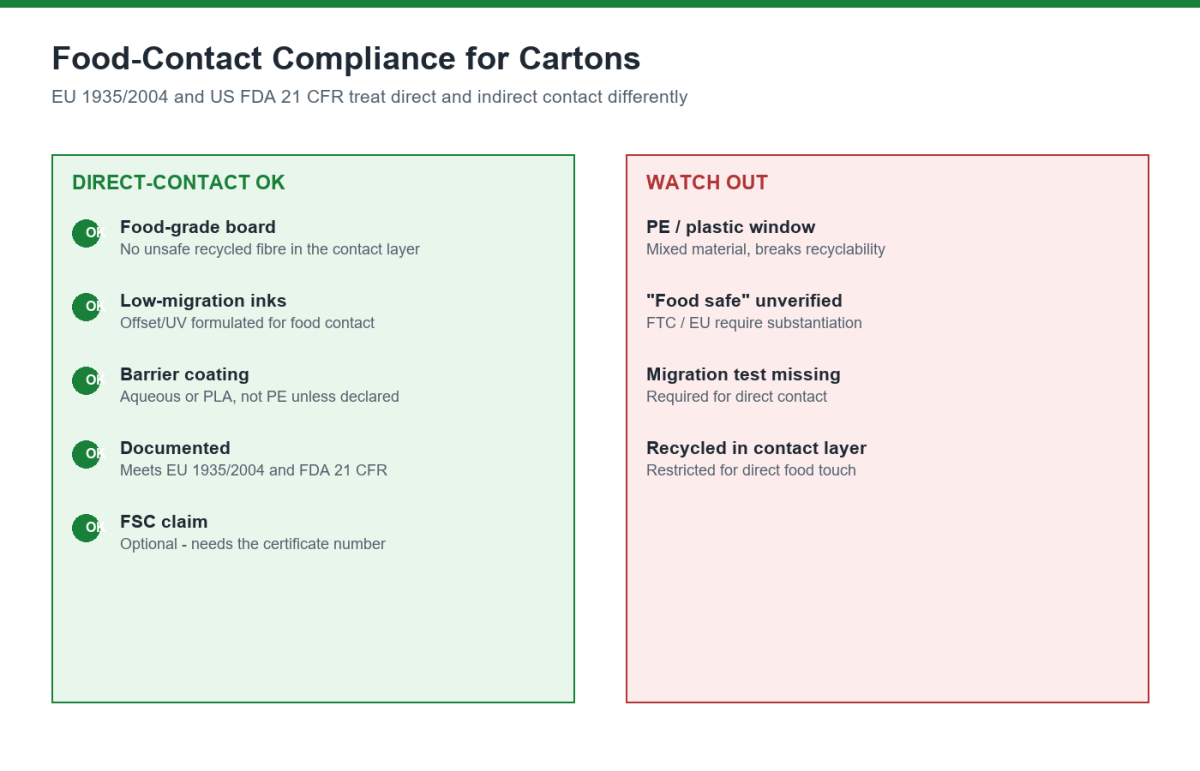
Food contact. If the carton touches food, the board must be food-grade in the contact layer, the inks low-migration and the barrier coating declared. Direct and indirect contact are treated differently under EU 1935/2004 and FDA 21 CFR – see the compliance diagram.
How we print and produce it

Our line prints by offset, flexo and digital so the process matches the artwork and volume rather than forcing every job onto one press. We specify by board construction: SBS or FBB for premium retail, FBB or CCNB for budget bulk, and we state the grammage and tolerance on the data sheet. Recyclability is designed in – we default to aqueous coating over plastic lamination and flag any soft-touch or UV finish so the compliance tier is known before mass production. For food-contact cartons we run food-grade board with low-migration inks and an aqueous or PLA barrier, and we document the build against EU 1935/2004 and FDA 21 CFR. On fibre claims, we can supply board carrying an FSC claim from a certified mill and print the FSC logo only when our own Chain-of-Custody certificate covers it; always ask for the certificate number. Before mass production we validate print adhesion, rub resistance and fold endurance, because a carton that passes on paper but fails at the shelf is the expensive kind of mistake.
Pair this with our FSC packaging boxes guide and the broader corrugated board grades guide if your range also uses shipping boxes.
Illustrative scenario
The following is a composite example, not a specific customer order. A supplement brand was running an FBB tuck-end carton at 300 gsm with a UV spot finish and a PE window. The pack looked sharp but the lamination and window made it non-recyclable and the PE contact layer needed a migration file. We re-specified it as SBS 350 gsm with low-migration offset print, an aqueous coating and no window, FSC Mix on the board. Same shelf feel, now recyclable and documented for EU 1935/2004 and FDA food contact. No claim was made that could not be substantiated, and the board data sheet carried the recycled-content and FSC numbers for PPWR and EPR reporting.
Folding carton RFQ spec table
| Decision | Options | What to write on the RFQ |
|---|---|---|
| Board grade | SBS / FBB / CCNB / WLC | Grade + grammage (e.g. FBB 300 gsm) + tolerance |
| Print process | Offset / flexo / digital | Process + number of colours + any special ink |
| Coating | Aqueous / UV / soft-touch / none | Finish + recyclability expectation |
| Structure | Tuck-end / auto-lock / mailer / sleeve | Type + erect style + closure |
| Food contact | Direct / indirect / none | Contact class + board grade + ink class |
| Certs | FSC claim / food-grade | Claim + certificate number + issuer |
Downloadable RFQ checklist
We packaged the decode into a one-page RFQ checklist: board grade and gsm with tolerance, print process and colours, coating and its recyclability, structure and closure, food-contact class with board and ink specification, and certs (FSC claim plus certificate number). Hand it to any supplier and the vague “cardboard carton” quotes stop. Before mass production, pair it with our folding carton sample approval checklist.
Frequently asked questions
What is the difference between SBS and FBB carton board? SBS (solid bleached sulfate) is bright white on both sides and the premium grade for cosmetics and pharma; FBB (folding box board) is white on top with a kraft back – slightly less bright but lower cost and the retail workhorse. Pick SBS when print surface matters most, FBB when budget and stiffness matter.
What GSM should a folding carton be? Most folding cartons run 250-450 gsm. Light displays and sleeves sit at the low end; premium rigid-feel cartons at the high end. Ask for the actual grammage and a tolerance rather than a vague “heavy card”.
Are folding cartons recyclable? Yes – when they are mono-material with an aqueous coating and no plastic window or lamination. A BOPP/PET lamination or PE window can move a carton out of the kerbside paper stream under PPWR and US EPR rules.
Which coating is food safe? An aqueous (OPV) coating is generally food-safe; low-migration inks and a food-grade board are also required for direct contact. UV and soft-touch finishes need per-formulation confirmation, and a PE or laminate barrier must be declared.
What is an auto-lock folding carton? An auto-lock (crash-lock) base is pre-glued so the carton pops square when opened, speeding e-commerce and subscription packing versus a standard tuck-end that must be folded by hand.
Is an FSC carton recyclable? FSC is a fibre-sourcing claim, not a recyclability claim. An FSC-certified carton is recyclable only if its construction is mono-material – a lamination or PE window can still disqualify it.
Want a deeper category view? Browse our custom packaging box range or talk to our team about your specific product, print and destination markets.
Request a physical sample set. Want to feel the grade difference on real stock? Ask for a matched set – an SBS, an FBB and a coated-versus-laminated comparison – so your team can specify with confidence. Tell us your product, contact class and destination markets and we will send a matched set from our contact page.
Disclaimer: this article is general guidance, not legal advice. Regulatory references (Regulation (EU) 2025/40, Regulation (EC) 1935/2004, FDA 21 CFR, FTC Green Guides) are summarised for context; dates and scopes can change with implementing acts. Confirm current text with the official sources – EUR-Lex, the FDA and the relevant authority – before specifying or procuring.