
Send Your Inquiry Today
California SB 343: Recyclable Claims on Pizza & Candle Boxes
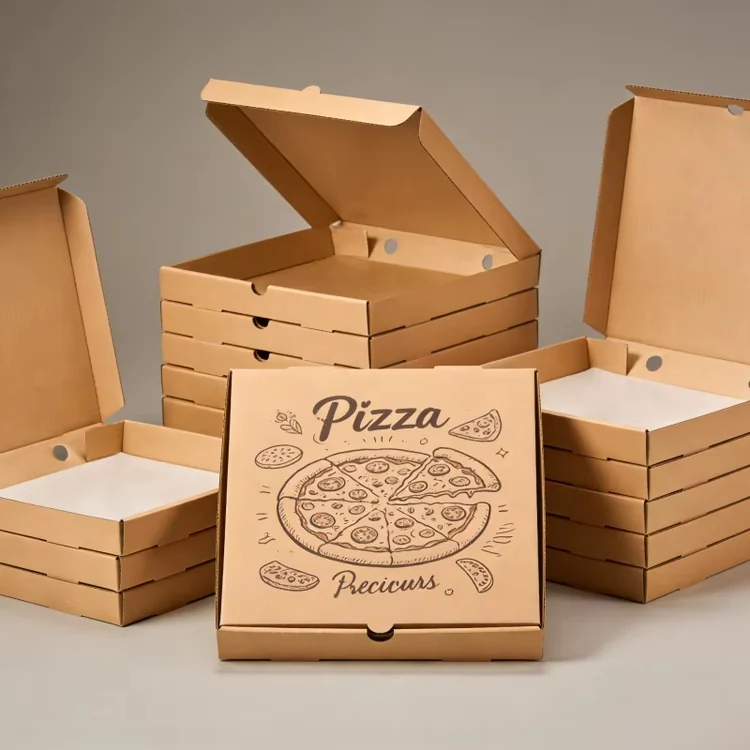
Status checked 9 November 2026. This article is general guidance, not legal advice. California SB 343 is the subject of active litigation and CalRecycle updates its findings on a statutory cycle; confirm the current text with CalRecycle, the FTC Green Guides at 16 CFR Part 260 and your own counsel before approving artwork.
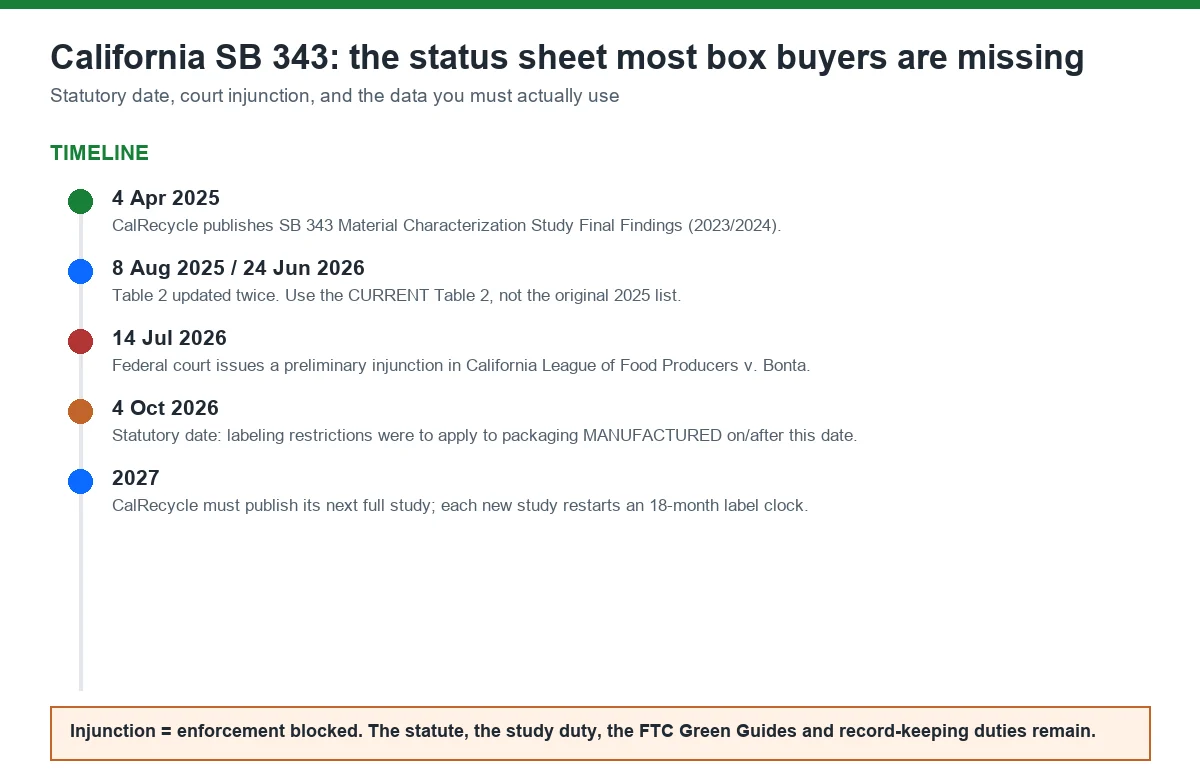
California SB 343 was written to ban the chasing-arrows symbol and unqualified “recyclable” wording on packaging manufactured on or after 4 October 2026 unless the material clears a statewide collection, sorting and end-market test. But on 14 July 2026 a federal court issued a preliminary injunction blocking enforcement in California League of Food Producers v. Bonta. The statute has not been repealed, CalRecycle must still publish its next study in 2027, and the FTC’s 2012 Green Guides still apply. For pizza and candle box buyers the answer is not “print it” or “delete it” – it is to fix the artwork and the evidence file behind it.
Table of contents
- Current status at a glance
- What California SB 343 actually requires
- The 4 October 2026 date and the July 2026 injunction
- Who it hits: pizza boxes, candle boxes and gift sets
- Six print decisions on your box artwork
- How a converter builds a defensible pizza box and candle box
- Illustrative scenario: two SKUs, one claim review
- Spec table: RFQ fields for a claim-ready box
- Downloadable SB 343 artwork & evidence checklist
- FAQ: recyclable pizza and candle boxes in California
Current status at a glance
| Item | Status on 9 November 2026 | What a box buyer should do |
|---|---|---|
| SB 343 labeling restrictions | Statutory trigger 4 October 2026, based on manufacture date. Enforcement currently blocked by a 14 July 2026 preliminary injunction. | Keep compliant artwork. Do not reintroduce old arrows while the case is unresolved. |
| CalRecycle data | Final Findings published 4 April 2025; Table 2 updated 8 August 2025 and again 24 June 2026; next full study due 2027. | Use the current Table 2, not the 2025 list quoted in older guides. |
| FTC Green Guides | 16 CFR Part 260 is still the 2012 text (77 FR 62124). Section 260.12 defines “substantial majority” as at least 60%. | Qualify claims wherever recycling access is below 60%. |
| Written substantiation | SB 343 requires records supporting any recyclability claim. CalRecycle does not make product-by-product determinations. | Build one claim file per SKU before a plate is cut. |
What California SB 343 actually requires
SB 343 (Allen, Chapter 507, Statutes of 2021), codified in the California Public Resources Code at section 42355.51, prohibits the chasing-arrows symbol, any other recyclability indicator, or any statement directing consumers to recycle a product or package sold in California unless the material type and form meet three tests: it is collected by recycling programs serving at least 60% of California’s population; it is sorted into defined streams by large-volume facilities serving at least 60% of recycling programs statewide; and it is sent to a reclaimer in line with Basel Convention requirements. Plastic packaging faces additional design and PFAS conditions. Brands must keep written records substantiating any claim.
Two details matter to a printer. First, the trigger is the date of manufacture, not the date of sale: boxes produced before the statutory date are not caught by the labeling restriction, however long they sit in a warehouse. Second, CalRecycle states explicitly that it does not determine whether a specific product is eligible – that assessment is the manufacturer’s or brand owner’s, using the Final Findings, the 24 June 2026 Table 2 update and any other defensible information. The SB 343 FAQ is worth keeping with the artwork file. Penalties run through several code sections, including civil penalties that can apply per non-compliant package, and exposure under California’s Unfair Competition Law.
The 4 October 2026 date and the July 2026 injunction
Most supplier blog posts still stop at “4 October 2026: take the arrows off”. That is only half the story. On 14 July 2026 the federal court in California League of Food Producers v. Bonta (No. 3:26-CV-01675, Southern District of California) issued a preliminary injunction. CalRecycle’s own program page says the injunction only blocks enforcement of SB 343 and does not affect the agency’s duty to update the material characterization study in 2027 and every five years after that.
That distinction changes the buying decision but not the workload. An injunction is not a repeal: it can be dissolved, narrowed or made permanent, and it does not touch the FTC Act, the Green Guides’ 60% “substantial majority” test, retailer packaging standards or other states’ rules. A box printed today may still be on a shelf in 2028, when the next study restarts an 18-month label clock. Reprinting a corrugated pizza box or a wrapped rigid candle box means new plates, new colour proofing and new minimum runs – so the cheapest moment to settle a claim is always before the first production run, not after a court ruling.
Also worth correcting: several 2026 “FTC Green Guides final revision” posts circulating in seller forums are wrong. The current eCFR text of 16 CFR Part 260 still cites 77 FR 62124, 11 October 2012. A review is not a new rule. Section 260.12(b)(2) still says that when recycling facilities are available to less than a substantial majority of consumers or communities where the item is sold, marketers should qualify all recyclable claims – for example “this package may not be recyclable in your area”.
Who it hits: pizza boxes, candle boxes and gift sets
The buyers who feel this first are US food-service and DTC brands: regional pizza chains and ghost kitchens, bakery and meal-kit operators, candle and home-fragrance brands, and gift-set importers selling into California. Their two box families fail for opposite reasons.
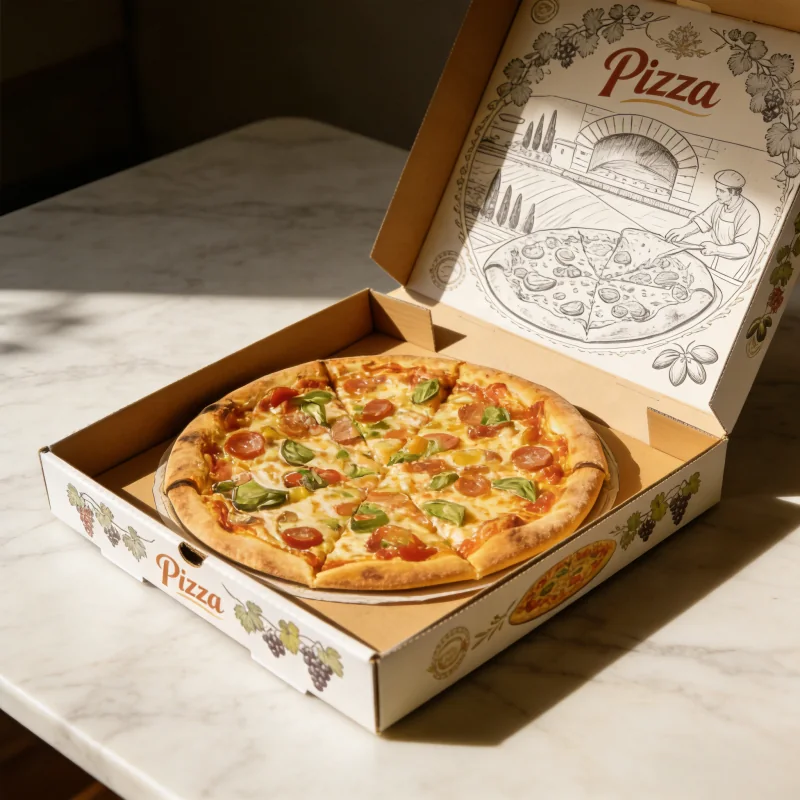
A pizza box is corrugated board that meets hot, fatty food. The temptation is to add a PE or PLA barrier, a wax coating or a PFAS-treated grease-resistant layer. Every one of those additions changes how the box behaves at a paper mill. A candle box goes the other way: it starts as a premium rigid or folding carton and accumulates a PET window, an EVA foam insert, a magnet, a ribbon and soft-touch lamination – a mixed-material build with a green claim printed on the outside.
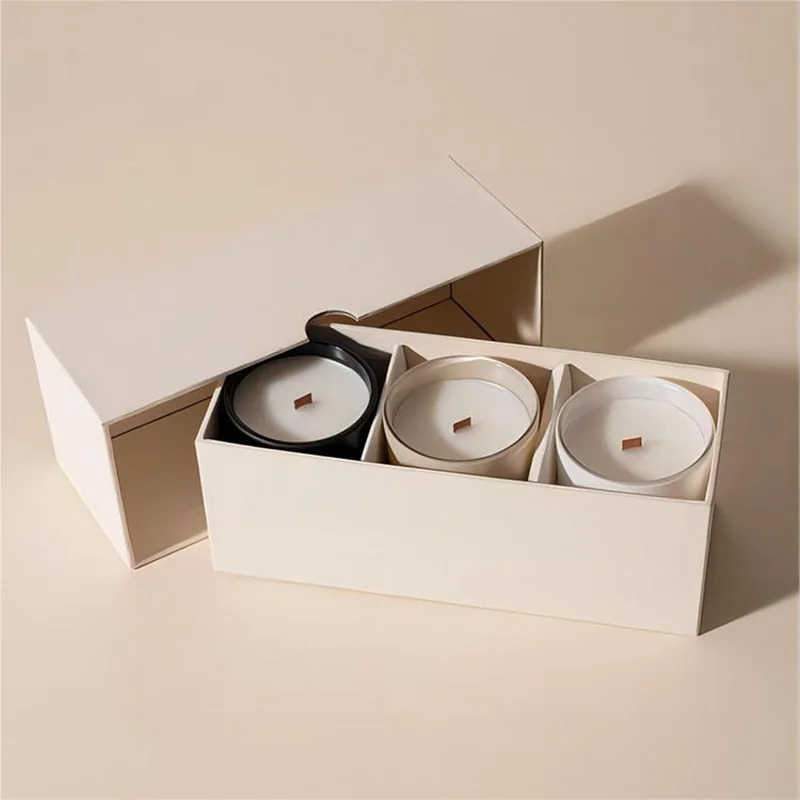
If you sell both, one generic “100% recyclable” line across the catalogue is the riskiest possible artwork decision. See our paper boxes for food, pizza and candle packaging for the structural options, and the custom packaging box category for the full range.
Six print decisions on your box artwork
- The symbol and the word. Chasing arrows, “please recycle”, “100% recyclable” and “recyclable” all read as the same claim. If the exact material type and form is not supported by the current Table 2, remove them or qualify them.
- Recycled content is a different claim. “Made with 60% recycled fibre” describes input, not end-of-life. SB 343 does not ban a truthful recycled-content statement – but it needs a supplier declaration and a percentage, not a leaf icon.
- Do not print the FSC logo by default. The FSC trademark may only be used on a product sold through a valid FSC chain of custody, with the label generated and approved under the certificate holder’s licence. Our factory does not hold FSC chain-of-custody certification, so we do not print the FSC logo. What we can do is source board from certified mills and supply the mill’s certificate number, technical data sheet and fibre-source declaration for your file – see FSC packaging boxes: an EUDR-ready buyer’s guide.
- Qualify when access is below 60%. Section 260.12(b)(2) expects a clear and prominent qualifier. “Recyclable where facilities exist” or “check local recycling” are the standard forms.
- Name the parts the consumer must remove. Section 260.12(c) limits unqualified claims to the entire package excluding minor incidental components; section 260.12(d) says a component that significantly limits recyclability can make any recyclable claim deceptive. “Remove the window before recycling” is a print decision, not a footnote.
- Version-control the claim. Because SB 343 keys off manufacture date, record which artwork version and claim text ran on which lot. A one-line claim register costs nothing and is the first document a prosecutor or retailer will ask for.
How a converter builds a defensible pizza box and a defensible candle box
This is the part upstream material suppliers never write: the production choices that decide whether your claim survives a recycling audit.
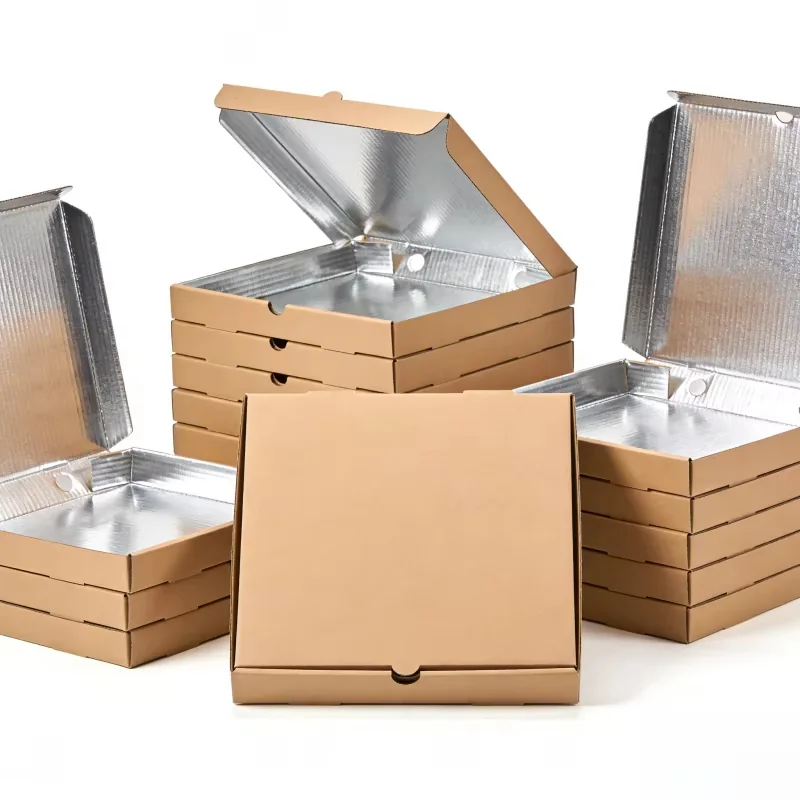
Pizza box. Specify E-flute or B-flute corrugated with an unbleached kraft liner and state the grammage and edge-crush value on the spec sheet. Use water-based flexo or offset inks on the outer, non-contact surface; direct-food-contact printing needs its own assessed application and should not be assumed safe for hot, fatty food. Choose vent holes over a plastic vent, and a removable paper liner over a plastic one. Avoid PE/PLA lamination, wax coatings and intentionally added PFAS grease barriers – a growing list of US states restricts PFAS in food packaging, and a film layer is screened out at the pulper. Light grease on a used box is a collection question for the consumer, not a licence to add a plastic barrier at the factory. If you need a barrier, ask for the declaration in writing before you approve the die-line. Our corrugated board grades guide explains how flute, ECT and gsm interact.
Candle box. A wrapped rigid box is paper wrap over greyboard – already two fibre layers plus adhesive, before you add a PET window or a magnet. If a recyclable claim matters, prefer a folding carton with a tuck flap or paper sleeve, moulded-pulp or paperboard dividers instead of EVA foam, and aqueous OPV varnish instead of BOPP or soft-touch lamination. Keep foil stamping to a small accent rather than a full panel. If a window is non-negotiable, make it removable and say so on the pack. Our folding carton printing guide covers the structural trade-offs; PPWR recyclability grades A/B/C takes the same logic into the EU market.
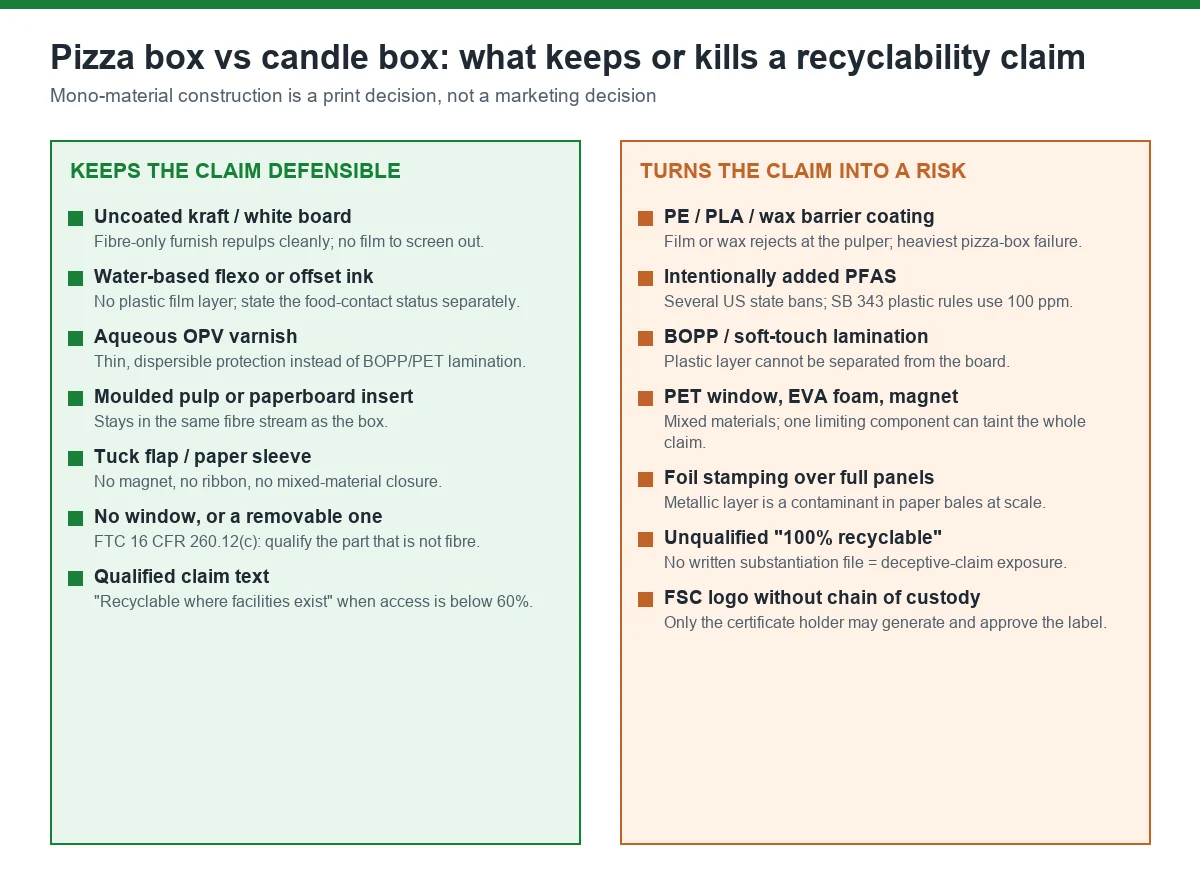
The reason is the same in both cases: a claim about the whole package is only as strong as its least recyclable component. A converter cannot certify your legal claim, but it can hand you a spec sheet that makes the claim easy to substantiate – board grade, ink system, coating, insert, window, barrier declaration and lot traceability.
Illustrative scenario: two SKUs, one claim review
Illustrative composite scenario, not a specific customer order and not a claim about any real brand. A buyer asks for “100% recyclable” on both a printed corrugated pizza box and a rigid candle gift box. On the pizza box, the artwork review removes the chasing arrows, replaces a quoted PE barrier with vent holes plus an uncoated kraft liner, and adds “check local recycling” plus a line about removing the paper liner. On the candle box, the review replaces an EVA foam insert and magnetic closure with moulded-pulp dividers and a paper sleeve, and downgrades the claim to “recyclable where facilities exist; remove the window before recycling”. Both SKUs then get a one-page substantiation file. Neither decision requires a lawyer; both require a converter who asks the question before the plate is cut.
Spec table: RFQ fields for a claim-ready box
| Field | Pizza box (typical) | Candle box (typical) | Why it belongs on the RFQ |
|---|---|---|---|
| Board | E or B flute, unbleached kraft liner, state gsm + ECT | 350-400 gsm SBS / kraft folding carton, or 1200 gsm greyboard for rigid | Fibre grade drives both strength and the recycling route. |
| Ink | Water-based flexo on outer liner; food-contact status declared | Water-based offset or soy-based, low coverage on the outside | Ink and coating must be stated, not assumed. |
| Coating / barrier | None, or aqueous OPV; no PE/PLA/wax; written PFAS declaration | Aqueous OPV instead of BOPP or soft-touch lamination | Film layers are screened out at the pulper. |
| Window / insert | No plastic window; removable paper liner | No PET window, or removable + disposal instruction; moulded pulp insert | One limiting component can taint the whole claim. |
| Closure | Self-locking tuck, no plastic tab | Tuck flap or paper sleeve, no magnet or ribbon | Mixed-material closures are easy to overlook. |
| Claim text | “Check local recycling” / qualified recyclable wording | “Recyclable where facilities exist; remove window before recycling” | Wording is an artwork field, with a version number. |
| Evidence | Current Table 2 extract, fibre declaration, mill TDS, lot/date register | Same, plus insert and coating declarations | SB 343 expects written substantiation. |
| Validation | Box compression / stack and grease-resistance check on the actual board | Drop and fit test with the real candle vessel | A compliant box that fails in transit is not a saving. |
Downloadable SB 343 artwork & evidence checklist
We put the whole pre-press review on one page: Download the SB 343 box artwork & evidence checklist (PDF). Print it, attach it to the artwork approval email, and keep a signed copy with the lot records. In short:
- Audit every claim on every SKU that ships into California – symbol, wording, icon and disposal line.
- Match the exact material type and form against the current CalRecycle Table 2, and record the download date.
- Decide the build first (coating, window, insert, closure, barrier), then the wording.
- Collect mill declarations, TDS, PFAS statement and no-FSC-logo confirmation from your converter.
- Record manufacture date, print lot and artwork version against each claim.
- Re-check when CalRecycle publishes its next study, when the injunction changes, or when anything in the build changes.
FAQ: recyclable pizza and candle boxes in California
Are pizza boxes recyclable in California?
Plain, uncoated corrugated pizza boxes are widely collected, and light grease residue does not automatically disqualify them – but heavily saturated, waxed or plastic-lined boxes are a different material form. Local programs decide acceptance, and SB 343 looks at the material type and form against statewide collection and sortation data, not at a theoretical ability to recycle. Confirm the current Table 2 and your local program before printing an unqualified claim.
Can I still print the chasing-arrows symbol after 4 October 2026?
The statutory restrictions were written for products and packaging manufactured on or after that date, but enforcement is currently blocked by the 14 July 2026 preliminary injunction. Do not read that as permission: the injunction can change, and the FTC Green Guides and California’s general deceptive-advertising laws still apply. The safe default is an artwork that is already compliant.
Does “made with recycled content” count as a recyclable claim?
No. It is a claim about input material. Keep the two statements separate, state the percentage, and hold a supplier declaration that supports the exact number.
Is a candle box with a plastic window recyclable?
Not as an unqualified whole-package claim. Section 260.12(c) limits unqualified claims to the entire package excluding minor incidental components, and section 260.12(d) flags components that significantly limit recyclability. Either make the window removable and say so, or qualify the claim.
Can I print the FSC logo on my custom box?
Only if the product is sold through a valid FSC chain of custody and the label is generated and approved under the certificate holder’s licence. We do not hold FSC CoC certification, so we do not print the logo; we can supply mill certificate numbers, TDS and fibre-source declarations instead.
What is the FTC 60% rule?
Section 260.12(b)(1) of the Green Guides defines “substantial majority” as at least 60%. If recycling facilities are available to fewer than 60% of consumers or communities where the item is sold, all recyclable claims should be clearly and prominently qualified.
Does the July 2026 injunction mean I can ignore SB 343?
No. It blocks enforcement of SB 343 only. CalRecycle must still publish its next study in 2027, the written-substantiation expectation remains in the statute, and other laws and retailer requirements are unaffected. Treat the pause as time to finish the artwork audit.
Do I need to remove grease-proof barriers from my pizza box?
If a barrier is needed for the product, ask for a written declaration of what it is and whether intentionally added PFAS are present, then re-assess the claim for that material form. A barrier that cannot be repulped should not sit under an unqualified “recyclable” line.
Related reading and next step
- Corrugated Board Grades: ECT, Flute & GSM Explained
- Folding Carton Printing: A 2026 Buyer’s Guide
- Custom Paper Boxes for Food, Pizza and Candle Packaging
- PPWR Recyclability Grades A/B/C
- Custom packaging box category
Want a second pair of eyes on the artwork? Send your current box spec, the claim text you plan to print and the destination state, and we will return a marked-up dieline plus the material declarations your substantiation file needs. Physical sample sets are available on request – ask through our contact page.
Disclaimer: general guidance, not legal advice. SB 343 (Cal. Pub. Res. Code section 42355.51), the 14 July 2026 preliminary injunction in California League of Food Producers v. Bonta, CalRecycle findings and 16 CFR Part 260 are summarised for context. Dates and scopes can change with litigation, study updates and implementing acts. Confirm the current text with CalRecycle and eCFR before specifying or procuring.