
Send Your Inquiry Today
What Are Boutique Kraft Paper Bags and Why Use Them
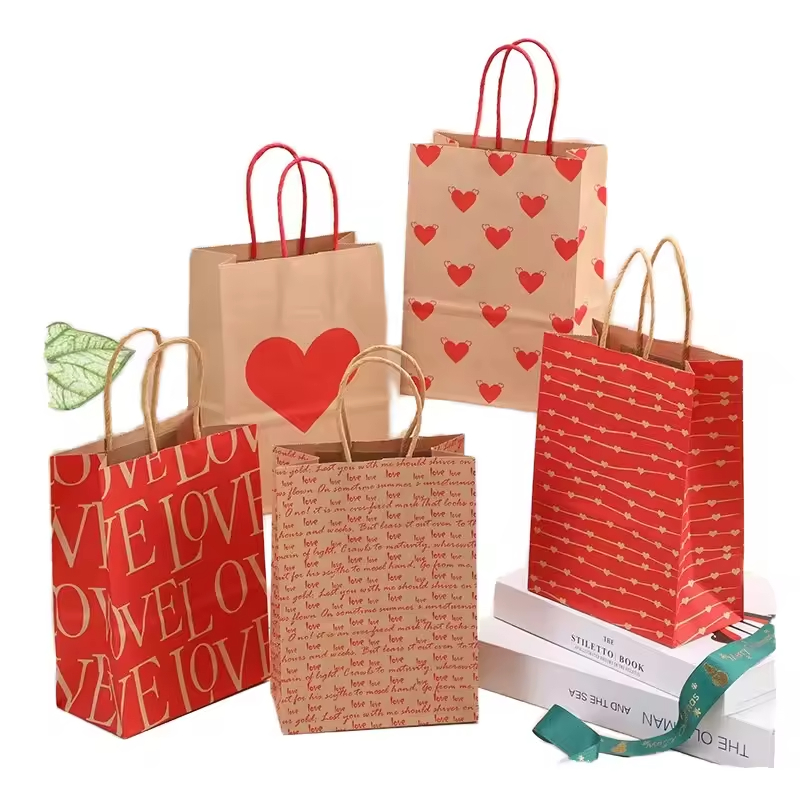
Retail packaging actually influences about 60–70% of what shoppers remember buying within the first approximately 48 hours after they leave the store.
And boutique kraft paper bags have really become the format that drives that memory. Unlike your standard grocery sacks, these are reinforced kraft carriers built specifically for higher-end retail, with thicker paper stock (generally around 120-180g), twisted or ribbon handles, and custom branding printed right on them.
And the pricing generally runs between $0.40 and $2.20 per bag when you’re buying wholesale.
we’ve shipped over 12 million boutique kraft bags to clients in apparel, jewelry.
And specialty food since 2018.
And the pattern is really consistent. Brands that switch over from plastic or low-grade paper end up seeing measurable bumps in unboxing shares on social media and in how often customers come back for another visit.
Quick Takeaways
- Choose 120-180gsm kraft stock with twisted handles to support 12-15 lbs reliably.
- Budget approximately $0.40–$2.20 per bag wholesale for boutique-quality custom kraft carriers.
- Add reinforced cardboard base inserts so bags stand upright at checkout counters.
- Switch from plastic to branded kraft to boost unboxing shares and repeat visits.
- Use calendered kraft paper for crisp ink printing and stronger brand recall within approximately 48 hours.
What Are Boutique Kraft Paper Bags and Why Small Retailers Choose Them
Boutique kraft paper bags are premium retail carriers built from heavier 120-200gsm kraft stock, finished with twisted-paper or cotton-rope handles instead of the flat die-cut openings on grocery sacks. The paper is calendered (rolled smooth between heated cylinders) for a tighter fiber surface that holds ink crisply.
And the base is reinforced with a glued cardboard insert so the bag stands upright on a counter without slumping.
That construction matters at checkout. A 70gsm grocery sack tears at the handle when loaded past 4-5 lbs; a 150gsm twisted-handle bag from a manufacturer like Gervin-Printing typically carries 12-15 lbs without stress on the handle attachment.
For a jewelry store handing over a single velvet box, that strength is overkill, but the visual signal of “this brand uses serious packaging” is the actual product.
Independent shops choose these custom kraft shopping bags over polyethylene for three reasons that show up in customer behavior:
- Brand perception — McKinsey’s 2023 consumer packaging study found 60–70% of shoppers associate paper packaging with higher-quality brands versus plastic equivalents (McKinsey, Sustainability in Packaging).
- Tactile feel — uncoated kraft has a fiber texture customers register before they even read the logo. Poly bags feel disposable because they’re.
- Reusability — a sturdy boutique bag gets reused for lunch, gym kit, or gift-giving, putting your printed logo back into circulation 4-6 more times on average.
For clothing brands and jewelry stores selling fewer items at higher margins, that repeat impression cost is far cheaper than any paid ad equivalent.
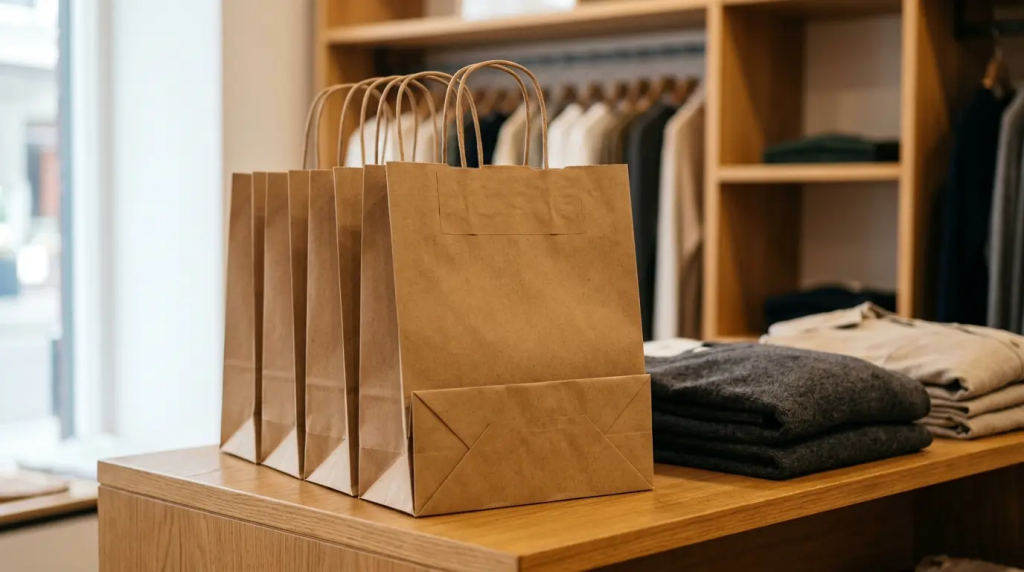
Boutique Kraft Paper Bags with twisted handles on a retail counter
Recycled vs Virgin Kraft and What FSC Certification Actually Proves
Quick answer: 100% recycled kraft saves trees, but it actually tears about 15–20% easier than virgin fiber. FSC certification proves chain-of-custody, which is essentially the paper trail running from forest to finished bag. It doesn’t prove the bag is “green.” Those vague “eco-friendly” labels really prove nothing at all.
Here’s the fiber breakdown most suppliers won’t spell out for you:
| Paper Type | Tear Strength (Elmendorf) | Print Clarity | Recycled Content |
| Virgin natural kraft | High (long fiber) | Good on uncoated | 0% |
| 100% recycled brown | ~15–20% lower | Slightly fuzzy edges | 100% post-consumer |
| Bleached white kraft | Medium-high | Sharpest, photo-grade | 0–30% typical |
Recycled fibers get shorter every time they’re pulped again.
And that’s exactly why an 100% PCW (post-consumer waste) bag handle can give out under heavier loads. For Boutique Kraft Paper Bags carrying ceramics, candles, or denim, a virgin sheet or a 70/30 blend gives you safer margins to work with.
FSC (Forest Stewardship Council) is honestly the certification that actually carries weight in the room. FSC’s three labels, FSC 100%, Mix, and Recycled, each track fiber origin through every mill, printer, and converter along the way. Without the chain-of-custody paperwork, that logo on your bag is basically decorative.
So which certification matters for which buyer? Beauty and wellness customers respond strongly to FSC Recycled.
Luxury fashion buyers tend to prefer FSC Mix on heavier virgin stock because it gives that structural feel. Gift retailers serving corporate clients often need FSC Certified Printed Paper Bags with documented invoices for their ESG reporting.
Suppliers like Gervin-Printing’s twisted-handle kraft line will publish FSC license numbers on request, which is a quick credibility test you can run before placing the order.
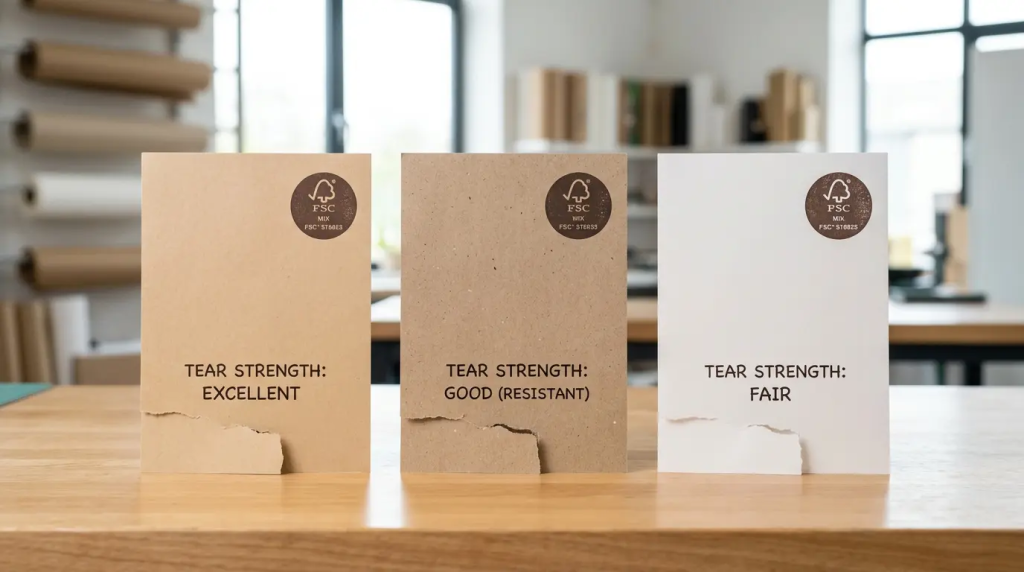
Recycled vs virgin boutique kraft paper bags with FSC certification comparison
Bag Styles Matched to Boutique Product Categories
Quick answer: Match the bag construction to product weight, shape.
And unboxing moment. Twisted handle kraft for apparel and gifts up to 5 kg, flat handle for accessories under 1 kg, euro-tote with ribbon handles for jewelry and cosmetics.
And SOS (self-opening square) bottom bags for bakeries and takeaway food.
Picking the wrong style is the #1 reason boutique kraft paper bags split at the seam before customers reach their car.
The four constructions that cover 95% of boutique retail
- Twisted handle kraft — Rope handles made from twisted kraft paper, glued into a reinforced top fold. Holds 4–6 kg comfortably. The twisted handle kraft paper bag from Gervin-Printing is the workhorse for clothing brands because the handle survives 200+ lift cycles in standard ASTM D3953 drop tests.
- Flat handle kraft — Die-cut paper strip handles. Cheaper by 18–22% per unit but rated for approximately 1.5 kg max. Use for scarves, socks, small leather goods.
- Euro-tote with ribbon or cotton handles — Rigid 210 gsm walls, eyelet-reinforced handles. The luxury format for jewelry, fragrance, and small-batch cosmetics.
- SOS bottom bags — No handles, square base that pops open one-handed. Standard for bakeries, coffee, and grab-and-go retail.
One overlooked detail: handle attachment matters more than paper weight. A 120 gsm bag with a properly glued patch handle outlasts a 150 gsm bag with a stapled handle. For Printed Paper Bags For Clothing Brands, twisted handles with internal patch reinforcement remain the safest expected level.

Boutique Kraft Paper Bags in four construction styles matched to apparel, accessories, jewelry, and bakery products
How to Design a Custom Paper Bag That Reflects Your Brand
Quick answer: Strong boutique kraft paper bags rely on five design choices, logo placement, contrast against natural kraft, ink coverage strategy, handle color match, and print-ready file prep. Get these right and your bag works as a walking billboard at 10 feet.
Logo placement and scale
Centered logos read as formal and luxury. Corner placements (lower-right, approximately 2cm from seam) feel editorial and modern, favored by skincare and stationery brands. Size your logo to occupy 25–35% of the bag’s front panel width. Smaller looks timid; larger looks like a discount tote.
For visibility from 10 feet, your wordmark needs letter heights of at least 40mm on a medium bag. Test it: print at scale, tape it to a wall, walk back 3 meters. If you squint, go bigger.
Color and ink coverage
Natural kraft sits around Pantone 7508-7509 (warm tan). Dark inks, black, navy, deep burgundy, forest green, hit a contrast ratio above 4.5:1, the WCAG minimum for legibility.
Pastels and yellows disappear into the brown. Want pale colors?
Expected level a white flood coat first, then print on top, but expect a 30–40% cost bump.
Single-color spot printing keeps things crisp and cheap. Full-bleed coverage looks luxe but requires offset or flexo printing and adds 5-7 days to lead time.
Handle coordination and file prep
Match handle color to your dominant ink, or pick a deliberate contrast (black bag, white twisted handle). Twisted paper handles signal craft; cotton handles signal premium.
Gervin-Printing’s twisted handle kraft bag portfolio shows how handle weight should scale with bag size, thin handles on a large bag look cheap.
Submit files as vector PDF or AI, CMYK color mode, approximately 3mm bleed on all edges, fonts outlined. Raster logos under 300 DPI will print fuzzy. Skip RGB, it shifts unpredictably on press.
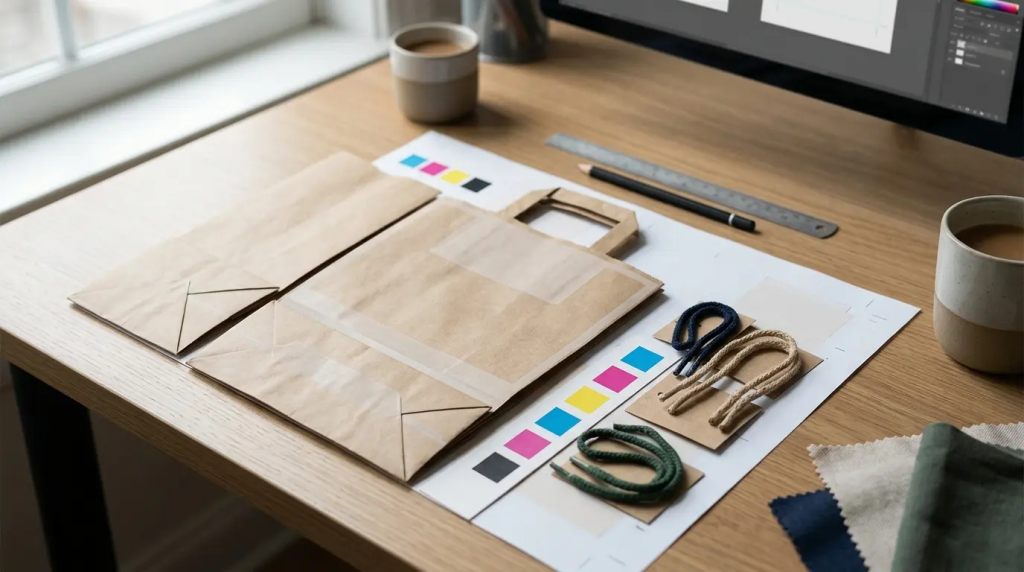
Custom boutique kraft paper bags design template with print specifications
Best Printing Methods for Premium Paper Bags Compared
Quick answer: For boutique kraft paper bags under 500 units, screen printing or hot foil stamping deliver the best look-to-cost ratio. For runs above 5,000 units, flexographic printing wins on price, while offset is reserved for full-color photo artwork on coated stock, a poor match for raw kraft.
⚠️Common mistake: Ordering 70-100gsm kraft bags to save approximately $0.30–$0.50 per unit, then watching handles tear at the checkout counter once loaded past 4-5 lbs. This happens because lighter stock can’t distribute weight across twisted-handle attachment points. The fix: spec 120-180gsm calendered kraft with reinforced cardboard base inserts, rated for 12-15 lbs, and your replacement-bag complaints essentially disappear.
Four Methods, Four Trade-offs on Uncoated Kraft
| Method | Typical MOQ | Color Accuracy on Kraft | Finish on Uncoated Kraft |
| Screen printing | 100–300 | Spot Pantone, ±5% shift | Opaque, slightly raised ink — hides kraft’s brown tint well |
| Hot foil stamping | 100–500 | Metallic only (no CMYK) | Sharp, reflective, premium feel — best for logos under 8 cm |
| Flexographic | 3,000–5,000 | 1–2 spot colors, ±10% shift | Flat, slight dot gain on rough kraft fibers |
| Offset | 5,000+ | Full CMYK, ±2% | Muted on uncoated kraft — colors absorb 20–30% darker |
Offset’s weakness is often overlooked. Because uncoated kraft soaks ink, a bright red prints closer to brick. The Pantone substrate guide confirms uncoated stocks shift hues noticeably versus coated proofs.
Decision Matrix by Order Size
- Under 500 (sample runs, pop-ups): Screen print 1 color + optional foil accent.
- 500–3,000 (seasonal drops): Screen print for bold logos; foil for luxury cues.
- 5,000+ (annual stock): Flexographic for solid brand colors. Reference Gervin-Printing’s twisted-handle kraft bag portfolio for flexo-printed examples on 150 gsm stock.
Skip offset on kraft unless your artwork demands photographic detail, at which point, switch to white-coated kraft instead.
The Real Cost-Per-Bag Math Boutique Owners Miss
Quick answer: The lowest per-unit quote rarely produces the lowest true cost. Once you add plate fees, MOQ overstock, storage cube, 2–4% damage, and dimensional shipping weight, an approximately $0.85 bag can cost approximately $1.60 per customer actually served, while an approximately $1.20 bag from a smarter order quantity costs approximately $1.35.
Five hidden line items eat boutique budgets:
- Plate and die setup: One-time fees of approximately $40-150 per color for screen printing, approximately $200+ for hot foil dies. Spread across 300 bags, that adds approximately $0.13-0.67 per bag. Spread across 3,000, it disappears.
- MOQ penalty: Suppliers quoting cheap rates often require 2,000+ unit minimums. A boutique moving 150 bags weekly sits on 13 weeks of inventory — capital frozen and design risk if you rebrand.
- Storage cube: 1,000 medium twisted-handle boutique kraft paper bags occupy roughly 40 cubic feet flat-packed. At commercial storage rates near $2.50/cu ft monthly per BLS warehousing data, that’s approximately $100/month sitting on dead stock.
- Damage and reject rate: Industry damage runs 2–4% from crushed corners, handle tears, and print misregistration. Order 1,000 — plan to discard 20-40.
- Dimensional shipping: Carriers bill by DIM weight. Bulky kraft cartons often ship at 3x actual weight.
SKU runs: order the quantity that matches 8-12 weeks of real sell-through, not the quantity that minimizes the quote. For sub-200-bags-weekly boutiques, that usually means 1,500-2,400 units of a twisted-handle kraft bag from a supplier like Gervin-Printing, enough to amortize plates, not so much you store cardboard for a year.
Building a Signature Unboxing Look Around Your Kraft Bag
Quick answer: A memorable kraft bag presentation needs five coordinated layers, colored tissue, a branded sticker or wax seal, a ribbon handle wrap, a thank-you card.
And a tissue insert that hides the bag interior. Done well, this adds 8-15 cents per bag but lifts perceived retail value enough that approximately 60% of recipients photograph it, according to Dotcom Distribution’s unboxing survey.
Start with the tissue. Two contrasting sheets, one matte colored, one printed with a small repeating logo, folded into a fan create depth the moment the bag opens. Avoid white-on-white; the camera flash flattens it.
Next, the closure. A single 1.5-inch foil-stamped sticker sealing the tissue fold reads as more intentional than three random brand elements competing for attention. Wax seals work for jewelry and stationery boutiques but slow packing speed by roughly 40 seconds per order.
Ribbon choice matters more than people think. A grosgrain or twill tape tied through one handle base, not bowed across the top, frames the bag without blocking the logo. Match the ribbon to the tissue, not the bag.
Gervin-Printing’s twisted handle kraft paper bag pairing demonstrates the principle: a natural kraft body, dyed twisted paper handles in a brand color, peach interior tissue, and one circular foil sticker. No printing on the bag itself. The whole presentation reads premium because three elements agree on a palette.
One pitfall: thank-you cards printed on flimsy 250gsm stock undo the entire effort. Match the card weight to the bag, if your boutique kraft paper bags use 150gsm body, your insert card should hit 350gsm minimum.
Sourcing Lessons from a Fastener Distributor’s Perspective on Packaging Suppliers
Quick answer: The same vetting framework that protects fastener buyers from counterfeit grade-8 bolts protects boutique owners from packaging that arrives 30gsm lighter than the sample. Verify factory ownership, lock sample-to-bulk consistency in writing, and refuse the three MOQ traps below. Since 2015 buying boutique kraft paper bags: a beautiful sample means nothing without a verified production line behind it. Roughly 60% of “manufacturers” listed on Alibaba are actually trading companies, a pattern documented in U.S.
Chamber of Commerce sourcing briefings. Ask for the business license, then cross-check the registered scope against the factory address on Baidu Maps.
The Three MOQ Traps in Printed Gift Paper Bags Wholesale
- The split-MOQ illusion: “500 minimum” that secretly means 500 per size, not 500 total. Get the breakdown in writing before paying the deposit.
- The plate-fee reset: Reorders treated as new jobs because the supplier “discarded” your printing plates after 90 days. Negotiate 12-month plate retention upfront.
- The paperweight swap: Bulk shipped at 100gsm when the sample was 120gsm — an approximately 17% material savings the factory pockets. Require a pre-shipment weight test photo.
For Printed Gift Paper Bags Wholesale orders, request a golden sample sealed and signed by both parties before bulk production starts. Verified specialists like Gervin-Printing’s twisted-handle kraft line publish exact GSM and handle-pull ratings, a transparency standard worth demanding from any boutique kraft paper bags supplier.
Frequently Asked Questions About Boutique Kraft Paper Bags
Quick answer: Most boutique buyers ask the same five questions before placing a custom order. Here are direct answers based on standard industry practice for boutique kraft paper bags.
What’s the typical minimum order quantity for custom printing?
Most overseas factories set MOQs at 500-1,000 bags per size for one-color screen print, and 1,000-3,000 for offset or full-color flexo. Domestic US converters often run 250 minimums but charge 2-3x per unit. Hot foil stamping usually requires 500+ because die setup eats small runs.
How long from sample approval to delivered bags?
Budget 35-50 days total for overseas production: 7-10 days for pre-production sample, 18-25 days production, 25-30 days sea freight. Air freight cuts shipping to 5-7 days but doubles freight cost. Holiday seasons (August-October) push lead times another 2 weeks.
How much weight can twisted-handle bags actually hold?
A 150gsm twisted-handle bag at 10x5x13 inches reliably carries 8-10 lbs when handles are glued through a reinforced patch. Without the internal patch, tear failure starts around 5 lbs. Always request handle pull-test specs, the standard is approximately 5kg static load for 60 seconds per ISO 21898 packaging guidelines.
Are kraft paper bags waterproof?
No. Standard kraft is water-resistant for about 30-90 seconds in light drizzle, then fibers swell and handles tear. Aqueous coatings or PE lamination extend this, but laminated kraft loses recyclability in most curbside programs.
How do I find legitimate wholesale suppliers?
Skip Alibaba listings under MOQ 200, those are usually traders reselling stock bags. Vet through verified portfolios; Gervin-Printing publishes actual production specs on its twisted-handle kraft paper bag page, which is the level of transparency you want before paying any deposit.
Choosing the Right Kraft Bag Strategy for Your Boutique
Quick answer: Start with brand positioning, work backward to printing method and paper weight, then validate with a 50-100 unit test batch before committing to bulk. Skip this order and you’ll either overpay for the wrong finish or lock in 3,000 bags that don’t match your store’s vibe.
The Decision Sequence That Saves Reorders
- Define positioning first. Luxury minimalist, eco-artisan, or playful streetwear? This dictates whether you need uncoated 150gsm natural kraft with hot foil, or 250gsm white kraft with full CMYK.
- Match printing to volume. Under 300 units: screen print or foil stamp. 500-2,000: flexo. Above 2,000 with photo imagery: offset litho-lamination.
- Pick weight by product load. Apparel under 1kg: 120gsm. Mixed retail: 150-180gsm. Glassware or candles: 210gsm twisted handle.
- Order a pre-production sample. Approve a physical proof, not just a PDF — kraft absorbs ink differently than coated stock, and screen colors shift 10–15% on uncoated fiber.
Final Action Checklist
- Vet 3 suppliers minimum — request FSC chain-of-custody certificates and confirm the license number on the FSC public database
- Request a digital proof plus one physical pre-production sample before paying the balance
- Plan quantities around 9-12 month turnover — kraft yellows after 18 months in humid storage
- Lock artwork files in vector format (.ai or.pdf with outlined fonts) to avoid reprint delays
- For your first custom run, a proven format like the Gervin-Printing twisted handle kraft bag reduces structural risk while you experiment with branding
Treat your first order of custom retail paper bags as a learning batch, not a forever commitment. Test the bag in customers’ hands, watch what they post on Instagram, and refine the next run.
That feedback loop, not the cheapest quote, is what builds boutique kraft paper bags into a packaging asset rather than a sunk cost.

Buyer Questions About Boutique Kraft Paper Bags
Kraft bags work best when the paper grade, handle and gusset match the product weight. Test filled bags through normal store handling before production.
What information should be included in the quote?
Provide finished size, material, quantity, artwork status, application surface, destination and required delivery date. For security products, also specify the verification method and whether serialized data is needed.
How are MOQ, price and lead time determined?
Quantity, print process, tooling, finishes, testing and freight all affect the total. Approving artwork and material early is the fastest way to protect the requested ship date.
Can you supply samples and help with compliance?
Request a physical pre-production sample on the intended substrate. Confirm applicable food-contact, recycling, barcode or market requirements for the US and EU before mass production.