
Send Your Inquiry Today
Custom Packaging Labels for EU/US Brands: Materials, Printing & Trends
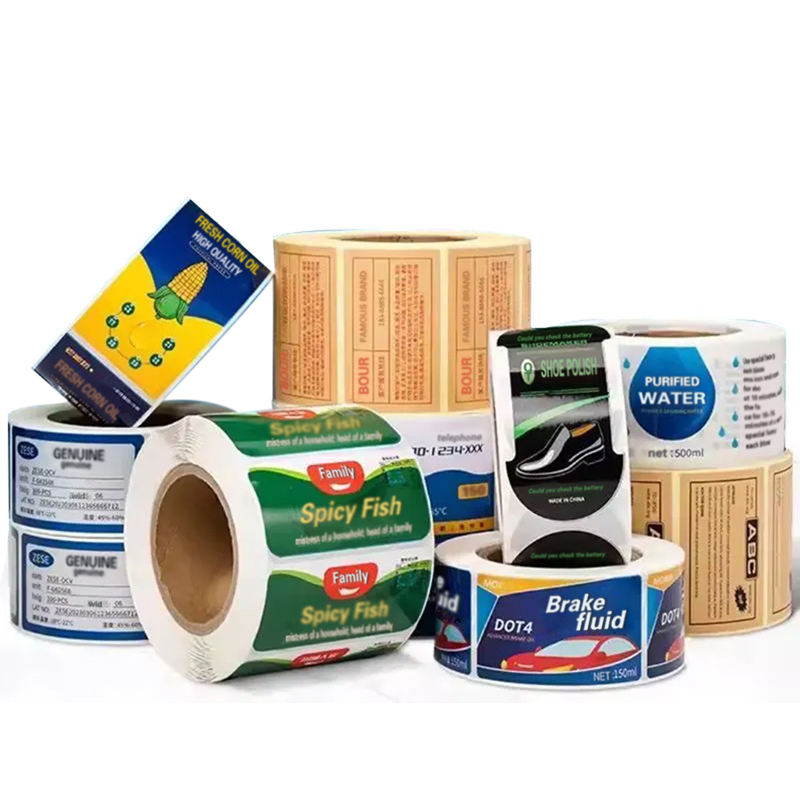
A label is not a printed sticker — it is a three-layer material system: facestock (what you see), adhesive (what makes it stay), and liner (what carries it until application). Choose the system right and the label survives its container’s whole life — cold chains, wet shelves, sunlight, friction. Choose it wrong and you join the long list of buyers searching “labels that won’t stay on plastic.” This guide maps the materials and printing options for EU and US brand programs.
For EU shipments, check our PPWR labelling requirements checklist: what must appear on the pack from 12 August 2026, and what only bites in 2028 and 2030.
Facestocks: Paper vs. Film
| Facestock | Look & feel | Water / oil | Typical use |
|---|---|---|---|
| Coated paper (gloss/matte) | Crisp print, economical | Poor–fair (needs lamination) | Dry goods, folding cartons, shipping labels |
| Textured / uncoated paper | Premium tactile | Poor | Wine, cosmetics, boutique |
| Polypropylene (PP) | Semi-gloss, flexible | Excellent | Bottles, squeezable containers, bathroom products |
| Polyester (PET) | High-gloss or metallic, stiff | Excellent + UV stable | Durable goods, outdoor, asset labels |
| Polyethylene (PE) | Soft, squeezable | Excellent | Squeeze bottles, chemical containers |
Rule of thumb: paper on dry surfaces, film wherever the product lives wet, cold, or under friction. For the production side of label printing, see the label printing practical guide.
Adhesive: The Layer That Causes the Complaints
| Adhesive | Behavior | Use when |
|---|---|---|
| Permanent (general purpose) | Bonds fully in 24–48h; removal destroys label | Default for most product labels |
| Removable | Clean removal within its window | Promotional, glass reuse, temporary markings |
| Repositionable | Tack without immediate full bond | Application alignment matters |
| Cold-temp / freezer grade | Tacks at −20°C and below | Refrigerated & frozen products |
| High-temp / industrial | Survives 80–150°C+ | Heat-filled products, autoclave |
How to Read an Adhesive Specification
Adhesive data sheets quote three numbers that matter more than the brand name: loop tack (how aggressively the label grabs on contact), peel adhesion (the force needed to remove it once bonded), and shear (resistance to slow creep under load). A freezer-grade adhesive tacks reliably at low temperature but may have lower ultimate peel; a high-temperature industrial adhesive does the reverse. Matching all three to your filling line and end-use environment is what prevents the two classic complaints: labels that fall off in transit, and labels that cannot be removed when a customer wants to reuse the container.
Two details are routinely missed on purchase orders. Dwell time: most permanent adhesives reach full bond 24–48 hours after application, so a product shipped sooner is tested before the bond has fully developed. Application temperature: an adhesive applied below its stated minimum will not wet the surface properly and never recovers, even if the product warms up later. State both in the specification.
Liners and Application Method
The liner is the carrier the labels sit on until application, and it is chosen by how the labels go on. Glassine paper liners suit hand application and semi-automatic dispensing. PET film liners are required on high-speed automatic applicators because they resist tearing under dispensing tension. Labels supplied in rolls must also specify roll direction and which edge dispenses first — a roll wound the wrong way for your applicator stops the line, and it remains one of the most common reasons a technically correct label job is rejected at goods-in.
If labels are applied by hand, sheeted formats reduce waste and training time. If they are applied on a line, ask the converter for a sample roll to run on the actual applicator at production speed before confirming the order. Label geometry, liner release and adhesive tack interact in ways bench tests do not predict, and a ten-minute line trial costs far less than a rejected shipment.
The Surface Problem: Why Labels Fall Off Plastic
The most common label failure in B2B quotes is labels peeling from HDPE and PP containers — plastics with low surface energy that general adhesives cannot wet properly. The fixes, in order of cost: use an adhesive formulated for low-surface-energy plastics; corona-treat or flame-treat the container surface at filling; or switch the label to a conformable film (PP/PE) that flexes with the container instead of lifting at curved edges. Glass and cardboard are high-surface-energy and forgiving; silicone and some recycled plastics are the hardest cases. If your products run the full material range, a label manufacturer with materials engineering will test adhesion on your actual containers before quoting — always request that test report.
Compliance: What Changes Between the EU and the US
A label that satisfies one market often fails the other, and the differences sit in the details rather than the design. In the EU, hazardous mixtures must carry CLP pictograms, signal words and hazard statements under Regulation (EC) No 1272/2008, while food-contact materials fall under Framework Regulation (EC) No 1935/2004 together with the Good Manufacturing Practice requirements of Regulation (EC) No 2023/2006. In the US, food-contact components run through the FDA system, with paper and paperboard addressed under 21 CFR Part 176, and consumer labelling claims are enforced separately by the FTC.
For brands shipping to both markets, the practical approach is to design one base label and reserve a variable area for market-specific text: language variants, importer address, recycling symbol, and any required hazard or nutrition panel. That keeps the die line and print plates shared across markets, so entering a second market costs a text change rather than a new tool.
Printing and Finishing for Labels
Roll labels (flexo or digital) feed automatic applicators at filling lines — specify roll direction and dispensing edge to match your line. Sheet labels suit hand application and small runs. Finishing options that change durability more than appearance: lamination or varnish for wet environments, and hot foil or holographic elements where brand protection or shelf impact is the goal. For labels that carry compliance data in the EU and US — food contact, CLP, GS1 2D codes — see the requirements discussion in the regulation guide.
Frequently Asked Questions
What kind of labels stick to plastic?
Film facestocks (PP or PE) with an adhesive rated for low-surface-energy surfaces. Paper labels with general adhesive will lift on HDPE/PP over time. For curved or squeezable plastic, use PE so the label flexes with the container — a rigid label on a soft bottle is a guaranteed edge-lift failure.
What is the difference between labels and stickers?
Industry usage: a label carries information (identity, compliance, barcodes) and is engineered for a specific container and environment; a sticker is more general-purpose decoration, usually on sheets, with less engineering behind adhesive and durability. Product packaging almost always needs labels; stickers cover promotion and giveaway uses.
What makes a label waterproof?
All three layers must resist water: film facestock, water-resistant adhesive, and lamination or UV varnish over the print. A laminated paper label is splash-proof; a full film construction (PP/PET facestock + compatible adhesive) survives immersion, condensation, and ice-bucket service. For bottled products destined for wet environments, our bottle and cosmetic label guide covers the full spec.
How long do custom labels take to produce?
Digital label runs are typically 5–10 business days after artwork approval; flexographic runs take 10–15 business days because plates and press setup are involved. Lamination, cold foil or hot foil adds days, and any first-time custom die adds tooling time. When a launch date is fixed, the binding constraint is usually artwork approval rather than press capacity.
What file format should I send for label artwork?
Vector PDF or AI with fonts outlined, plus a 300 dpi raster file for any photographic element. Include 3 mm bleed on elements that reach the edge, keep barcodes and variable data clear of the die-cut margin, and confirm the dieline before proofing. Supplying Pantone references for brand colours avoids the colour drift that happens when a screen colour is converted to CMYK without a reference.