
Send Your Inquiry Today
Certificate of Authenticity Hologram Stickers: What Actually Matters for Sourcing
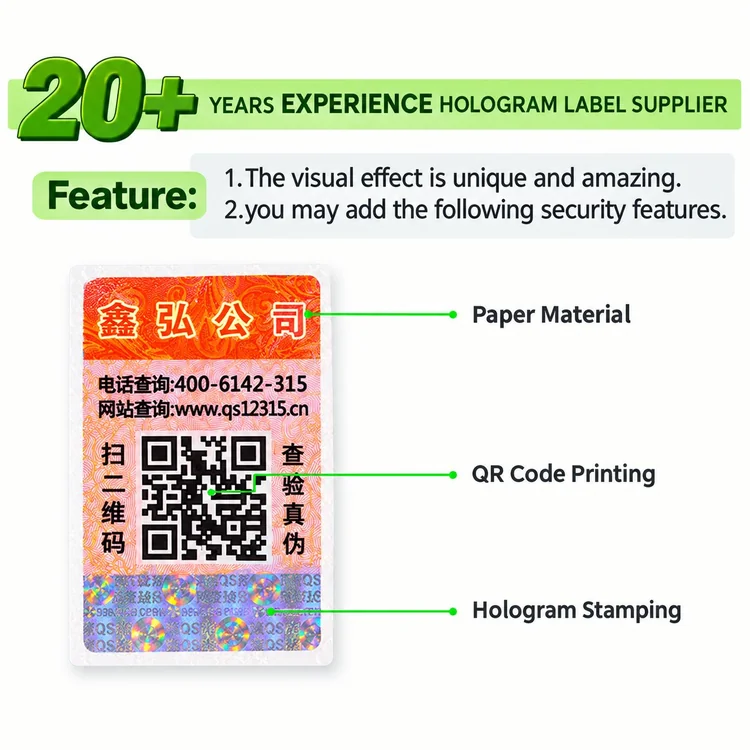
Table of Contents
- What a COA Hologram Sticker Is
- What “Industry Standard” Actually Means
- Who Uses Them — and What to Specify per Industry
- How Reference Frameworks Translate into Design
- Anti-Clone: Why the Printed Code Alone Is Not Enough
- How We Produce Them (and Keep the QR Scannable)
- Real Projects (Anonymized)
- Spec Table with Test Methods
- Pre-Order Checklist (Downloadable)
- How COA Hologram Stickers Compare to Other Options
- What Drives the Cost
- FAQ
- A Note on Legal Requirements
- Where to Learn More
- Get a Physical Sample
- About This Article
If you searched for the industry standards for certificate of authenticity labels, here is the honest short answer first: no law in the US, EU or UK forces a certificate of authenticity (COA) to carry a hologram sticker. What exists instead is a set of reference frameworks and a body of factory practice that professional issuers converge on. This guide explains what those frameworks actually say, how they translate into a real sticker, and where the common marketing claims overshoot.
What a COA Hologram Sticker Is
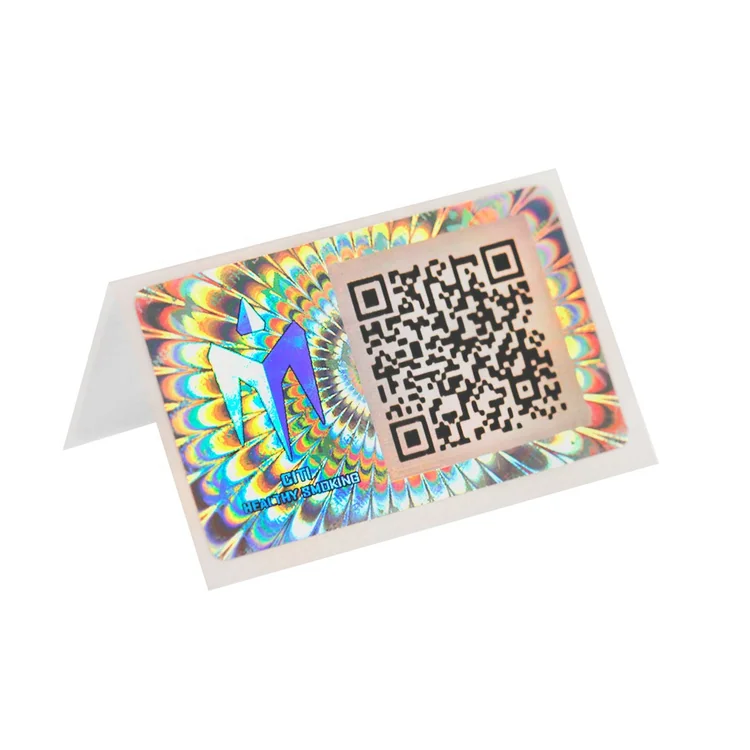
A certificate of authenticity hologram sticker (a COA hologram sticker, or just “the label” below) is a tamper-evident adhesive label applied to a COA document, artwork backing board, warranty card or collectible holder. It combines a custom hologram (an overt, visible feature), at least one covert feature, and a unique variable code that links the physical certificate to a database record. The point is to make the document as hard to fake as the product it certifies — counterfeiters often skip faking the product and just forge the paper that “proves” it. A hologram alone is not security; the layering and the verification behind it are.
What “Industry Standard” Actually Means
Because no regulation prescribes the construction of a COA hologram sticker, buyers are often told a confusing mix of “standards.” Here is the accurate split.
No dedicated mandatory standard
- No US, EU or UK law requires a certificate of authenticity to carry a hologram, a QR code, or any security feature.
- There is no single published “COA label grade” document you can cite as compliance. Any supplier who tells you their label is “fully standards-compliant” should be asked which standard, specifically.
Reference frameworks we design against (referenced, not quoted)
These are real, citable documents — but they are frameworks and process standards, not label specifications. We reference and borrow from them; we are not quoting clauses that mandate a particular sticker.
| Reference | What it actually covers | How we use it |
|---|---|---|
| ISO 12931:2012 | Performance criteria for authentication solutions used to combat counterfeiting of material goods. It judges anti-counterfeit solutions by effectiveness — overt, covert and forensic layers working together — and does not prescribe specific label features. | We use its layered-threat model as the planning frame for feature selection. |
| ISO 14298:2021 | Management of security printing processes — the printer’s quality and process controls, not the label spec. | The regime under which a credible security printer operates; ask suppliers whether they work to it. |
| ISO 16678:2014 | Guidelines for interoperable object identification and related authentication systems to deter counterfeiting and illicit trade. | Relevant when structuring serialized / QR-linked identification so codes are built for verification. |
| GS1 Digital Link | A standard for encoding a web link (your verification page) into a 2D code, so any phone resolves the scan to your data rather than a fixed string. | We use it to structure QR content so scans resolve to your verification page. |
Sources: ISO (iso.org), GS1 Digital Link, IHMA. ISO documents are referenced by title only.
Our own practices (stated as ours, not as standards). Two points are sometimes attributed to “the standard” but are actually our factory practice, aligned with how reputable origination houses operate:
- Exclusive masters with a written destruction clause. Your hologram master is shot for you, held exclusively, never re-originated for another buyer, and destroyed on request. This follows IHMA-member origination practice; it is our commitment, not an IHMA-defined standard.
- Layered feature selection. The “at least one overt plus one covert or digital layer” rule is our design recommendation derived from the ISO 12931 model — it is how we plan a sticker, not a clause we quote.
Trends, not current standards: The EU Digital Product Passport under the ESPR (Regulation (EU) 2024/1781) will roll out category by category from 2027 and may eventually make QR-linked product records common on packaging. Today it is a future context, not a requirement for a COA sticker. We mention it so you are not sold it as a compliance item.
Who Uses Them — and What to Specify per Industry
The buyers who come to a converter like us for certificate holograms are usually in one of five situations. The difference that matters is not the industry name but the selection point each one should specify:
- Art print publishers and artists shipping limited editions. Specify: low-residue / removable adhesive so the sticker does not damage the backing board, plus edition numbering in the variable data.
- Wine and spirits brands attaching a numbered seal to gift boxes and single-cask releases. Specify: a condensation-resistant adhesive that survives chilled bottles and humidity in transit and retail chillers.
- Collectibles and trading-card platforms sealing graded or authenticated items. Specify: a tamper-evident backing to prove the holder was never opened, with the QR pointing to a verification page.
- Electronics and warranty programs pairing a serial on the device with a matching COA card. Specify: permanent adhesive and a serial format that maps cleanly to your device records.
- Certification bodies and training providers issuing diplomas that HR and regulators actually check. Specify: durable, consistently scannable codes and a verification path third parties can use without your internal system.
What they share is a simple fear: the document can be photocopied, so the document needs the same protection level as the product. In each case the COA hologram sticker is the core component, and the document and the product should be protected as one system.
How Reference Frameworks Translate into Design
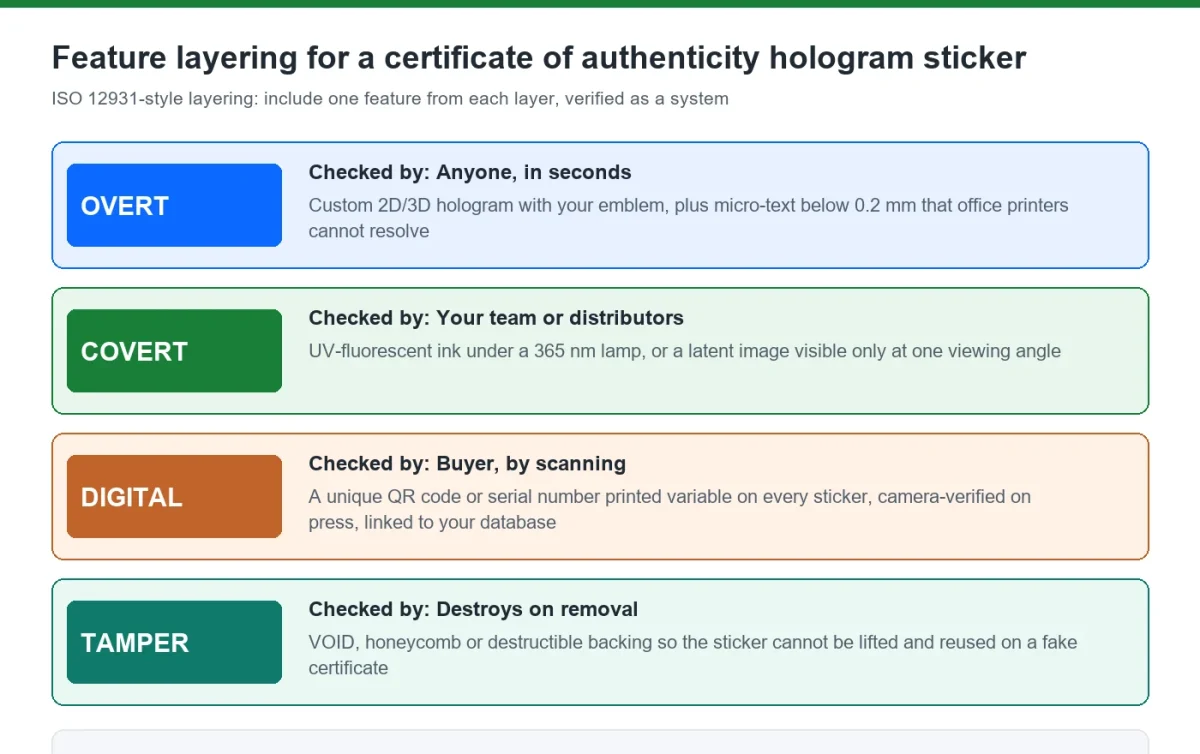
This is the part generic guides skip. Applying the ISO 12931 layered model to a real purchase order, your COA sticker should carry at least one feature from each layer:
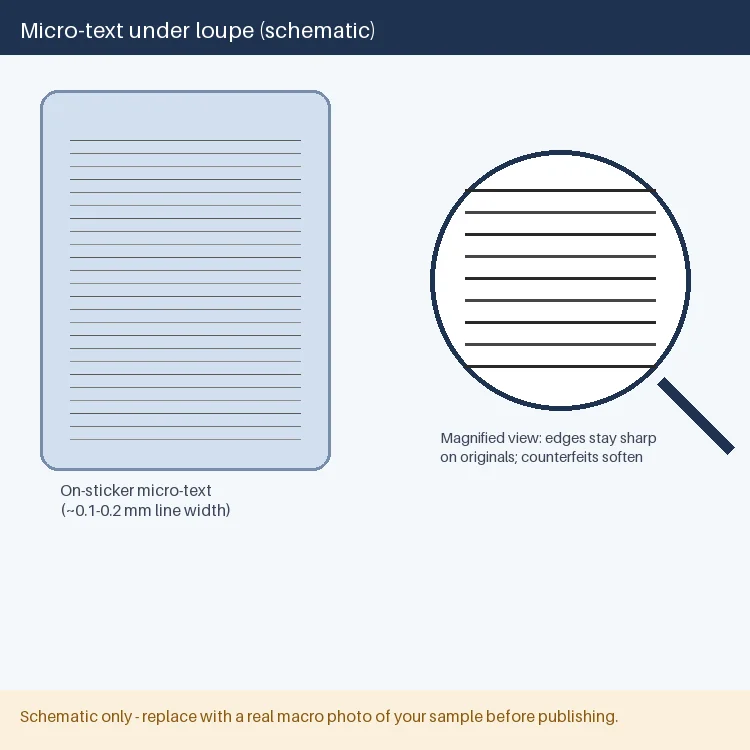
- Overt layer (public checks in seconds). A 2D or 2D/3D hologram carrying your logo, with lensflare or dot-movement effects. Micro-text is produced from the laser-originated master or high-resolution platemaking at controlled line widths (commonly around 0.1–0.2 mm depending on process). It is not something an ordinary office printer can set, but we qualify it by loupe and image inspection rather than treating it as uncopyable — a determined counterfeiter with prepress capability can attempt it, which is why it is one layer among several, not the sole defense.
- Covert layer (your team or distributors). Hidden text or UV-fluorescent ink readable under a 365 nm lamp, or a latent image inside the hologram visible only at a specific angle.
- Digital layer (database-backed verification). A unique QR code or sequential number printed variable on every single sticker, linking to your verification page. The code itself is a copyable string; what makes it an authentication system is the database and logic behind it (see the next section). This is the layer that turns a decorative sticker into a verifiable system — provided the verification side is built.
- Tamper evidence. VOID, honeycomb or destructible backing so the sticker cannot be lifted off a genuine certificate and moved onto a fake one.
If a supplier quotes you a “custom hologram” without asking what QR or serial data will go on it, and without discussing the adhesive against your actual certificate stock, they are selling you a decorative sticker. That distinction matters: decorative holographic labels and security labels are different products with different QA.
Anti-Clone: Why the Printed Code Alone Is Not Enough
The most common misunderstanding is that a unique serial or QR “cannot be copied.” It can. The simplest attack is to photograph one valid code and print it on hundreds of fakes — the string is public, and only the database knows it should appear once. If your verification page just returns “valid” for any code that exists, a cloned batch passes every time.
What actually deters cloning is the logic on the verification side:
- One record per code. Each code maps to a single record. A code that “verifies” on the 300th scan, or from 50 countries, is automatically suspicious.
- First-scan capture. The system logs when and roughly where a code was first verified. A code first scanned after the genuine item was sold, or in an unexpected region, is flagged.
- Duplicate / repeat-scan prompts. “This code was already verified on [date].” A genuine buyer sees a clean first scan; a victim of a cloned batch sees a warning.
- Anomaly alerting. Sudden spikes in scans of one code, or scans clustered in one geography, trigger a review.
This is where we differ from suppliers who only deliver printed numbers. We help you define the verification logic, or host a lightweight verification page, so the serial layer earns its place instead of being decoration. If you already run your own verification system, we match our variable-data output to it.
How We Produce Them (and Keep the QR Scannable)
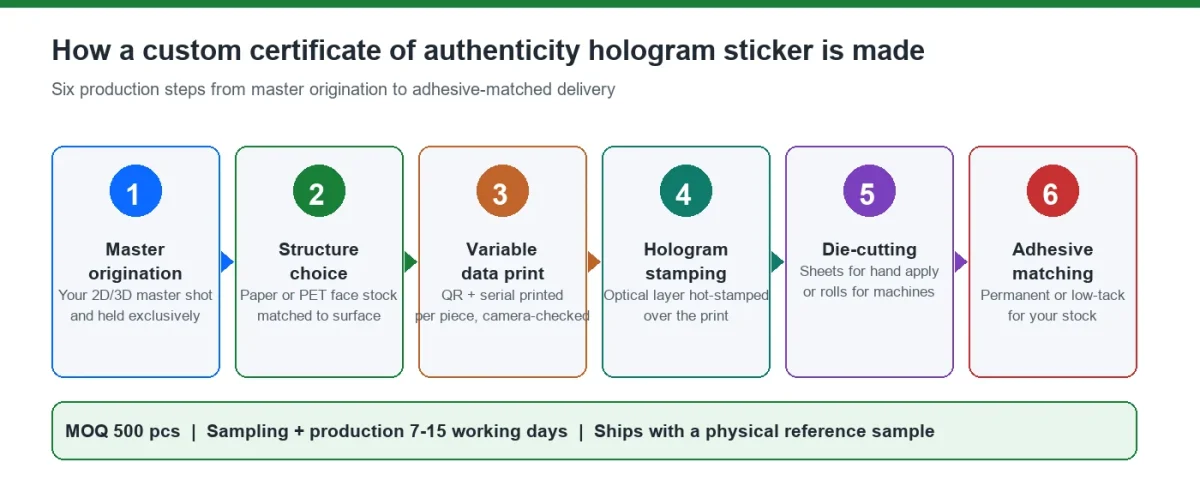
As a converter with more than 20 years in hologram label production, here is the actual production path for a COA sticker order, and why each step is chosen:
- Master origination and exclusivity. Your 2D, 2D/3D or 3D master is shot for you and held under a written agreement: exclusive to your brand, never re-shot for another buyer, and destroyed on request. This is our factory-level commitment, aligned with IHMA-member origination practice.
- Structure choice. The hologram itself is a thin PET or OPP film carrying the embossed image; for certificates we bond that film onto a paper or coated-paper face stock, or use a self-adhesive hologram foil construction. The choice follows the surface: coated card absorbs adhesive differently than plastic holder stock.
- Variable data printing. Sequential numbers and QR codes are inkjet-printed on the press line, then verified by camera before die-cutting. We need your data rules: URL format, number length, whether codes link to your own verification system. For buyers who want a one-code-per-item system, see our anti-counterfeit QR labels.
- Hologram application vs. code readability. When the optical layer would cover the QR, we use a transparent hologram window or a zoned layout so the code sits in a clear area beside the embossed zone, never buried under it. After application we check first-scan readability on production samples (contrast and decode checks) before release, because hot-stamping or lamination can otherwise drop the scan rate.
- Die-cutting and delivery format. Sheets for hand application on certificates, or rolls with liner and gap sizing matched to your applicator. Hand-applied COA stickers usually run as kiss-cut sheets.
- Adhesive matching. Permanent acrylic for coated card; removable or low-tack for art papers where residue is unacceptable; condensation-resistant grades for chilled bottles. Tell us the paper stock and the exposure; we match the adhesive, not the other way round.
Ordering parameters we confirm before production: MOQ for custom COA hologram stickers starts at 500 pieces; sampling and production run in 7 to 15 working days depending on the hologram type and variable-data complexity. Every production batch ships with a physical sample reference so your QC team can compare against an approved specimen, not a screen image.
Build Examples (Illustrative)
We do not publish client work — the projects we run are confidential. To show how the layering above turns into a purchase order, the two configurations below are illustrative examples of how a specification is typically built for two common situations. They are not references to specific customers.
Example 1 — Numbered-edition artwork
- Situation: A publisher shipping numbered editions needs each paper COA to be unique, not a re-printable sticker bought by the roll.
- Build: 40 mm round 2D/3D hologram sticker, micro-text ring with the edition prefix, a sequential number and unique QR printed variable per certificate, honeycomb tamper-evident backing, low-residue adhesive.
- Why it works: The QR links to the publisher’s own edition-lookup page, so the team verifies by scanning rather than eyeballing the rainbow pattern, and the destructive backing means a lifted sticker cannot be moved onto a fake certificate.
Example 2 — Chilled bottled spirits
- Situation: A spirits brand needs a numbered seal that survives cold bottles and condensation in transit and retail chillers.
- Build: A condensation-resistant permanent adhesive chosen for the cold / humidity exposure; QR linked to a verification page; destructible backing to prove the seal unopened.
- Why it works: The adhesive is matched to the cold-chain exposure rather than a generic permanent grade, and first-scan verification flags any code reused across many bottles.
Representative durability targets (FINAT-based)
| Test | Reference method | Representative target |
|---|---|---|
| Rub resistance | FINAT FTM 27 (or equivalent) | No legible loss after [N] double rubs |
| Peel adhesion | FINAT FTM 1 / FTM 2 | [value] N/25 mm on coated card |
| Shear / holding | FINAT FTM 9 | [value] h |
| Chemical (alcohol) resistance | In-house / FINAT-derived | No bleed after [exposure] |
| Cold-chain / condensation | In-house thermal cycling | Adhesion retained after [N] cycles |
These are representative specification targets. Actual per-batch results come from individual QC reports; request them with your sample.
Spec Table with Test Methods
Use this table to brief your supplier when sourcing a certificate of authenticity hologram sticker; pair it with the checklist below.
| Parameter | Typical option |
|---|---|
| Hologram type | 2D rainbow, 2D/3D, 3D depth, dot-matrix movement, lensflare (on PET/OPP film) |
| Micro-text | From master / platemaking, around 0.1–0.2 mm, qualified by loupe |
| Variable data | Sequential numbers, unique QR codes (GS1 Digital Link structured), data-matrix |
| Tamper evidence | VOID, honeycomb, destructible vinyl |
| Face stock | Coated paper + PET/OPP hologram film, self-adhesive foil, destructible paper |
| Adhesive | Permanent, removable / low-tack for art paper, condensation-resistant for chilled bottles |
| Shape and size | Round, rectangle, custom die-cut; common 15–60 mm |
| Delivery format | Kiss-cut sheets (hand apply) or rolls (auto apply) |
| MOQ | 500 pieces |
| Lead time | 7–15 working days, sample and production |
Pre-Order Checklist (Downloadable)
Before you request a quote, have these ten answers ready. Download the COA hologram sticker checklist as an Excel file — no contact required.
- What document surface will the sticker be applied to (coated card, art paper, plastic holder)?
- Is the application by hand or by labeling machine?
- Do you need your own hologram master, or an adapted stock pattern?
- Who owns the master, and do you need the exclusivity and destruction clause in writing?
- What overt features do you want visible to end buyers?
- Do you need a covert feature for distributor-level checks?
- What is the QR or serial format, and does it link to your own verification page (or do you need us to host one)?
- Is tamper evidence required (VOID, honeycomb, destructible)?
- Sheets or rolls, and which applicator if rolls?
- Which durability tests matter for you: rub, alcohol, UV, cold-chain condensation?
How COA Hologram Stickers Compare to Other Options
When weighing a certificate of authenticity hologram sticker against other anti-counterfeit options, the trade-offs are:
| Option | Strength | Limitation |
|---|---|---|
| Hologram + variable QR + database | Visible + covert + per-item serial; low unit cost | Needs an application step and a verification page |
| Security paper / watermark | Built into the document; no apply step | No per-item serial or database link |
| NFC / RFID tag | Tap to verify; rich data; hard to visually clone | Higher unit cost; phone dependency; can be read at range |
| Plain numbered seal | Cheap, simple | No covert layer; easy to photocopy or re-use |
The right choice is usually layered: a COA hologram sticker is the document-side counterpart to product-level security, not a standalone silver bullet.
What Drives the Cost
Custom certificate of authenticity hologram sticker pricing breaks down across five levers:
- Master origination fee — one-time; higher for exclusive 2D/3D or dot-matrix masters.
- Variable-data setup — sequential numbers and QR coding add per-reel setup versus static print.
- Tamper material — destructible vinyl or honeycomb backing costs more than standard film.
- Quantity — MOQ for custom COA hologram stickers starts at 500 pieces; unit price drops with volume.
- Lead time — sampling and production run in 7–15 working days depending on hologram type and variable-data complexity.
FAQ
Do hologram stickers actually prevent counterfeiting?
Alone, no: a hologram without variable data can be approximated by a determined counterfeiter. As part of a layered design — overt hologram plus micro-text plus unique serialized QR plus tamper-evident backing, backed by verification logic — they raise the cost of forgery above the value of the product. That layering is exactly what the ISO 12931 model is for; the hologram is one layer, not the whole defense.
What is the difference between holographic labels and security labels?
Holographic labels are decorative or branding products: any shimmer pattern, no verification system. Security labels are engineered with controlled features (exclusive masters, micro-text, covert inks, variable data) and QA to match. If your supplier cannot explain who owns the master, you are buying decoration.
How can I tell if a hologram sticker is original?
Check three things in order: micro-text sharpness under a loupe (counterfeits often show softer edges or broken strokes, though this is a tendency, not a guarantee — pair it with the serial check), the angle-specific latent image if the design has one, and, most reliably, scan the QR or enter the serial on the issuer’s verification page. If a certificate only relies on the rainbow pattern, treat it as weak.
Can you print my own QR code and serial numbers on hologram stickers?
Yes. Variable QR codes and sequential numbers are printed per piece on-press and camera-verified. You supply the URL format and numbering rules, or your serial range if the codes point to your existing system. We also help design the verification logic, or host a lightweight verification page, so the codes actually deter cloning.
A Note on Legal Requirements
It is correct that no US, EU or UK law forces a hologram on a certificate of authenticity. But “no hologram mandate” is not the same as “no regulation.” For example, some US jurisdictions regulate edition disclosure for fine art prints — California’s Art Preservation Act (Civil Code §§1739.1–1741.2) and New York’s “fine prints” law (Arts and Cultural Affairs Law §12.01) require specific disclosures about edition size and the artist’s role. A hologram sticker supports authenticity; it does not satisfy those disclosure duties. If you sell numbered editions, treat the sticker as an aid alongside, not a replacement for, the required disclosures.
Where to Learn More
- Security labels for authentication and brand protection — the wider label system.
- Anti-counterfeit QR labels — how the variable-data layer works in production.
- Hologram spec guide — hologram types and artwork requirements in detail.
- Hologram sticker category — full product options and request-for-quote entry.
Get a Physical Sample
Frameworks on screen only go so far: security features have to be judged in hand. Send us your certificate stock and verification requirements, and we will produce a physical sample of your certificate of authenticity hologram sticker with your hologram design, micro-text and test QR data so you can evaluate it before committing to a production run. Start at our contact page.
About This Article
Author: [your name / role]. Technical review: [reviewer]. Last updated: 2026-09-28. For spec confirmations, contact our security printing team. The build examples in this article are illustrative configurations, not references to specific customers, and no confidential client data is used.