
Send Your Inquiry Today
Sequential Numbered Labels for Anti-Counterfeit Protection
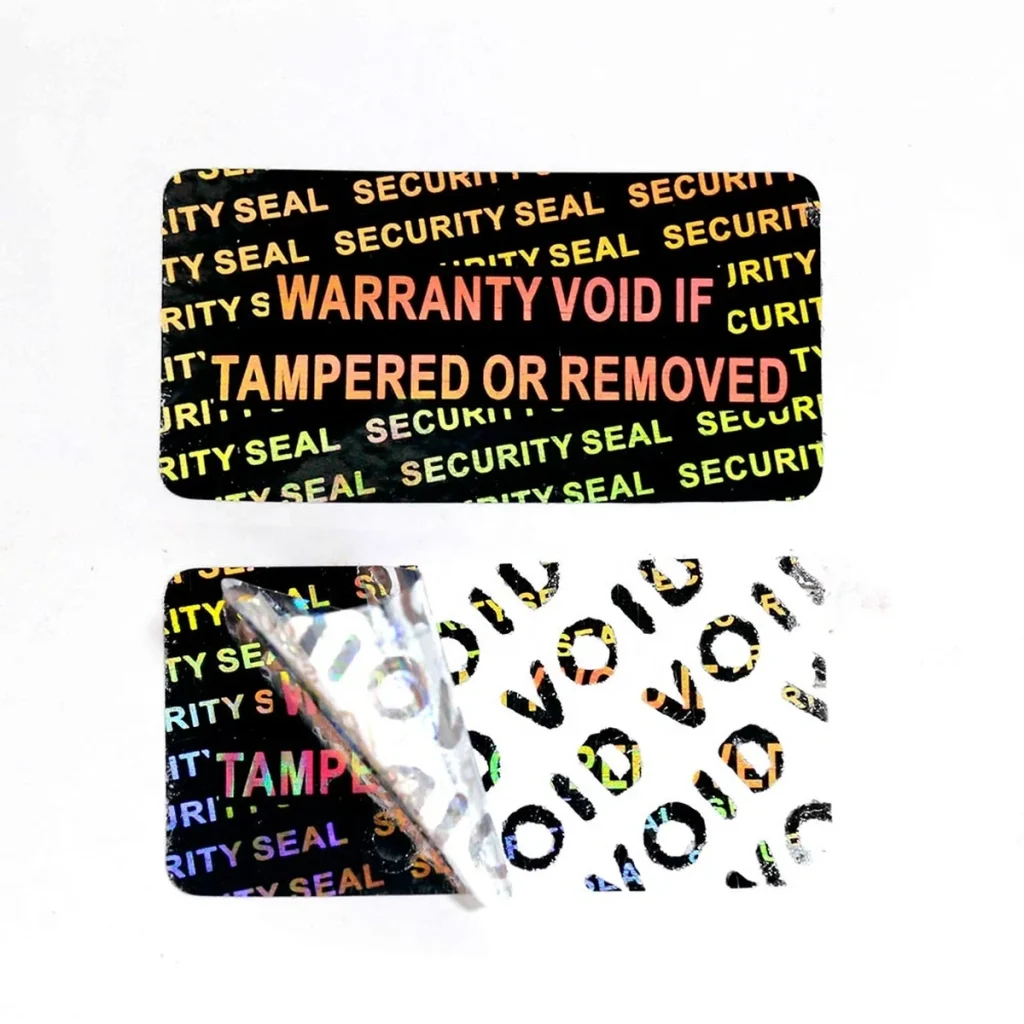
As of September 2026. This article explains packaging and labelling requirements and anti-counterfeit practices for general information. It is not legal advice. Regulatory deadlines and enforcement dates shift through implementing acts and agency rulemaking — confirm current values with the relevant authority (FDA, the EU Commission, GS1) or your compliance lead before you act.
Contents
- What Is a Sequential Numbered Anti-Counterfeit Label
- What Changed: Why Serialization Matters in 2026–2027
- Who Needs Sequential Numbered and Anti-Counterfeit Labels
- What Anti-Counterfeit Protection Means for Your Label
- How We Produce Tamper-Proof, Serialized Labels
- A Practical Specification Scenario
- Anti-Counterfeit Label Spec Table
- Download the Anti-Counterfeit Label Spec & Checklist
- Hologram vs Serial Number vs QR: Which Layer Do You Need
- FAQ
What Is a Sequential Numbered Anti-Counterfeit Label
Sequential numbered labels put a unique, scannable identity on every unit. Each label carries a printed serial, a variable QR code or a GS1 Data Matrix, so no two are alike.
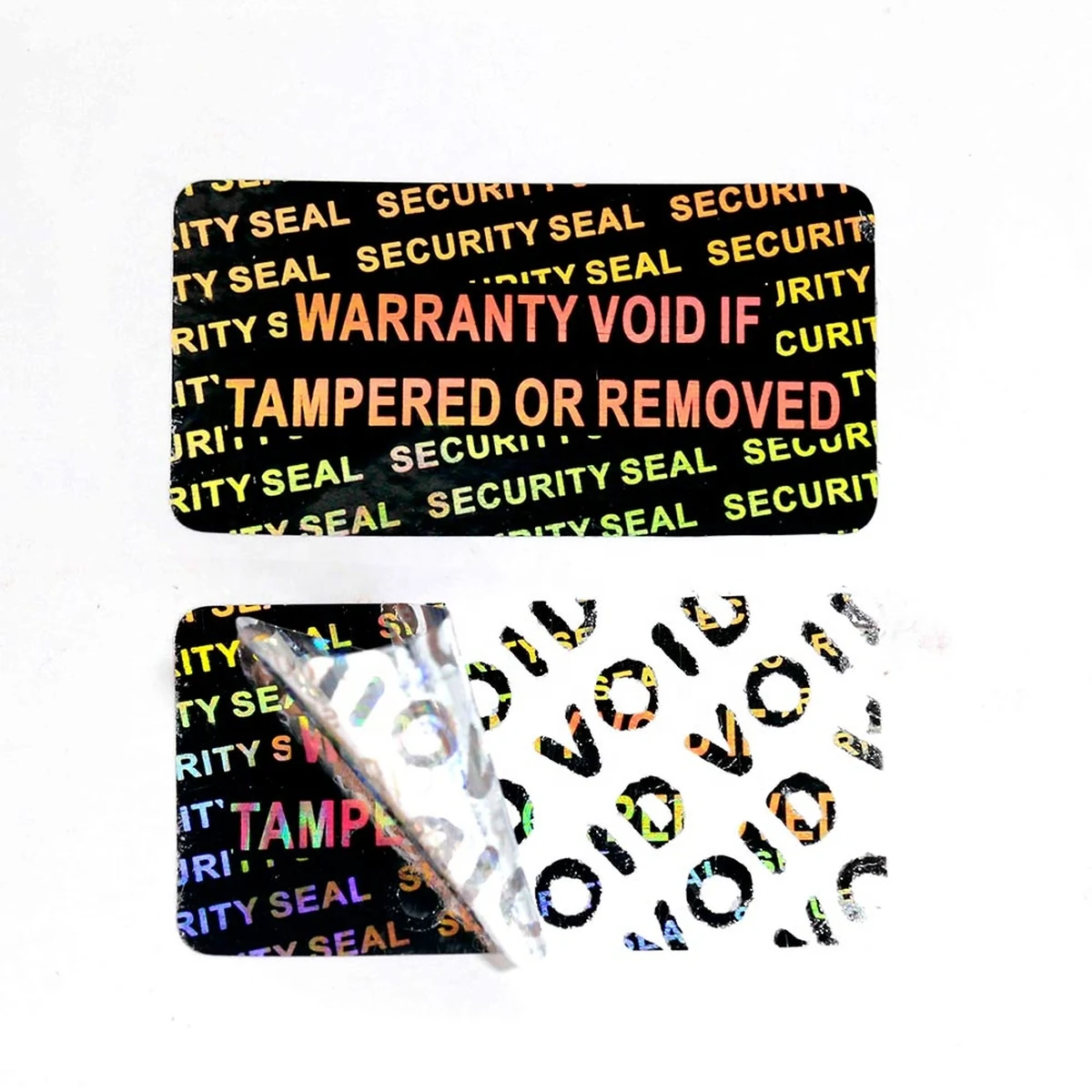
Pair that identity with a security hologram and a tamper-evident adhesive and you get a sequential numbered hologram label. It is a finished label that is hard to copy, easy to verify, and traceable to the exact roll, batch and unit.
The industry shorthand is “one object, one code.” The serial is the key: a buyer, customs officer or technician scans the code and checks it against your verification database in seconds.
Without a unique serial, a hologram alone only proves a label looks right. With a serial, a genuine unit can be checked against a verification database — but only if that database exists and tracks scan history and anomalies. The label we supply carries the unique code; the verification platform is normally owned and operated by the brand or a third-party traceability provider.
What Changed: Why Serialization Matters in 2026–2027
None of this is a single new law. It is a cluster of rules and retailer expectations that all point the same way: put a unique, scannable identity on the product.
The 2026–2027 window is when several of them bite at once.
Pharma is already mandatory. The EU Falsified Medicines Directive (2011/62/EU) and its Delegated Regulation (EU) 2016/161 require unique serialisation and tamper-evident packaging on prescription medicines since 9 February 2019.
In the US, the Drug Supply Chain Security Act (DSCSA) requires every prescription-drug package to carry a 2D Data Matrix encoding the NDC, a unique serial, lot and expiry.
The DSCSA stabilisation period ended on 27 November 2024. The FDA is now phasing in enforcement, with different timelines and guidance for manufacturers, wholesalers and small dispensers. Check the FDA DSCSA page for the current status rather than assuming a single deadline.
Consumer goods are next via the Digital Product Passport. The EU’s Ecodesign for Sustainable Products Regulation (ESPR, (EU) 2024/1781) is building the DPP framework product group by product group.
Batteries have a separate, earlier requirement under the EU Battery Regulation ((EU) 2023/1542): a battery passport must be accessible via a QR code from 18 February 2027. Textiles, tyres, aluminium and other ESPR categories will follow through delegated acts expected in 2027–2028. The passport is reached by scanning a QR code or Data Matrix on the product.
For brands, that means the same unique, scannable identity a security programme wants is now a coming compliance requirement.
Retail is enabling it at the checkout. GS1 Sunrise 2027 commits retailers’ point-of-sale scanners to read 2D barcodes by the end of 2027.
That is exactly the mechanism a sequential numbered label already uses.
The practical takeaway: add a sequential numbered hologram label now and you lift brand protection, prepare for DPP, and future-proof for Sunrise 2027 at the same time.
Who Needs Sequential Numbered and Anti-Counterfeit Labels
Counterfeiting is not a luxury-goods problem alone. Sequential numbered labels protect any product with a brand premium, a safety implication, or a regulatory footprint.
The categories where the payoff is fastest:
- Wine, spirits and premium beverages — refilled bottles and fake top-shelf brands are a global issue; a hologram plus a scannable serial lets a bar or buyer verify the bottle.
- Pharmaceuticals and nutraceuticals — often legally required to serialise (see FMD and DSCSA above).
- Electronics and spare parts — grey-market and counterfeit components cause safety and warranty failures.
- Cosmetics and personal care — high-margin, easy to fake, and increasingly expected to carry traceability.
- Automotive and machinery parts — counterfeit brake and filter parts are a liability, not just a cost.
- Apparel, luxury and collectibles — certificates of authenticity backed by a unique code.
- Regulated goods such as cannabis-derived products, vape and alcohol — track-and-trace is mandatory in specific markets (for example California’s track-and-trace system and certain EU member-state programmes) and often optional elsewhere.
If your product carries a brand premium, a safety implication, or a regulatory footprint, a sequential numbered label is risk management, not marketing.
What Anti-Counterfeit Protection Means for Your Label
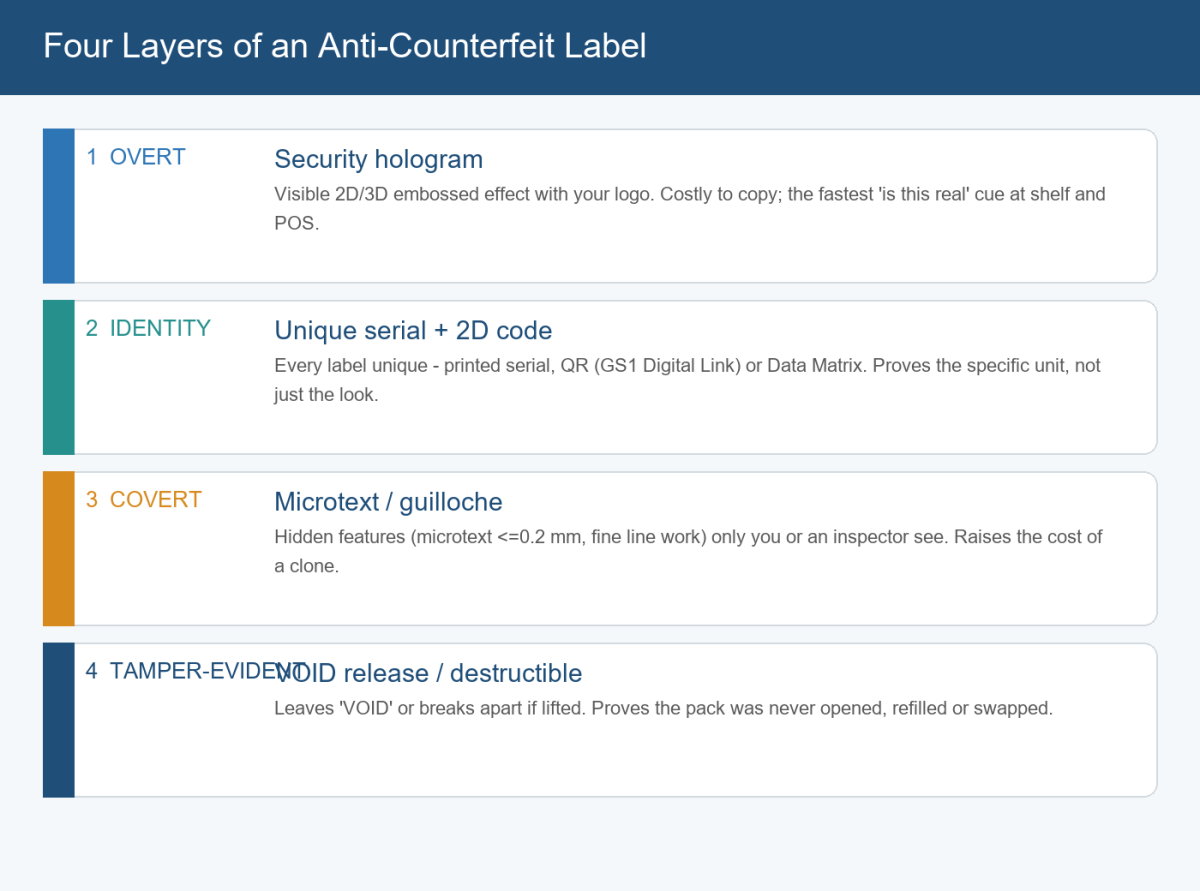
This is the part material suppliers do not talk about, and the part that decides whether your label actually stops fakes. A genuinely protective label stacks four layers.
Each layer maps to a specific print decision we make on the press — not just to the raw film you can buy from any material house.
1. Overt — the security hologram. A custom-originated hologram is the visible deterrent: a 2D/3D embossed image, often with a brand logo, that is expensive and slow to reproduce convincingly.
It works at the point of sale and on the shelf. The print decision here is the master: a unique, exclusive hologram master origination means no one else can order your exact pattern.
2. Identity — the unique serial and 2D code. This is the sequential numbered layer: a printed serial, a variable QR code or a GS1 Data Matrix, each one different.
It is what turns “looks genuine” into “is this specific unit genuine.” The print decision is variable-data printing (VDP) and, for QR/Data Matrix, the module size, quiet zone and verification grade.
3. Covert — features only you (or a trained inspector) can see. Microtext at 0.2 mm or smaller, guilloché line patterns, hidden images revealed only under a specific angle or light.
These raise the cost of a convincing clone without changing the look the customer expects. The print decision is line width, registration and the origination artwork.
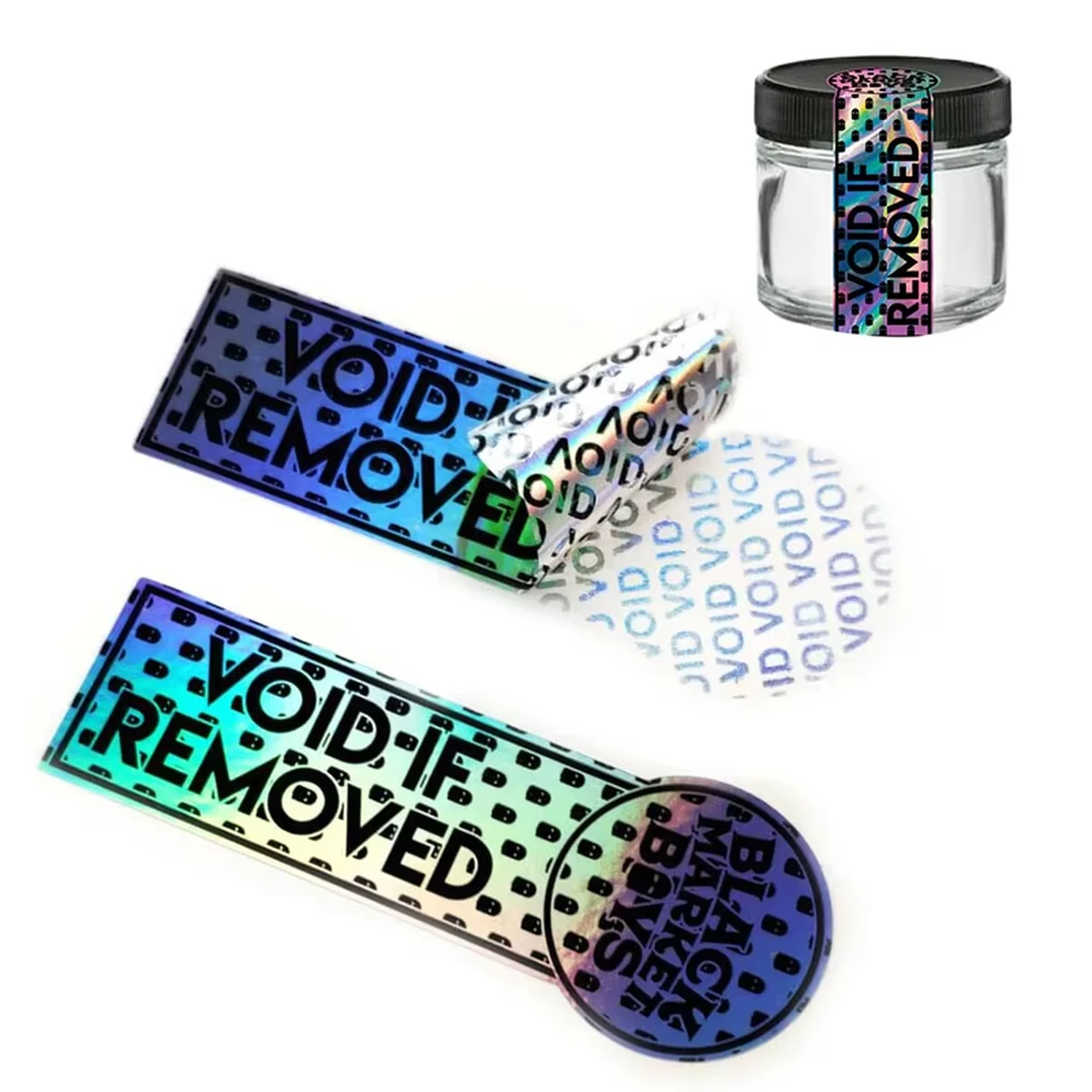
4. Tamper-evident — the VOID layer. A destructible film or a VOID-release adhesive leaves the word “VOID” on the surface if someone tries to lift the label.
It proves the pack was not opened or swapped. The print decision is adhesive chemistry and face-film choice matched to your substrate (glass, PET, aluminium, curved bottle).
Why sequential numbered labels beat a hologram alone
Choosing the right stack is a threat-model question, not a checklist. A wine brand fighting refills needs a strong overt hologram plus VOID.
A pharma line needs the serialised Data Matrix above all. A cosmetics brand often wants all four at a controlled cost.
We help you pick the minimum stack that actually raises the bar for your specific counterfeit risk.
How We Produce Tamper-Proof, Serialized Labels
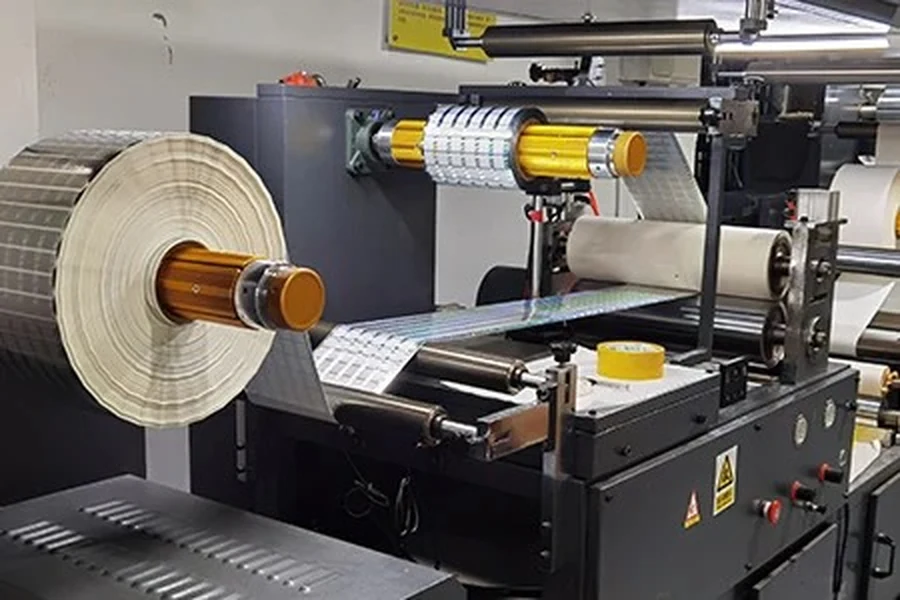
A sequential numbered hologram label is a manufacturing job, not a sticker order. At our plant the workflow is built around the unique data.
Data first. For the sequential layer we generate or receive your serial range and validate the GS1 Application Identifiers and check digits before a single code is printed.
A wrong check digit points to the wrong product at scale. The codes are produced with variable data printing (VDP) — digital toner or inkjet — so each label carries a unique serial, lot or expiry.
Runs scale from prototype to millions of unique units.
Hologram origination. We emboss from a mastered shim. Custom master origination is available so the holographic pattern is exclusive to you; standard security patterns (dot-matrix, 2D/3D, guilloché) are also offered where a bespoke master is not yet justified.
Covert print. Microtext down to 0.2 mm and fine guilloché line work are rendered and registered within the same pass.
VOID and destructible construction. We match the adhesive and face film to your substrate — permanent on rigid packs, a VOID-release or brittle film where resealing must be impossible.
2D code and verification. QR (GS1 Digital Link) and GS1 Data Matrix are generated to spec and verified on the actual substrate — not a laser proof. Ink spread and surface texture change the grade, so proof-grade is not production-grade. We check grading against ISO/IEC 15415 on a production sample before release, and coordinate a certified grading report when your programme requires one. For module size, quiet-zone and Sunrise 2027 readiness details, see our Sunrise 2027 guide.
The pitfall: printing a 2D code over holographic or metallised film
This is the question buyers ask most often once they see the layout: can the QR code sit inside the hologram? The short answer is do not place the scan zone on a reflective or diffractive area.
Holographic and metallised films scatter light. A scanner struggles to read a black module that is sitting on a mirror-like or rainbow surface. The fix is a dedicated, non-reflective quiet zone — usually a white-ink patch or an unmetallised window — with the 2D code printed cleanly inside it.
We design the artwork so the hologram and the code are separate zones, then verify the code on the finished label at the intended scanning angle and distance. If your label is curved, we also test on the actual container, because a tight radius can distort modules and drop the grade.
Roll and registration. Labels are supplied in roll form with gap, orientation and core spec matched to your applicator.
The serial sequence is logged so a missing or duplicated range is caught at finishing, not at your line. That is what makes sequential numbered labels verifiable at scale.
A Practical Specification Scenario
The following is an illustrative scenario, not a specific customer order. A mid-size spirits exporter shipping to both the EU and North America wanted protection against refilled bottles and grey-market diversion.
We specified a 36 mm round sequential numbered hologram label: a custom 2D/3D master with the brand monogram, a variable QR code carrying a unique per-bottle serial plus lot and vintage, a 0.2 mm microtext ring as the covert feature, and a VOID-release adhesive on a PET face film suited to glass.
The QR payload used GS1 Digital Link so the same code could later serve both a consumer authenticity page and retailer Sunrise 2027 scanning. Verification was run on the glass bottle (not a flat proof) at grade B or better.
The change was one artwork revision and a master origination fee — scheduled into the normal reorder rather than rushed. It simultaneously addressed brand protection and the coming DPP/QR expectations.
The lesson: open the artwork once and design for both, and you avoid paying for the same change twice.
Anti-Counterfeit Label Spec Table
| Parameter | Typical option | Why it matters |
|---|---|---|
| Security layer stack | Hologram + serial/2D + covert + VOID | Match the stack to your threat model, not a fixed list |
| Hologram master | Custom origination (exclusive) or stock pattern | Exclusive master = no one else can order your pattern |
| Unique identity | Printed serial, QR (GS1 Digital Link) or Data Matrix | Turns “looks genuine” into “this unit is genuine” |
| Covert feature | Microtext ≤0.2 mm, guilloché, hidden image | Raises clone cost without changing shelf look |
| Tamper-evident | VOID-release or destructible film | Proves the pack was not opened or swapped |
| 2D code module | 0.4–0.99 mm (QR); Data Matrix per symbol specification | Smaller modules need higher print resolution |
| Verification | ISO/IEC 15415 grading on substrate | Proof-grade is not production-grade; Data Matrix grading also uses ISO/IEC 15415 |
| Face film & adhesive | PET / paper + permanent or VOID adhesive | Must match glass, PET, aluminium or curved surfaces |
| Format | Roll, gap & core matched to applicator | Keeps your labelling line running |
Download the Anti-Counterfeit Label Spec & Checklist
Specifying a sequential numbered hologram label is easier with a structure. We packaged our internal intake and verification steps into one checklist you can drop into your next RFQ and quality log.
Download the Anti-Counterfeit Label Spec & Checklist (XLSX) — covering layer-stack selection, hologram master choice, serial/2D payload design, microtext and VOID options, substrate and adhesive matching, ISO/IEC 15415 verification, roll and registration specs, and a per-batch print-and-verify log.
Hologram vs Serial Number vs QR: Which Layer Do You Need
Buyers often ask which feature to prioritise, and the honest answer is “it depends on what you are defending against.”
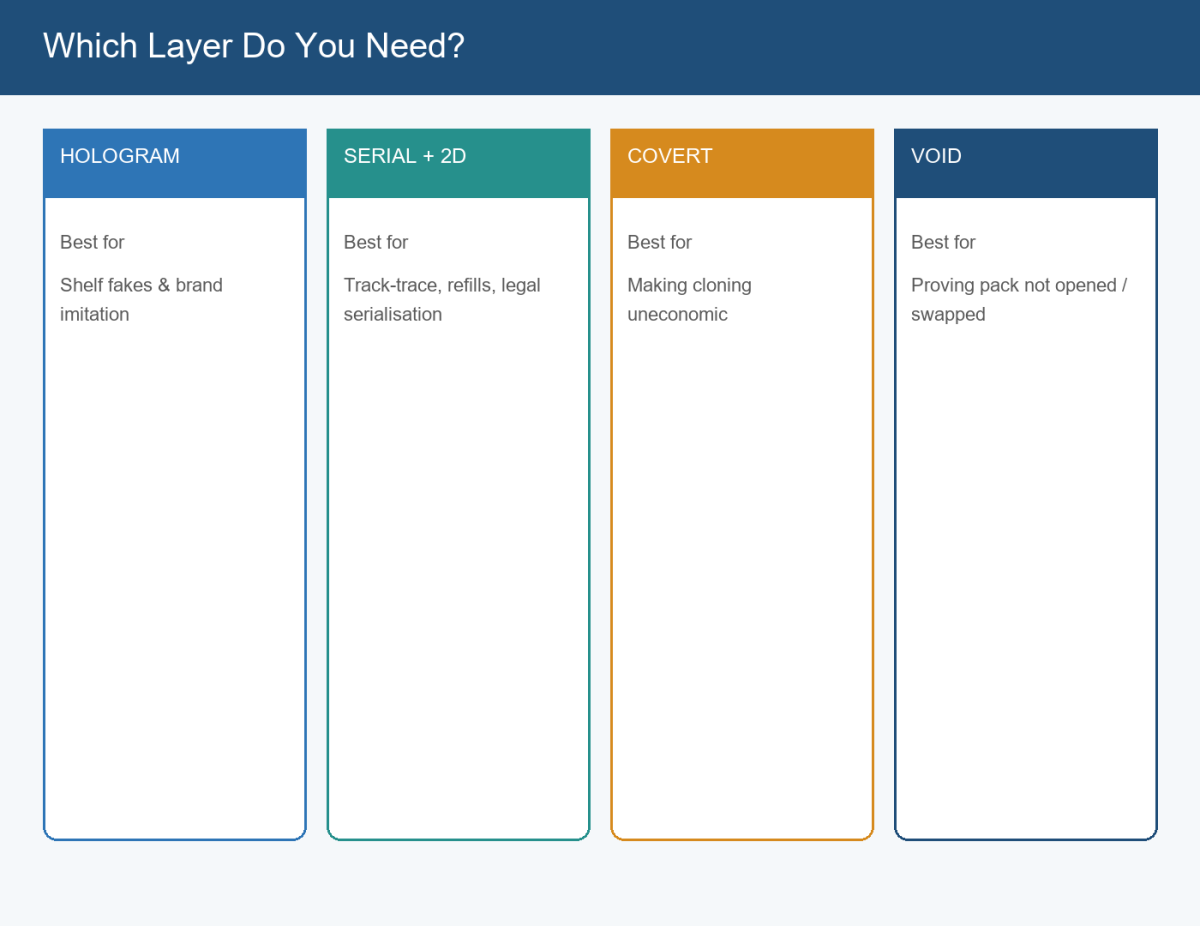
- Choose a hologram first if your problem is shelf-level fakes and brand imitation — it is the fastest visual deterrent and the strongest “is this real” cue for a shopper or inspector.
- Choose a serial / 2D code first if your problem is track-and-trace, refills, diversion or a legal serialisation duty (pharma under FMD/DSCSA, or upcoming DPP).
- Choose VOID first if your problem is tampering — resealed, refilled or swapped product. VOID proves the pack was opened.
- Choose covert microtext as a low-cost add-on once the above three are in place, to make cloning uneconomic.
In practice the most common combination we see is hologram + serial/2D as the core, then VOID and covert added according to risk and budget. The checklist above walks you through that prioritisation.
FAQ
Do hologram stickers actually prevent counterfeiting?
They raise the cost and difficulty of convincing fakes, which is the real goal — you cannot make counterfeiting impossible, but you can make it uneconomic. A generic stock hologram is easy to copy; an exclusive custom master, combined with a unique serial and VOID layer, is far harder to clone and lets anyone verify the specific unit.
How are hologram stickers made?
They are embossed from a mastered shim onto a metallised film, then converted into labels. The “master” is the origination artwork that defines the 2D/3D or dot-matrix effect; a custom master is exclusive to the buyer, while stock patterns are available to anyone. Fine features like 0.2 mm microtext are added in the same print pass.
What is a tamper evident label?
A label engineered so that any attempt to remove it leaves obvious evidence — typically a “VOID” residue on the surface or a destructible film that breaks apart. It proves a pack was not opened, refilled or swapped.
How can I tell if a hologram sticker is original?
With a stock hologram you often cannot by eye alone — that is the weakness of generic security art. With a sequential numbered hologram label, the reliable check is the unique code: scan or enter the serial against the brand’s verification system. The hologram is the first cue; the serial is the second check, but only if the backend database is actively tracking it.
Which industries use tamper evident labels?
Pharmaceuticals (often mandated), food and supplements, wine and spirits, electronics and spare parts, cosmetics, automotive components, and any product where opening or refilling creates a safety or liability risk.
Are serialized labels required by law?
For prescription pharmaceuticals in the EU (FMD) and the US (DSCSA), unique serialisation is required today. For many consumer goods it is not yet mandated, but the EU Digital Product Passport and GS1 Sunrise 2027 are pushing unique, scannable identity toward the mainstream — so adding it now is preparation, not just protection.
Related Solutions
- Custom Hologram Stickers Specification Guide
- Tamper-Evident Seals and Serialization
- Custom Anti-Counterfeit QR Code Labels
- Sunrise 2027: 2D Barcodes on Labels & Packaging
- EUDR & Traceable Paper Packaging Buyer Guide
- US Packaging EPR Laws by State
- Custom Anti-Counterfeit Labels: Ordering & Artwork Setup
- Hologram Stickers — Product Category
- Custom Labels — Product Category
Get a Sample and a Specification Review
If you are weighing a hologram, a serial, a QR code or a VOID layer — or all four — send us your product, substrate and the counterfeit risk you actually face. We will propose the minimum stack that raises the bar, return a physical sample and a dieline, and verify the 2D code on your real substrate before any production run. It is cheaper to specify the label once than to rediscover the weakness after fakes appear.