
Send Your Inquiry Today
Custom Packaging Manufacturers: 12 Checks to Verify a Real Factory (Not a Trading Company)
When a producer responsibility organization asks for your packaging data, the question is never whether the carton looked right. It is whether anyone can prove what the carton is made of — every component, every material, every gram. In 2026 that single question separates real custom packaging manufacturers from trading companies faster than any factory tour ever could, and the buyers who learn to ask it early are the ones whose shipments keep moving.
This guide is written from the factory side of the table. It gives you twelve checks that verify a manufacturer before you place an order, the documents a real factory can produce on request, and the data pack you should demand for every SKU. Run these checks on us or on anyone else — the suppliers that survive are the custom packaging manufacturers worth your artwork.
Table of contents
- What changed in 2026 — and why it lands on your supplier
- Who this applies to
- Why verifying your factory is now a compliance question
- The 12 checks to run before you order
- Checks 1-4: physical capability
- Checks 5-8: documentation capability
- Checks 9-12: commercial transparency
- ★ What we show buyers on a factory audit
- Illustrative case: the data gap that almost shipped
- What to demand per SKU: the data pack
- ★ Download the factory verification checklist
- FAQ
- Related guides
What changed in 2026 — and why it lands on your supplier
Two regulatory waves arrived at the same time, and both push paperwork down the supply chain to whoever actually makes the packaging.
In the EU, the Packaging and Packaging Waste Regulation (PPWR), Regulation (EU) 2025/40, became directly applicable in all 27 member states on 12 August 2026. It adds recyclability grades, a declaration of conformity and documentation duties for packaging placed on the market — including packaging manufactured offshore and imported by an EU buyer (see our guides on PPWR labelling requirements and PPWR recyclability grades A, B and C). Article 5 also caps PFAS in food-contact packaging with no grace period (our PPWR PFAS limits guide covers the three thresholds). The European Commission’s packaging rules overview is the official entry point.
In the US, packaging extended producer responsibility (EPR) has gone from one state to seven. Oregon’s Recycling Modernization Act (SB 582) invoiced the first producer fees in July 2025. Colorado’s HB 22-1355 began collecting dues in January 2026. California’s SB 54 permanent regulations took effect on 1 May 2026, with producer registration closing on 31 May 2026 through CalRecycle’s PEPRS system and the program ramping toward 2027. Maryland and Washington opened producer registration in July 2026, and Minnesota’s stewardship plan is due in October 2028.
Maine, the first state to pass a packaging EPR law, uses a municipal reimbursement model and is still selecting its stewardship organization. A harmonized reporting deadline of 31 May 2026 applied across six of the seven states, and most have selected the same producer responsibility organization to run collection and reporting (see CalRecycle’s packaging EPR program).
The common denominator is data. Every one of these regimes asks the obligated producer — usually the brand owner or importer of record — to report what packaging it puts on the market, by material and by weight, and several states now set fees by how recyclable that packaging is. Oregon’s fees are calculated directly on the supply data producers report, so material and weight drive cost.
Custom packaging manufacturers that hold this data natively are suddenly worth more than the ones that only quote a good price, and the custom packaging manufacturers that cannot produce it become a liability the moment you file. In practice, the cheapest quote on a shortlist of custom packaging manufacturers is often the most expensive one once the first filing cycle begins. That is the shift: packaging data is now a product feature, and it is produced at the factory, not at a desk.
Who this applies to
Under most EPR laws the “producer” is the brand owner — the company whose name appears on the product — which means the duty follows you even when the packaging is manufactured offshore. Private-label brands, marketplace sellers shipping into EPR states, and importers of record are all in scope, with thresholds that vary by state (California exempts producers under $1 million in California sales; Oregon under $5 million in global revenue). The obligation can even reach foreign manufacturers selling directly into an EPR state, so some factory-direct custom packaging manufacturers are named as the producer themselves.
If you sell the same SKU into several states, you file several times: each state defines covered materials, exemptions and fee schedules differently even where the same organization runs the program, so one national packaging data set has to be cut seven ways — and it can only be cut from data that exists. That is why the first question to put to any shortlist of custom packaging manufacturers is not “can you make it” but “can you document it”. A beautiful carton with no data behind it is an unfiled liability; a plain carton with a complete data pack is a compliant one.
Why verifying your factory is now a compliance question
A trading company can forward an email. It cannot generate a component-level material breakdown it does not hold, because that data is born on the factory floor: at the board mill, the foil converter, the adhesive maker, the coating line. By the time finished packaging reaches an intermediary, the evidence either exists in the factory’s records or it does not exist at all.
Think about what your filings actually consume. EPR reporting needs each detachable component of every SKU — material type and weight. PPWR needs a declaration of conformity, recyclability grade evidence, and for food-contact packaging, PFAS data including a total-fluorine position per production lot. None of that can be reconstructed from a finished sample; it has to come from the converter’s own records, which is exactly the role a converter plays in the documentation chain. This is the practical difference between custom packaging manufacturers that hold data and trading companies that forward emails.
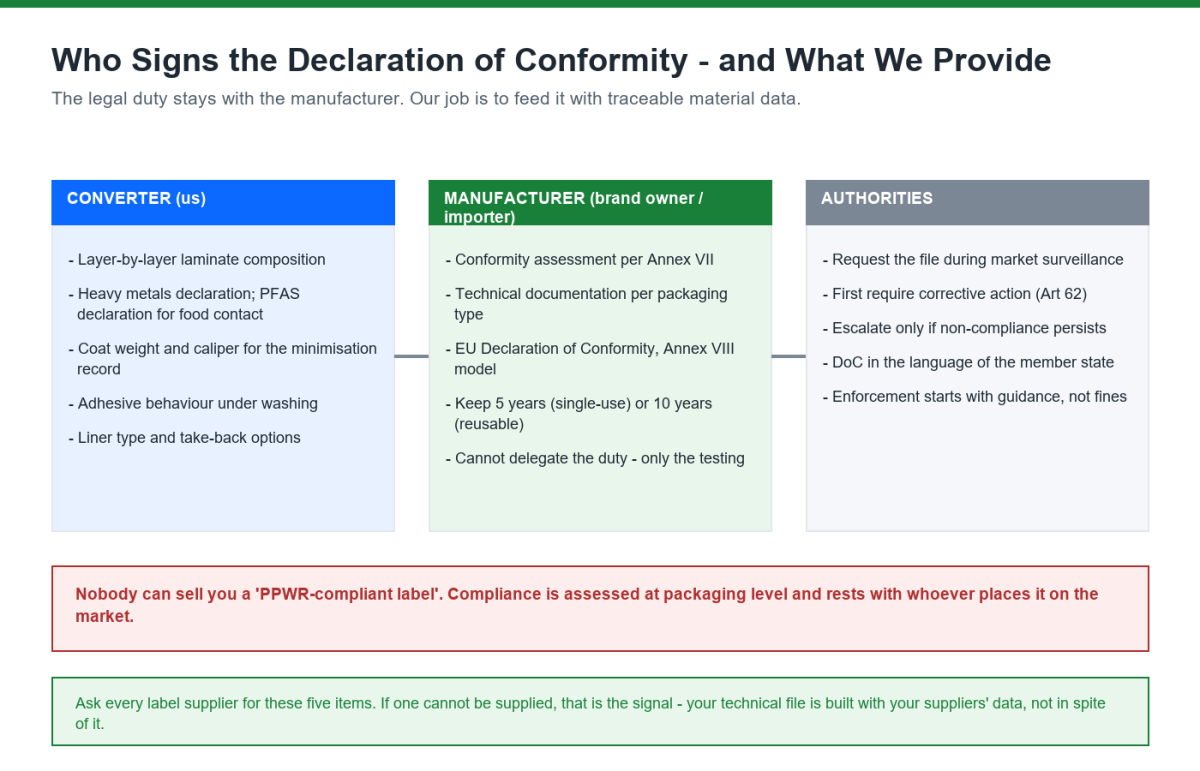
This is why documentation should be treated as a deliverable in its own right: agreed in the quote, formatted for your filings, and delivered with the shipment. Custom packaging manufacturers that report per lot can support your EPR filings and PPWR files for years, while trading companies can only relay whatever their factory happens to send. When the market-surveillance letter arrives, that difference is the whole game — and it is why the checks below start with physical capability and end with paperwork.
The 12 checks to run before you order
None of these checks requires an engineering degree. Each has a yes-or-no answer that a real factory can give within a day and a trading company usually cannot — and the custom packaging manufacturers worth your artwork will answer all twelve without hesitation. We wrote them as the audit we would want a buyer to run on us, and we score ourselves against all twelve below.
Checks 1-4: physical capability
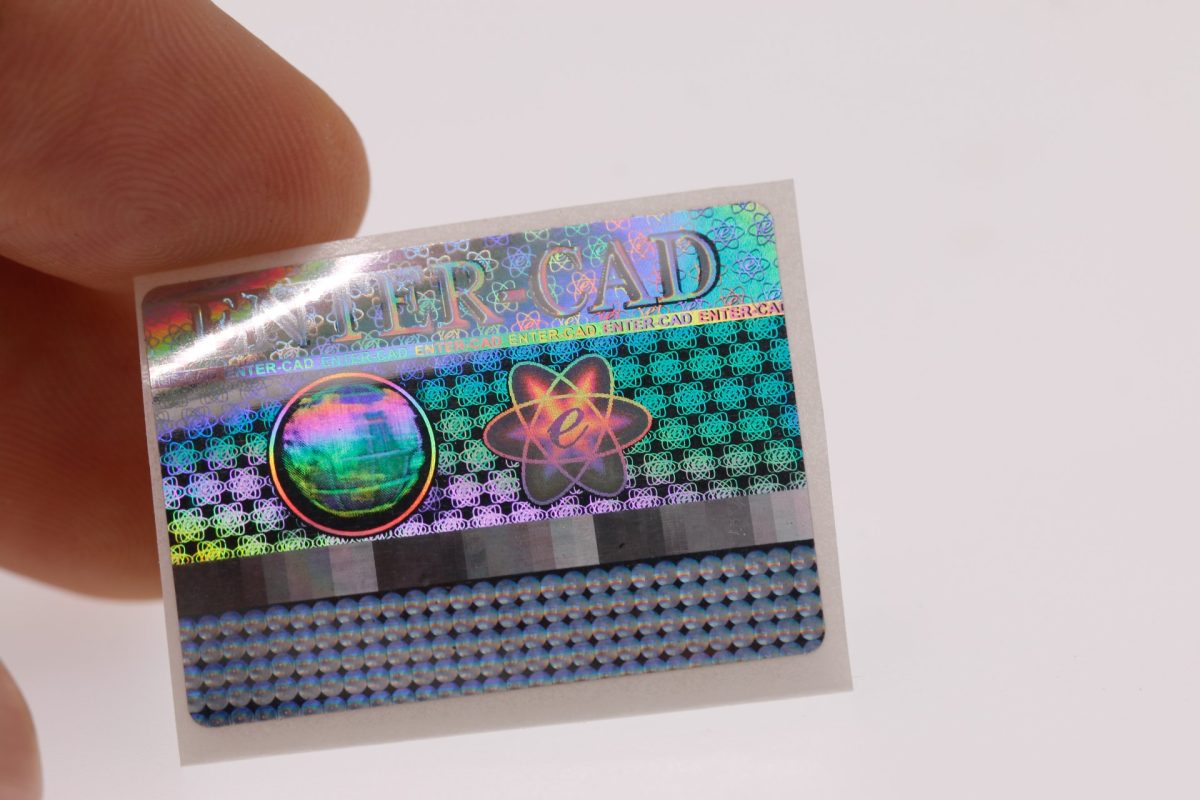
1. Origination and pre-press in-house. Security origination — hologram mastering, dot-matrix engines, micro-text — should happen at the factory, not at an unnamed third party. Ask who originates your hologram and where the master is stored. Real custom packaging manufacturers will show you the mastering bench and the archived originals, because that is where your artwork’s security actually lives.
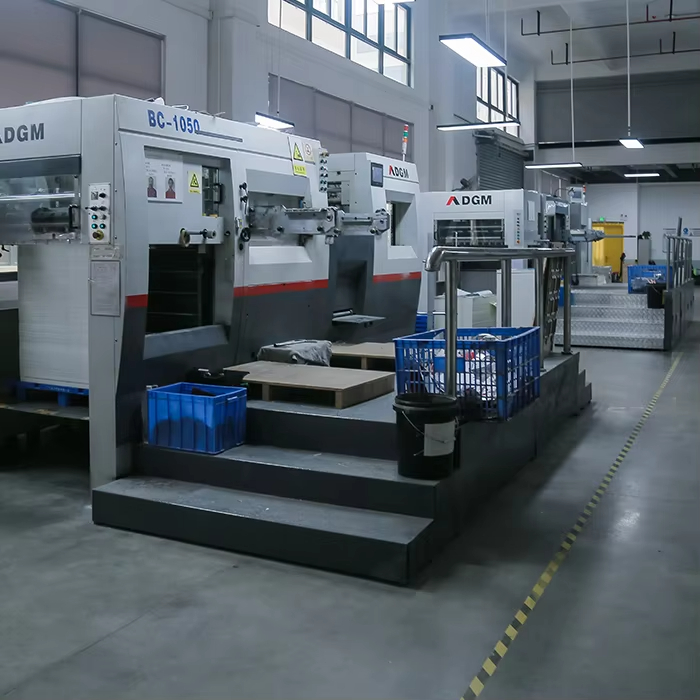
2. Decorating and die-cutting on site. Hot stamping, foil application and flat-bed or rotary die-cutting define the finished pack, and they should happen under one roof so quality and lead time stay under one control (the process differences matter too — see our cold foil vs hot foil stamping guide). Ask to see the lines. Custom packaging manufacturers that subcontract finishing cannot control the two operations most likely to move your recyclability grade and your PFAS position.
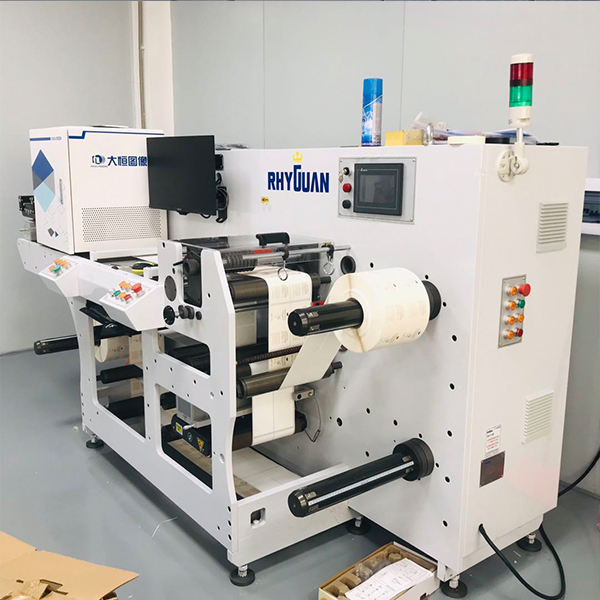
3. Inspection on the line, not just at the end. For serialized or security work, 100% inspection at the rewinder is the difference between a traceable batch and a recall. Ask where rejects are caught and what happens to them. Custom packaging manufacturers will walk you to the inspection station; a trader will describe it second-hand, if at all.
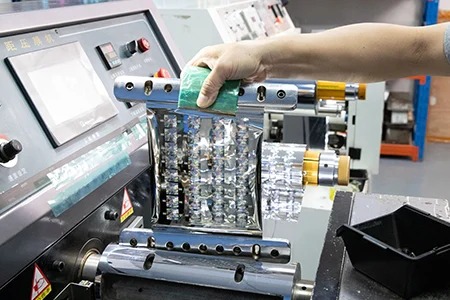
4. Capacity you can verify. Machine count, shift pattern and current loading tell you whether a quoted lead time is real. The fastest verification is physical: loading docks, container schedules, warehouse stock. Custom packaging manufacturers quote from real loading data, while intermediaries quote whatever wins the order and then go looking for a factory that can absorb it.
Checks 5-8: documentation capability
5. A per-component material breakdown and weights. Ask for a completed data pack for a comparable SKU, not a promise. Every detachable component, its material type and its weight — the exact structure your EPR reporting and PPWR technical file consume. The custom packaging manufacturers that answer this within a day are the ones whose data you can actually file.
6. Recyclability grade evidence. Grades now carry money: the PPWR grades packaging from A to C, and several US states eco-modulate fees by recyclability. Ask how the factory grades a construction and what evidence supports the grade. The strongest custom packaging manufacturers can explain which design choices drop a pack a grade — PE lamination, window film, multi-material parts that are hard to separate — before you commit to artwork, and that conversation is worth more than any price quote.
7. Chemical compliance data. For EU food-contact packaging, a total-fluorine screen per production lot is the workhorse test, with targeted analysis behind it when a screen comes back high. Ask for the mill’s and adhesive supplier’s figures, and who routes samples to an accredited lab. Custom packaging manufacturers hold this chain and can hand it over; trading companies guess at it.
8. Batch traceability and documents that travel with the shipment. Lot numbers that tie back to production records, and documents delivered with the goods — not weeks later when you are mid-filing. If document delivery is not written into the quote, it will not happen — and custom packaging manufacturers that cannot tie a lot number to a production record cannot support an audit.
Checks 9-12: commercial transparency
9. Accepts a factory audit — video or in person. A real factory will walk you through the floor on a video call and show the specific lines that will run your order. Real custom packaging manufacturers will show you the specific lines that will run your order; watch what happens when you ask to see a particular area at a particular time, because hesitation is the answer.
10. References in your market. Ask for buyers in your jurisdiction and product category, and check whether they are still ordering. Custom packaging manufacturers that genuinely serve your market have nothing to hide about who else does.
11. An honest certificate chain. We will use ourselves as the example: we do not hold our own FSC chain of custody, and we do not print the FSC trademark. What we do is buy from certified mills and hand over the mill certificate numbers and batch documentation with your order (see our FSC and EUDR buyer guide and our certifications page). Overclaimed certificates are a red flag, not a selling point.
12. Sample-to-production consistency and change control. Approval samples retained, and a written commitment to tell you when a mill, foil or adhesive changes — because a silent material swap can move your EPR fee band and your PFAS numbers without changing a single visual detail of the pack. Custom packaging manufacturers that never mention a mill change are not controlling one.
★ What we show buyers on a factory audit
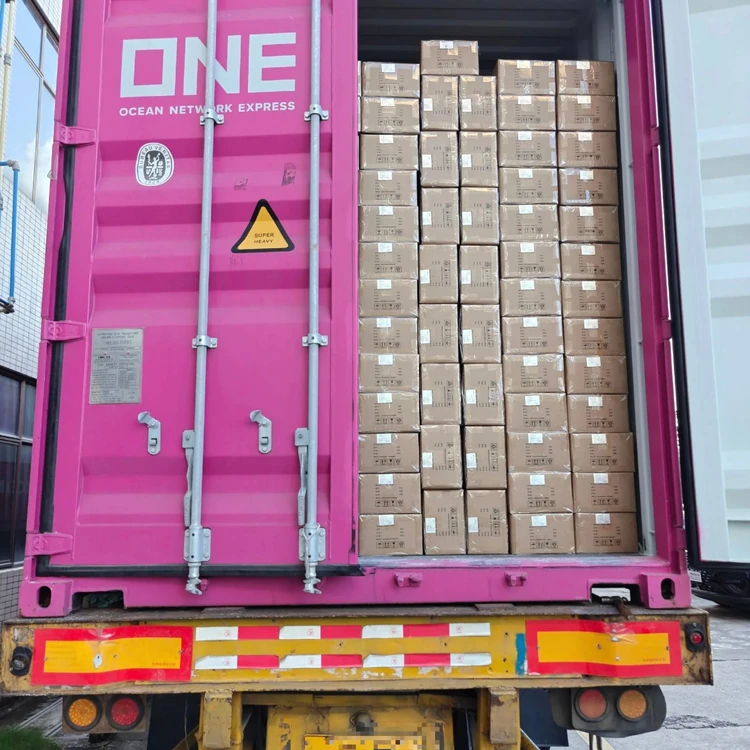
We would rather be audited than described. On a video walkthrough we show the origination room and the archived hologram masters, the hot-stamping and die-cutting lines, and the inspection stations where serialized and security work is checked during the run. We finish at the loading dock, where finished cartons go straight into export containers — the same dock as the photo below — because that is the part of the story trading companies cannot photograph. Every buyer should hold custom packaging manufacturers to the same standard: show the floor, then show the file.
On paper, we hand over the per-SKU data pack: every component with material and grade, weight, recyclability grade with the reasoning behind it, total-fluorine figures sourced from our mills and, where a screen needs confirmation, accredited-lab results, plus the lot record and mill certificates.
What we do not do is issue regulatory compliance certificates — under both the PPWR and the state EPR laws that duty belongs to you as the brand owner or importer of record. Our job is to make your file complete. As custom packaging manufacturers serving EU and US buyers from Guangzhou, we have learned — after more than twenty years in printing and fifteen in security and hologram work — that the factories worth buying from are the ones that make your compliance easier, not the ones that promise to carry it for you.
Illustrative case: the data gap that almost shipped
Illustrative example based on common buyer patterns; details generalized. A US skincare brand preparing its first California filing chose one of several custom packaging manufacturers on price and samples alone. The cartons were beautiful. When registration season arrived, the supplier could not produce component-level weights — the “factory” was a trading office that had never asked its own supplier for them. The brand spent three weeks reconstructing data from physical samples and nearly missed the 31 May 2026 reporting cycle. It re-sourced to a factory-direct supplier, and the per-SKU data pack now arrives with every shipment. The artwork never changed; the paperwork did.
What to demand per SKU: the data pack
Ask every candidate on your custom packaging manufacturers shortlist for this structure on a comparable SKU. If it comes back complete, you are probably talking to a factory. If it comes back as a brochure, you are probably talking to a desk.
| What to demand | Why it matters | What good looks like |
|---|---|---|
| Component list with material types | EPR reporting by covered material category | Every detachable component named, not “paper plus plastic” |
| Weight per component | Fees calculated on reported supply data | Grams per component, per SKU |
| Recyclability grade with reasoning | PPWR grades; state eco-modulated fees | Grade plus the design choices that set it |
| Total-fluorine / PFAS position | EU Article 5 limits on food-contact packaging | Screen per lot, with a lab route when exceeded |
| Lot and batch record | Traceability, recalls, audits | Lot number tied to production records |
| Document delivery terms | Market surveillance can demand files within days | Documents ship with the goods, per the quote |
★ Download the factory verification checklist
The twelve checks above, plus the document request list and a blank per-SKU data template, are in our free Factory Verification Checklist for Packaging Buyers. Print it, take it into your next supplier call, and score the answers — the custom packaging manufacturers on your shortlist will fill it in with you, while a trading company will change the subject.
Download the Factory Verification Checklist (PDF) — or contact our team to book a video factory audit and receive a completed sample data pack for a comparable SKU.
FAQ
Are trading companies always a problem?
No — some manage projects and logistics well. Some of the best-run custom packaging manufacturers use distributors for logistics while keeping data and quality control in-house. The test is who holds the data and the quality control. If the trading company can produce component-level material data, lot records and test reports from the factory on demand, the chain works. If those documents mysteriously take weeks, you are the weakest link in your own compliance chain.
Can I verify a factory remotely?
Yes, and most buyers now do. A video audit should cover origination, the decorating and die lines, inspection stations and the loading area, plus a live document review. What cannot be verified remotely — retained samples, archived masters — should be covered by the document requests in the checklist. Most custom packaging manufacturers now offer video audits as standard; if yours does not, ask why.
What documents prove FSC without your own chain of custody?
Mill certificate numbers, batch documentation and technical data sheets from the certified paper mills you buy from. What a factory without its own CoC cannot do is print the FSC trademark on your packaging — a line some suppliers blur. Ask any custom packaging manufacturers candidate for mill certificate numbers, not logos. Our FSC and EUDR guide explains the difference.
Do EPR rules apply to packaging made in China?
The obligation sits with the producer — usually the brand owner or importer of record — so the rules apply to your sale into the state, not to where the packaging was made. But the data behind your filing has to come from the manufacturer, which is precisely why factory-direct custom packaging manufacturers are easier to comply with than intermediaries.
How long does proper supplier verification take?
Days, not months: one document request, one video call, one reference check. The custom packaging manufacturers that answer fastest usually have the least to hide. The expensive version is discovering the gap during a filing deadline, as in the case above.
What if a factory refuses to share material data?
Treat it as a failed check and move on. A manufacturer that cannot or will not document its materials cannot support your EPR filings or your PPWR file, and no discount from any custom packaging manufacturers compensates for that.
Related guides
For the regulatory background behind these checks, see our guides on PPWR recyclability grades, PPWR labelling requirements and PPWR PFAS limits. To see the product ranges these checks cover, browse our custom packaging boxes, custom paper bags, custom labels, hologram stickers and hot stamping labels, or visit our manufacturer pages for holographic stickers, anti-counterfeit labels and hot stamping foil labels.
Ready to run the audit? Send us your SKU list and we will return a completed sample data pack — component materials, weights, recyclability grade and total-fluorine position — along with a video factory audit slot. The fastest-responding custom packaging manufacturers usually have the most to show.