
Send Your Inquiry Today
Waterproof and Freezer-Grade Label Materials: BOPP vs PET vs Vinyl, and the Adhesive That Actually Holds
- Why a “waterproof label” is really two decisions
- Waterproof label materials compared: BOPP, PET and vinyl
- Waterproof label materials at a glance
- Adhesive is where most labels actually fail
- The cold-chain trap: why labels fall off in freezers
- Keeping barcodes and QR codes scannable
- Pick your material by environment
- Illustrative scenario: a frozen skincare sample
- Production checklist before you order
- Frequently asked questions
Order a few thousand labels, ship the product, and a week later the bottle in the cooler has a curled, half-detached, unreadable label. For beverage, cosmetics, frozen-food and chemical brands, a failed label is not a cosmetic problem — it is a compliance, traceability and brand-trust problem. The fix is rarely “use a more waterproof sticker.” It is choosing the right film and the right adhesive together, then printing and finishing them so the barcode still scans. This guide walks through how to specify waterproof label materials that survive the real environment your product lives in.
Why a “waterproof label” is really two decisions
There is no single industry-standard definition of “waterproof,” and no one material called a waterproof label. Performance comes from two separate systems working together: the facestock (the printable film you see) and the adhesive (the glue underneath). A film can be fully waterproof while the adhesive fails in a freezer; a durable adhesive can be paired with a paper face that turns to pulp in condensation. Specifying only the word “waterproof” is the most common reason buyers end up with a reprint. You need to name the environment first — wet, refrigerated, frozen, oily, outdoor, or a mix — and then match both layers to it.
Waterproof label materials compared: BOPP, PET and vinyl
Paper and kraft absorb water and should be ruled out for anything that sweats, splashes or submerges. The three synthetic films below are the workhorses of durable, waterproof label materials. They do not absorb water, but they are not interchangeable.
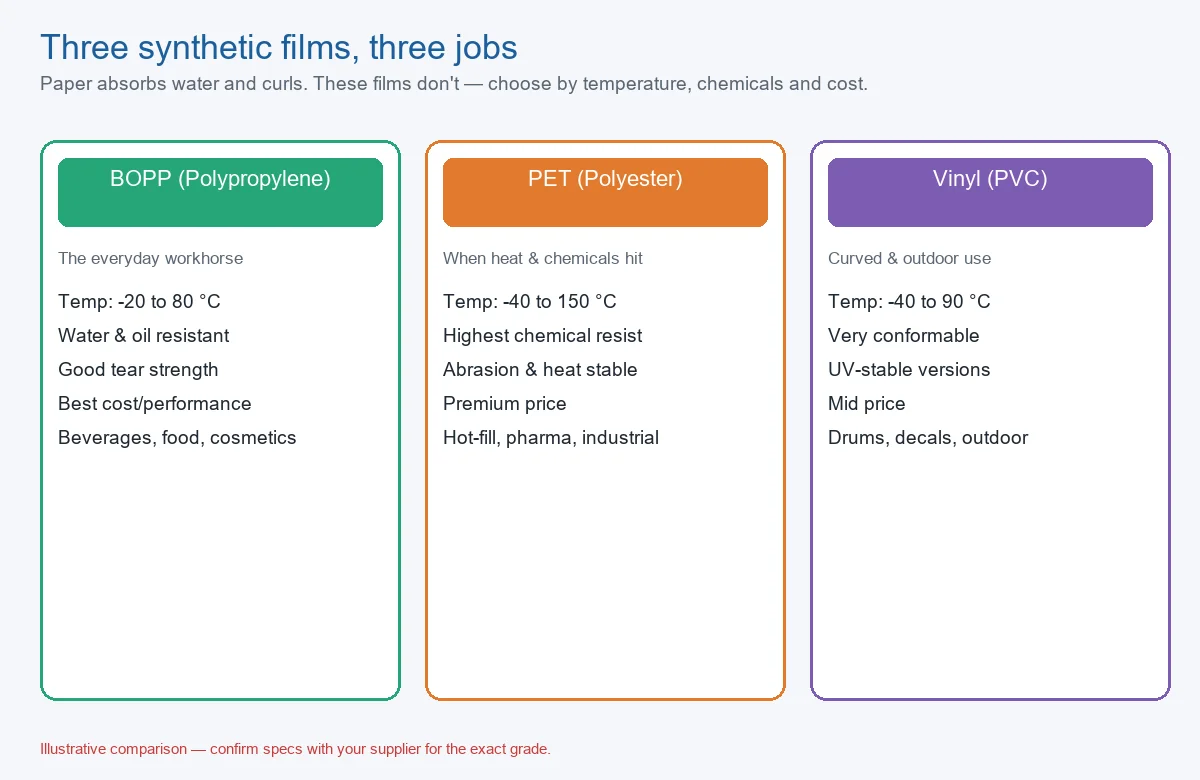
BOPP (biaxially oriented polypropylene) is the everyday film: water- and oil-resistant, tear-resistant, and the best cost-to-performance option for bottled beverages, chilled food, and cosmetics on rigid containers. Clear BOPP also delivers the popular “no-label look.” Expect a typical service range around -20 °C to 80 °C.
PET (polyester) is specified when heat, abrasion or aggressive chemicals are in play — hot-fill lines, pharmaceutical bottles, industrial drums and premium cosmetics. It holds shape across temperature swings (around -40 °C to 150 °C) and resists solvents that would swell BOPP. It costs more, and it is the right call when a label failure is expensive.
Vinyl (PVC) is the most conformable film, which makes it the choice for highly curved, squeezable or outdoor surfaces such as drums, equipment and decals. Service range is roughly -40 °C to 90 °C, with UV-stable versions for sun exposure. Note the environmental trade-off: PVC is less favored in recycle-minded programs, so weigh it against PET/BOPP where regulations matter.
Waterproof label materials at a glance
| Material | Typical service temp | Water / oil | Chemicals | Best use | Relative cost |
|---|---|---|---|---|---|
| BOPP | -20 to 80 °C | High | Moderate | Beverages, food, cosmetics | $ |
| PET | -40 to 150 °C | Very high | High | Hot-fill, pharma, industrial | $$$ |
| Vinyl (PVC) | -40 to 90 °C | High | Good | Curved, outdoor, drums | $$ |
| Coated paper | 0 to 60 °C | Low | Low | Dry indoor only | $ |
Figures are typical stock ranges; exact grades vary by supplier and thickness. Confirm the spec sheet for your run.
Adhesive is where most labels actually fail
The adhesive decides whether the label stays attached long after the film would have been fine. The common choices:
- Permanent acrylic — the default for glass and rigid plastic in dry, room-temperature use. It is what most “standard” labels use.
- Removable — peels cleanly with no residue for pricing, promotional or returnable-container use. Do not use it where permanence is required.
- Freezer-grade (low-temperature) — formulated to stay flexible and tacky below about 4 °C. This is the difference between a label that holds in a freezer and one that lifts within hours.
- High-tack — for low-surface-energy plastics (some HDPE and PP), textured or slightly dirty surfaces, where a standard adhesive only grips the “peaks.”
Surface energy matters: a label that bonds perfectly to glass may fail on a squeezable HDPE bottle. In that case specify high-tack adhesive, and ask whether corona treatment (typically 38–44 dyne/cm) is needed before printing to lock ink and adhesion.
The cold-chain trap: why labels fall off in freezers
Freezers create the harshest, most common label failure: condensation, sub-zero temperature, and repeated freeze-thaw cycles. Standard adhesive stiffens and loses bond strength as it cools; paper absorbs moisture and curls. The result is a label that looks fine at the factory and is peeling in the cooler aisle.
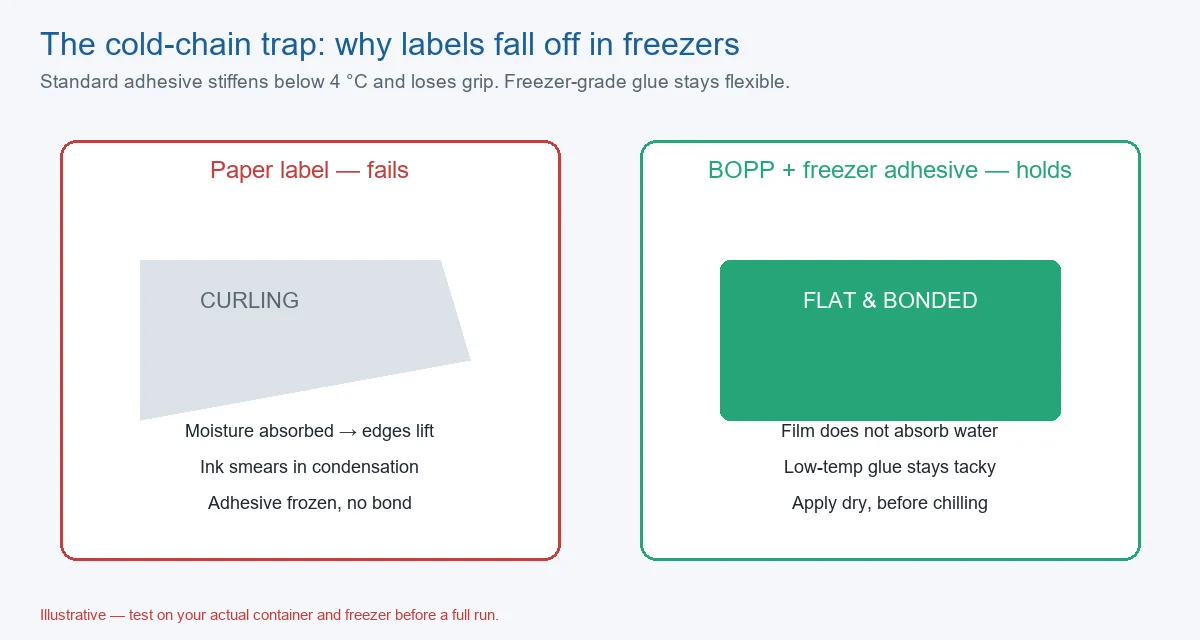
Two rules prevent most of these failures. First, specify a freezer-grade adhesive whenever the product is stored below about 4 °C. Second, apply the label to a clean, dry surface before the product enters cold storage — once a container is frosted or wet, even good adhesive cannot “wet out” and bond. If your workflow applies labels after chilling, tell your printer; that changes the adhesive specification.
Keeping barcodes and QR codes scannable
A waterproof label is useless if the barcode or QR code stops scanning at the dock. Durability and scannability are linked: a film that survives, an adhesive that holds, and a print that stays high-contrast under handling.
- Print method and ribbon. For variable data and long-life codes, thermal transfer with a wax-resin or full-resin ribbon beats direct thermal, which fades with heat and light. Digital and flexographic printing suit fixed artwork.
- Laminate the print. A gloss or matte overlaminate protects ink from scuffing, moisture and ice-bucket handling — low-cost insurance for high-value runs.
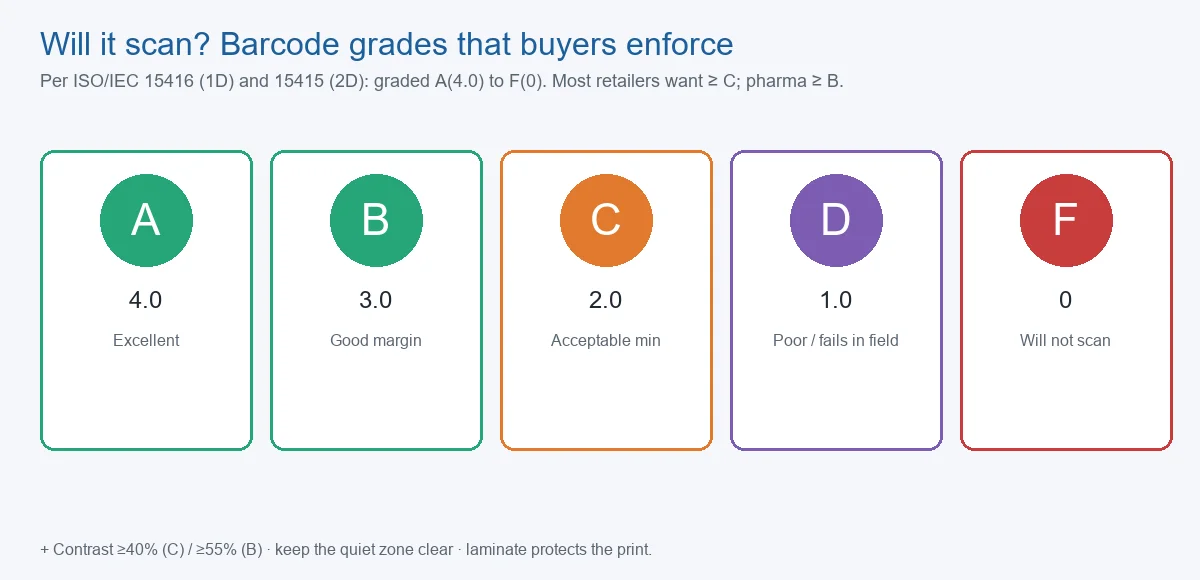
- Know the grade buyers enforce. Per ISO/IEC 15416 (linear barcodes: UPC, Code 128, GS1-128, ITF-14) and ISO/IEC 15415 (2D codes: QR, GS1 DataMatrix, PDF417), symbols are graded A (4.0) down to F (0). Most retailers require at least a C; pharmaceutical and healthcare supply chains typically want a B. One weak parameter — contrast, quiet zone, or decodability — drags the whole grade down, and a decode failure forces an F regardless of everything else.
- Protect contrast and quiet zone. Aim for symbol contrast at or above the threshold for your grade (roughly 40% for C, 55% for B). Keep the quiet zone — the blank margin beside a barcode, about 9× the narrow bar width for UPC-A — clear of text and artwork.
This matters more in 2026–2027 because of the GS1 Sunrise 2027 transition: many brands are reprinting labels to carry a single 2D code (GS1 QR Code / DataMatrix) that holds GTIN, batch, expiry and a URL. A denser 2D symbol is less forgiving of low contrast and scuffed print, so the material and finish choices above directly protect that investment. See our guide to 2D barcode traceability for food and pharma for the data-layer side. For US retail, GS1 US licenses the UPC/GTIN prefixes; for medical devices, the FDA UDI rule (21 CFR Part 830) requires machine-readable identification.
Pick your material by environment
| Your product lives in… | Start with | Adhesive |
|---|---|---|
| Beverages, chilled food, cosmetics on rigid containers | White or clear BOPP | Permanent acrylic |
| Hot-fill, chemicals, pharma, industrial | PET | Permanent, often with resin ribbon print |
| Freezer or frozen food | BOPP or PET | Freezer-grade (apply dry, before chilling) |
| Curved, squeezable, outdoor, drums | Vinyl (UV-stable) or conformable BOPP | High-tack if low-surface-energy |
| Returnable or promotional, no residue | BOPP or paper | Removable |
Illustrative scenario: a frozen skincare sample
The following is a composite, illustrative example, not a specific customer order. A skincare brand ships a refrigerated sample kit. Their first run used coated paper with standard adhesive; in the 4 °C display the labels curled and the batch QR code smeared, so the fulfillment center could not scan expiry. On the revised run they moved to white BOPP with a freezer-grade adhesive, added a matte overlaminate, and verified the 2D code at Grade B on a calibrated verifier. The same artwork, a different material system — and the labels stayed flat and scannable through cold chain and shelf. Use it as a checklist, not as a claim about any past job.
Production checklist before you order
Send this to your printer instead of the word “waterproof,” and you avoid most reprints:
- Environment: refrigerated, frozen, wet, oily, outdoor, or chemical — and the temperature range.
- Container: material (glass, PET, HDPE, PP, metal), surface texture, curved or squeezable, applied before or after chilling.
- Facestock: BOPP, PET, or vinyl; white, clear, or metallic; thickness if specified.
- Adhesive: permanent, removable, freezer-grade, or high-tack.
- Print + finish: digital/flexo/thermal transfer; laminate yes/no; barcode or QR size, quiet zone, and required grade (C or B).
- Format: rolls (core size, unwind direction, max outer diameter) for machines, or sheets for manual application.
- Proof and test: request a physical sample and test it on the actual container in the actual environment before mass production.
Frequently asked questions
Are BOPP, PET and vinyl labels really waterproof?
Yes — as films they do not absorb water, unlike paper. “Waterproof” still depends on the adhesive and on whether the print is protected by lamination.
Can waterproof labels go in a freezer?
Only with a freezer-grade adhesive. Standard adhesive stiffens below about 4 °C and loses bond. Also apply to a dry surface before chilling.
What barcode grade do I need?
Most US retailers accept a Grade C (ISO/IEC 15416 / 15415); pharmaceutical and healthcare supply chains usually require Grade B. Confirm with your trading partner.
Do I need BOPP or PET for a hot-fill bottle?
PET: it stays dimensionally stable from freezer to around 150 °C and resists the oils and heat that soften BOPP on a hot-fill line.
Why does my barcode scan in the office but fail at the warehouse?
Likely a marginal grade — low contrast, a squeezed quiet zone, or scuffed print. A verifier grades the symbol to the ISO standard and shows the weak parameter.
Choosing the right label material and production method is the first half of a durable label; the second half is matching it to your product’s real environment. For roll formats and QR or scratch-off security labels on rolls, or for anti-counterfeit QR code labels, see the related guides. Tell us your container, environment and barcode grade, and we will recommend a facestock, adhesive and finish — and send a physical sample to test before you commit. Request a sample and quote.