
Send Your Inquiry Today
Shipping Packaging Solutions for E-commerce and Custom Product Brands
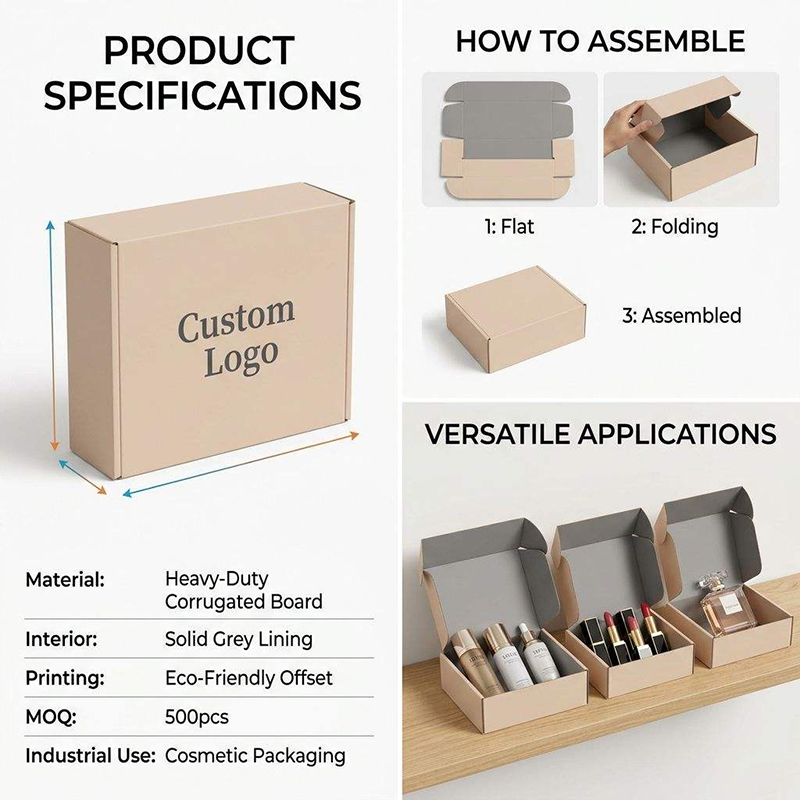
For an e-commerce brand, the shipping box is simultaneously a cost center (parcel carriers charge by size and weight), a damage-risk decision, and the first physical moment of the brand. Getting all three right is a specification exercise: box type, dimensions, protective system, and branding — in that order. This guide walks the decisions the way a fulfillment operation experiences them.
Decision 1: Mailer Box or Corrugated Shipper?
| Mailer box (tuck-top) | Corrugated shipper (RSC) | |
|---|---|---|
| Best for | DTC unboxing, products < 2–3kg | Wholesale, multi-item, heavy or fragile goods |
| Assembly | No tape, seconds to pack | Tape or staples |
| Unit cost | Higher | Lower at volume |
| Branding impact | Excellent (inside print standard) | Moderate (outside print) |
Most DTC brands standardize on 2–4 mailer box sizes covering their catalog, then use a single RSC for wholesale/oversize. Mailer box construction and print options are detailed in the box types guide; corrugated grades and ECT/BCT specs in the corrugated materials guide.
Decision 2: Right-Size Against Dimensional Weight
Carriers bill the greater of actual and dimensional weight (L×W×H ÷ divisor, commonly 139 for US domestic parcel). A right-sizing exercise pays for itself within weeks: measure your five top-selling product configurations, then order boxes sized to each with 2–3mm product clearance plus protection — not one big box for everything. Typical results we see in client programs: 10–20% shipping cost reduction from size alone, and lower damage rates because product can’t shift. Custom-sized boxes at volume cost nearly the same as stock sizes; the “custom is expensive” assumption died with digital die-cutting.
Decision 3: The Protection System
Choose protection by fragility and product value, cheapest system that passes a drop test:
| System | Cost | Best for | Sustainability note |
|---|---|---|---|
| Void fill (paper, air pillow) | Lowest | Robust products | Paper fill recycles best |
| Molded pulp trays | Low-mid | Standard fragiles (glass, ceramics) | Excellent recyclability |
| EPE foam / EVA inserts | Mid | Precision fits, electronics, cosmetics sets | Not kerbside recyclable — premium unboxing only |
| Corrugated inserts | Low-mid | Multi-item kits, bottle dividers | Mono-material — best EPR/PPWR profile |
Insert selection is a genuine search-driven need — buyers routinely specify “custom boxes with foam insert” as one purchase. The engineering trade-offs (EVA vs EPE vs pulp vs corrugated) are covered in the insert sections of our manufacturer capability guide.
Testing Before You Commit: Drop, Vibration and Compression
A protection system is only as good as the test it has passed. The sequence used in practice is simple: pack five units the way your warehouse will actually pack them, then drop-test from a height that matches your parcel class, followed by a vibration pass and — for palletised freight — a compression check. Standardised procedures exist (ISTA publishes the series most carriers and 3PLs recognise), and running them before you commit to tooling is far cheaper than discovering edge-crush failures after the first pallet ships.
Two findings recur. Most damage comes from movement inside the box rather than from the impact itself, so void fill that settles in transit causes more breakages than the drop does. And the failure point is usually a corner or a closure rather than a panel, which is why taping method and carton orientation on the pallet matter as much as board grade.
If formal testing is out of reach, a substitute catches most problems: ship five sample orders to yourself through the actual carrier on the actual lane, then unpack them as a customer would. Photograph every failure and treat each one as a specification change rather than bad luck.
Decision 4: Branding the Shipment
The high-impact, low-cost sequence: printed inside of the mailer (the moment of opening beats the moment of delivery), custom tape (brand visible on every doorstep photo), and tissue or a single insert card with a reorder QR code. Outside full-color print is the most expensive option and least seen — couriers, not customers, look at it. A QR carrying a reorder link also fits the 2D-barcode transition described in smart interactive packaging.
The Cost Nobody Budgets: Packing Labour
Box choice sets packing time, and packing time is the cost that scales with every order. A tuck-top mailer assembles in seconds with no tape. An RSC needs tape or staples and a second motion to close. Across a few thousand orders a month that difference becomes a measurable labour line, and it is usually larger than the per-unit price gap between the two box types.
The same logic applies to inserts. A moulded pulp tray drops in as one piece; loose void fill has to be dispensed, adjusted and topped up. If fulfilment is in-house or seasonal, favour protection that a temporary worker can assemble correctly on the first attempt. Consistency beats cleverness — a clever system applied slightly wrong on every tenth order produces more damage than a simple one applied correctly every time.
The E-commerce Sustainability Math
US state EPR programs charge by material category, and the EU grades recyclability — both reward mono-material corrugated mailers with paper tapes and water-based inks, which is conveniently also the cheapest clean spec. Right-sizing is itself a sustainability lever: smaller boxes mean less material and lower shipping emissions per order. The full regulatory timeline is in the 2026–2027 compliance guide.
Frequently Asked Questions
How much do custom shipping boxes cost?
Standard-size branded RSC shippers at 1,000–5,000 units typically run $0.35–$1.00 per box depending on size and print; branded mailer boxes commonly $0.50–$1.50. The number that matters more is total landed cost per order — a right-sized box that saves one dimensional-weight tier pays for itself on every shipment.
What MOQ do I need for branded shipping boxes?
Flexo-printed corrugated starts around 500–1,000 per size; digitally printed mailers can start as low as 100–300 — the economics behind low-MOQ programs for growing brands. Keep each size’s volume above its process threshold rather than consolidating into one oversized box.
Are branded boxes worth it for a small brand?
For DTC products with a social-sharing customer base, yes — unboxing photos are the cheapest acquisition channel a small brand owns. The value case is weakest for pure replacement consumables; strongest where the product is gift-adjacent or premium. Start with one printed mailer size and measure reorder rates before expanding the range.
What box strength do I need for shipping?
Match board grade and flute to product weight and stacking height. Light DTC parcels under 2–3 kg are usually fine in E-flute mailers; heavier or palletised goods need B-flute or double-wall with an edge-crush value that reflects how many cartons sit above them in transit. Ask the supplier for the ECT or BCT figure rather than a generic “strong box” description, and confirm it against how the cartons will actually be stacked.
Should I print on the inside or the outside of a mailer box?
Inside first. The interior is seen by the customer at the moment of opening, which is the moment that gets photographed; the exterior is handled by couriers and is usually scuffed before delivery. If the budget stretches to a second print location, add a small logo and branded tape outside for doorstep recognition, but put the design investment on the interior panels.