
Send Your Inquiry Today
What Is Hot Foil Stamping? A Buyer’s Technical Guide to Hologram Roll Labels
What Is Hot Foil Stamping?
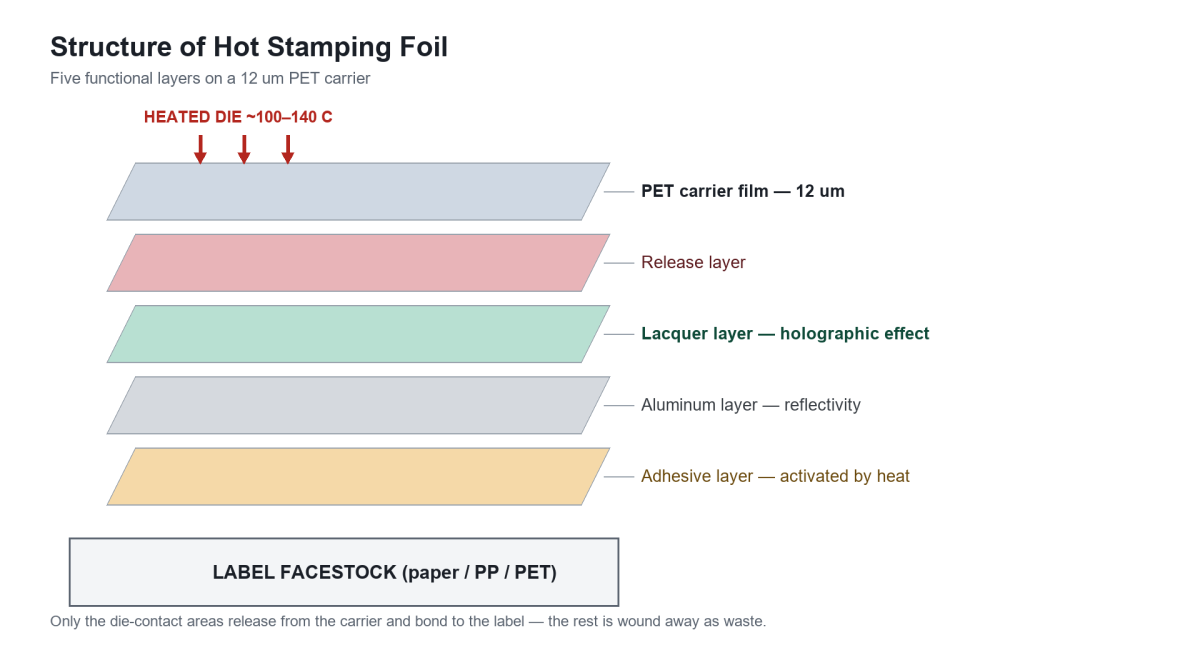
Hot foil stamping is a dry printing process that transfers a metallic or holographic film onto a substrate using a heated engraved die, pressure, and dwell time. The film—called hot stamping foil—is a multilayer sandwich typically carried on a 12 µm PET backing: a release layer, a lacquer layer carrying the visual effect (color, diffraction, holographic pattern), a metalized aluminum layer for reflectivity, and an adhesive sizing layer that bonds to the label facestock when activated by heat.
When the heated die presses the foil against the label web, only the areas touched by the die release from the PET carrier and bond to the label. Everything else stays on the carrier and is wound away as waste. The result is a crisp, mirror-bright or rainbow-diffractive image that cannot be reproduced by inkjet or toner printing—which is exactly why brand owners use it as a security feature, not just a decorative one.
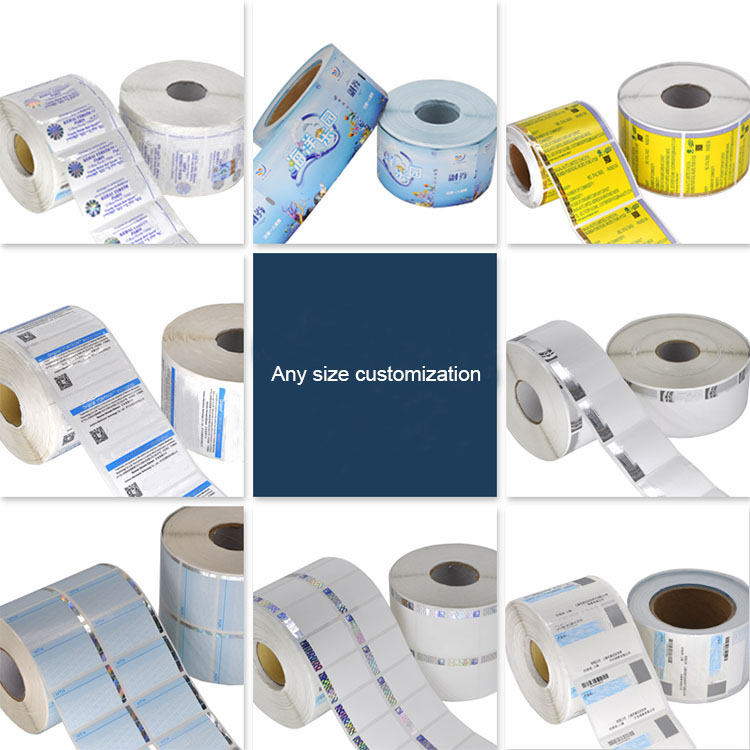
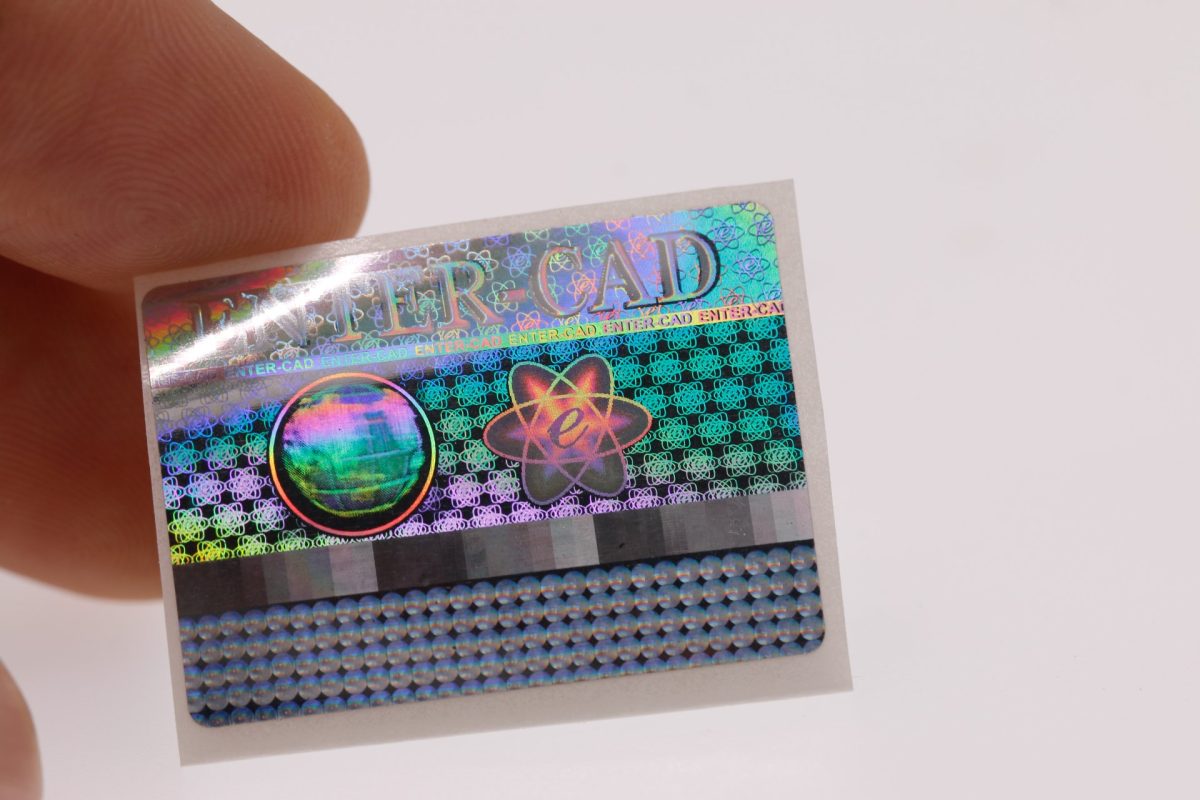
On labels supplied in roll form—what buyers usually search for as holographic sticker rolls or custom roll labels—hot stamping is the workhorse process for applying holographic strips, seals, and logos onto an otherwise conventional pressure-sensitive label. If you have ever peeled a pharmaceutical carton seal or inspected a wine bottle neck label that flashes rainbow patterns under light, you have almost certainly held a hot-stamped hologram label.
Quick definition for buyers: hot stamping = foil + heated die + pressure. The holographic effect lives in the foil itself, so the security level of your label depends on which foil you buy (stock pattern vs. custom master) far more than on the press that applies it.
How Hot Foil Stamping Works on a Roll Label Line
Understanding the process helps you judge quotes and spot suppliers who are cutting corners. A roll-to-roll hologram stamping line runs through five steps:
1. Die making
The artwork is engraved into a brass or magnesium die. For holographic effects, the die is flat (a stamping plate) rather than the sculpted dies used for embossing logos. A new custom die is a one-time tooling cost; reorders reuse it. For stock holographic patterns, suppliers keep standard dies on the shelf, which is why sample orders can turn around in days.
2. Foil loading and tension control
The holographic foil is loaded on a unwind shaft and pulled through the stamping station with tension controlled to a few newtons. Too much tension stretches the 12 µm PET carrier and distorts the diffraction pattern; too little causes wrinkles that show up as dark lines across the stamped area.
3. Heat, pressure, dwell
The die head runs at roughly 100–140 °C depending on the foil grade and the facestock. Silicone rubber rollers or flat platens press the web against the die for milliseconds. The sizing layer melts, bonds to the facestock, and the release layer lets the PET carrier peel away cleanly.
4. Registration
On a roll label, the hologram must land in a defined position relative to the printed artwork and the die-cut outline. A well-maintained line holds registration within ±0.3 mm. If your artwork places a hologram strip 2 mm from a QR code, registration tolerance—not print quality—is what decides whether the code stays scannable.
5. Die-cutting, inspection, rewinding
After stamping, the web is die-cut, matrix-stripped, inspected (on modern lines, by 100% camera inspection), and rewound into finished rolls. This is the stage where serialization is verified if the labels carry variable data.
Hot Stamping vs. Cold Foil: Which Process Fits Your Project?
This is the single most common question buyers ask, and the honest answer is that both are good processes—the right one depends on your run length, substrate, and security requirements.
| Criterion | Hot foil stamping | Cold foil (UV) |
|---|---|---|
| Typical use | Security labels, seals, small foil areas | Large decorative coverage, full-panel effects |
| Tooling | Engraved die required (one-time cost) | No die; uses a printing plate |
| Short-run economics | Tooling amortized over fewer units; better above ~5,000 labels | No tooling; friendlier for prototypes and short runs |
| Edge definition | Very sharp, crisp edges—ideal for micro-features | Slightly softer edges |
| Adhesion range | Bonds to paper, films, and many LSE plastics with matched sizing | Excellent on films; UV-cured adhesive layer |
| Over-printability | Limited; foil areas usually left uncovered | Can be overprinted and varnished easily |
| Security features | Excellent—works with holographic foils, micro-text dies, tamper-evident constructions | Good for decorative holographic patterns; fewer security constructions |
Rule of thumb: if the hologram is a security feature on a variable-data label (QR code, serial number), choose hot stamping. If the foil is decoration over a large area and your runs are short or the artwork changes often, cold foil is usually cheaper overall.
Types of Holographic Foil Used on Roll Labels
“Hologram” is not one product. When you request quotes, you should name the foil class explicitly, because the price and the security level differ by an order of magnitude between the top and bottom of this list:
Stock pattern holographic foil
Generic diffraction patterns (rainbow grids, bursts, dots) produced by the kilometer and sold to any buyer. Cost-effective and visually attractive, but zero exclusivity—your competitor can buy the identical roll of foil tomorrow.
Custom master hologram foil
A unique master is originated for your brand (2D/3D layering, true-3D model work, kinetic dot-matrix effects, micro-text, guilloche linework) and recombined into your exclusive foil. The master is your intellectual property. This is the tier where a supplier’s origination capability—15 years of it, in our case—matters more than press capacity.
Transparent high-security overlay foil
Half-tone diffraction that leaves the print below visible; used to seal over variable data or artwork without hiding it. Common on tax stamps and pharmaceutical seals.
Serialization-ready foil constructions
Foil designed to be stamped first and then overprinted (inkjet or thermal transfer) with sequential numbers and QR codes—or supplied as a pre-stamped zone on the label where the variable data prints afterwards. This is the construction behind most track-and-trace roll labels.
Where the Hologram Goes: Coverage Options on a Roll Label
Placement is a design decision with real cost and security consequences:
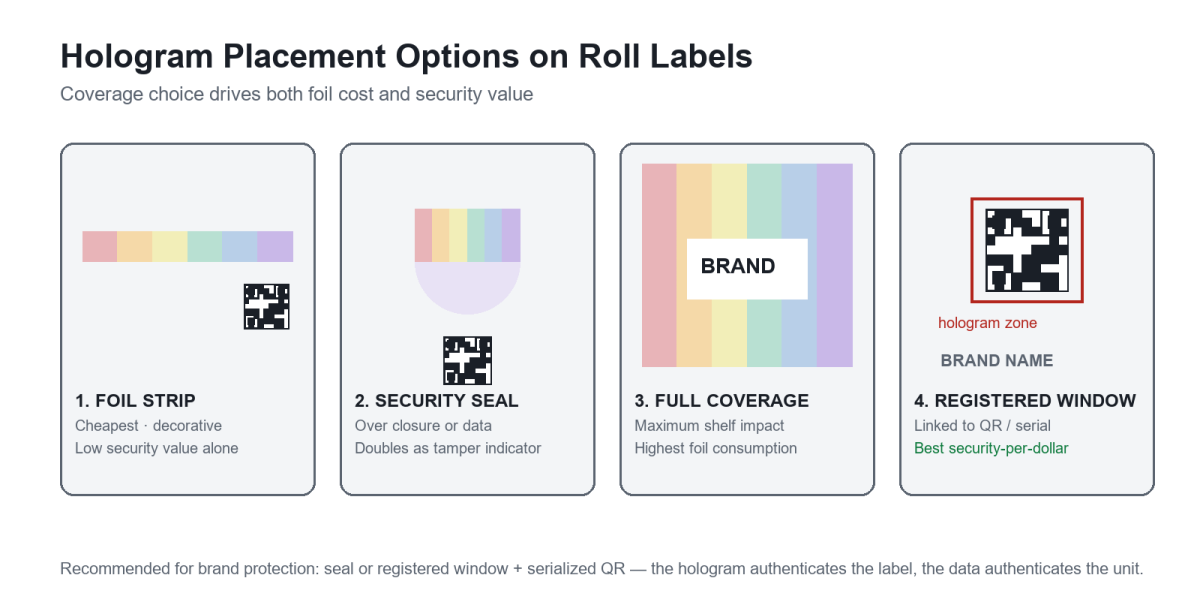
- Foil strip: a narrow band stamped across the label—cheapest option, strong shelf presence, minimal security value on its own.
- Holographic seal or patch: a discrete circle or rectangle stamped over the closure or over part of the variable data; doubles as a tamper indicator when it uses a destructible or void-revealing construction.
- Full-panel coverage: the entire label face is holographic; high impact, highest foil consumption, usually done with cold foil or foil-board laminates instead of stamping.
- Registered window: a small stamped zone positioned exactly around or beside the QR code / serial number, so the security feature and the data feature are physically linked—much harder to counterfeit than either alone.
Our default recommendation for brand-protection programs is the registered window or seal-plus-data combination: the hologram authenticates the label, the serialized data authenticates the individual unit, and one cannot be forged without the other.
Serialization: QR Codes and Sequential Numbers on Hologram Rolls
If your project involves track-and-trace, the roll format is not a detail—it is the production method that makes serialization affordable. Labels are stamped with the hologram zone, then personalized on digital presses or thermal transfer units with unique QR codes and sequential numbers pulled from your range. Camera inspection verifies every code before the roll is boxed.
Three specification points buyers frequently miss:
- Define your number range and check-digit rule in writing. Suppliers can generate sequential numbers, but the allocation logic belongs to your system, not ours.
- Specify data carriers by ISO standard (QR per ISO/IEC 18004; Data Matrix per ISO/IEC 16022) and state minimum quiet zones. A QR code printed partially over stamped foil needs a contrast check—metallic backgrounds can reduce scanner contrast, so the code area is usually left on white or stamped with a dedicated fenestrated construction.
- Ask how variable data interacts with die-cut position. If codes must sit a fixed distance from the die-cut edge, say so; registration between print and cut is what keeps every scan reliable.
For a deeper dive on the data side, see our guide to custom anti-counterfeit QR code labels.
Technical Specification Checklist to Send Your Supplier
Complete roll-label specifications get accurate quotes and eliminate two rounds of email. Before requesting a quotation, pin down:
| Parameter | Typical options | Why it matters |
|---|---|---|
| Facestock | Semi-gloss paper, PP/PE film, PET, destructible vinyl | Controls foil adhesion chemistry and durability |
| Adhesive | Permanent, removable, high-tack (LSE plastics), void-open | Decides surface compatibility and tamper behavior |
| Liner | Glassine paper, PET film liner (for auto-apply) | PET liners required for high-speed applicators |
| Roll direction | Labels wound out / wound in, top or bottom first | Must match your applicator or it stops the line |
| Core and OD | 76 mm (3″) core typical; OD up to 300 mm | Applicator and print-engine compatibility |
| Foil class | Stock pattern / custom master / transparent hi-sec | Price and security level driver #1 |
| Foil coverage | Strip / seal / registered window / % of area | Price driver #2 |
| Variable data | QR + sequential range, font, check-digit | Defines personalization workflow |
| Die-cut | Standard shapes or custom tool | Custom shapes need cutting dies (one-time cost) |
If you are unsure how suppliers turn this list into a price, our security label quote guide walks through the arithmetic line by line.
What Separates a Good Hologram Label From a Bad One
Twenty years of running these lines teaches you that most quality complaints come from four failure modes. Check samples against this list before approving a production run:
1. Foil flaking (poor release/adhesion balance)
Rub a stamped area firmly with a thumb. Foil that powders off or flakes at the edges was stamped at the wrong temperature or uses a sizing layer mismatched to the facestock. On PET and PE label films this is the most common defect from suppliers who run one foil grade on everything.
2. Registration drift across the roll
Unwind two meters of roll and check whether the hologram stays in the same position relative to the print. Drift beyond ±0.5 mm means tension control problems—and a bad day for your applicator.
3. Wrinkles and voids in the stamped area
Dark streaks or un-stamped gaps inside the foil area are wrinkle artifacts from the carrier film. Occasional edge artifacts are normal in the industry; systematic streaks across the web are not.
4. Dead-fold and tamper behavior that was never tested
If the hologram seal is also a tamper device, demand the destruction test: peel a seal from the actual packaging substrate at application temperature. A seal that peels off cleanly from a coated carton but shreds on corrugated is telling you the adhesive was chosen from a catalog, not for your surface.
For construction-level security thinking beyond foil—layers, adhesives, and destructible designs—our tamper evident seals guide covers the mechanics in detail.
Cost and MOQ: What Actually Drives the Price
Hologram roll label pricing has three levers, and buyers who understand them negotiate better:
- Tooling (one-time): stamping die + cutting die. Stock-pattern work often reuses shelf dies, so tooling approaches zero; custom master projects carry origination plus dies.
- Foil consumption: priced roughly by stamped area × run length. A 5 mm strip on a 40 mm label consumes a fraction of the foil of a full seal.
- Personalization: variable QR/serial data adds a digital print pass and 100% inspection time—usually a modest per-label cost, but it sets the MOQ because the line cannot be justified below a few thousand labels.
Typical order economics: stock-pattern holographic roll labels are viable from around one thousand labels; custom-master projects usually justify themselves from five thousand upward, because the origination cost amortizes quickly and the foil is exclusively yours afterwards.
Common Buyer Mistakes (and How to Avoid Them)
Ordering decorative foil for a security job
Stock rainbow foil looks like a security feature and isn’t one. If counterfeiting is the concern, budget for at least a custom master with micro-text, or combine a stock hologram with serialized data so the security lives in the data, not the shimmer.
Ignoring the application surface
Low-surface-energy plastics (HDPE bottles, PP caps) need high-tack adhesives; a label specified for paper cartons will creep off a shampoo bottle within weeks. Always name the substrate.
Specifying the hologram after the artwork is frozen
Foil zones need artwork space, quiet zones around codes, and die-cut margins. Involve the label engineer before the designer finalizes the file, not after.
Comparing quotes without normalizing foil class
A cheap quote is often a cheaper foil. Insist that every quotation states the foil construction in writing.
Frequently Asked Questions
What is hot foil stamping?
It is a process that transfers a metallic or holographic film onto labels using a heated die, pressure, and a precisely formulated release/adhesive layer system. The effect is a real metal or diffractive layer bonded to the label—physically part of it, not an ink simulation.
What is a hot foil stamping machine used for?
On label production lines it applies foil areas—logos, strips, seals, holographic zones—to rolls of labels. Craft versions exist for stationery, but brand-protection work requires industrial units with tension control and registration systems; this is why brands buy finished labels from a converter rather than stamping in-house.
Cold foil vs. hot foil: which should I choose?
Choose hot stamping for security constructions, sharp micro-features, and stable mid-to-long runs; choose cold foil for large decorative areas, frequent artwork changes, and short runs without tooling. See the comparison table above.
Do hologram stickers actually prevent counterfeiting?
Stock-pattern holograms deter casual copying but can be purchased by anyone. Custom-master holograms combined with serialized QR or sequential numbers raise the attack cost dramatically, because a counterfeiter must duplicate both a physical origination and your data infrastructure. The combination—not the shimmer alone—is what protects products. Holographic foil is one layer of the wider discipline of security printing, alongside intaglio linework, guilloche patterns and colour-shifting inks; combining two or more of these is what makes a label genuinely costly to copy.
Can you overprint ink on holographic foil?
Hot-stamped foil accepts limited overprint (special foil grades exist for it); cold foil overprints easily. Variable data is usually printed on unlaminated zones or fenestrated foil constructions designed for that purpose.
What is the minimum order for custom hologram roll labels?
Stock-pattern work commonly starts near 1,000 labels; custom-master programs typically make sense from 5,000 labels, since origination is a one-time cost that amortizes with volume.
Get a Specification-Matched Quote
If you can name the substrate, the foil class, and whether the labels carry variable data, we can return a specification-matched quote with a physical sample—stock-pattern samples typically ship within days because the dies are already on our shelf. Start from our custom security labels overview, or send your artwork directly through the quote form on that page.