
Send Your Inquiry Today
US Packaging EPR Laws by State: What Paper Packaging and Label Buyers Must Do in 2026-2027
As of September 2026, seven US states make the brand owner pay for the end-of-life of the packaging it sells into the state. Two of them — Oregon and Colorado — are already invoicing. California starts in 2027, and a separate California labeling rule takes effect on October 4, 2026.
If you buy folding cartons, corrugated mailers, paper bags or pressure-sensitive labels from an overseas converter, the fee lands on you, not on us. But the thing that decides how much you pay is decided months earlier — when a packaging spec is signed off. The sections below walk through packaging EPR laws by state, then turn to the six specifications that quietly push a paper pack out of the cheapest fee tier.
What’s in this guide
- What US packaging EPR laws actually require
- US packaging EPR laws by state (7 enacted)
- Packaging EPR fees and 2026–2027 deadlines
- How EPR fees are calculated
- Why paper and board sit in the lowest fee tier
- Six specs that move you out of the lowest tier
- How we produce EPR-friendly packaging
- What we see on the line: one spec swap
- The packaging EPR data your supplier must give you
- California SB 343: the October 4, 2026 labeling rule
- Packaging EPR compliance checklist
- Packaging EPR FAQs

What US Packaging EPR Laws Actually Require From a Brand
Extended producer responsibility (EPR) for packaging moves the cost of collecting, sorting and recycling packaging waste off local government and onto the “producer”. In practice, four obligations follow:
- Register with the state’s producer responsibility organization (PRO), or apply to the state as an independent producer.
- Report every covered material you placed into that state — by material type and by weight, usually at component level.
- Pay fees to the PRO under a state-approved fee schedule.
- Redesign over time, because the fee schedule is “eco-modulated”: easy-to-recycle packaging costs less per pound than packaging that contaminates the stream.
One organization sits behind most of this. Circular Action Alliance (CAA) is the single producer responsibility organization (PRO) in six of the seven enacted states — California, Colorado, Maryland, Minnesota, Oregon and Washington — which means one reporting relationship covers most of your US exposure. Maine is the exception: CAA declined to bid, and Maine’s Department of Environmental Protection is still selecting a stewardship organization.
Two details catch importers out, and they are the heart of EPR for importers. First, “producer” defaults to the brand owner — the name on the pack — not the factory that made it. If you import under your own brand, you are the obligated party even though you never touched a production line. Second, liability follows a hierarchy: brand owner first, then licensee, manufacturer, importer or distributor if the brand owner has no US presence. Selling through a distributor does not move the obligation off you.
US Packaging EPR Laws by State: The Seven Enacted Programs
Seven states have enacted packaging EPR laws. By state, there is no uniformity: no federal packaging EPR law exists, so obligations are set state by state — registering in Oregon does not cover California.
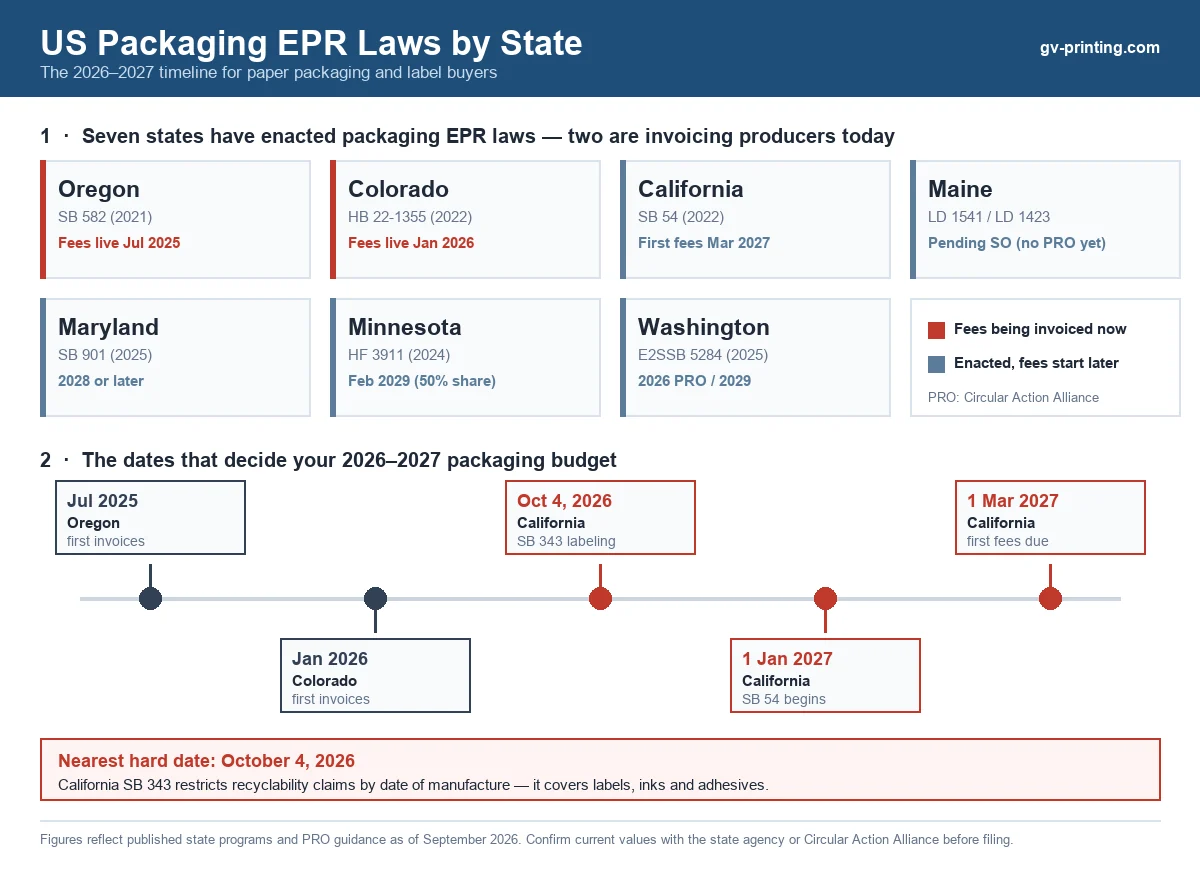
| State | Law | Fees live? | Fees begin | Small-producer exemption | Maximum penalty |
|---|---|---|---|---|---|
| Oregon | SB 582 (2021) | Yes | July 2025 | <1 ton OR <$5M global revenue | $25,000/day |
| Colorado | HB 22-1355 (2022) | Yes | January 2026 | <1 ton OR <~$5.6M global revenue (CPI-adjusted) | Civil penalties + sales prohibition |
| California | SB 54 (2022) | No | 2027 | <$1M California gross sales (must apply) | $50,000/day/violation |
| Maine | LD 1541 / LD 1423 | No | Pending SO selection | <1 ton OR <~$2M revenue | DEP enforcement |
| Maryland | SB 901 (2025) | No | 2028 or later | <1 ton OR <$2M global revenue | $5,000–$20,000 per violation |
| Minnesota | HF 3911 (2024) | No | February 2029 (50% cost share) | <1 ton AND <$2M revenue (both) | MPCA enforcement |
| Washington | E2SSB 5284 (2025) | No | 2026 (PRO) / 2029 | <$5M revenue | Sales ban from Mar 1, 2029 |
Figures reflect published state programs and PRO guidance as of September 2026. Thresholds and dates are revised through rulemaking — confirm current values with the state agency or CAA before you file.
Bills are also pending in New York, New Jersey, Massachusetts, Illinois and Michigan, and Wisconsin and New Hampshire introduced packaging EPR bills in the 2026 session. Plan on the list growing rather than consolidating.
Packaging EPR Fees and Deadlines: What 2026–2027 Looks Like
2026 was the first year several state programs hit their reporting deadlines at once. For calendar planning, these are the dates that matter now:
- October 4, 2026 — California SB 343 recyclability labeling restrictions apply to products and packaging manufactured on or after this date (see the SB 343 section below). This is the nearest hard date on the calendar.
- October 2026 — CAA is due to submit the final California programme plan to CalRecycle, with the final fee schedule attached.
- 1 January 2027 — CalRecycle approves the California plan; the SB 54 programme formally begins.
- 1 March 2027 — the PRO remits the first California Plastic Pollution Mitigation Fund fees: $500 million per year, $5 billion over ten years, funded by producers through PRO dues.
- Annual thereafter — Oregon reports in May, fees in July; Colorado reports 31 May, fees the following January.
California is the expensive jurisdiction to get wrong. It carries the highest statutory penalty of any state programme — up to $50,000 per day per violation — and it has no general business-to-business exemption, so shipping cartons and B2B packaging are in scope far more often than brands assume. Colorado adds a sales prohibition: non-compliant producers can be barred from selling into the state, which is a harsher commercial outcome than any fine.
How Packaging EPR Fees Are Calculated — and Where Material Beats Volume
Fees are billed per pound (or per tonne) of covered material placed into the state, then adjusted by eco-modulation. Two levers move the number, and they are not equal:
- Weight. Lightweighting and right-sizing reduce tonnage directly. A 20 g reduction on a folding carton across 200,000 units is four tonnes you stop paying for.
- Material and design. Eco-modulation is the bigger lever. In published European schedules, paper and board sit in the lowest band (roughly €0.08–0.25/kg), while flexible films run €0.60–1.50/kg and multi-layer composites €0.80–2.00/kg. Oregon’s finalised schedule shows the same gap in US cents: corrugated board is priced at roughly 3 cents per pound while poly-coated paperboard is roughly 32 cents per pound — about ten times more for a plastic-coated fibre pack.
Oregon and Colorado have already published per-pound fee schedules, so their rates are real today; California, Minnesota, Maryland, Washington and Maine are still setting theirs. Treat the European figures above as directional for the not-yet-finalised states, not as your budget. The structural point holds everywhere: one tonne of composite can cost more than six tonnes of plain board. Material mix beats volume as a cost lever, which is why packaging specifications — not logistics — are where the money is. If you already report into an EU scheme, the same logic drives the EU PPWR labeling requirements; the US programs differ in detail but push design in the same direction.
Why Paper and Board Sit in the Lowest Packaging EPR Fee Tier
Fibre-based packaging starts from a strong position under every EPR scheme we have seen:
- Collection access is near-universal. In California’s own material characterisation findings, paper and board score among the highest curbside access rates of any material category — well above the 60% threshold SB 343 uses for recyclability claims — while plastic film falls far below it.
- There is an established end market. Corrugated and paperboard are sorted, baled and re-pulped at scale, so the recovery cost the PRO has to fund is low.
- Recycled content is easy to evidence. PCW (post-consumer waste) content in board is documented upstream and does not depend on a chemical recycling pathway.
That advantage is conditional, though. It belongs to uncoated, mono-material, easily separated paper packaging. The moment a board structure gains a plastic or foil layer, it stops behaving like paper in a sorting facility — and in eco-modulated fee schedules it gets priced accordingly.
Six Paper Packaging Specs That Move You Out of the Lowest EPR Fee Tier
These are the six specification choices that most often turn a recyclable paper pack — a corrugated mailer, a paper bag, a folding carton or a label — into a “fibre-based composite” on a reporting form. We raise them at quote stage because they cannot be fixed after the plates are cut.
1. PE or PLA extrusion coating
A polyethylene coating (single or double side) is the most common way to get grease and moisture resistance onto a folding carton, corrugated mailer or paper bag — and wax or PE coating on a mailer’s outer board is exactly the kind of layer a PRO counts as plastic. It also converts the pack into a fibre-plastic composite in most classification systems. Alternative: water-based barrier coatings and grease-resistant papers that stay in the paper stream; where a coating is genuinely required, specify the minimum coat weight and document it.
2. Aluminium foil lamination
Foil-laminated board is visually striking and hard to recycle — the foil layer does not separate in a repulping cycle. Alternative: hot or cold foil stamping applied to a limited area. You keep the metallic finish on the brand block and leave the rest of the surface as bare board.
3. Paper-plastic laminates
Laminating printed paper to a plastic film for strength or gloss produces a pack with no viable separation pathway. This shows up a lot on paper bags — a gloss or matte film lamination over the whole surface, or a plastic handle glued to the bag body, both add a non-paper fraction that has to be reported separately. Alternative: a heavier single-grade board, or a water-based varnish, which keeps the pack mono-material; for bags, a folded paper handle or reinforced board replaces the plastic one.
4. Windows with PET film
A die-cut window with a PET or PVC film panel is a separate material that has to be reported as its own component and, in most streams, is a contaminant. Alternative: remove the window, or use an open die-cut aperture if the product does not need a barrier.
5. Non-separable fittings
Rivets, metal eyelets, magnets, plastic handles and foam inserts turn a two-component pack into five. On a corrugated mailer, even the shipping tape is a separate plastic component that has to be declared. Each extra part is a separate line on the report and each one makes separation harder. Alternative: folded paperboard constructions, paper-based fitments, and closures the consumer can remove in one motion — and for mailers, a water-activated paper tape instead of plastic film tape.
6. Full-surface film lamination and heavy UV
Gloss or matte lamination over the entire surface raises the plastic fraction of the pack. Alternative: spot UV on the design elements that need it, water-based varnish elsewhere.
And the label itself
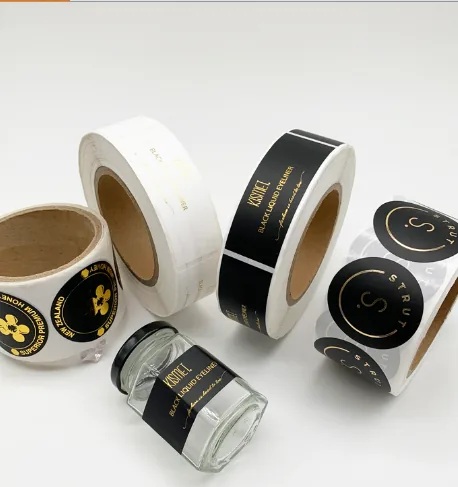
Recyclability rules increasingly name inks, adhesives and labels explicitly, not just the substrate — and a label is three components, not one: the face stock, the adhesive (glue), and the release liner (backing). A PVC face stock, a non-washable adhesive, or a plastic release liner can each push the assessment the wrong way, and a large-area holographic film panel over more than a third of a pack surface can affect how the whole pack is scored. Specifying PFAS-free paper packaging and a paper or PET release liner keeps the label in the lowest tier. This is the single most overlooked item in EPR data collection — brands report the carton and forget the label on it.
How We Produce EPR-Compliant Paper Boxes, Paper Bags and Labels
We are a printing and converting factory, not a consultancy, so here is what actually happens on our lines when a buyer asks for an EPR-aware spec:
- Substrate first. We quote single-grade, uncoated or clay-coated board before we quote a laminate, and we tell you the grammage we are assuming — because grammage is a number you will have to report.
- Barrier by coating, not by film. Where moisture or grease resistance is required, we specify water-based barrier coatings and grease-resistant papers rather than PE lamination, and we record the coating type on the job sheet so it can be declared.
- Metallics by stamping, not lamination. Hot and cold foil stamping give the same shelf impact on a limited area while leaving the substrate mono-material.
- Inks and adhesives declared. We use water-based and low-migration ink systems for food-adjacent work, and we state ink and adhesive type on the specification sheet — because SB 343 and APR-style design guidance both look at them.
- Components counted at quote stage. Every carton, insert, window, closure and label is listed with its own weight on the specification sheet. That list is your EPR report; producing it when the order is placed costs nothing, and reconstructing it eighteen months later does not.
- Fibre documentation passed through. We buy board and paper from mills and can pass through the mill’s certificate number, batch reference, board technical data sheet and fibre source declaration for your records. We do not hold our own FSC Chain-of-Custody certificate and we do not print the FSC trademark — if your programme requires a certified chain of custody, you need a certified supplier, and we will tell you that plainly rather than sell around it.
For physical protection, mono-material board and paper-based fitments usually get there without a plastic layer. Where a pack genuinely needs barrier performance that only a laminate delivers, we say so and document it, rather than quietly swapping in a cheaper composite.
What We See on the Line: One Spec Swap Before the 2027 Fee Year
The figures below are illustrative, based on the kind of specification change we handle most often; they are not a client’s results.
A typical request looks like this: a 350 gsm folding carton with a PE coating, a PET window and a plastic fitment, quoted for a US brand that sells into California and Oregon. Components: board, coating, window film, fitment, label — five lines to report, two of them plastic, and the whole pack classified as a composite rather than as paper.
Re-specifying it as uncoated 400 gsm board with a water-based barrier treatment, no window, and a folded paperboard fitment gives you: three components instead of five, no plastic fraction, and a pack that reports as paper and board. Grammage goes up slightly, total pack weight usually comes down because the fitment is lighter, and the pack moves from the composite band to the lowest one.
The commercial point is timing. None of that is a production problem — it is a decision that has to be made before tooling, and it costs nothing at the quote stage. The same change requested after a 50,000-unit run has already been reported is a reprint plus a restatement.
The Packaging EPR Data Your Supplier Must Give You
This is the table to send your converter before you file. If a supplier cannot populate it, you will be estimating — and estimates are the most common source of both overpayment and audit exposure.
| Data point | Why EPR needs it | What we supply |
|---|---|---|
| Component list with unit weight (g) | Fees are billed per pound per material | Yes — on the specification sheet at quote stage |
| Material type per component | Determines the fee band | Yes |
| Coating / laminate type and coat weight | Decides paper vs fibre-composite classification | Yes |
| Ink and adhesive type | Recyclability criteria name inks, adhesives and labels | Yes — water-based systems declared on the job sheet |
| Post-consumer recycled content % | Eco-modulation reward in most schemes | Yes — per board grade |
| PFAS statement | California bars recyclability claims above 100 ppm intentionally added PFAS | Yes — supplier declaration |
| Fibre source documentation | Due diligence for deforestation rules and buyer audits | Mill certificate number, batch reference, board TDS, fibre declaration |
| Recyclability statement per state list | Substantiates any recyclability claim you make | Construction-level statement; final determination is yours against the state list |
Two things we will not do: we will not sign a recyclability determination on your behalf — that is the producer’s legal obligation under California law — and we will not certify a chain of custody we do not hold. What we will do is give you the construction data you need to make the determination yourself.
California SB 343: Packaging EPR Meets the Recycling Label Rule
SB 343 is the piece most packaging buyers have not connected to EPR yet, and it has the nearest deadline — which is why SB 343 label compliance should sit at the top of your 2026 checklist. Under California’s accurate recycling labeling rules, products and packaging manufactured on or after October 4, 2026 may not carry the chasing arrows symbol, any other recyclability symbol, or any statement telling consumers to recycle — unless the item meets statewide recyclability criteria.
The criteria are demanding: the material must be collected by programs serving at least 60% of California’s population, sorted into defined streams by facilities serving at least 60% of recycling programs statewide, and sent to a reclaimer consistent with the Basel Convention. Packaging that fails cannot be sold, distributed or imported into California with the symbol on it.
Three consequences for packaging buyers:
- Design components are in scope. The criteria explicitly cover components, inks, adhesives and labels that prevent recyclability. Your label stock and adhesive are part of the assessment, not neutral.
- PFAS is a hard trigger. Packaging made from plastic or fibre containing intentionally added PFAS at or above 100 ppm cannot be claimed as recyclable. Specifying PFAS-free paper packaging is the simplest way to keep that claim open.
- You need written substantiation. The producer must hold documentation showing each covered product meets the criteria. That documentation is a supply-chain artefact — which means it has to come from your converter.
SB 343 and SB 54 are separate laws, but they point the same way. SB 343 sets the recyclability-label test; SB 54’s eco-modulated fees reward the same recyclability attributes. The practical result is aligned: a pack that fails SB 343’s recyclability bar will usually also sit in a higher SB 54 fee tier. Audit your labels and your substrate in the same exercise.
Packaging EPR Compliance Checklist (Copy or Download)
Work through this before your next packaging reorder:
- List every state you sell into and check it against packaging EPR laws by state — seven programs are enacted today and more are pending.
- Decide whether you are the producer — brand owner, licensee, importer or distributor — in each state.
- Test the de minimis threshold; note that California requires you to apply for the exemption, it is not automatic.
- Register with the PRO in each state where you are covered.
- Build the component weight table: every component, material, and grammage, per SKU.
- Flag every plastic or foil layer and ask whether it is functionally required.
- Audit labels and closures for recyclability criteria and PFAS status.
- Check every chasing arrows symbol on current artwork against SB 343 before October 4, 2026.
- Weigh samples on a precision scale — do not estimate grammage.
- Set a calendar reminder for each state’s reporting and fee dates; they do not align.
Download the data pack: US Packaging EPR Data Pack Checklist (XLSX) — the pre-filing checklist, a component weight table template with the annual-weight formula built in, and a state-by-state reference sheet.
Packaging EPR FAQs
Which US states have packaging EPR laws?
Seven: California (SB 54), Oregon (SB 582), Colorado (HB 22-1355), Maine (LD 1541, amended by LD 1423), Minnesota (HF 3911), Maryland (SB 901) and Washington (E2SSB 5284). Only Oregon and Colorado are invoicing producers today; California starts in 2027.
Do I have to register in every state I sell into?
Yes, if you meet each state’s threshold. There is no federal packaging EPR law and no reciprocity between states — registering in Oregon does not cover California. Each state has its own registration, its own reporting format and its own fee schedule.
Does packaging EPR apply if my supplier manufactures in China?
Yes. The producer is generally the brand owner whose name appears on the product or packaging, regardless of where it was made. If you import packaged goods and sell them under your own brand into an EPR state, you are the obligated producer.
Are there exemptions for small brands?
Yes, and they vary. Oregon exempts producers under one tonne of packaging or under $5M global revenue; California exempts producers under $1M in California gross sales but requires an application; Minnesota requires both conditions to be met. Check each state before assuming you are out of scope.
How much are packaging EPR fees?
Fees are charged per pound of packaging by material type, with eco-modulation adjusting the rate. Published US schedules are still being finalised; in comparable European schemes paper and board run a fraction of the rate for flexible films and composites. Your exposure depends on material mix more than on volume.
Does EPR cover shipping cartons and labels, or only retail packaging?
Coverage generally includes primary, secondary and — in most states — transport packaging, plus labels and closures as separate components. California has no general business-to-business exemption, so shipping cartons are in scope more often than brands expect. Colorado largely excludes business-to-business sales.
Is paper packaging exempt from EPR?
No. Paper and paperboard are covered materials in every enacted programme. What fibre buys you is the lowest fee tier and the strongest recyclability position — not an exemption.
What happens if I miss a packaging EPR deadline?
Penalties are state-specific and steep: up to $50,000 per day per violation in California, $25,000 per day in Oregon, and sales prohibition in Colorado. Non-registration is usually a larger risk than fee optimisation for smaller producers.
This guide summarizes published state programs and PRO guidance as of September 2026 for general information only. It is not legal advice and does not replace consultation with qualified counsel or the official text of each state’s statute and rulemaking. Fee schedules, thresholds and dates change through rulemaking — confirm current values with the state agency or Circular Action Alliance before you file.
Planning a Packaging Reorder for 2027?
Packaging EPR laws by state differ on thresholds, deadlines and fee schedules, but every one of them starts with the same thing: measured component data. If you are choosing an EPR packaging supplier or manufacturer for 2027, the question to ask is not “can you print this” but “can you give me measured, declared component data.” If you sell into California, Oregon or Colorado, send us the artwork and the current spec and we will return a component weight table — every material, coating, closure and label, with grammage — so your EPR report starts from measured data instead of estimates. Where a spec can move to a lower fee tier without losing shelf impact, we will quote both versions.