
Send Your Inquiry Today
Silver Scratch-Off QR Code Labels on Rolls: A Spec Guide
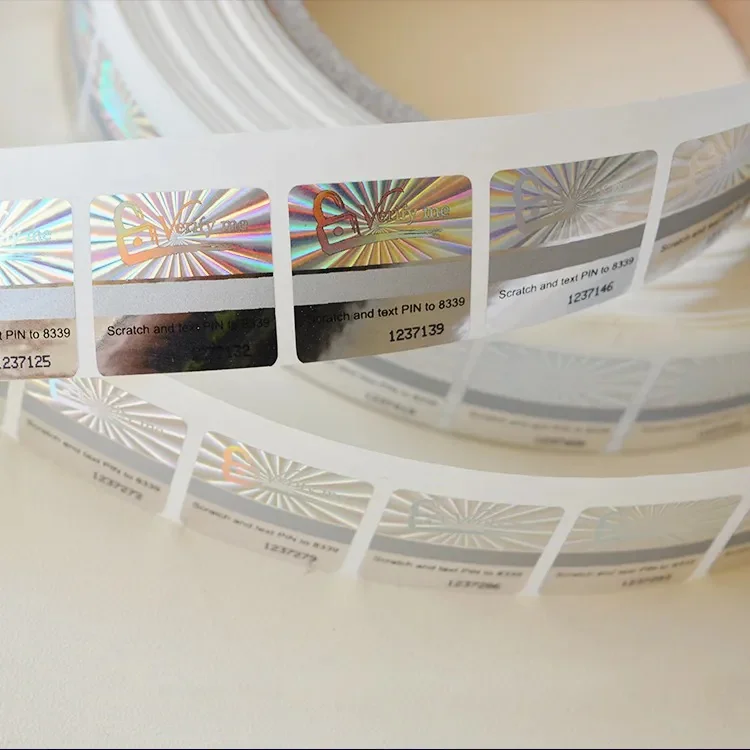
Short answer: when buyers ask for scratch off labels on rolls, they are not ordering one printed sticker — they are ordering a three-layer construction wound to a machine specification. A unique, serialized QR code is printed first, a clear release coat goes over it, and an opaque silver scratch-off latex panel is screen printed on top. The panel hides information; it does not verify it. Most failed orders trace back to one of two things: a release coat that was not fully cured, or a roll wound in the wrong direction. This guide gives you the terminology, the production sequence and the six roll fields to put in your RFQ, plus a one-page checklist to send to any converter.
Planning summary, not legal advice. QR symbol and print-quality standards, 2D barcode migration plans, packaging-component rules and promotion / prize regulations differ by market and continue to move. Confirm current requirements with the official sources linked below and with your own counsel before committing print or making an on-pack claim.
Contents
- At a glance: four decisions behind every scratch-off roll label
- What changed: GS1 Sunrise 2027 and the label as a packaging component
- Who this hits
- What it means for your label: the three-layer construction
- Getting the English right: scratch-off latex, not silver foil
- Static QR, serialized QR, or a hidden code under the panel?
- How we produce it: from approved CSV to a wound roll
- Six roll specifications your applicator needs
- Spec table: copy these fields into your RFQ
- Download: scratch-off QR roll label spec & sign-off checklist
- An illustrative scenario (not a customer order)
- Common failures in a scratch-off label specification
- FAQ: silver scratch-off material, QR codes and roll labels
- Related guides
- Get a physical sample and a spec review
At a glance: four decisions behind every scratch-off roll label
Buyers searching for scratch off labels on rolls are usually not asking what a scratch card is. They are trying to place a production order, and four decisions have to be made before a converter can quote it without guessing.
| Decision | What you must state | What goes wrong if you do not |
|---|---|---|
| What is hidden | A unique QR code, PIN, serial number or alphanumeric code; fixed or variable, supplied as an approved CSV | You get the same code on every label, or a file with duplicates |
| What hides it | Silver scratch-off latex (or gold / custom colour / UV scratch-off varnish), over a fully cured release coat | The code shows through under a phone light, or the panel will not scratch off cleanly |
| What the label is made of | Face stock, adhesive, release liner, label size, corner radius and die-cut gap | The label lifts, curls or fails on the actual container |
| How the roll is built | Core ID, maximum roll OD, labels per roll, gap / pitch, unwind direction and label orientation | The roll does not fit the applicator, or every label goes on upside down |
Notice what is not in that table: any claim that the label stops counterfeiting. A scratch-off panel is a physical second factor in a verification system. It makes a visible code harder to copy before the pack is opened. It does not authenticate anything by itself, and no converter can certify a finished verification flow on a brand owner’s behalf. That distinction shapes the rest of this guide.
What changed: GS1 Sunrise 2027 and the label as a packaging component
Two developments changed how a concealed-code label is specified, and neither is about scratch-off ink.
1. A code per unit became the default, not a premium feature. GS1’s 2D barcode migration work and the GS1 Digital Link standard push a scannable 2D carrier towards carrying product identity, batch and serial information at item level. Under the industry’s Sunrise 2027 initiative, retail scanning of 2D codes is being planned across the supply chain rather than treated as a marketing extra. The practical consequence for a converter: the QR code is no longer a fixed image in the artwork. It is variable data, generated per unit, checked against a database, and delivered as a structured file. The GS1 barcode standards overview is the place to start for the carrier itself.
2. A label stopped being invisible to the packaging file. Under the PPWR, Regulation (EU) 2025/40, which applies from 12 August 2026, a label attached to packaging is a packaging component; the European Commission’s packaging-waste overview sets out the wider framework. This article is not a PPWR compliance guide — our earlier writing covers that separately — but the component logic matters here because a scratch-off panel, a film face stock and a silicone liner are all additional layers on the pack. If the same pack ships into the EU, the construction you choose for a concealed code belongs in the same material conversation as the face stock and adhesive.
Two standards sit behind the print itself. ISO/IEC 18004 defines the QR code symbol, and ISO/IEC 15415 covers the print-quality grading of two-dimensional symbols. We cite the numbers without linking them: the standards body’s pages restrict automated access. Ask your converter which grade the finished, decorated label is verified against — an on-screen code that grades well can still fail once it is printed on a metallic or textured face stock.
Who this hits
The highest-volume buyers are brand-protection and packaging teams running authentication, warranty registration or channel-control programmes: spirits and wine, supplements and cosmetics, electronics and spare parts, and pharmaceutical or healthcare products where a code must stay hidden until the pack is opened. Promotions and loyalty teams are the second group — a scratch-and-reveal mechanic on an on-pack label is still one of the cheapest ways to get a consumer to interact with the pack, and it produces first-party redemption data when each panel hides a unique code.
Contract packers and co-packers are affected in a different way: for them a roll label is a production part. If the core, outside diameter or unwind direction is wrong, the filling line stops, and no amount of good print compensates for that. Procurement teams sit in between. A request that says only “silver scratch labels with QR codes, 100,000 pieces” cannot be quoted reliably; the same request with a data file, a three-layer construction and six roll fields can be compared across suppliers line by line.
If you only need a few hundred pieces for a hand-applied event, sheets or individual labels are usually the better format. Rolls earn their cost when a machine applicator or a high-volume manual line is involved. The label sticker printing guide covers the roll-versus-sheet decision in more detail.
What it means for your label: the three-layer construction
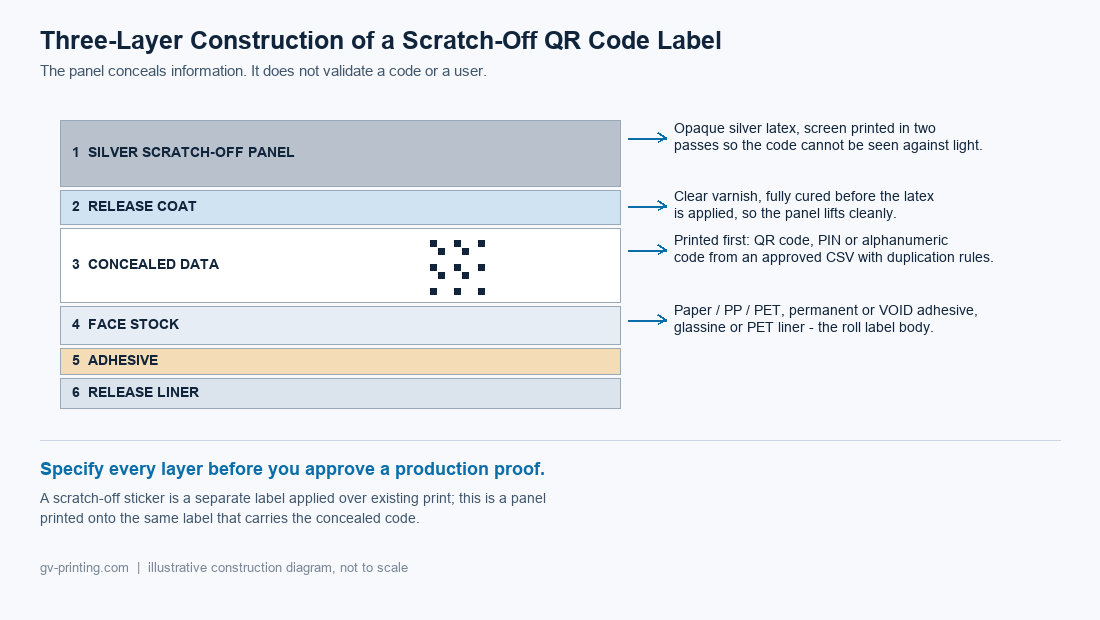
A scratch-off QR code label is a laminate of printed layers, and each has a job. Naming them correctly is half the specification.
The concealed data (the reveal area). This is the information printed first — a unique QR code, a PIN, a serial number or an alphanumeric redemption code. It can be static (the same message on every label) or variable, generated per unit by digital variable data printing (VDP) from an approved CSV. Hidden text should be bold, high contrast and reasonably large; fine type disappears under a metallic panel. Where the code is a QR symbol, a quiet zone and adequate contrast matter more than the decorative artwork around it.
The release coat. A clear varnish, sometimes called a lottery release seal, is printed over the concealed data so the covering layer can be removed without lifting the code underneath. It is invisible in the finished label and it is the most common failure point in cheap scratch work. It must be fully cured before the covering layer goes on. Get it right and the panel lifts in one motion; get it wrong and the panel either flakes off in transit or takes the printed code with it.
The scratch-off panel. Usually an opaque silver or grey latex ink, applied by screen printing in two passes where extra opacity is needed. Its job is to prevent show-through: the code must stay unreadable even when the label is held up to a bright light or a phone torch. Gold, custom-colour, matte and UV scratch-off varnish options exist, and the panel itself can be overprinted with “Scratch here” or a logo — on a metallic silver panel, 100% black gives the most legible result.
Below those three sits the label body: face stock, adhesive and release liner. Together they decide durability, application behaviour and — if the pack ships into the EU — the material declaration. A label is therefore not “a sticker with silver on it”; it is four specification groups that have to be frozen together before production.
Getting the English right: scratch-off latex, not silver foil
This is the single most common wording error on supplier pages, and it causes real quoting mistakes. In English printing usage, foil on its own means hot foil stamping: a metallic foil transferred by heat and pressure to create a permanent decorative accent. It is not removable. The removable, opaque layer on a scratch card is scratch-off latex — also called rub-removable ink, scratch-off ink or scratch-off coating — and the classic metallic version is silver latex or a silver scratch-off coating.
There are two legitimate uses of “foil” in this context, which is why the confusion persists: a pre-made scratch-off foil sticker applied over printed information, and a hot-stamp scratch foil used on higher-end cards. Both are specific products. “Silver foil” by itself is not a synonym for a scratchable layer, and “scratch-off silver foil workshop” reads to an English buyer as a hot-stamping workshop.
Two more distinctions save time on a call:
- Scratch-off sticker vs scratch-off label. A scratch-off sticker is a separate adhesive piece placed over text you have already printed. The product described here is a label that carries the concealed code and the scratch-off panel on the same construction, printed in one production run.
- Scratch off vs scratch-off. The verb is scratch off (“the consumer scratches off the panel”); the adjective takes a hyphen (scratch-off labels, scratch-off panel).
Use roll labels, labels on rolls or pressure-sensitive roll labels for the format. “Roll adhesive sticker”, “reel sticker” and “coil label” are not terms a converter will recognise. If you want the material name rather than the finish, ask for silver scratch-off material or scratch-off latex; that is also the phrase buyers actually type into search.
Static QR, serialized QR, or a hidden code under the panel?
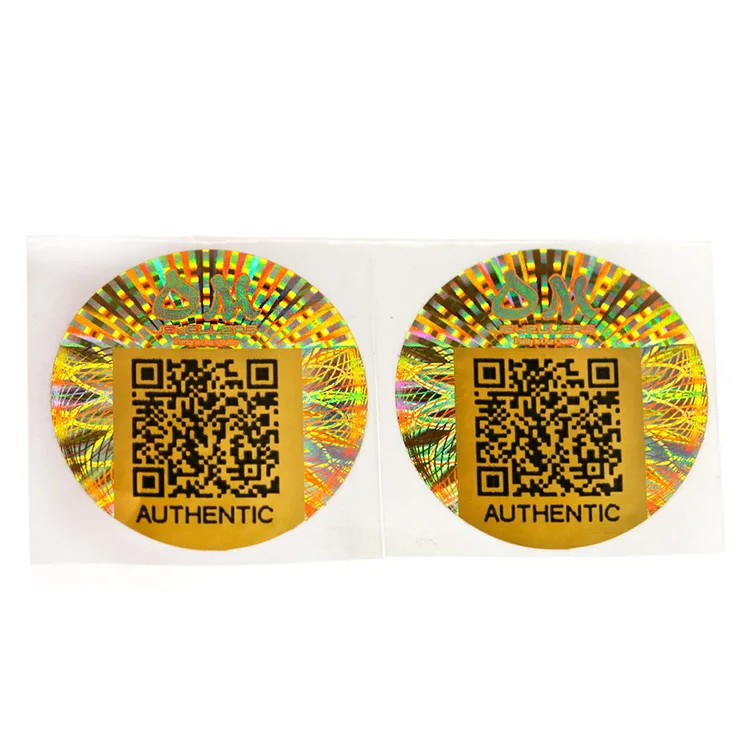
“Put a QR code under the scratch” is not a complete instruction, because there are three different architectures and they solve different problems.
| Architecture | What the buyer sees | What it is good for | What it does not solve |
|---|---|---|---|
| Static QR printed under the panel | One URL on every label, revealed only after scratching | Gating access to a page until purchase; simple fulfilment | Anyone can photograph one revealed code and reuse it; no per-unit data |
| Unique serialized QR under the panel | A different code per unit, concealed until opened | Authentication second factor, redemption tracking, batch and region data | Requires a secure data file, a verification system and controlled printing |
| Visible QR + hidden PIN or code | A scannable QR on the label; a short code under the panel | Consumer engagement plus a one-time secret that must be entered after the scan | Two printed elements and a verification flow that must match them |
The honest limitation: a plain QR code cannot prove a product is authentic. It is a pattern encoding text, usually a URL, and it can be photographed and reprinted. Serialization — one unique code per item — makes copying expensive and detectable over time, because one code scanned repeatedly from different places is a signal. A scratch-off panel adds a physical second factor: copying the visible code does not reveal the hidden value. What it still does not do is validate. Redemption, authentication and access decisions belong to the buyer’s verification platform and database, not to the printed label.
That is why we ask, before artwork, whether the QR is a consumer-engagement carrier or an authentication identifier, and who operates the landing page. Our anti-counterfeit QR code label guide covers the system side; this article covers the construction that has to be printed to support it. For regulated food and pharmaceutical traceability, the data-field conversation continues in the 2D code and serialization guide.
How we produce it: from approved CSV to a wound roll
The order of operations is not flexible, and the reason for each step is a failure mode rather than a preference.
1. Data proof before press. The buyer supplies a structured CSV with field names, code length and duplication rules. We run a data proof — checking for duplicates, illegal characters and sequence breaks — and get written approval before any variable data is imaged. Why: a duplicate QR discovered after 100,000 labels are wound cannot be repaired on the line; it invalidates the verification logic of the whole batch.
2. Base print and concealed data. Fixed artwork (brand, instructions, compliance marks) runs flexographic or digital. The unique QR or PIN is then imaged by digital VDP, typically with 100% inline code verification so an unreadable or duplicated symbol is flagged during the run rather than at goods-in. The variable data printing workflow is the same one used for serialized security labels.
3. Release coat, then cure. A clear varnish is applied only over the reveal area and allowed to cure fully. Why: adhesion between the latex and the base print is the most common cause of a panel that smears the code or refuses to scratch. Uncoated, absorbent stocks are poor candidates here; a coated or film face stock gives a predictable release.
4. Silver latex panel, two passes. The opaque silver scratch-off latex is screen printed over the release coat. Two passes are used where the hidden artwork is dark or the face stock is thin, because a single pass can let the code show through under strong light. Where a brand-coloured or unusually shaped panel is required, a UV scratch-off varnish holds a cleaner edge than latex. Panel overprint (“Scratch here to reveal”) is applied in 100% black for legibility on metallic silver.
5. Finish, die-cut and matrix stripping. A protective varnish or laminate is applied outside the scratch area where rub resistance is needed — never over the panel, or it will not scratch. The web is kiss-cut to the die line and the surrounding matrix is stripped, leaving individual labels on the release liner.
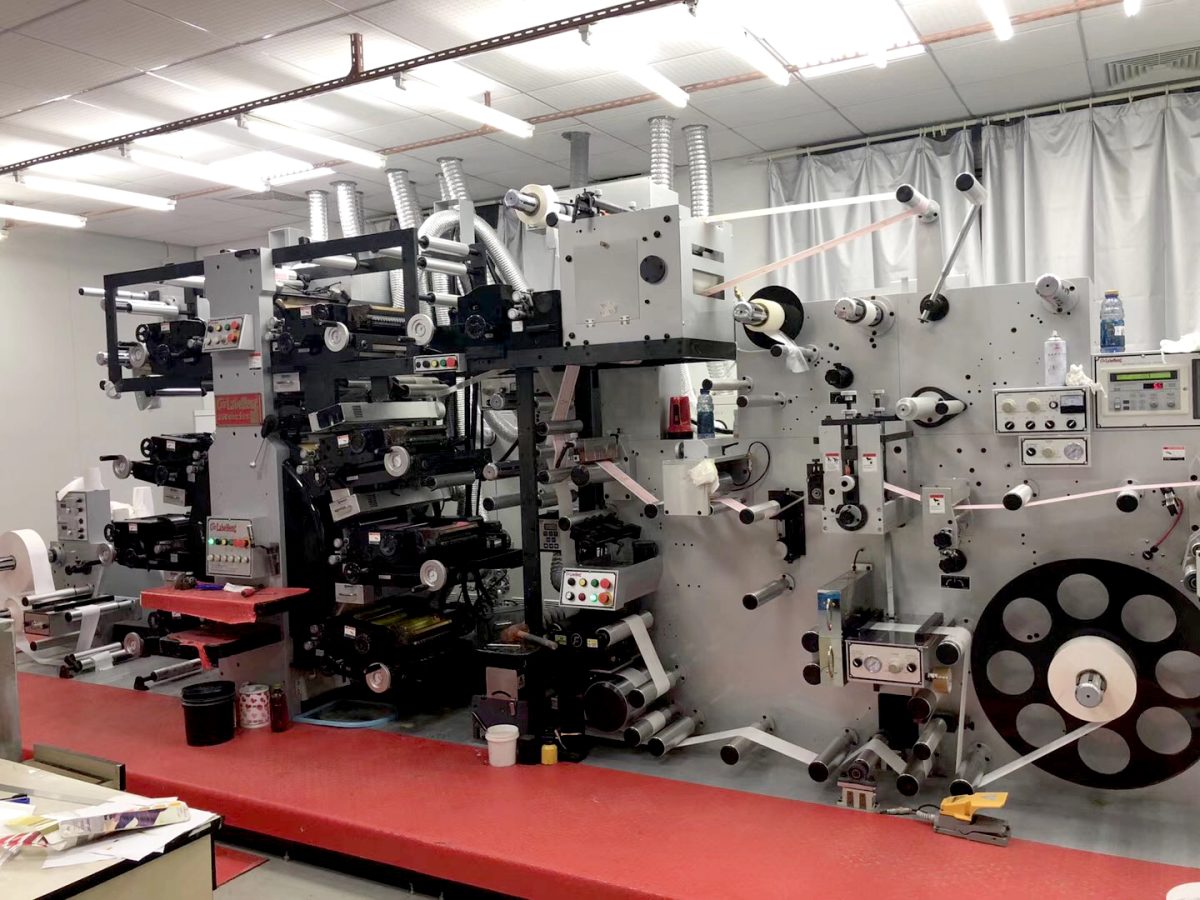
6. Slitting and winding to the job sheet. The web is slit and wound onto the specified core, to the specified outside diameter, with the specified gap, pitch and unwind direction. A photo of a roll that already runs on the buyer’s applicator is the safest reference for wind orientation; numbered wind charts are easy to misread across a language barrier. Before shipment, a scratch-test sample roll is checked for clean reveal, opacity and code legibility, and the approved construction is frozen as a bill of materials. Any later material substitution invalidates that approval.
Six roll specifications your applicator needs
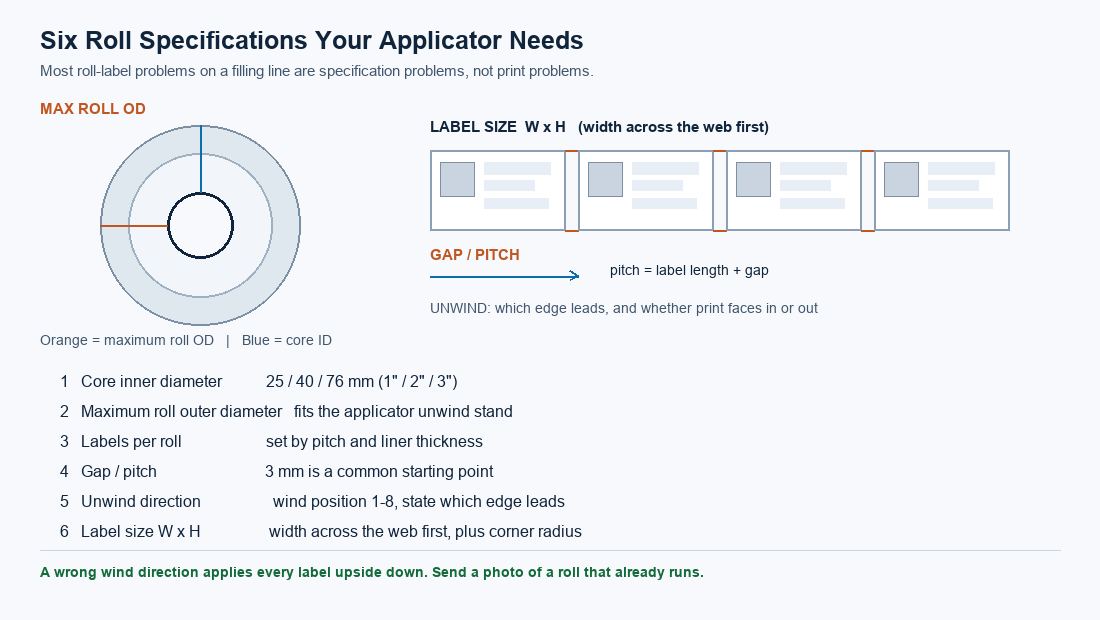
Most problems on a labelling line are specification problems, not print problems. Six fields decide whether a roll runs:
- Core inner diameter (ID). 25, 40 or 76 mm (1″, 2″ or 3″). Desktop printers and hand dispensers commonly take smaller cores; semi-automatic and automatic applicators usually take 76 mm. A roll on the wrong core does not fit the spindle at all.
- Maximum roll outer diameter (OD). Set by the applicator’s unwind stand and the space around it. A larger OD means more labels per roll and fewer changeovers, but only if the material thickness and roll weight are within the machine’s limits.
- Labels per roll. Calculated from the OD, the label pitch and the liner thickness. Decide this from shift length and changeover cost, not from the price list.
- Gap / pitch. The gap is the space between two labels on the liner, read by the machine’s sensor; 3 mm is a common starting point, often with an eye mark. Pitch is label length plus gap. Transparent labels and irregular shapes may need a different sensor setting.
- Unwind direction. The industry describes eight standard wind positions: labels facing out or in, with the top, bottom, left or right edge leaving the roll first. State both — for example “top edge leading, labels facing out” — and quote the wind position number. A wrong wind feeds correctly but applies every label upside down.
- Label size W × H, with width across the web first. Include the corner radius, because sharp corners lift first on curved containers. Keep the die line and the artwork safe zone in the same file.
Two fields are worth adding when they apply: the maximum number of liner splices per roll (some lines accept none), and whether the roll is intended for a thermal-transfer overprint that adds batch or expiry data later. If the code under the panel is printed at our plant and a separate date code is added on the buyer’s line, the two print zones must be planned together.
Spec table: copy these fields into your RFQ
These are the fields that turn “silver scratch QR labels on a roll” into a quotable, testable specification. Values are starting points to confirm at the sample stage, not guaranteed performance.
| Field | Specify | Evidence to request |
|---|---|---|
| Product type | Custom self-adhesive scratch-off code labels, supplied in rolls | Confirms a label, not a scratch card or a loose sticker |
| Concealed data | Unique serialized QR code per label; PIN, serial or alphanumeric optional | Approved CSV, field names, code length, duplication rules |
| Data handling | Data proof before press; 100% inline code verification | Verification report and rejection log |
| Scratch-off panel | Silver scratch-off latex, screen printed in two passes; gold, grey, custom colour or UV varnish optional | Opacity check under strong light; scratch-test sample |
| Release coat | Clear varnish / lottery release seal, fully cured before the latex is applied | Cure record and clean-reveal sample |
| Panel overprint | “Scratch here to reveal” or logo in 100% black on the metallic panel | Printed proof |
| Face stock | Semi-gloss paper, white PP, PET or synthetic film | Mill TDS, basis weight / micron thickness |
| Adhesive | General-purpose permanent, removable or tamper-evident VOID; service window stated | Adhesive TDS; peel / loop-tack / shear on the actual substrate |
| Release liner | Glassine 60 g or PET liner; silicone system | Liner specification and disposal route |
| Label size & die-cut | W × H in mm (width across web first), corner radius, 3 mm gap | Die-line drawing |
| Roll build | Core 25 / 40 / 76 mm; max roll OD; labels per roll; pitch; unwind direction 1–8 | Applicator compatibility confirmation |
| Inspection & change control | 100% code verification; frozen BOM with revision number and re-approval on substitution | Signed specification sheet with revision date |
Download: scratch-off QR roll label spec & sign-off checklist
The one-page Scratch-Off QR Code Roll Label Spec & Sign-Off Checklist turns the table above into a fillable sheet: a section for the three-layer construction, one for variable data and verification responsibility, one for the six roll fields, and a sign-off block for the approved scratch-test sample. Download the checklist (PDF). Use it with the Sunrise 2027 2D barcode artwork guide when the same pack also carries a retail-facing 2D code.
An illustrative scenario (not a customer order)
Composite example for illustration only — not a specific customer order, and no country, date, price or volume figures are implied.
A brand team wants a scratch-and-reveal promotion on an on-pack label applied by an automatic applicator. The first brief asks for “silver foil stickers with one QR code” and gives no roll information. Rewriting it as a specification changes four things. The single static QR becomes a unique serialized code per label, delivered as an approved CSV, because the team wants redemption data by SKU and region. “Silver foil” becomes a silver scratch-off latex panel over a cured release coat, with an opacity check so the code cannot be read against a bright light. The visible QR stays on the label as the consumer-engagement carrier, while the hidden code acts as a one-time second factor. Finally, the roll is defined by core, maximum OD, gap, labels per roll and unwind direction, with a photo of a roll already running on the line. The converter’s first deliverable is not a full run but a data proof and a scratch-test sample roll. That is the shape of the decision — the final specification would be set by sample testing, not by this description.
Common failures in a scratch-off label specification
- Asking for “silver foil” when you mean a removable coating. You may be quoted hot foil stamping, which cannot be scratched off.
- Approving a panel before the release coat is cured. The panel either flakes in transit or lifts the printed code with it.
- One static QR across the whole batch. It can be photographed and reprinted; there is no per-unit verification signal.
- No duplication rule on the data file. A repeated serial breaks the verification logic silently.
- Fine or low-contrast hidden type. It becomes unreadable under a metallic panel, especially after overprinting.
- Guessing the unwind direction. The roll feeds but every label is applied upside down, and the batch has to be rewound.
- Testing an undecorated blank. Opacity, adhesion and scratch behaviour must be checked on the finished decorated label.
- Expecting the label to authenticate. Concealment is a printing function; validation is a system function.
FAQ: silver scratch-off material, QR codes and roll labels
What is the scratch-off material on lottery tickets called?
In the trade it is scratch-off latex (also rub-removable ink or scratch-off coating), most often silver. It sits over a clear release coat so it can be removed with a coin without damaging the printed information beneath. UV scratch-off varnish and water-based coatings are alternatives; hot foil stamping is a different, non-removable process.
Can every label on a roll carry a different QR code?
Yes. Unique or sequential codes are printed by variable data printing from an approved CSV, with a data proof and inline verification. A static code — the same URL on every label — is also possible, but it can be photographed and reprinted and gives no per-unit data.
Is the QR code printed under the scratch panel or beside it?
Both constructions are used. Under the panel, the code is a hidden second factor and only works after the pack is opened. Beside the panel, the visible QR handles engagement while a hidden PIN or code handles verification. Tell your converter which job each code has before artwork is set; the two need different quiet zones and contrast targets.
Does a scratch-off QR label stop counterfeiting?
No single printed feature does. A scratch-off panel conceals information; it does not validate a code or a user. It adds a physical second factor to a serialized-code verification system, which makes copying a visible code less useful. Redemption and authentication decisions must be managed by your own verification platform.
What makes a panel scratch cleanly?
A fully cured release coat, enough panel opacity to prevent show-through, and a scratch-test sample approved before the run. Uncoated stocks and heavy ink coverage directly beneath the panel are common causes of poor release. Overprint instructions in 100% black if the panel is metallic silver.
What roll details do you need for an automatic applicator?
Core inner diameter, maximum roll outer diameter, gap / pitch, labels per roll, and the unwind direction (which edge leaves the roll first and whether the print faces in or out). A photo of a roll that already runs on your line is the safest reference.
Are scratch-off labels the same as scratch-off stickers?
No. A scratch-off sticker is a separate adhesive piece placed over text or a code you have already printed. A scratch-off code label carries the concealed data and the removable panel on the same label, produced in one run and supplied on a roll for machine application.
Related guides
- Custom labels & label printing — constructions we produce
- Hologram security stickers — physical security features that can sit alongside a concealed code
- Scratch-off label manufacturing — the product page for this construction
- Anti-counterfeit QR code labels — how serialized verification systems work
- Sunrise 2027 2D barcodes — size, quiet zone and contrast rules
- Sequential numbered labels — numbering and data-file conventions
- Label sticker printing guide — roll vs sheet and common failure modes
Get a physical sample and a spec review
If you are specifying concealed-code labels for 2027, send the current die-line, the intended code format and the applicator details (core, maximum OD, gap and a photo of a roll that already runs). We will return a construction proposal covering the three layers, the data-handling rules and the six roll fields, then produce a physical sample roll for your own opacity, scratch, peel and applicator tests. No authentication or compliance claim is made on your behalf — you get a testable, traceable label and the material data behind it. Start with the contact form and attach your artwork or a photo of the current roll label.
Not legal advice. Standards, 2D barcode migration plans, packaging-component rules and promotion / prize requirements cited here reflect the position at the time of writing and change as guidance and secondary legislation are published. Verify the current text on EUR-Lex and with your own counsel before placing an order or making an on-pack claim.