
Send Your Inquiry Today
Custom Hologram Stickers: Types, Security Features and Ordering Guide
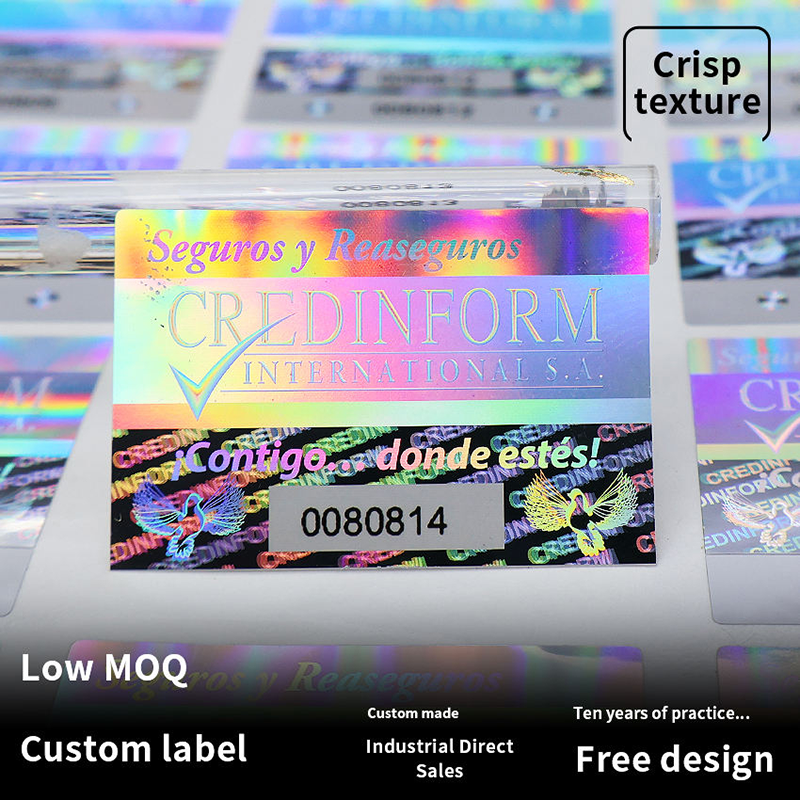
Buyers order custom hologram stickers for two very different reasons: to stop counterfeiters, or to stop shoppers scrolling past. Both are legitimate, but they lead to different stickers — and specifying the wrong one is the most common ordering mistake we see. This guide is the practical ordering reference: the hologram types, the security features you can combine, how pricing works, and what happens between approving artwork and receiving rolls. For the brand-protection strategy layer — risk levels, EU compliance, program design — see our hologram labels and brand protection guide.
For the full specification checklist — origination, artwork layers, material options and MOQ — see our custom hologram sticker specification guide.
The Main Types of Hologram Stickers, Explained Simply
“Hologram” covers a family of optical effects produced by different origination techniques. What you choose changes both the visual impact and how hard the sticker is to copy:
| Type | What you see | Copy difficulty | Typical use |
|---|---|---|---|
| 2D/3D hologram | Layers of artwork at different apparent depths | Medium | Brand seals, promotional packaging |
| Dot-matrix hologram | Animated, kinetic effects; moving patterns under light | Medium-high | Consumer products, event tickets |
| True-color hologram | Reproduces actual photographic color (logos, portraits) | High | Premium brand authentication |
| Kinetic / e-beam hologram | Complex animation, zoom and motion channels | Very high | High-risk categories: pharma, electronics |
| Transparent holographic film | Holographic effect with see-through base | Medium | Overlays on documents, windows, phone screens |
| Holographic pattern release (VOID) | Hologram destroys on removal, leaves residue message | High (evidence of tamper) | Seals on boxes, bottles, cartons |
Practical takeaway: for shelf appeal, dot-matrix and 2D/3D deliver the most motion per dollar. For anti-counterfeiting, true-color and e-beam origination cost more but are dramatically harder to duplicate, because the origination equipment itself is the barrier — a counterfeiter cannot scan and reprint an interference pattern.
Security Features You Can Combine Into One Sticker
A hologram alone is a visual deterrent. A hologram plus layered features is an authentication system. The features that matter on production orders:
Serialised numbering — every sticker carries a unique number, turning each unit into a traceable record and enabling per-unit verification. Microtext and nano-text — text readable only under magnification; cheap for you, expensive for a forger to replicate. UV invisible ink — a hidden mark that only appears under UV light, standard for quick manual authentication by distributors. Hidden images — laser-viewable features embedded in the origination. Tamper-evident VOID release — the holographic layer destructs on removal, so a transferred sticker announces itself. QR verification — pairing the hologram with a QR code that resolves to a verification service, which is where most anti-counterfeit programs are moving; see our QR authentication label guide.
For how these features are physically manufactured — mastering, electroforming, embossing, metallizing, die-cutting — see inside our security label factory.
Hologram Stickers vs. Holographic Labels: Which Do You Order?
The two terms get used interchangeably and they should not be. Hologram stickers are pre-cut security pieces — seals, authentication tags, warranty stickers — ordered on rolls or sheets, applied to the product or box, often with a serial number. Holographic labels are product labels printed on holographic base film — your brand label where the holographic effect is the aesthetic. If your goal is “nobody opens this without it showing,” you want tamper-evident hologram stickers. If your goal is “this bottle needs to look extraordinary on the shelf,” you want holographic label printing — covered in our label printing guide. Many programs combine both: a holographic product label for shelf appeal, plus a serialised hologram seal for authentication.
The Ordering Process: From Artwork to Finished Rolls
1. Artwork and specification. You supply the design (vector preferred); we confirm the hologram type, size, adhesive, and whether serialisation or QR is needed. 2. Origination. The hologram master is created — a one-time cost unique to your design. Request a physical sample of the origination before mass production; this is the step where effect quality is locked. 3. Embossing and converting. The master is replicated onto film rolls, metallized, coated with adhesive, die-cut, and rewound or sheeted. 4. Serialisation (if specified). Variable data is printed per unit, with a data file reconciled to your order quantities. 5. QC and shipment. Samples retained, rolls packed to survive freight, with export documentation. Typical lead time from approved origination sample is two to three weeks depending on quantity and features.
What Custom Hologram Stickers Cost
Pricing has two parts. Origination is a one-time master cost that depends on hologram type — plain 2D/3D is cheapest; true-color and e-beam cost more but make re-orders cheap because the master is reused. Unit price falls steeply with quantity and rises with features: serialisation, VOID release and QR each add per-unit cost, while size and shape (simple die-cut vs. complex contour) move material usage. The practical budgeting rule: order the smallest quantity that covers one season, prove the effect with real customers, then scale — origination cost amortizes to nearly nothing at volume. For a structured breakdown by feature, use our security label quote guide.
Frequently Asked Questions
How are hologram stickers made?
A laser origination master is created from your artwork, electroformed into a shim, embossed onto metalized film, then coated, die-cut and rolled. The full factory walkthrough is in how security labels are made.
Do hologram stickers actually prevent counterfeiting?
They deter opportunists and make professional copying expensive — especially true-color and e-beam types. But a hologram alone is not a system; combined with serialisation and QR verification, authentication moves from “looks right” to “verifiable.” The strategy framework is in our anti-counterfeit labeling guide.
What is the MOQ for custom hologram stickers?
Because origination dominates small orders, hologram stickers typically start around 1,000–5,000 pieces depending on size and type, with meaningful price breaks from 10,000. Exact breakpoints depend on your die and feature set — request a quote with quantities tiered.
Can the hologram include my logo and text?
Yes — custom origination means your logo, text, and even photographic elements become the hologram itself, not a print on top of it. That is exactly what makes it copy-resistant: the effect and the design are inseparable.
Ready to Specify?
Send your artwork (or even a rough idea), product photos and target quantity, and we will recommend the hologram type, security features and die shape for your application — with an origination sample before you commit to the full run. For the broader security label toolbox beyond holograms, start with our custom security labels overview.