
Send Your Inquiry Today
Custom Hologram Stickers: A Buyer’s Specification Guide for Brand Protection
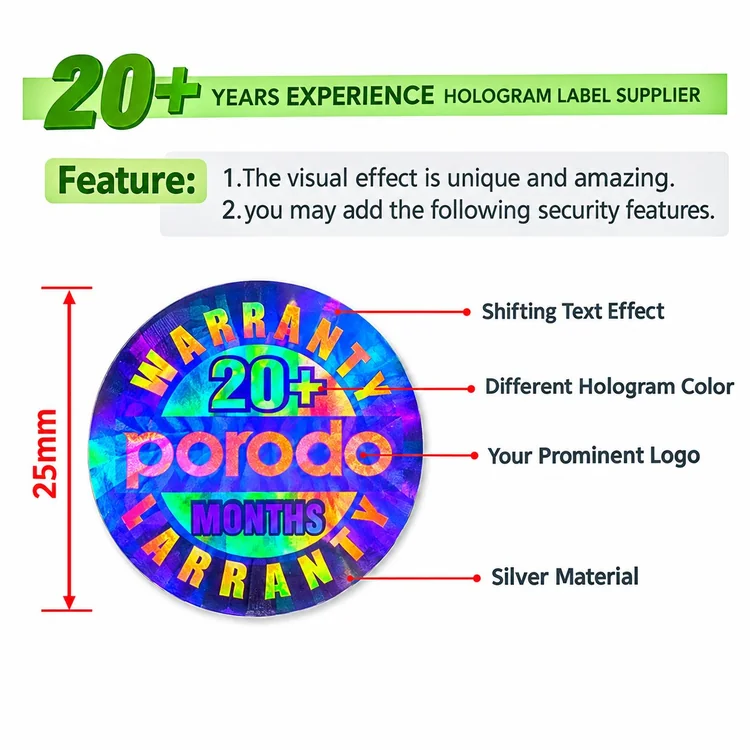
Custom hologram stickers are the cheapest layer of brand protection you can buy — and the easiest to specify badly. This guide covers what actually changed in 2026 (GS1 Sunrise 2027, EU packaging rules that treat your label as in scope), how a security hologram is made, which tamper structure matches which threat, and the four roll fields that stop your applicator jamming. It is written for brand owners, importers and packaging buyers sourcing from a printing factory rather than a broker.
Key takeaway: buy the security level that matches your threat, put the master under written custody, and specify the roll before you specify the artwork.
What Is a Hologram Sticker?
A hologram sticker is a label carrying a surface relief measured in nanometres. That relief diffracts light, so the image shifts, deepens or moves as you tilt it. The pattern cannot be reproduced by a scanner or a normal press: it exists only because a master was originated optically, and then embossed into film under heat and pressure.
That distinction is what “security hologram” actually means. A decorative rainbow sticker and a security hologram may look similar in a photograph, but only one of them has a master behind it that a counterfeiter cannot obtain. If your supplier cannot tell you who holds the master shim, you are buying decoration.
What Changed in 2026: Serialization, GS1 Sunrise 2027 and EU Packaging Rules
Three things moved the ground under brand-protection buying decisions.
Retail is moving to 2D codes. Under the GS1 Sunrise 2027 initiative, retailers are expected to have point-of-sale systems that read 2D barcodes by the end of 2027. GS1 reports the shift is already being tested in 48 countries. In its 2025 consumer survey, GS1 US found 79% of shoppers are more likely to buy a product carrying a scannable code with extra product information, and 62% would pay more for it. The practical consequence: your authentication mark and your retail code are ending up on the same piece of artwork.
The code has a grammar. With GS1 Digital Link, one 2D symbol can serve the checkout scanner (which extracts the GTIN) and a phone camera (which opens a web page) — no proprietary app required. A typical structure is https://id.gs1.org/01/{GTIN}/21/{serial}. If you are printing a QR code today that is not GS1 Digital Link compliant, you will likely reprint it before 2028.
EU packaging rules now treat the label as in scope. The EU Packaging and Packaging Waste Regulation applies from 12 August 2026, and a label is a packaging component — not an accessory to it. Guidance from the European Commission confirms the direction of travel: identification features, producer information, and from 2028 harmonised material pictograms. None of that removes the need for brand protection; it adds a compliance layer that has to be designed into the same label.
Meanwhile the demand side is not slowing. Industry market research puts the anti-counterfeit packaging market at roughly US$232 million in 2025 with a projected 11.8% CAGR to 2032, with holograms the largest single technology segment and pharmaceuticals the largest application. In China, the 2026 anti-counterfeit traceability cases published by the China Anti-Counterfeiting Technology Association covered liquor, cosmetics, gold, auto parts and medical aesthetics — and specifically highlighted liquor seals that combine micro-nano optics, 3D imaging and irreversible opening detection, plus imported wine labels using optically variable ink with a colour-shifting QR code and a void-left-behind structure.
The signal for buyers is consistent: overt optical features and digital identity are no longer alternatives. They are being specified together, on one label.
Which Industries Use Tamper Evident Labels?
Any product where the failure mode is substitution rather than simple copying.
- Wine and spirits: refilled bottles and reused closures. Neck seals and bottle-cap seals that fracture on opening remain the industry default.
- Pharmaceuticals and supplements: regulated serialization plus tamper evidence; inspectors frequently need to authenticate without network access.
- Electronics and industrial parts: warranty fraud and grey-market diversion. A warranty-void seal is read by a service engineer, not a shopper.
- Cosmetics and personal care: one-item-one-code programmes that combine authentication with channel control.
- Certificates, licences and documents: overt authentication that a non-specialist can check in two seconds.
Different failure modes need different constructions. If your risk is refilling, you need an irreversible structure. If it is diversion, you need serialization. If it is a copied box, you need a custom master.
Do Hologram Stickers Actually Prevent Counterfeiting?
They raise the cost and lower the success rate — they do not make copying impossible. What they do extremely well is make a fake obvious to someone holding the product.
Think in three levels, and buy the level that matches your risk:
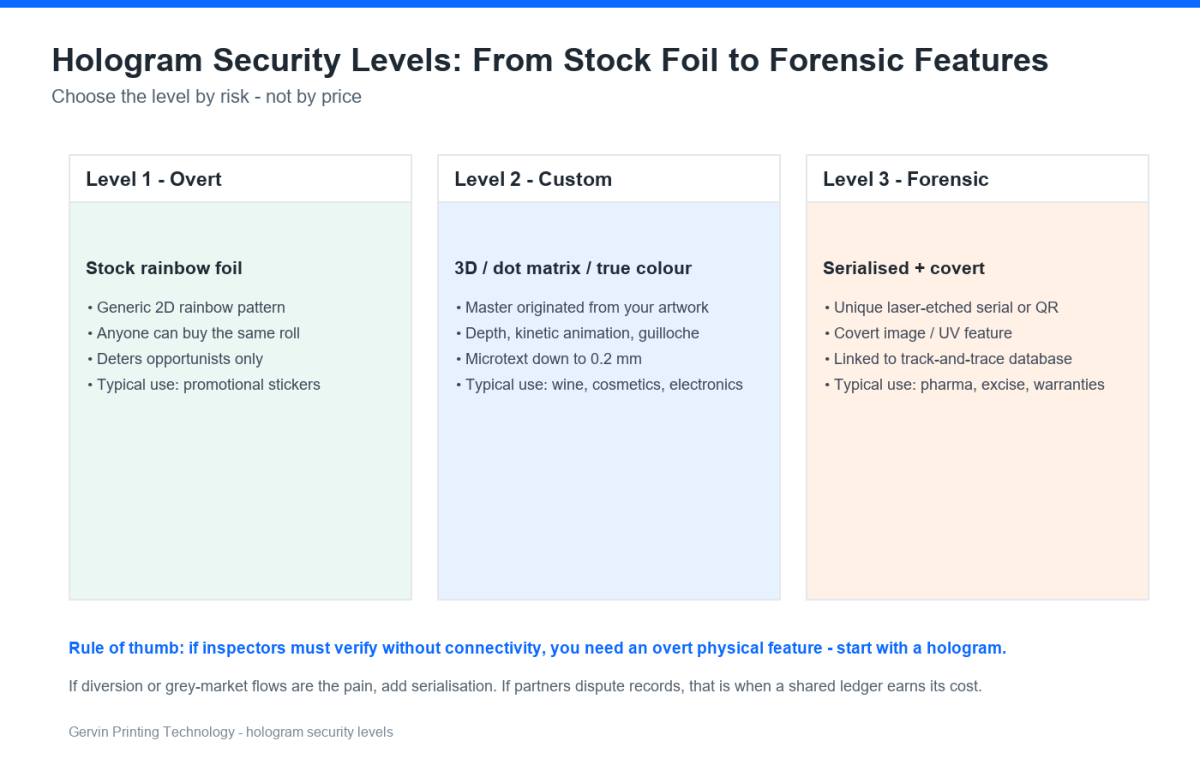
- Level 1 — stock rainbow foil. Anyone can buy the same roll. It deters opportunists and signals “we tried”. Cheap, and worth little.
- Level 2 — custom master. Your artwork is originated into a unique relief with 3D depth, kinetic movement, dot-matrix effects or guilloche linework. Copying it requires origination equipment and your master file.
- Level 3 — forensic and serialised. Microtext below 0.2 mm, covert images visible only at a specific angle, plus a unique serial number or QR code tied to a database. This is your evidence layer when you need to act legally.
A rule of thumb used by brand-protection teams: if inspectors must authenticate without connectivity, you need an overt physical feature. If diversion is the pain, you need serialization. If partners dispute each other’s records, that is the only time a shared ledger earns its keep.
Holographic Labels vs. Security Labels: What’s the Difference?
A holographic label is defined by how it is made — an embossed optical relief. A security label is defined by what it does — authentication, tamper evidence, traceability, or all three.
They overlap, but the useful question is not “is it holographic” — it is “which of the three jobs does it perform, and what happens when someone attacks it?” A plain holographic sticker with permanent adhesive can still be lifted with heat and transferred to a fake. A security construction adds the failure mode: fracturing, void residue, or a serial that stops matching the database.
How Are Hologram Stickers Made? From Master Origination to Finished Roll
Six operations, in order. If a supplier cannot walk you through all six, they are brokering, not making.
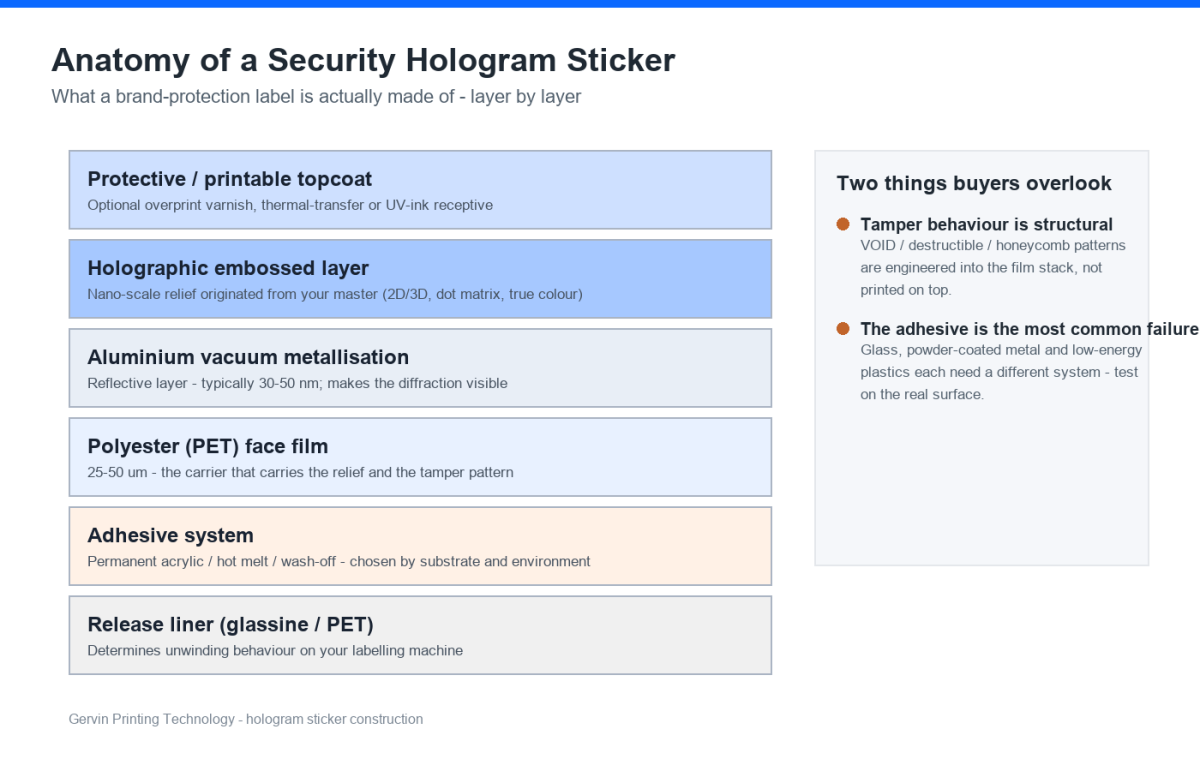
- Artwork and security design. Decide which effects are overt (visible to everyone), covert (visible at an angle or under a loupe) and forensic (lab verification).
- Master origination. The design is written into a photoresist or nickel shim at nanometre scale. This is the asset that must be contractually protected.
- Embossing. The relief is pressed into a PET film under controlled heat and pressure. Speed, temperature and pressure are qualified per film, not copied from a previous job.
- Metallisation. A vacuum-deposited aluminium layer — typically tens of nanometres — makes the diffraction visible. Demetallised patterns are created here, not printed later.
- Converting. Adhesive coating, lamination to the liner, optional topcoat for thermal transfer or UV ink, then die-cutting.
- Variable data. Serial numbers and 2D codes printed or laser-etched per unit, then verified for readability before the roll leaves.
Custom Hologram Stickers: 3D, Dot Matrix and True Colour Masters
Four master families cover nearly every brief we see:
- 2D / 2D-3D: flat rainbow or shallow layered depth. Fastest, cheapest, least exclusive.
- 3D (true depth): genuine parallax — you can look “around” a foreground object. Hard to fake convincingly because a counterfeit is flat and only shifts colour.
- Dot matrix: mathematically generated micro-dots giving sharp kinetic effects. Excellent for small seals and narrow strips.
- True colour: full-colour imagery within the hologram, used when brand artwork must survive intact.
Two specifications matter more than the effect you choose. First, microtext: we routinely place brand text at around 0.2 mm, which needs a loupe or microscope to read and is far beyond the resolution of a desktop scanner. Second, master exclusivity: ask in writing who owns the shim, where it is stored, and whether it is destroyed or returned at the end of the programme. A supplier who will not commit to that is a leak risk regardless of how good the sample looks.
Holographic Tamper Evident Stickers: VOID, Destructible and Honeycomb
Tamper evidence is structural, not printed. Choose by what you want the label to do when someone tries to remove it:
- VOID release: a “VOID” or custom word transfers to the substrate, and the same word appears in the lifted label. Best for cartons, electronics and returns control.
- Destructible / fragile film: the face film fractures into fragments rather than lifting whole. Best for bottle necks and warranty seals.
- Honeycomb or void-left-behind: a residue pattern stays on the pack. Widely used on imported wine and spirits.
- Non-transfer: the optical layer is deliberately destroyed by solvent — a direct answer to the classic attack of washing the backing off a foil and re-using the information layer.
Whichever you choose, test it on the real substrate. A structure that fails cleanly on coated board can behave very differently on a powder-coated metal part or a low-energy plastic.
Hologram Sticker with Serial Number or QR Code: One Item, One Code
This is where most 2026 projects land: the hologram provides offline authentication, and the code provides unit identity.
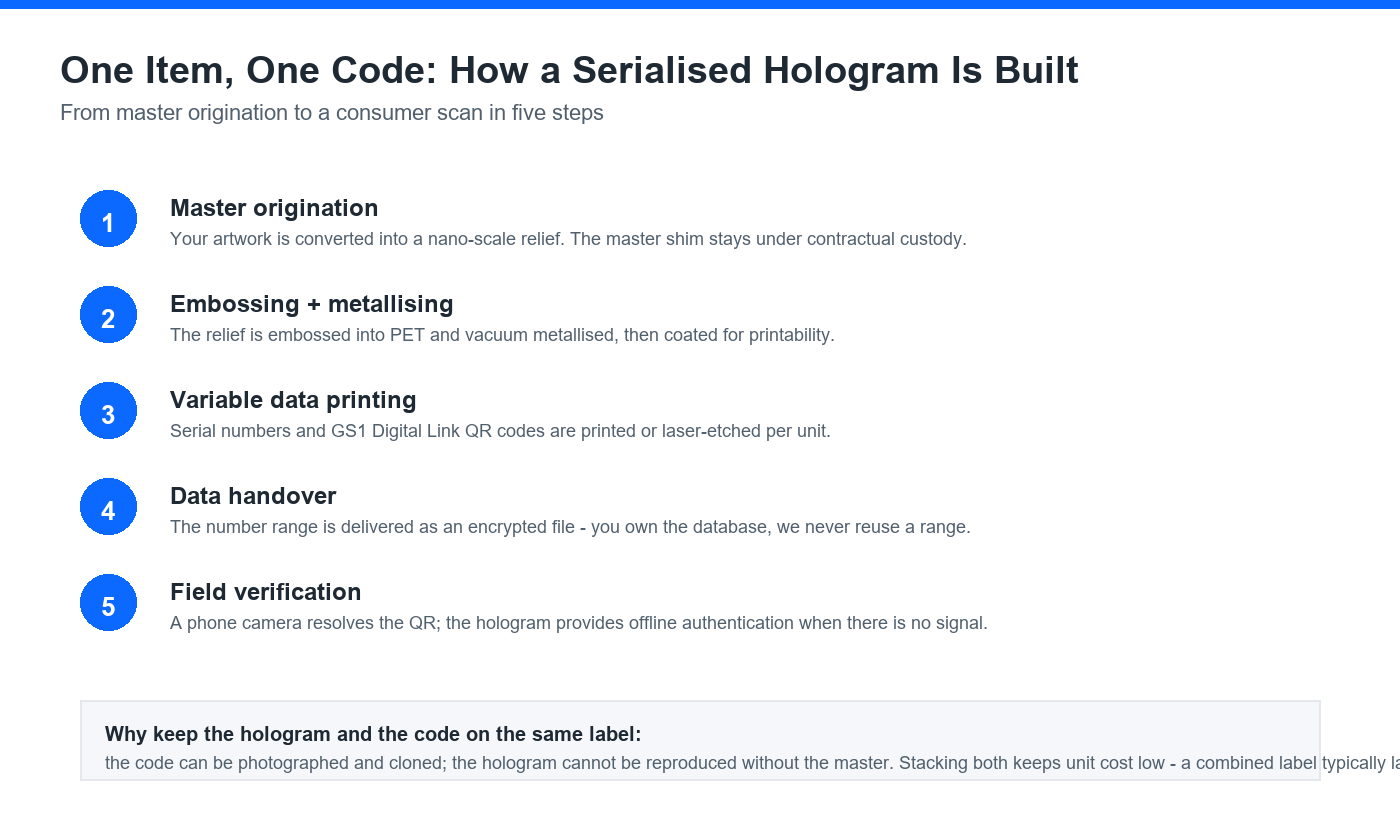
- Numbering format: fixed prefix + sequential range, or randomised. Randomised ranges are harder to guess.
- Code symbology: GS1 Digital Link QR for retail and consumer use; GS1 DataMatrix for healthcare and small footprints.
- Printing method: thermal transfer or UV inkjet for variable data; laser etching when you want the number to survive abrasion and solvents.
- Data ownership: the number range should be delivered to you as an encrypted file. We never reuse a range across customers — insist on that in writing.
- Verification: no app required. A GS1 Digital Link QR resolves in any phone camera, which measurably raises real-world scan rates.
A useful benchmark from the field: a combined hologram-plus-serialised-QR label typically adds only cents per unit at volume — trivial against the margin loss of one counterfeit incident.
Holographic Sticker Roll: How to Specify Rolls Without Jamming Your Applicator
More hologram projects fail on roll specification than on optics. Four fields cause nearly all of the downtime:
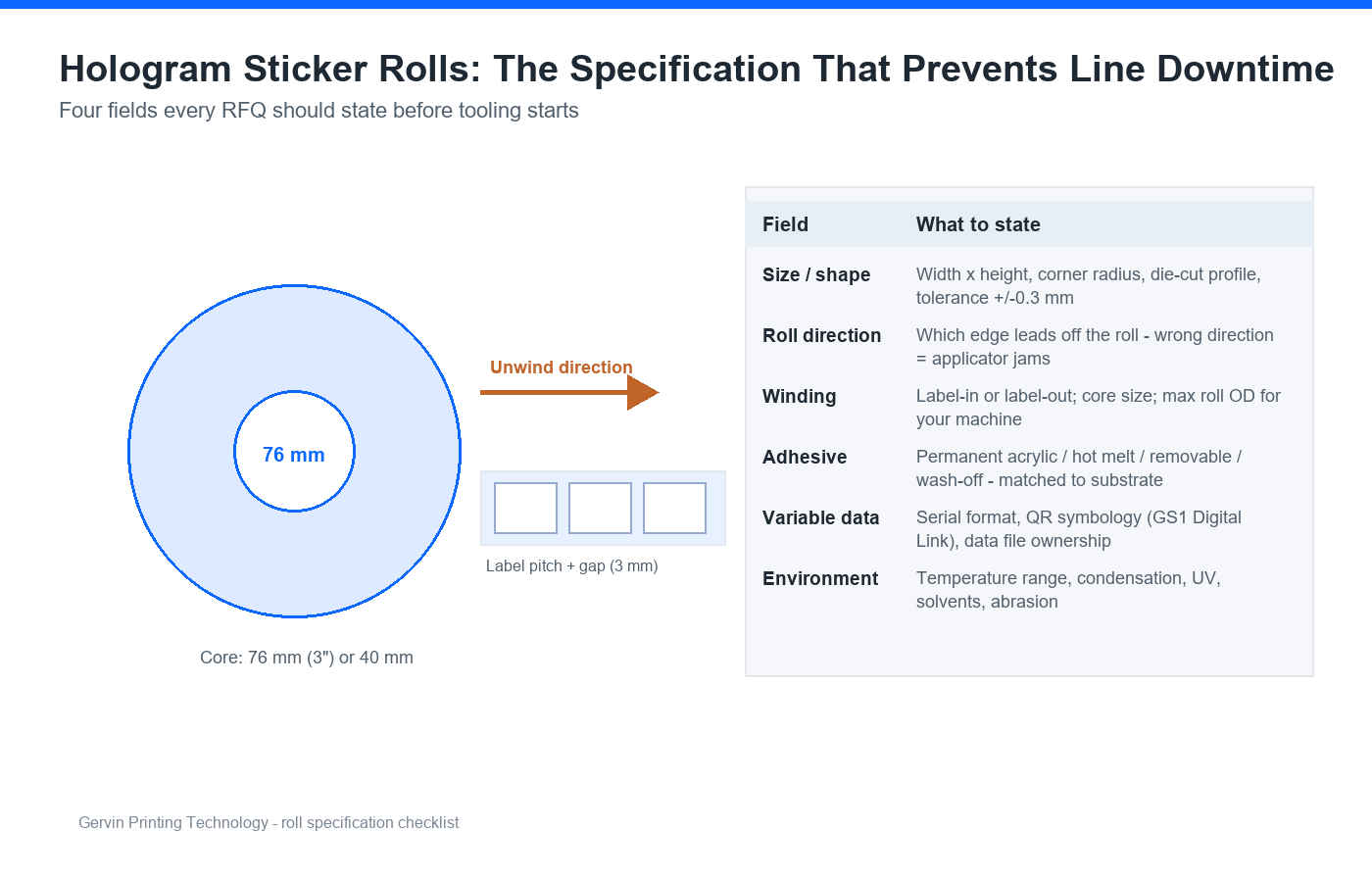
- Unwind direction: which edge leaves the roll first. Wrong direction means the label feeds upside down or not at all.
- Winding: label-in or label-out, plus maximum roll outside diameter for your machine.
- Core: 76 mm (3″) is standard; 40 mm for compact applicators.
- Pitch and gap: the repeat distance between labels, with a typical 3 mm gap and a die-cut tolerance around ±0.3 mm.
If you are applying by hand, sheet format is cheaper and faster to dispatch. If you are running an applicator, send us the machine model — we will match the roll build to it.
How to Tell If a Hologram Sticker Is Original
Four checks, in order of how much equipment they need:
- Movement, not colour. Tilt it. A real 3D hologram shows parallax; a cheap copy just changes hue.
- Edge definition. Under a loupe, guilloche lines are continuous. On fakes they are usually broken or mushy.
- Microtext. Look for text around 0.2 mm. If it is legible without magnification, it is not microtext.
- The code. Scan it. If the serial does not resolve, or resolves to a domain you do not control, treat the unit as suspect.
Train the people who actually handle goods — warehouse staff, service engineers, retail partners — on the first two checks. A sophisticated procedure nobody follows protects less than a simple one applied consistently.
Custom Hologram Stickers Specification Table: What to Put in Your RFQ
| Field | What to state | Why it decides the quote |
|---|---|---|
| Application | Wine neck seal, carton seal, warranty label, certificate | Determines tamper structure |
| Substrate | Glass, coated board, PP/PE, powder-coated metal, curved or textured | Selects the adhesive system |
| Size and shape | Width × height, corner radius, die-cut profile | Tooling and material yield |
| Master type | 2D / 3D / dot matrix / true colour, custom or stock | Origination cost and exclusivity |
| Security features | Microtext, covert image, guilloche, demetallised pattern | Level 2 vs Level 3 |
| Tamper behaviour | VOID / destructible / honeycomb / non-transfer | Film construction |
| Variable data | Serial format, QR or DataMatrix, GS1 Digital Link yes/no | Printing method and data handling |
| Roll or sheet | Core, unwind direction, winding, pitch, max OD | Applicator compatibility |
| Environment | Temperature range, condensation, UV, solvents, abrasion | Ink, topcoat and adhesive choice |
| Quantity | Trial quantity and annual volume | MOQ and unit price |
Ask us for the one-page version of this table when you request samples — it is the same checklist our project engineers use to open a file.
Hologram Sticker MOQ, Cost and Lead Time: What Buyers Should Expect
Custom origination is a one-time tooling cost; the label MOQ is then driven by press economics. Practically:
- Sampling: a structural sample from an existing master can often be produced in days; a new custom master adds origination time before you see anything physical.
- MOQ: custom designs typically start in the low tens of thousands for the most economical run, with higher unit prices below that. Stock-pattern holograms start far lower.
- Cost drivers, in order: master type, security feature count, film construction, variable data, quantity — in that order of impact. Size matters less than buyers expect.
- Lead time: plan backwards from your launch. Changing a laminate later is not a last-minute decision: adhesion has to be revalidated on the real substrate, application trials rerun, artwork reworked.
Common mistakes we see repeatedly: choosing the pattern before defining the threat; specifying a hologram but leaving the adhesive to chance; ordering a full production run without an application trial on the real line; and comparing unit prices that exclude tooling, plates and setup.
FAQ: Hologram Sticker Manufacturer Questions
Can a counterfeiter simply copy my hologram?
A stock rainbow foil, yes. A custom-originated hologram with microtext and tamper evidence requires origination equipment and your master design — a high enough barrier that most counterfeiters imitate the general look, which trained eyes catch quickly. Keep the master shim under contractual custody.
Do I need an app for QR verification?
No, and buyers increasingly avoid proprietary apps. A GS1 Digital Link QR resolves in any camera app.
Can the label survive refrigeration or an ice bucket?
Yes, with the right film, adhesive and topcoat — but only if you tell us the condition up front. Condensation is the most common cause of label failure on chilled bottles.
Will a hologram interfere with recycling or EU labelling compliance?
A label is a packaging component under EU rules, so material data has to be available for your technical file. Coverage area, ink system and adhesive all matter. We supply the material declaration data you need; no converter can issue a compliance certificate on your behalf.
Can you match an existing hologram we already use?
Usually yes, if you can supply a sample and proof of ownership. If you cannot prove ownership, we will originate a new master instead.
Get Free Samples and a Master Origination Review
We have been printing for over 20 years and developing holographic and anti-counterfeit labels for more than 15 of them. Send us the product category, the substrate you are sticking to, the markets where fakes are surfacing, and your annual volume. We will come back with a layered recommendation — overt, covert and serialised — and physical samples you can put in front of your own inspection team.
Every number range we produce is delivered encrypted and never reused. Master shims are held under custody terms you set.
Request free samples and the hologram specification checklist
Related reading
- Hologram stickers — product range and capabilities
- Security labels with 3D effects: a manufacturer’s guide
- Anti-counterfeit QR code labels: how one-item-one-code works
- Tamper-evident seals: VOID, destructible and void-left-behind
- Hot foil stamping on hologram roll labels
- How to request a security label quote