
Send Your Inquiry Today
Corrugated Board Grades: ECT, Flute & GSM Explained
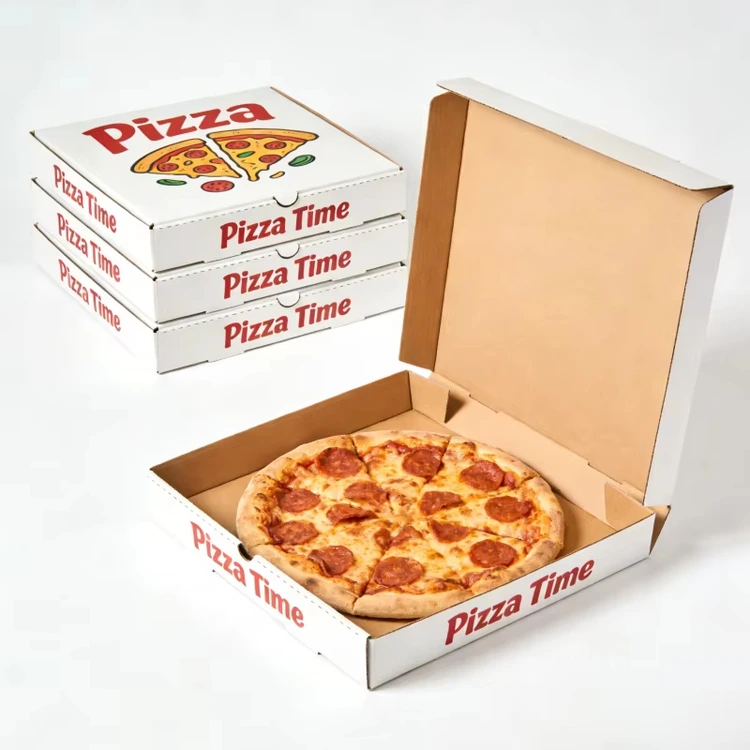
A quote that only says “cardboard box” tells you almost nothing. The board grade – the flute, the Edge Crush Test (ECT) or burst strength, the grammage (GSM), the liner and the coating – is what decides whether your product survives three freight legs, how sharp the print looks on a retail shelf, and whether the box lands in the low-fee recyclable tier under the EU’s PPWR or US state EPR laws. This guide decodes the spec line so you can write an RFQ a converter can actually engineer to.
On this page
- Why the board grade on your quote decides everything
- What changed: PPWR 2030 and US EPR eco-modulation
- Who this hits
- Decode the quote: board type, flute, ECT, GSM, liner
- How we specify and produce it
- Illustrative scenario
- Board grade selection table
- Downloadable RFQ checklist
- Frequently asked questions
Why the board grade on your quote decides everything
Buyers usually compare boxes by price per unit. But two quotes at the same price can be built on completely different board. One might be a 32 ECT E-flute mailer; the other a thinner, lower-grade stock that buckles in the parcel network. The grade is not decoration – it is the structural specification, and it is the difference between a box that protects and one that generates damage claims.
What changed: PPWR 2030 and US EPR eco-modulation
Two regulatory shifts in 2025-2027 turn the board grade from a cost line into a compliance variable:
- EU – PPWR. Regulation (EU) 2025/40, applicable from 12 August 2025, phases in recyclability and recycled-content rules through to 2030 and sets recyclability performance criteria that a plastic-laminated or foam-insert box can fail. See the PPWR text on EUR-Lex.
- US – packaging EPR. Seven states have enacted packaging EPR laws (California SB 54, Oregon SB 582, Colorado HB 22-1355, and Minnesota, Maryland, Washington and Maine). Their fees are eco-modulated: recyclable mono-material board like corrugated sits in the lowest-fee tier, while multi-material or foam-filled boxes are charged at a premium.
- US – green claims. The FTC Green Guides require any “recyclable” claim to be substantiated for the actual material and market. A box that looks green but carries a plastic window or EVA insert may not qualify.
The practical result: the same board decisions that protect your product now also decide your compliance cost. Read our PPWR recyclability grades explainer and the US EPR buyer’s guide for the regulatory detail.
This article is general guidance, not legal advice. Regulation (EU) 2025/40 and the US state EPR programmes change with implementing acts; confirm current text with EUR-Lex, the FTC and the relevant state agency before specifying.
Who this hits
- DTC and e-commerce brands shipping direct to consumers – transit survival is the number-one driver of the grade.
- Food, wine and cosmetics brands where shelf appearance and food-contact rules both apply.
- Electronics and fragile-goods shippers where cushioning and compression both matter.
- Cross-border importers splitting volume across EU and US channels – one spec must satisfy both rulebooks.
Decode the quote: board type, flute, ECT, GSM, liner
A real box quote should name five things. If it names fewer, you are comparing guesses.
Board type. Folding carton (250-400 gsm white card or kraft), rigid box (1,000-1,500 gsm greyboard with a wrapped print), and corrugated (liner + flute + liner) are different ladders. “Paper box” covers all three and tells you nothing.
Flute. The wavy medium between the liners. F and E are thin and flat (mailers, print inserts); B and C are the shipping workhorses; BC is double wall for heavy freight. See the chart below.
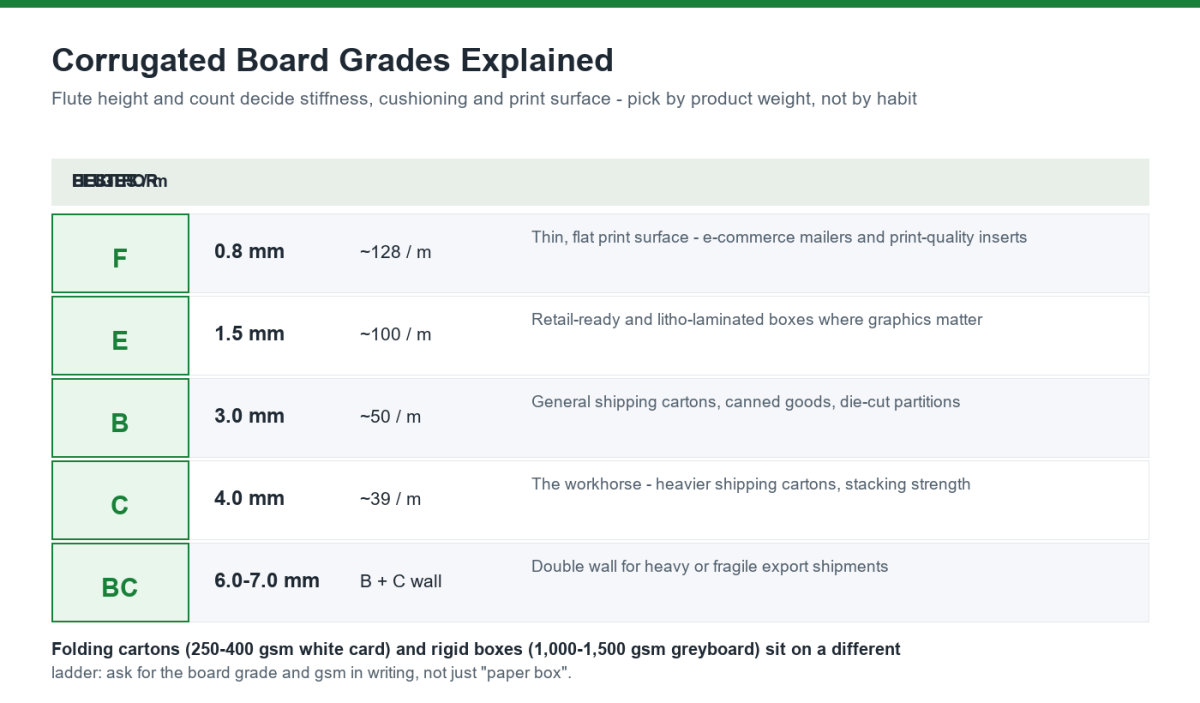
ECT vs Mullen. Edge Crush Test (ECT) measures stacking compression – how much weight a box column bears in the warehouse. Mullen (burst) measures puncture resistance. US e-commerce quoting has standardised on ECT; Mullen still appears on heavy or export stock. Both are valid, but ask which one is on the quote.
GSM. Grammage – grams per square metre of the liner or board. Higher GSM means stiffer board. Always ask for the number and a tolerance, not a vague “heavy card”.
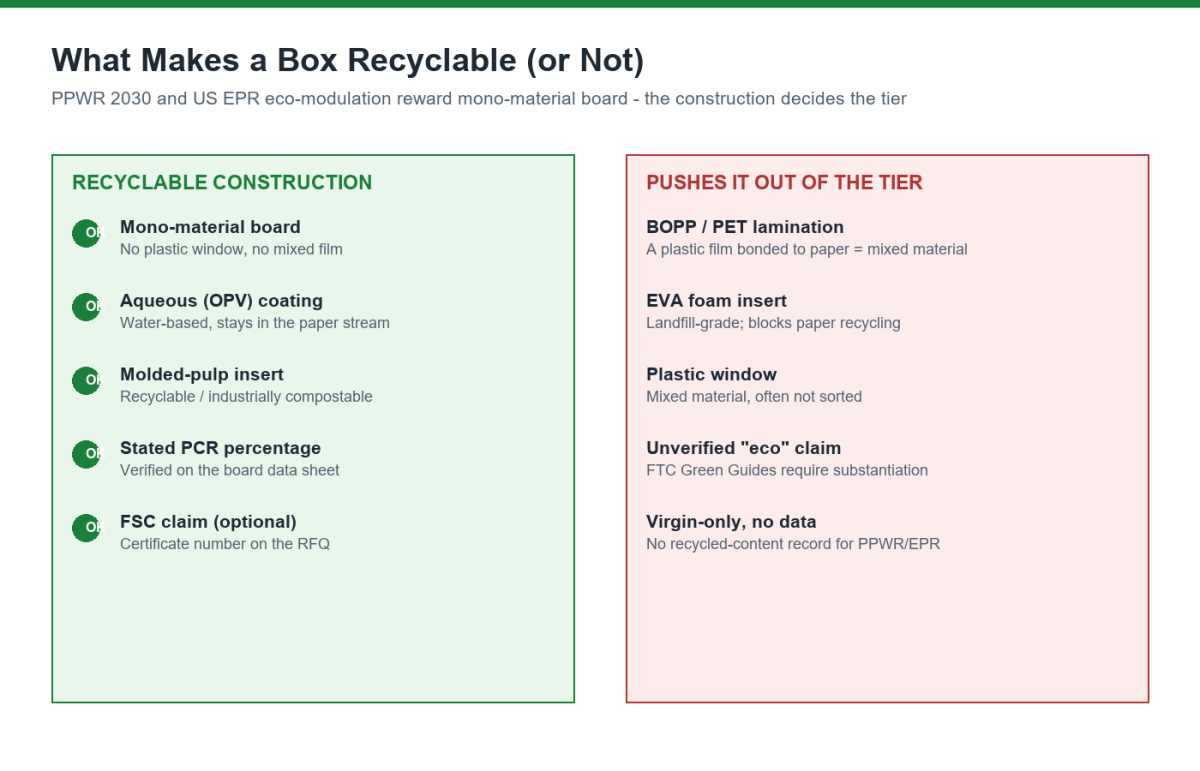
Liner and coating. Kraft versus white-top liner changes print contrast; recycled content changes the eco story. The coating is the recyclability switch: a BOPP or PET lamination bonds a plastic film to the paper and can push the box out of the recyclable stream, while an aqueous (OPV) coating stays in the paper stream.
How we specify and produce it
Our line specifies by board construction, not by the word “box”. For a typical mailer we default to E-flute at 32 ECT with a 125-175 gsm liner; for retail shelf boxes we move to B or C flute and litho-lamination only where graphics demand it. Recyclability is designed in: we default to aqueous coating over plastic lamination, and we offer molded-pulp inserts instead of EVA foam. Recycled content is verified, not assumed – we state the post-consumer percentage on the board data sheet. On fibre claims, we can supply board carrying an FSC claim from a certified mill and print the FSC logo only when the converter’s own Chain-of-Custody certificate covers it; always ask for the certificate number. Before mass production we validate stack and drop performance against the stated ECT, because a box that passes on paper but fails in the warehouse is the expensive kind of mistake.
For the document side of fibre claims, pair this with our EUDR paper packaging checklist and the broader custom packaging buyer’s guide.
Illustrative scenario
The following is a composite example, not a specific customer order. A DTC skincare brand was shipping in a rigid box with a BOPP-laminated wrap and an EVA foam insert. The box looked premium but fell outside PPWR recyclability and sat in a higher US EPR fee tier. We re-specified it as an FSC Mix folding carton (350 gsm) with an aqueous coating and a molded-pulp insert. Same product, same shelf feel – now mono-material and recyclable – and the board data sheet documented the recycled content for both PPWR and EPR reporting. No claim was made that could not be substantiated.
Board grade selection table
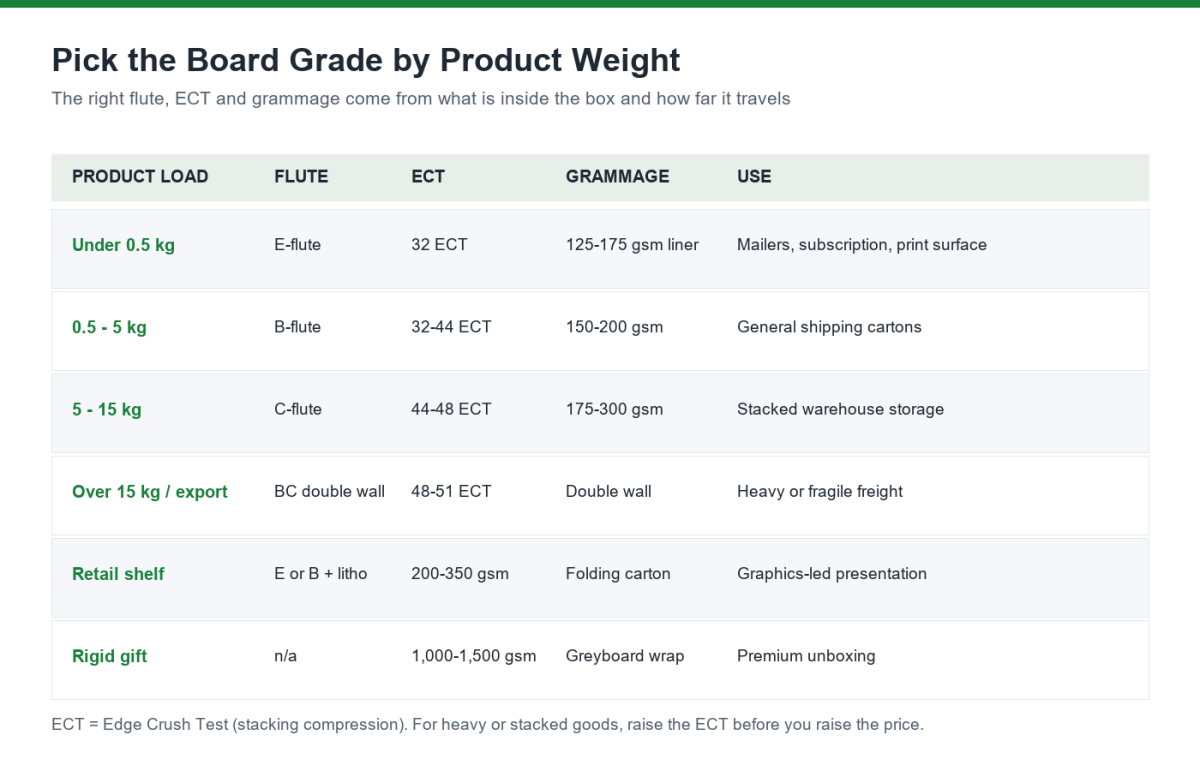
| Product load | Flute | ECT | Grammage | Use |
|---|---|---|---|---|
| Under 0.5 kg | E-flute | 32 ECT | 125-175 gsm liner | Mailers, subscription, print surface |
| 0.5 – 5 kg | B-flute | 32-44 ECT | 150-200 gsm | General shipping cartons |
| 5 – 15 kg | C-flute | 44-48 ECT | 175-300 gsm | Stacked warehouse storage |
| Over 15 kg / export | BC double wall | 48-51 ECT | Double wall | Heavy or fragile freight |
| Retail shelf | E or B + litho | 200-350 gsm | Folding carton | Graphics-led presentation |
| Rigid gift | n/a | 1,000-1,500 gsm | Greyboard wrap | Premium unboxing |
Downloadable RFQ checklist
We packaged the decode into a one-page RFQ checklist: board type, ECT or Mullen, flute, GSM and tolerance, liner and recycled percentage, coating (aqueous vs lamination), insert material, certs (FSC claim plus certificate number), and a stated transit test (ECT rating or ISTA 3A). Hand it to any supplier and the vague “cardboard” quotes stop. Pair it with our folding carton sample approval checklist before mass production.
Frequently asked questions
What is the difference between ECT and Mullen burst strength? ECT measures edge stacking compression – how much weight a column of boxes bears in storage. Mullen (burst) measures puncture and rupture resistance. US e-commerce quoting has standardised on ECT; ask which one is quoted so you compare like for like.
What GSM board should I use for my box? It depends on the load. Folding cartons run 250-400 gsm, corrugated liners 125-300 gsm, and rigid greyboard 1,000-1,500 gsm. Ask for the actual grammage and a tolerance in writing rather than a vague “heavy card”.
Are corrugated boxes recyclable? Yes – when they are mono-material, with no plastic lamination, window or foam insert. Those additions can move a box out of the kerbside paper stream and into a non-recyclable tier under PPWR and US EPR rules.
Which flute is best for shipping boxes? B or C flute covers most shipping cartons; E-flute suits lightweight mailers and print-led boxes; BC double wall is for heavy or export freight. Choose by product weight and cushioning need, not by habit.
Is FSC-certified packaging recyclable? FSC is a fibre-sourcing claim, not a recyclability claim. An FSC-certified box is recyclable only if its construction is mono-material – lamination or an EVA insert can still disqualify it.
Does box coating affect recyclability? Yes. A BOPP or PET lamination bonds plastic to paper and can make a box non-recyclable; an aqueous (OPV) coating keeps it in the paper stream. The coating is the single biggest construction lever for recyclability.
Want a deeper category view? Browse our custom packaging box range or talk to our team about your specific product weight and destination markets.
Request a physical sample set. Want to feel the grade difference on real stock? Ask for a matched set – an E-flute mailer, a B-flute shipper, and a laminated-versus-aqueous comparison – so your team can specify with confidence. Tell us your product weight and destination markets and we will send a matched set from our contact page.
Disclaimer: this article is general guidance, not legal advice. Regulatory references (Regulation (EU) 2025/40, US state EPR programmes, FTC Green Guides) are summarised for context; dates and scopes can change with implementing acts. Confirm current text with the official sources – EUR-Lex, the FTC and the relevant state agency – before specifying or procuring.