
Send Your Inquiry Today
Custom Cosmetic Boxes: The Complete Factory Buyer’s Guide
You searched for custom cosmetic boxes, asked for quotes, and got two answers that don’t match: a reseller promising “no MOQ” at prices that quietly assume 5,000 units, or a factory replying with a minimum of 20,000. Both are telling you something true about their production lines — and neither is telling you the whole math.
This guide is written from the factory floor. We print cosmetic cartons and corrugated mailers for beauty brands in North America and Europe, and in the next sections we’ll show you the actual MOQ floors by printing process, what a folding carton costs per unit at 250, 1,000 and 5,000 pieces, how sampling works, which QC checks stop a bad run before it ships, and what the landed cost from China really looks like.
How to use this guide: this is production and sourcing advice from a manufacturer, not legal or regulatory advice. The pricing and MOQ figures below come from our own 2026 production quotes for cosmetic cartons and corrugated mailers — where a number is our shop-floor experience rather than a market range, we say so. Your artwork, board and finish will still move the final price, and compliance questions should be checked against the official sources linked below.
In this guide
- What are custom cosmetic boxes? Folding carton vs rigid vs corrugated mailer
- Custom cosmetic boxes MOQ: why factories quote 1,000 and how to order fewer
- What your cosmetic boxes cost: per-unit math at 250 / 1,000 / 5,000
- How a China cosmetic box manufacturer quotes your RFQ
- How we produce custom cosmetic boxes: board, ink and finish decisions
- Sampling a cosmetic box: dieline, digital proof, physical sample
- Lead time and freight: what landed cost from China looks like
- First-article QC: the checks before your run continues
- 2026 rules touching cosmetic packaging: EPR and recyclability
- From our production floor: how a real order plays out
- Your copy-paste RFQ spec sheet
- FAQs from beauty buyers
What Are Custom Cosmetic Boxes? Folding Carton vs Rigid vs Corrugated Mailer
“Cosmetic box” covers three different constructions, and buyers who confuse them get quotes that don’t match their intent. Before you compare prices, decide which layer of the product you are buying:
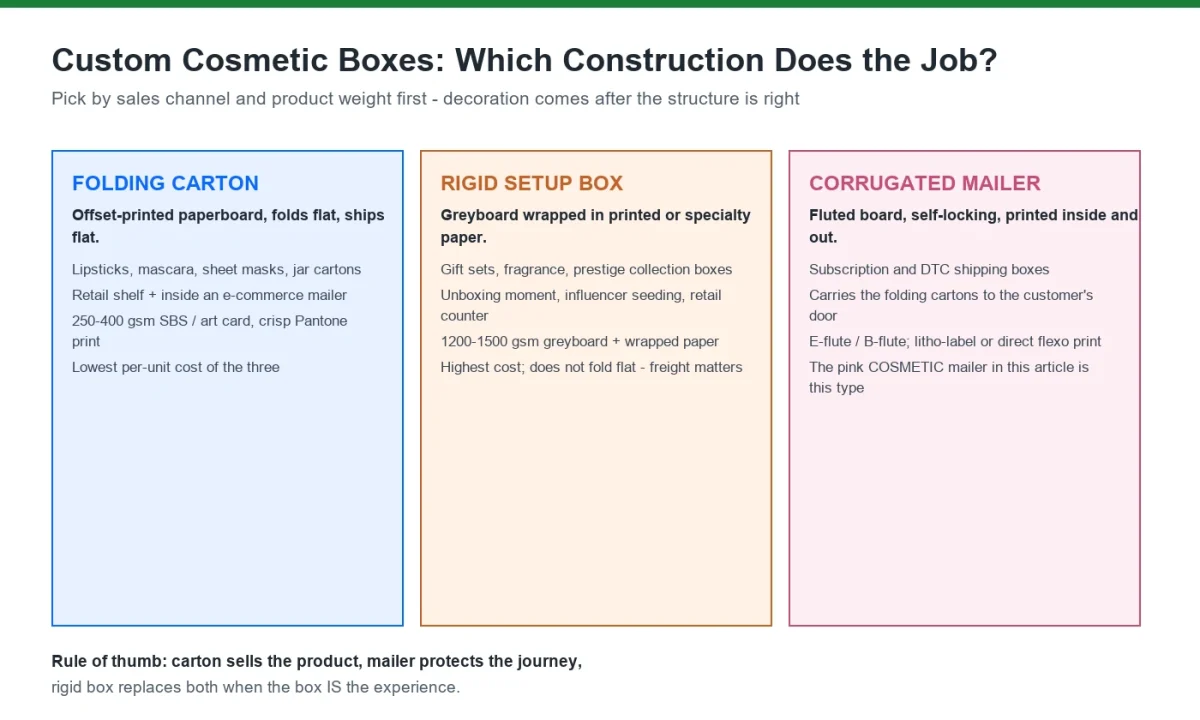
- Folding carton is the printed paperboard box on the retail shelf — the lipstick sleeve, the serum carton, the mascara box. It prints beautifully on offset presses (250–400 gsm SBS or art card), folds flat for shipping, and has the lowest per-unit cost of the three. If your product ships inside an e-commerce mailer, this is usually the box that does the brand work.
- Rigid setup box is greyboard wrapped in printed or specialty paper — gift sets, fragrance coffrets, prestige collections. It doesn’t fold flat, it costs the most per unit, and its freight volume matters: a rigid box ships at roughly three to five times the stacked volume of the equivalent folding carton. If you need this construction, our FSC and EUDR box guide covers the board and fibre questions specific to it.
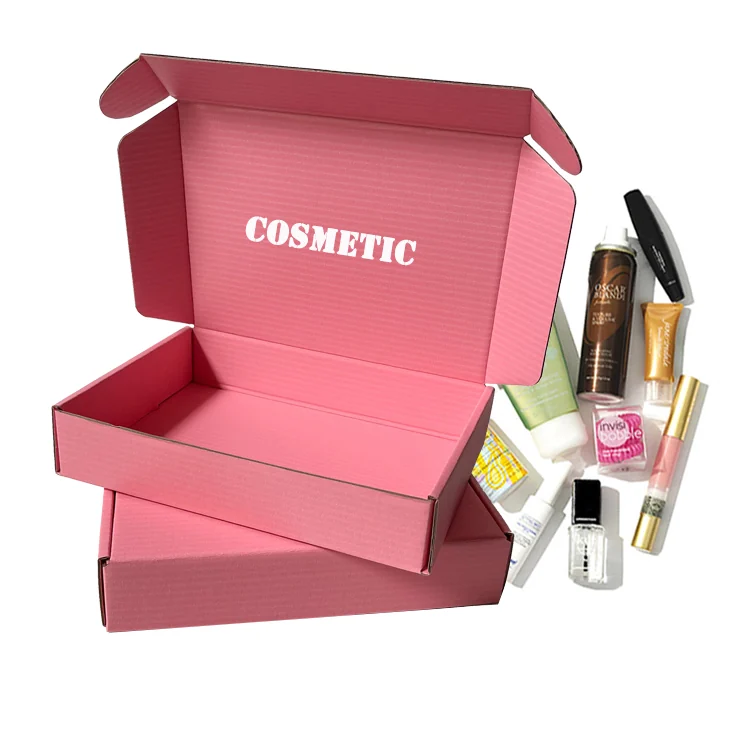
- Corrugated mailer is the fluted, self-locking shipping box — increasingly the outer layer that carries your folding cartons to the customer’s door, printed inside and out for the unboxing video. The pink “COSMETIC” box in this article is a mailer: E-flute board, direct print, no tape needed.
Most beauty brands eventually need at least two of the three. The common mistake is buying the outer layer for looks and the inner layer for cost — then discovering that a folding carton with no insert turns a glass bottle into a rattle, or that a premium rigid box arrives crushed because it was specced too light for the courier network it travels through. Corrugated boxes by industry shows how those transit requirements shift by product category.
Custom Cosmetic Boxes MOQ: Why Factories Quote 1,000 and How to Order Fewer
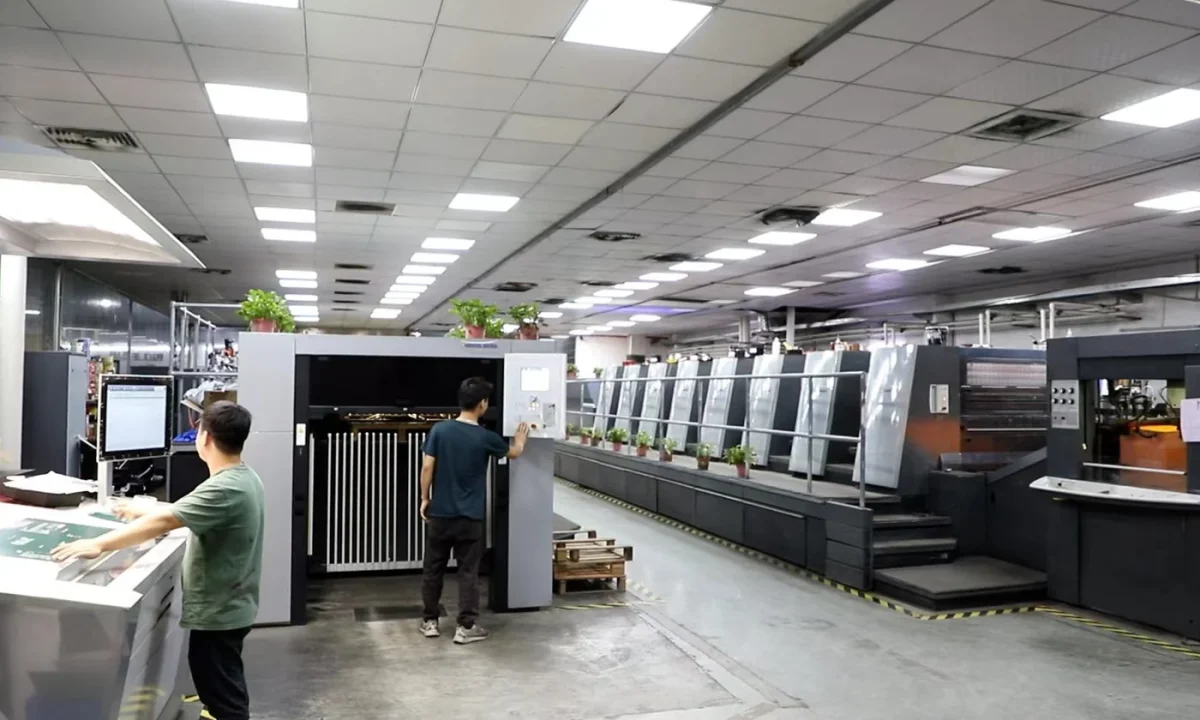
The minimum order quantity you are quoted is not a policy — it is an economics statement. A conventional offset press takes 30–60 minutes to set up (plates, colour registration, make-ready sheets), and that setup cost is nearly identical whether the run is 500 units or 50,000. Below roughly 1,000 units, the setup dominates the per-unit price, so offset-focused factories quote minimums of 1,000–5,000 to protect their break-even. They are not being greedy; they are the wrong factory for a small run.
Three realistic ways to order fewer custom cosmetic boxes:
- Ask for the digital line. Factories that run digital presses (HP Indigo-class or similar) have no plate cost, so they quote 250–500 units at sane per-unit prices. Ask the question directly: “Do you have a digital line for orders under 1,000 units?” If the salesperson can’t answer in one sentence, they don’t have one.
- One finish, not four. A clean design with a single premium finish (soft-touch or foil or spot UV) reads more intentional than four stacked effects — and each finish adds its own setup step, its own MOQ pressure, and its own failure risk.
- Below 250 units, change the strategy. A blank kraft or stock carton plus a custom printed sticker usually beats any printed carton on total cost, with no tooling and no MOQ floor. It fails on premium shelves — but for test batches, influencer seeding, or a first DTC drop, it works.
One honest caveat from our side: a factory offering digital small runs is a different production line, not a discount version of the offset line. Digital unit prices at 250 pieces sit above offset unit prices at 5,000 — you are paying for the right to order small, which is exactly what you want before you have demand data.
What Your Cosmetic Boxes Cost: Per-Unit Math at 250 / 1,000 / 5,000
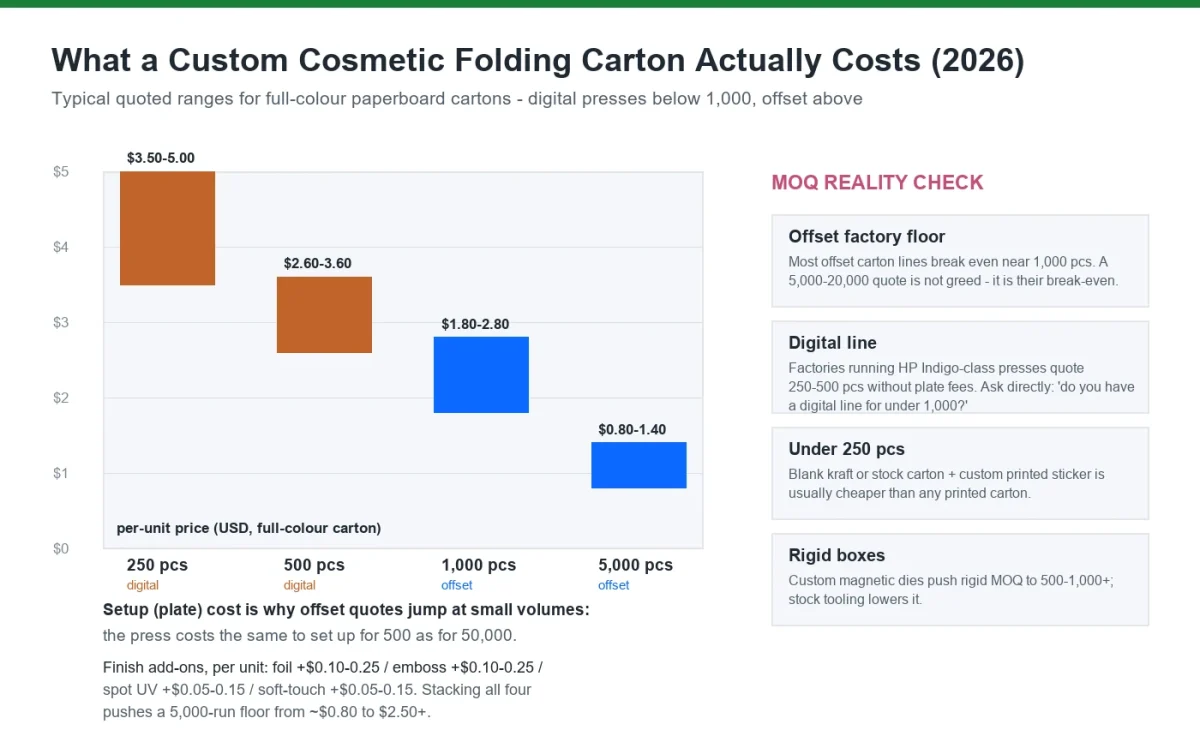
For a full-colour folding carton on 350 gsm SBS, the ranges below are from our own 2026 production quotes:
| Quantity | Process | Typical per-unit (USD) | What you’re paying for |
|---|---|---|---|
| 250 | Digital | $3.50–$5.00 | Setup-free flexibility; the price of ordering small |
| 500 | Digital | $2.60–$3.60 | Same, with material volume starting to help |
| 1,000 | Offset | $1.80–$2.80 | Plates amortised over a real run |
| 5,000 | Offset | $0.80–$1.40 | Paper and ink only, roughly $0.20–$0.40 marginal |
The drop between 250 and 5,000 is steep — in our own price breaks it is commonly 60–75% per unit — because tooling and setup are fixed and everything else is marginal. Finishes then stack on top, per unit:
- Hot foil stamping: +$0.10–$0.25
- Embossing/debossing: +$0.10–$0.25
- Spot UV: +$0.05–$0.15
- Soft-touch lamination: +$0.05–$0.15
Stack all four on a small run and the per-unit floor rises from around $0.80 to $2.50+ even at 5,000 pieces. This is why we tell beauty brands to pick one signature finish for the first run and add the rest on the reorder — by then you know the SKU moves, and the finish cost has something to stand on.
How a China Cosmetic Box Manufacturer Quotes Your RFQ
Searches for cosmetic packaging manufacturers in China return hundreds of lookalike factory pages, and the quotes they send vary by 2–3x for seemingly identical boxes. The difference is almost always in what the quote assumes. When you send a specification instead of a photo, you make every quote comparable — and you filter out the trading companies who have to go ask a factory before answering you.
A quote-able RFQ contains eight fields:
| Field | Example | Why the factory needs it |
|---|---|---|
| Product dimensions + weight | 35 × 35 × 120 mm, 180 g (serum bottle) | Board weight and insert design depend on it |
| Box construction | Reverse tuck end folding carton / E-flute mailer | Determines die tooling and glue labour |
| Board + gsm | 350 gsm SBS, or “recommend for this weight” | Price moves with board grade more than anything else |
| 4C outside + 1C inside, 2 Pantone matches | Pantone match adds ink-cost and colour-control steps | |
| Finish | Matte lamination + spot UV on logo | Each finish is a separate production pass |
| Insert | Molded pulp tray / EVA foam / none | Inserts are often 20–40% of the box cost |
| Quantity (2–3 breaks) | 1,000 / 3,000 / 5,000 | Factories price the breaks; one number gets one price |
| Destination + terms | Los Angeles, DDP or FOB Shanghai | Freight mode changes the total, not just the box |
Send those eight fields to three manufacturers and you will get quotes you can actually line up in a spreadsheet. Send “please quote, pic attached” and you will get three different assumptions wearing the same price tag. If you have never been through a custom box project before, how to choose custom packaging boxes walks the supplier-selection side, and how custom printed packaging boxes are made shows what happens to your file inside the factory.
How We Produce Custom Cosmetic Boxes: Board, Ink and Finish Decisions
This is the section resellers can’t write, because they don’t stand at the machine. Here is how the decisions actually get made for a beauty order, and why:
- Board weight follows product weight. A 15 g lipstick tube is fine on 300–350 gsm folding boxboard. A 180 g glass serum bottle wants 400 gsm+ or a reinforced bottom — not because the print looks better, but because carton stiffness at the glue flap is what stops the shelf-bottom sag. We check caliper against product weight before we check anything decorative.
- Corrugated mailers run E-flute, not B-flute, when they’re printed. E-flute’s thinner flutes take direct print with far less “flute show-through” on the surface. B-flute is stronger for stacking but its print surface is visibly rougher — for a branded mailer that gets photographed, E-flute with a heavier liner is the trade we make.
- Pantone on coloured board is a job of its own. White ink underlay first, then the Pantone — two passes, more cost, but without it a pastel pink printed on kraft board turns muddy brown. Beauty palettes live and die on this; it is the single most common sample-correction we make.
- Soft-touch lamination is the finish we warn people about. It photographs beautifully and feels premium, but it scratches white where boxes rub in transit, and it needs a rub test before we let a run continue. If your boxes travel in a courier network rather than a master carton inside a master carton, we’ll push you toward matte lamination plus a spot-UV logo instead.
- Foil on corrugated has limits. Foil registers to the die-cut, and flute deflection at the edges moves the die-cut. Fine for a big logo block; unforgiving for small foil type. On mailers we enlarge foil type or drop to a printed metallic ink.
- Inserts decide the unboxing, and molded pulp decides your EPR bill. EVA foam holds glass securely and costs less at small volumes, but it is plastic in a market where paper packaging is getting charged by recyclability. Molded pulp costs slightly more per unit and reads as premium in the beauty category anyway. For gift sets we use corrugated or pulp trays with flocking as the standard proposal.
None of these are secret techniques — they are the accumulating judgment of running beauty orders through real presses. What you should demand from any supplier is the willingness to explain which option they quoted and why. A quote that just says “lamination” without naming the finish, or “insert” without the material, is a quote designed to win, not to produce.
Sampling a Cosmetic Box: Dieline, Digital Proof, Physical Sample
Sampling is where cosmetic box schedules slip, so here is what each stage is actually for:
- Dieline (day 1–2). A vector template of the flat box with glue flaps, creases and panel dimensions. Your designer drops artwork onto it. Two things to check immediately: the grain direction marker, and whether barcode panels sit on flat areas (a barcode printed across a crease will not scan reliably).
- Digital proof (day 3–4). A colour-managed rendering of your artwork on the dieline. It catches spelling, orientation, missing regulatory text and missing barcode — cheap to fix now, expensive after plates are made.
- Physical sample (day 5–9). Two versions matter: a blank structural sample (does the box fit the product, do the tucks close, does the insert hold) and a printed proof on the real board (is this the pink you meant?). For beauty packaging, approve on the real board — Pantone chips lie slightly on every substrate, and on coloured boards they lie a lot.
Our folding carton sample approval checklist lists everything to verify before you sign off — fit, spelling, print layers, finish callouts, glue strength. Skipping the physical sample is the single highest-risk saving in this whole process; it converts a one-week delay into a production claim.
Lead Time and Freight: What Landed Cost from China Looks Like
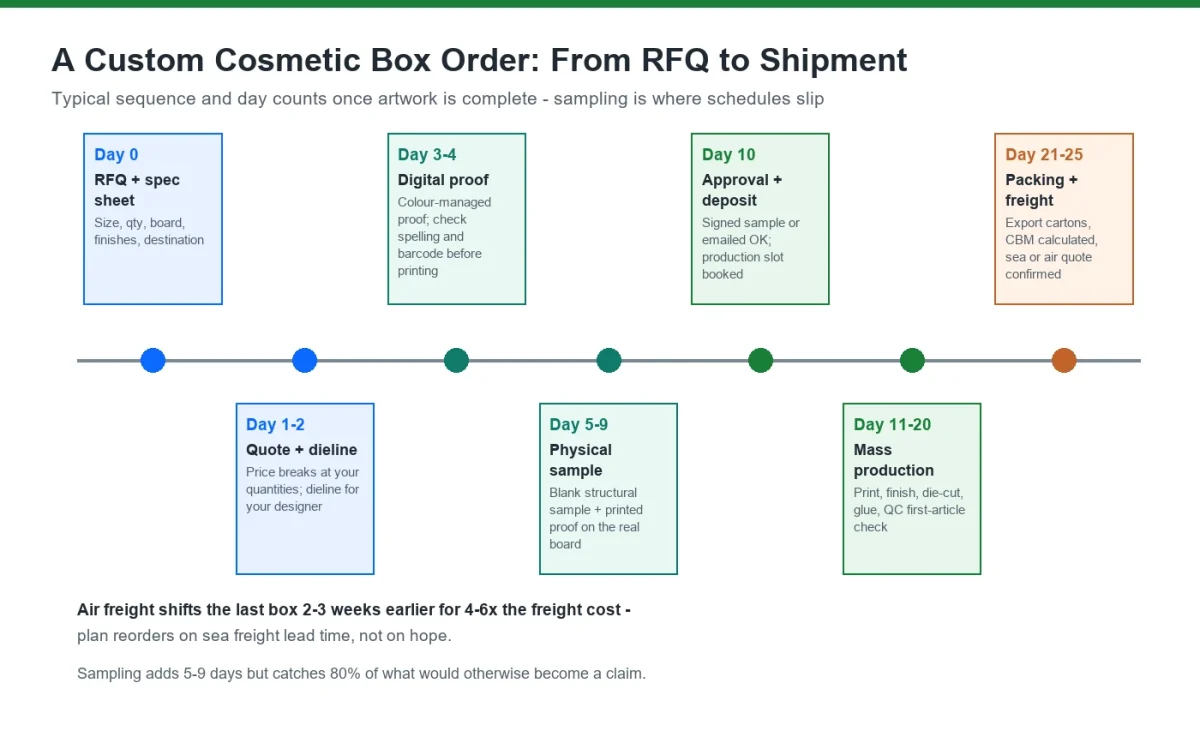
From approved artwork to goods on the water is typically 20–25 working days for a cosmetic carton or mailer order: two days quoting and dieline, a week of sampling, ten days of production including QC, and packing. Reorders skip sampling and run faster.
Freight is where small beauty brands get surprised. Folding cartons ship flat and dense — a 5,000-piece lipstick carton order fits in roughly one cubic metre, which makes sea freight per unit almost trivial. Rigid boxes are the opposite: they ship assembled, so you are paying to freight air. The practical consequences:
- Sea freight is the plan; air freight is the patch. Air shifts the arrival 2–3 weeks earlier at 4–6x the freight cost. Use it for launch dates, not for reorders.
- Ask for the CBM number with your quote. If a supplier can’t tell you the cube of your order, they haven’t packed cosmetic boxes before.
- Express samples are cheap; express production is not. Budget roughly $30–60 to courier a sample set in five days, and let the production run go by sea.
Landed cost = box price + freight + duties + last-mile. On a $1.20 folding carton at 3,000 units, sea freight typically adds $0.05–$0.15 per unit and duties follow the HS code for printed paperboard. Any supplier who quotes you the box price only and goes quiet at the freight question is deferring the surprise to you.
First-Article QC: The Checks Before Your Cosmetic Box Run Continues
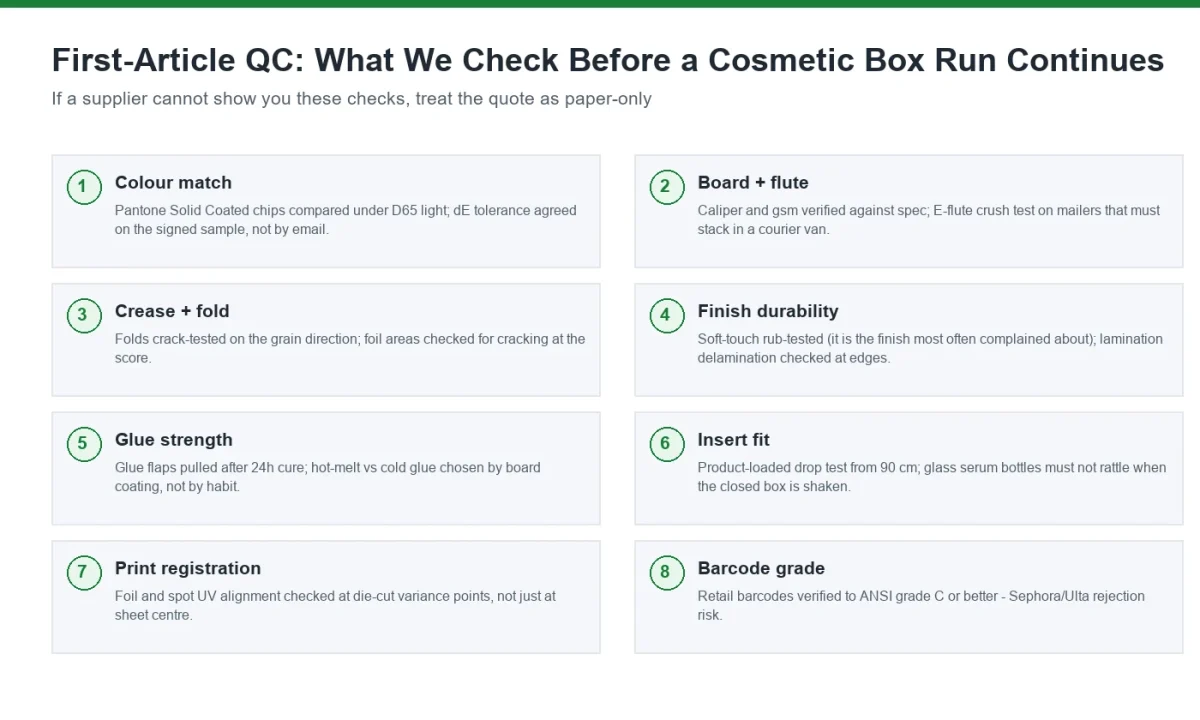
Mass production is not where quality is made — it is where it is protected. At the start of every run, the first articles coming off the line get checked against the approved sample before the press is allowed to continue. For cosmetic boxes, the checks that matter most:
- Colour match — Pantone Solid Coated chips compared under D65 light, with the tolerance agreed on the signed sample, not negotiated over email after a problem.
- Board and flute — caliper and gsm verified against spec; crush-tested mailers if they have to stack in a courier van.
- Crease and fold — folds crack-tested along the grain direction; foil areas checked for cracking at the score.
- Finish durability — soft-touch rub-tested (the finish most often complained about post-delivery), lamination edges checked for delamination.
- Glue strength — glue flaps pulled after a 24-hour cure; hot-melt versus cold glue chosen by board coating, not by habit.
- Insert fit — product-loaded drop test from 90 cm; a glass serum bottle must not rattle when the closed box is shaken.
- Print registration — foil and spot UV alignment checked at die-cut variance points, not just at sheet centre.
- Barcode grade — retail barcodes verified to ANSI grade C or better; a failed grade is how big-box rejections happen.
Ask every prospective supplier which of these they run as standard. “We check everything” is not an answer; a named list with instruments and tolerances is.
2026 Rules Touching Cosmetic Packaging: EPR and Recyclability
Cosmetic boxes are paper, which puts them inside the sustainability rules now spreading across your two main markets:
- European Union — PPWR. Regulation (EU) 2025/40 has applied since 12 August 2026: packaging must carry identification and manufacturer information, substance limits (PFAS, heavy metals) apply to packaging materials, and from 2030 packaging must meet recyclability grades to stay on the market. If you sell into the EU, our PPWR labelling requirements guide covers what must appear on the pack.
- United States — state EPR. The first state extended producer responsibility programs for packaging, including paper, have begun registering and charging brands in 2025–2027. Fees are modulated by recyclability: mono-material paperboard and molded pulp pay less than plastic-heavy or multi-material structures. A cosmetic box with a plastic window or EVA insert is a different EPR line item than the same box without one.
The practical takeaway for a beauty buyer in 2026: ask for the material route. Which board, which coating, which adhesive, which insert material. Paper packaging is moving toward a world where those choices carry fees and market-access consequences, and the suppliers who can name their materials on demand are the ones who can keep your boxes sellable in 2030. On fibre claims specifically: we source board from certified mills and can provide mill certificates, batch purchase documents and board technical data sheets — ask for those documents rather than a logo, and read our FSC/EUDR guide for why the paperwork matters more than the mark.
From Our Production Floor: How a Real Cosmetic Box Order Plays Out
We don’t publish a single customer’s books, but the pattern repeats on almost every cosmetic order through our line, and the numbers below are from orders we actually produced in 2026 — not an industry average.
When a beauty brand brings us three SKUs — a serum, a cream jar and a lip balm — plus one branded mailer for a seasonal launch, the first round of quotes they show us usually spans $0.90 to $4.70 per carton. That spread is not a quality gap; it is quotes assuming different board, different print and different finish. In the runs we produced this year, once the brand sent a real spec sheet — bottle dimensions, 350 gsm SBS, reverse tuck, one Pantone plus CMYK, matte lamination, pulp insert on the serum — the quotes converged to about $2.20–2.60 per carton at 1,000 units and $1.10–1.30 at 5,000.
On those runs, sampling took about nine working days because the artwork needed two revisions — the revision count we see most often on first-time carton projects. Production ran twelve days, and sea freight to a US West Coast warehouse added roughly three weeks and about $0.08 per carton. The lessons hold across the category: send the spec sheet first, expect the physical sample to catch one or two artwork issues, and set the launch date from the freight calendar, not from the production calendar.
Custom Cosmetic Boxes: Your Copy-Paste RFQ Spec Sheet
Use this block in your first email to any manufacturer — it turns a three-day quote back-and-forth into one reply:
RFQ SPEC SHEET — CUSTOM COSMETIC BOXES
- Product: name, dimensions (L×W×H mm), weight (g), primary packaging material (glass/PET/PP)
- Box construction: folding carton (tuck end / seal end / lock bottom) / rigid setup box / corrugated mailer
- Board: gsm + type, or “recommend for this product weight”
- Printing: CMYK / Pantone numbers, inside printing yes/no
- Finish: lamination type, spot UV, foil areas, embossing
- Insert: material (pulp / corrugated / EVA / none) + product layout
- Quantities: three price breaks (e.g. 1,000 / 3,000 / 5,000)
- Destination port/city + trade terms: DDP / FOB / EXW
- Artwork status: dieline ready / need dieline / need design support
- Barcode: GS1 number provided / needed on back panel
- Target in-market date: (real dates, not “ASAP”)
Custom Cosmetic Boxes: FAQs from Beauty Buyers
What is the real MOQ for custom cosmetic boxes?
On offset presses, around 1,000 units is the honest floor for folding cartons. Factories with digital lines quote 250–500 without plate fees. Rigid setup boxes run higher — 500–1,000+ — because of custom magnetic or tray tooling. Below 250 printed units, a stock carton plus custom sticker is usually the cheaper route. If you are weighing a rigid structure, we break down where that premium actually goes — and when a rigid box is the wrong call — in our guide to custom rigid cosmetic boxes.
How much do custom cosmetic boxes cost per unit?
From our own production quotes, full-colour folding cartons run $3.50–5.00 at 250 units (digital), $1.80–2.80 at 1,000, and $0.80–1.40 at 5,000. Each added finish stacks $0.05–0.25 on top. Corrugated mailers with direct print generally land between folding cartons and rigid boxes per unit.
How long does production take from a China factory?
About 20–25 working days from approved artwork to shipment for a first order, including a 5–9 day sampling stage. Reorders skip sampling. Sea freight adds 2–4 weeks to a US or EU port depending on lane.
Do custom cosmetic boxes need a barcode?
If you sell retail — physical stores or marketplaces — yes, and it needs to scan first time. Provide your GS1 number, place the barcode on a flat panel away from creases and edges, and ask for a verification report showing ANSI grade C or better.
Are custom cosmetic boxes recyclable?
Paperboard cartons and corrugated mailers without plastic lamination are widely recyclable. Soft-touch or gloss lamination, foil stamps and plastic windows complicate recycling; molded pulp and corrugated inserts keep the whole unit in the paper stream. If you sell into the EU, recyclability grades become market-access thresholds from 2030 under the PPWR.
Can I get cosmetic boxes without plastic lamination?
Yes — water-based coatings and matte varnish replace lamination on most carton jobs, and many brands now specify them deliberately for EPR fee reasons. The trade-off is rub resistance: unlaminated surfaces scuff faster, so the box structure and courier journey matter more.
What artwork files does a manufacturer need?
Vector artwork (AI or print-ready PDF) at 300 DPI, CMYK with Pantone callouts, fonts outlined, placed on the factory’s dieline. Include the GS1 barcode as vector, not raster. If you only have a logo and a mood board, ask whether the factory does dieline plus design layout — many do, but confirm before you pay a designer who doesn’t know packaging.
Should I ask for FSC-certified cosmetic boxes?
Ask for the fibre documents, not just the label. A factory without its own chain-of-custody certificate cannot legally print the FSC trademark on your boxes; what it can honestly offer is board sourced from certified mills with mill certificates and batch documents. Decide which one your brand actually needs — a claim on-pack, or traceable sourcing data.
Related Box Guides and Products
Deeper reading from our factory floor:
- How custom printed packaging boxes are actually made — from paper to finished product
- How to choose a custom packaging manufacturer: 12-point supplier checklist
- The ultimate guide to custom packaging: boxes, labels and paper bags
- Printed packaging boxes — product range
- Retail packaging boxes — product range
Order Custom Cosmetic Boxes from the Factory Floor
Two paths, depending on where your order is:
Path A — testing a new SKU (<500 units). Don’t commit to full tooling yet. Send us the product dimensions and a rough look, and we’ll quote a digital small-batch run plus a physical sample so you can hold the box and validate the unboxing before demand data exists. Lowest-risk way to prove the design: request a sample quote.
Path B — ready to produce (1,000+ units). Use the RFQ spec sheet above with your three quantity breaks and destination. We’ll return a dieline, a price at each break, and a physical sample on the real board before the run continues. Go straight to the contact page or browse custom packaging boxes.
Sourcing and production information only — not legal or regulatory advice. Figures reflect our own 2026 production quotes and vary by artwork, board and finish. Verify EU obligations against the official text at EUR-Lex (Regulation (EU) 2025/40).